
How churches can support families in Christian addiction recovery is not a secondary question to the “real work” of helping the person who uses. Families are not peripheral to recovery; they are often the first place where addiction’s damage is absorbed and the first place where rebuilding must occur. Scripture’s account of sin and redemption is never merely individual. It is personal, and it is communal.
Churches also sit at a difficult intersection: compassion and accountability, confidentiality and safety, spiritual care and clinical reality. Donors who fund addiction recovery ministries often sense these tensions but do not always receive clear guidance on what faithful, effective support for families actually entails. The hard question is not whether churches should help, but how they can help without enabling, shaming, or attempting to replace professional treatment.
1. Name addiction as a spiritual and clinical crisis without reducing it to either
Addiction presents as a spiritual crisis because it is bound up with worship, desire, fear, and the search for refuge. “No temptation has overtaken you that is not common to man,” Paul writes, and yet the enslaving power of sin is also real (1 Corinthians 10:13; Romans 6). Families often carry a parallel burden: self-blame, secrecy, and a constant oscillation between hope and dread. Churches serve families well when they speak truthfully about sin and suffering without collapsing addiction into a simple moral failure or excusing genuine harm.
Hold together repentance and trauma awareness
Christians genuinely disagree about language—disease model, disorder, bondage, habit, idolatry—and some of those disagreements track real differences in theology and clinical frameworks. What this means in practice is that families need churches that can hold two truths at once: people are responsible moral agents, and many have been shaped by trauma, mental illness, and neurological pathways that require wise, structured care. The church’s task is not to win a terminology debate. It is to shepherd people toward repentance, repair, and durable patterns of freedom.
Resist simplistic narratives that punish families
Families are often told—explicitly or implicitly—that their loved one’s addiction is their fault, a failure of discipline, or proof of poor spiritual formation. That counsel is neither clinically credible nor biblically faithful. Scripture’s categories are more honest: we reap what we sow, and we also suffer what others sow. Churches can relieve unnecessary shame by teaching a careful doctrine of responsibility that distinguishes guilt from grief, and consequences from condemnation.

2. Build church practices that protect families from chaos and secrecy
Addiction thrives in secrecy. Families frequently learn to manage appearances: explaining absences, covering financial loss, hiding relapse. Church culture can unintentionally reinforce this by treating addiction as a disqualifying scandal rather than a call to confession and care. Jesus’ call to bring deeds into the light is not a demand for public exposure; it is a path to truth where healing can begin (John 3:20–21).
Create clear pathways for disclosure and triage
Families need to know whom to tell, what happens after they tell, and how their information will be handled. A well-run church will have designated pastoral points of contact, written confidentiality practices, and a clear triage process when there is risk of violence, child endangerment, or self-harm. Churches are not courts, but they are responsible communities. When safety is at stake, secrecy is not mercy.
Establish boundaries that prevent financial enabling
One of the most common family dynamics in addiction is “rescue” that becomes enabling: covering rent without accountability, paying off debts without addressing patterns, or giving cash that is easily diverted. Churches can support families by normalizing boundaries as a form of love rather than abandonment. Corbett and Fikkert’s When Helping Hurts framework has shaped many Christian leaders’ understanding that unstructured aid can unintentionally reinforce dependency and disempowerment; their work is widely accessible through Moody Publishers.
- Offer benevolence through structured assistance rather than cash
- Require a plan for treatment, sobriety supports, and accountability when aid is ongoing
- Provide budget coaching and debt triage for affected households
- Coordinate with professional counselors and case managers when appropriate
- Document benevolence decisions to protect both families and the church
3. Provide family-focused discipleship that is patient, specific, and accountable
Families living alongside addiction need more than generic encouragement. They need a form of discipleship that addresses trauma, anger, fear, manipulation, and chronic uncertainty. Churches can help families grow in wisdom: when to speak, when to refuse, when to call authorities, when to grieve, and when to hope again. The Psalms are a school of prayer for this kind of life—honest lament that refuses despair and refuses denial.
Support spouses, parents, and adult children as distinct pastoral cases
A spouse navigating relapse and broken trust faces different realities than parents supporting an adult child or grandparents suddenly raising grandchildren. Churches that care well avoid one-size-fits-all counsel. They also avoid treating family members as “co-addicts” by default; some family systems are unhealthy, and some are simply desperate. The wise church asks careful questions and provides tailored care plans that include pastoral counseling, support groups, and referrals.
Offer support groups with trained leadership and theological clarity
Peer support can be powerful, but it can also turn into unstructured venting, advice-giving, or spiritual bypassing. Churches should train leaders, set expectations for confidentiality, and articulate what the group is and is not. Some congregations partner with Celebrate Recovery; others use biblically grounded counseling curricula or host family support groups in coordination with local treatment centers. The key is not branding. The key is accountable leadership and a clear theology of sanctification that makes room for both immediate repentance and long, uneven growth.
For donors assessing ministries that serve families as part of recovery, it is worth examining whether a church’s approach aligns with coherent recovery practice and credible oversight. Across our verification work at Most Trusted, we observe that ministries that meet The Most Trusted Standard tend to be specific about program boundaries, referral relationships, and what “success” means over time, rather than relying on inspirational language alone.
4. Coordinate with professional treatment and community systems without surrendering spiritual care
Churches can and should provide spiritual care—prayer, sacraments, community, moral formation, and pastoral counsel. They should not pretend to be detox facilities, psychiatric clinics, or law enforcement. Families often need help navigating treatment options, insurance constraints, and the complexity of co-occurring disorders. The church serves best when it becomes a reliable bridge rather than an isolated alternative.
Know the limits of pastoral competence and the duty to refer
Addiction is frequently entangled with depression, anxiety, bipolar disorder, and trauma histories. When suicidality, domestic violence, or child endangerment is present, families need immediate, competent intervention. Churches should maintain a vetted referral list of licensed clinicians, inpatient and outpatient programs, and crisis resources. For general information on mental health and substance use conditions, the National Institute of Mental Health provides reliable public education.
Partner wisely with recovery ministries and protect families from reputational risk
Not all recovery ministries operate with the same governance, financial integrity, or safeguarding practices. Donors know this intuitively; families experience it acutely when a program collapses, mishandles relapse, or lacks accountability. This is where independent verification matters. Most Trusted exists to help donors give with confidence by evaluating ministries against The Most Trusted Standard across faith commitments, financial integrity, governance and leadership, and transparency and effectiveness. Churches can apply similar rigor when choosing partners: Who oversees the program? What is the relapse policy? How are staff trained? How is money handled? What happens when a leader fails morally?
Those seeking a broader view of partnership patterns within Christian Addiction Recovery Ministries should prioritize ministries that can describe their model clearly, document outcomes carefully, and demonstrate governance that can withstand stress.
5. Equip donors to fund family support without feeding the starvation cycle
Family support in addiction recovery often looks “inefficient” on a spreadsheet. It involves long timelines, repeated crises, and staff time that does not translate into simple conversion counts or graduation metrics. Donors can inadvertently pressure ministries to overpromise, underreport relapse, or prioritize public-facing stories over durable care. Serious Christian philanthropy should resist those incentives.
Fund what families actually need, not only what photographs well
Families frequently need counseling subsidies, childcare during meetings, transportation to treatment, legal navigation, and safe temporary housing. They also need trained staff who can hold complex cases without burnout. Underfunding these realities does not produce “lean ministry”; it produces fragile ministry. The “Starvation Cycle,” described by Ann Goggins Gregory and Don Howard, has helped the sector recognize how unrealistic overhead expectations harm effectiveness; their analysis is available through Stanford Social Innovation Review.
Use verification questions that match the moral weight of the work
Responsible donors ask more than whether a ministry is sincere. They ask whether it is safe, accountable, and truthful. For those supporting family-focused recovery work, our team recommends questions such as: How are volunteers screened? What mandatory reporting policies are in place? How are finances audited? What is the doctrine of the church or ministry, and how does it shape care? How are stories and testimonials obtained, and is consent documented? These are not bureaucratic demands. They are the practical expression of loving one’s neighbor with integrity.
Donors exploring the wider landscape of Christian Addiction Recovery in Families and Churches should be attentive to whether ministries treat family members as full recipients of care, not merely as supporting characters in someone else’s recovery narrative.
FAQs for How churches can support families in Christian addiction recovery
Should a church require sobriety before offering support to a family?
Churches should not require a loved one’s sobriety before supporting the family. Families often need immediate care precisely because sobriety is not present: safety planning, pastoral counsel, practical help, and guidance on boundaries. What churches should require is clarity about what support entails. Ongoing benevolence, leadership roles, or access to vulnerable populations may properly involve conditions, accountability, and documented safeguarding practices.
How can donors tell whether a recovery ministry is truly serving families well?
Credible family service is usually visible in program design: trained staff, clear confidentiality and safeguarding policies, structured peer support, and referral relationships with licensed care providers. It is also visible in governance and transparency: independent oversight, financial integrity, and honest reporting that does not hide relapse or exaggerate outcomes. Most Trusted’s verification work is built to help donors assess these factors through The Most Trusted Standard so giving supports durable, faithful care rather than fragile programs.
Conclusion
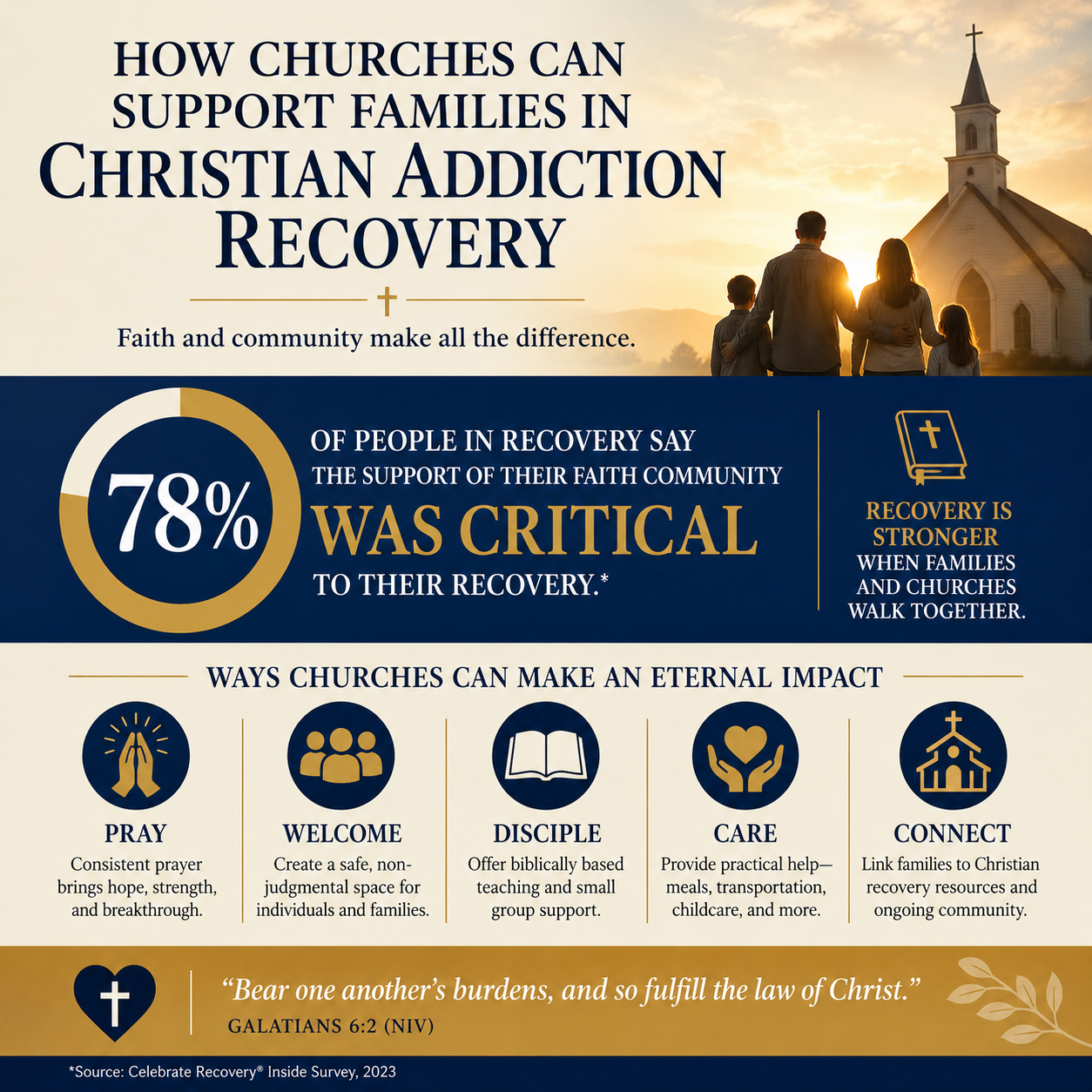
Churches support families in Christian addiction recovery by telling the truth about sin and suffering, protecting families from secrecy and chaos, discipling them with patient specificity, coordinating with competent treatment, and inviting donors to fund the unglamorous work that makes long-term healing possible. This is not a departure from the gospel’s priorities. It is one expression of the church bearing burdens in a way that is both compassionate and accountable (Galatians 6:2).



