

How to budget monthly giving for child sponsorship is ultimately a question of Christian stewardship: how to make a durable promise without presumption, and how to keep faith with a child and a ministry without endangering the responsibilities God has already placed in our care. Many donors can afford a first month. The harder question is whether the commitment can be sustained when medical bills arrive, work changes, or other obligations press in.
Scripture treats money as a spiritual matter, not merely a technical one. Jesus’ teaching repeatedly joins the heart, the household, and the use of wealth (Matthew 6:21; Luke 12:15). Child sponsorship can be a disciplined expression of mercy, but only if the commitment is made with clarity, integrity, and humility before God—especially because it often creates expectations on the ground that are not easily adjusted from a distance.
Start with a stewardship frame, not an emotion frame
Monthly giving is a promise with moral weight
Child sponsorship often feels personal, and ministries frequently describe it in relational language. That language can be appropriate when it reflects real accountability and durable support. It also carries risk: a donor can confuse a moving story with a sustainable pledge. Mature giving begins by naming the nature of the commitment. Sponsorship is closer to a recurring obligation than a one-time gift, even when the ministry’s legal relationship is not formally contractual.
Scripture commends thoughtful intention in giving. “Each one must give as he has decided in his heart, not reluctantly or under compulsion” (2 Corinthians 9:7). Deciding “in the heart” is not mere spontaneity; it implies deliberation that a household can live with. When a donor starts with stewardship rather than sentiment, the result is usually a longer, steadier line of support.
Put sponsorship in its proper order within the household
Christians genuinely disagree about how to prioritize various financial obligations, but most traditions recognize a basic moral order: honest work, debts that must be paid, provision for dependents, commitments to the local church, and generosity to the poor and vulnerable. Sponsorship belongs in that ecosystem, not outside it. If a sponsorship pledge regularly competes with rent, basic medical care, or essential family provision, the pledge is not strengthening generosity; it is destabilizing the household.
Across our verification work at Most Trusted, the ministries that meet The Most Trusted Standard tend to communicate this plainly. They encourage donors to give with consistency, but they also avoid manipulative pressure and leave room for donors to make adjustments responsibly when circumstances change.

Build a sponsorship budget that can survive ordinary disruptions
Choose a number that remains true in harder months
A reliable monthly amount is rarely the maximum a donor could give in a strong month. It is the amount that remains feasible in a weaker month. Many households budget discretionary spending with optimism and then discover that volatility—car repairs, travel costs, seasonal expenses—erodes the margin that recurring gifts require.
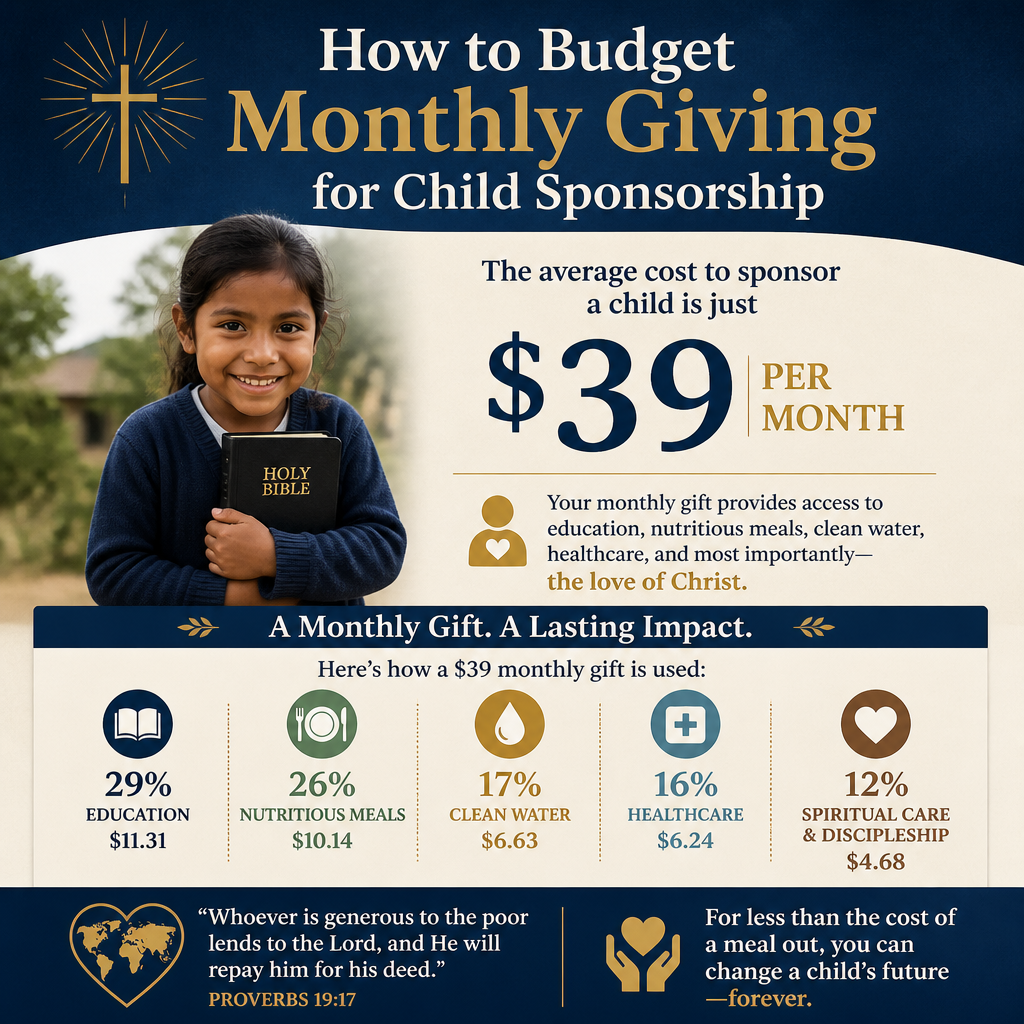
A practical approach is to treat sponsorship like a bill you intend to pay for a year at a time. If the ministry’s suggested amount is $39, $45, or $50 per month, the question is not whether that amount is admirable; the question is whether it is stable. If stability requires beginning at a lower level, it is often better to begin lower than to begin high and lapse.
Plan for the hidden costs ministries do not always emphasize
Sponsorship can create additional giving opportunities: birthday gifts, Christmas funds, emergency appeals, “special projects,” and optional correspondence costs. Some of these are legitimate; some are more ambiguous. The challenge is that these extras can become a second stream of unplanned spending that quietly turns a $45 monthly commitment into a materially higher annual outlay.
What this means in practice is that donors should budget sponsorship as a package rather than as a single line item. A reasonable discipline is to reserve a small “sponsorship overflow” amount each month—modest, but deliberate—so that occasional opportunities do not become recurring budget crises.
- Base sponsorship amount you can sustain for 12 months
- Annualized extras for seasonal appeals you typically support
- Giving buffer for unforeseen household volatility
- Evaluation time once or twice per year to confirm the ministry remains trustworthy
- Contingency plan for how you will respond if income declines
Make room for generosity without confusing it with financial denial
Generosity and wisdom are not rivals
Some Christians worry that budgeting generosity undermines faith, as though planning were a substitute for dependence on God. Scripture does not treat wisdom as unbelief. Proverbs commends foresight and honest weights; Jesus criticized careless counting of costs, not careful counting (Luke 14:28). A sponsorship commitment that is regularly kept is often a more faithful witness than a larger commitment repeatedly broken.
Financial strain can also tempt donors toward secrecy or resentment—both corrosive to spiritual health and household unity. If sponsorship is a point of anxiety or conflict in a marriage, that is not merely a “budget problem.” It is a signal that the commitment needs a clearer agreement and a more stable plan.
Use a two-tier giving model for stability
One of the most durable patterns we observe is a two-tier approach: a “baseline” recurring gift that is highly reliable, paired with separate, occasional generosity when God provides unusual margin. Sponsorship fits well as a baseline commitment. Special projects, emergency relief, or year-end matching opportunities belong in the second tier.
For donors who want to increase their sponsorship impact over time, the two-tier model can be morally and financially disciplined: increase the baseline only after a sustained period of surplus, not after a single strong month.
Verify the ministry so your budget serves real outcomes
Sponsorship is a category with documented strengths and real risks
Child sponsorship has supported schooling, health interventions, and community development at scale. It has also been criticized for weak transparency, inflated relational claims, and incentives that can distort how ministries represent individual children. The field has had to reckon with these tensions, and donors should not ignore them simply because the cause is compelling.
A widely cited longitudinal evaluation by Innovations for Poverty Action assessed a large-scale child sponsorship program and found statistically significant impacts on education and employment outcomes in certain contexts, while also clarifying that impacts vary by design and implementation quality. See the research summary from Innovations for Poverty Action.
Wise budgeting therefore includes organizational discernment. Giving faithfully is not only about our consistency; it is also about whether the ministry is candid, governed well, and able to demonstrate credible results without exaggeration.
What to look for when you are funding a recurring commitment
Because monthly giving is cumulative, small weaknesses become large over time. Donors should ask whether the ministry provides clear financial reporting, meaningful program detail, and transparent communication about what sponsorship does and does not mean. It is not sufficient for a ministry to say that “every dollar goes to the child,” especially given the sector-wide consensus that overhead ratios alone are a poor measure of effectiveness. The joint statement commonly known as the Overhead Myth, signed by major evaluators, makes this point directly: administrative and fundraising costs can be necessary for good outcomes. See the overview at Candid GuideStar.
Most Trusted exists for this reason: to help Christian donors give with confidence by evaluating ministries against The Most Trusted Standard, a 15-criteria framework spanning faith foundation, financial integrity, governance and leadership, and transparency and effectiveness. In the world of sponsorship, the tests that most often matter in practice are governance independence, audited financials, clarity about program models, and truthful donor communication that avoids relational claims the ministry cannot substantiate.
For donors comparing approaches and ministry models within this space, our coverage of Child Sponsorship Ministries can help frame the category-level questions that sponsorship materials sometimes leave unanswered.
Set up a review rhythm that honors both the child and your household
Review annually without treating people as line items
A stable budget is not static. The responsible practice is to review recurring giving at set intervals, usually annually, and to make changes only after prayer, household agreement, and a careful look at the ministry’s reporting. Annual review avoids the whiplash of monthly second-guessing while still acknowledging that circumstances change.
Donors sometimes fear that reviewing sponsorship is disloyal. That fear is understandable if sponsorship has been framed as a quasi-parental promise. Yet moral seriousness cuts both ways: if a ministry is not truthful or is poorly governed, continuing to fund it out of sentiment can entrench harm. A review rhythm is not cynicism; it is stewardship.
If you must reduce or end support, do it with clarity and charity
Income loss, caregiving responsibilities, or other obligations can require a donor to reduce recurring commitments. When that happens, the goal is to avoid abruptness when possible. Some donors choose to set aside one month of sponsorship funding as a “transition reserve,” so that if they must stop, they can give the ministry time to reassociate the child to another sponsor without sudden disruption.
Many sponsorship ministries also have policies for sponsorship changes or reassignment. Those policies are part of the transparency donors should ask about early, not only when a crisis arrives. For more on sustaining commitments with integrity, see Managing a Child Sponsorship Commitment.
FAQs for How to budget monthly giving for child sponsorship
How much should we give per month for child sponsorship?
The right amount is the amount we can sustain through ordinary disruptions for at least a year, not the maximum we could give in a strong month. Many sponsorship programs suggest a standard monthly figure; donors can accept that figure when it fits their household margin, or choose a lower recurring amount paired with occasional additional gifts. The moral priority is reliability and truthfulness in what we commit to support.
Should we sponsor more than one child or increase our monthly gift?
Increasing sponsorship can be a faithful decision when it is grounded in stable income, low consumer debt pressure, and clear household agreement. A disciplined pattern is to sustain one sponsorship for 6–12 months, confirm the ministry’s transparency and reporting, and then increase only if the budget continues to carry the commitment without strain. Growth in generosity is commendable; overextension is not the same as sacrifice.
A monthly sponsorship budget should be an act of truth
Christian donors do not honor children in sponsorship programs by making impressive commitments; we honor them by keeping commitments that are real. A monthly budget that can be sustained, paired with careful ministry verification and a humble review rhythm, turns compassion into durable help. That is stewardship shaped by love of neighbor and the fear of the Lord, which Scripture calls the beginning of wisdom.



