

Christian donors increasingly ask what impact metrics child sponsorship ministries share with donors, not because compassion has cooled, but because stewardship has sharpened. When Jesus commends faithful management in the parable of the talents, he assumes accountability is part of discipleship, not an obstacle to it. Sponsorship ministries that treat measurement as a form of truth-telling usually strengthen donor confidence, protect children from unintended harm, and clarify what sponsors can and cannot expect.
The harder question is not whether ministries should report impact, but what kinds of metrics are faithful to the work. Child sponsorship is personal by design, and it is also complex: outcomes depend on family systems, local schools, government services, and churches that carry responsibility long after any donor letter is read. Mature ministries do not hide that complexity. They choose metrics that are measurable, child-protective, and spiritually honest.
What donors should expect to see from credible sponsorship reporting
Impact reporting in child sponsorship tends to fall into three overlapping categories: outputs, outcomes, and evidence of sound practice. Outputs are easiest to count, outcomes are harder to attribute, and sound practice is often what keeps outputs from becoming a form of harm. Strong ministries present all three, with appropriate humility about causation.
Across our verification work at Most Trusted, we observe that ministries meeting The Most Trusted Standard avoid a single headline number. They build a small set of consistent indicators and explain how data is gathered, verified, and safeguarded. Donors are treated as adult stewards rather than customers to be reassured.
Outputs that show what was actually delivered
Outputs answer basic stewardship questions: What services did sponsored children and their families actually receive? Common examples include tutoring hours provided, days of school fee support, medical visits facilitated, or households enrolled in savings groups. Outputs are not the same as transformation, but they do establish whether a ministry did the work it claimed.
In sponsorship, output reporting should also clarify the ministry’s delivery model. Some ministries deliver benefits directly to children; others strengthen household stability so children remain in school. Both can be faithful, but the metrics should match the model.
Outcomes that reflect child and family flourishing
Outcomes seek to describe change over time: improved school attendance, grade progression, literacy gains, reduced preventable illness, household income stabilization, or increased access to safe water. Because poverty is not a single-variable problem, outcomes should be presented as trends, comparisons, or cohorts rather than as guaranteed results for every child.
When ministries cite broader research to contextualize outcomes, the most responsible ones distinguish between what sponsorship programs can plausibly influence and what requires systemic change. Claims should be proportionate to evidence.

Common impact metrics sponsorship ministries share and what they really mean
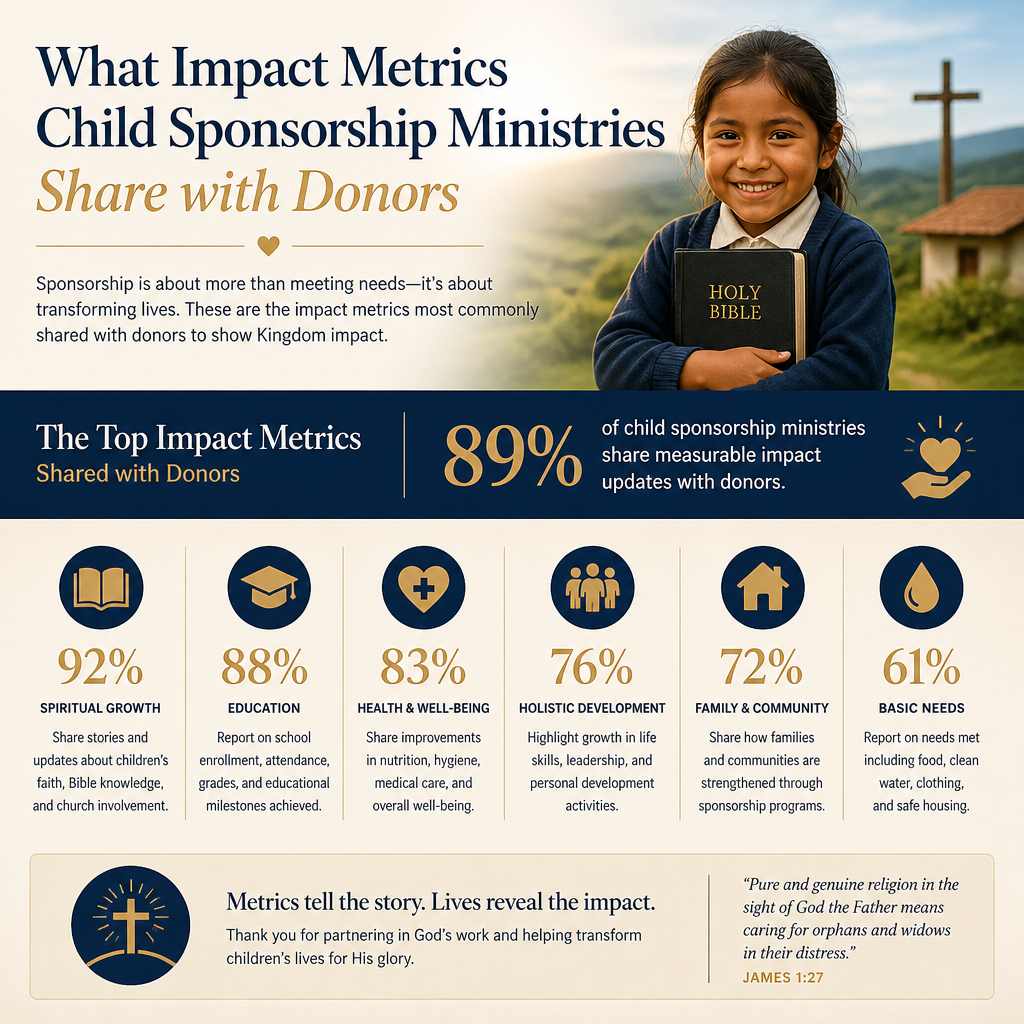
The most useful metrics are those donors can interpret without a marketing filter. In many cases, the metric itself is not the problem; the problem is a lack of definitions. “Education supported” can mean school supplies once a year or consistent fee coverage plus tutoring. “Health supported” can mean a single clinic day or a structured community health worker model. Clear definitions are part of donor respect.
Education metrics beyond enrollment
Enrollment is often the first education metric donors see, but it is rarely the most revealing. Better indicators include attendance, grade completion, learning assessments, and transition points such as primary-to-secondary progression. Ministries also sometimes report teacher training, classroom infrastructure, or parent engagement, particularly when sponsorship is linked to community development.
Where learning assessments are used, ministries should disclose the tool and frequency. A reading assessment conducted consistently across cohorts can reveal more than a single photo of a school uniform.
Health and nutrition metrics that avoid overclaiming
Health reporting often includes clinic visits, immunization support, nutrition screening, or access to clean water and sanitation. The key question is whether the metric is a proxy for real health improvement or simply a count of activities. A clinic visit can be appropriate and still not represent meaningful care if follow-up is missing.
When ministries report malnutrition screening or child growth monitoring, donors should expect care with privacy and dignity. Children’s medical information should not become sponsorship marketing.
Child protection and safeguarding indicators
Sponsorship creates unique risks: a child can be singled out, family dynamics can be distorted, or communication with donors can expose identifying details. Credible ministries report on safeguarding systems more than they report about individual children. Donors should look for metrics and disclosures such as background checks for staff and key volunteers, incident reporting pathways, safeguarding training completion, and third-party audits where applicable.
Risk is not always evidence of wrongdoing; it is evidence that the ministry is honest about the field. A ministry that reports zero incidents year after year may be perfect, or it may be silent. Mature safeguarding reporting explains how concerns are surfaced, triaged, and resolved.
How trustworthy ministries handle attribution and the limits of measurement
Christians genuinely disagree about how much “proof” donors should require for compassion ministries. Some donors fear that measurement will crowd out mercy. Others fear that sentiment will crowd out truth. The responsible path is neither cynicism nor sentimentality, but measured claims grounded in verifiable evidence.
The research conversation around sponsorship illustrates why attribution matters. A frequently cited long-run study found that child sponsorship increased the probability of completing secondary school and increased adult income for sponsored children in the sample studied, but those findings come with specific program contexts and time periods and should not be generalized carelessly. Donors should appreciate ministries that use such research to inform learning rather than to promise guaranteed outcomes. See the National Bureau of Economic Research working paper by Wydick, Glewwe, and Rutledge for details at National Bureau of Economic Research.
Disaggregation and who is actually being helped
One of the most revealing practices is disaggregation: breaking outcomes down by age, gender, disability, geography, or vulnerability status. Average outcomes can hide the children who are hardest to serve. Disaggregation is also a form of justice, because it forces ministries to confront whether the most vulnerable are being reached or inadvertently excluded.
When disaggregation is reported, ministries must protect privacy. Small sample sizes can make children identifiable, particularly in rural communities. Responsible reporting chooses the child’s safety over the donor’s curiosity.
Independent evaluation and honest learning
Not every ministry can fund randomized controlled trials, and donors should not demand a research budget that displaces care. But donors can reasonably expect some form of external accountability over time: third-party financial audits, periodic program evaluations, or partnerships with credible research institutions. Where external evaluation is not feasible, ministries should at least disclose internal monitoring methods and the steps taken to reduce bias.
Many mature ministries also publish what did not work. That posture aligns with a Christian doctrine of truth: we are not saved by outcomes, but we are accountable for honesty.
What a donor can ask for without turning sponsorship into a transaction
Sponsorship’s strength is relational, but relationship is not the same as entitlement. Ministries must protect children from performative reporting, forced gratitude, or donor expectations that pressure families. Donors can seek clarity while still giving in a manner worthy of the gospel.
For donors comparing ministries, it helps to ask for the same small set of information each time. The point is not to interrogate a ministry, but to see whether its reporting is coherent with its theology of dignity and its operational realities.
Questions that surface substance rather than polish
- How does the ministry define a “sponsored benefit,” and what portion is child-specific versus community-wide?
- Which outcomes are tracked over time, and how are they measured?
- What safeguarding standards govern child communication, photography, and data privacy?
- How are local churches, schools, and authorities involved, and how is accountability shared?
- What is the plan when a child relocates, leaves the program, or faces heightened risk?
What this means in practice is that donors should value ministries that can answer in plain language. Excessive complexity can be a smokescreen, but oversimplification can be a form of manipulation.
How Most Trusted’s verification lens applies
Most Trusted evaluates ministries against The Most Trusted Standard, including criteria related to transparency and effectiveness as well as governance and financial integrity. In sponsorship contexts, we pay close attention to whether reported metrics match the stated model, whether child protection is treated as non-negotiable, and whether public claims are supportable. Ministries do not need perfect outcomes to be trustworthy. They do need honest reporting, coherent practices, and accountable leadership.
Donors who want a broader view of how programs are assessed across the field can consult How Child Sponsorship Ministries Measure Impact as a reference point for common reporting patterns and red flags.
How ministries should communicate spiritual impact with integrity
Christian donors often want to know whether a sponsorship ministry is bearing spiritual fruit. That desire is not improper. Scripture ties mercy and proclamation together in a way Christians cannot dismiss. Yet spiritual fruit is not a commodity, and the church has learned painful lessons when conversion reporting becomes a fundraising device.
What can be measured and what must be narrated carefully
Some spiritual indicators can be reported with relative clarity: participation in discipleship groups, Bible distribution paired with follow-up, training of local leaders, or attendance in child protection training within churches. Even then, definitions matter. Attendance is not discipleship, and counting professions of faith can become coercive if incentives are misaligned.
A mature approach often includes qualitative reporting: testimonies vetted for consent, descriptions of local church partnership, and accounts of how families are being served without pressure. The goal is not to reduce spiritual life to a number, but to avoid pretending that spiritual claims require no accountability at all.
A theological reason to resist inflated claims
Christian ministry is always tempted to justify itself through impressive results. Yet Scripture repeatedly warns against boasting in visible success rather than in the Lord’s faithfulness. Inflated spiritual metrics can also harm the people a ministry serves by turning their stories into proof. Donors should reward ministries that communicate spiritual impact with restraint, dignity, and verifiable context.
For donors seeking to compare sponsorship work across organizations and models, Child Sponsorship Ministries provides a useful orientation to the landscape and the questions that tend to matter most.
FAQs for What impact metrics child sponsorship ministries share with donors
Should child sponsorship ministries report a cost per child?
Cost per child can be a helpful stewardship metric if it is defined carefully. Donors should ask what the figure includes, how shared community costs are allocated, and whether safeguarding, monitoring, and local staff development are treated as essential rather than as “overhead.” The Overhead Myth statement, endorsed by Charity Navigator, Candid, and the BBB Wise Giving Alliance, remains a useful reminder that low administrative percentages are not a reliable proxy for effectiveness; see Charity Navigator.
Is it a red flag if a ministry reports mostly stories instead of numbers?
Stories are appropriate in Christian ministry because people are not data points. It becomes a concern when stories substitute for basic accountability: clear definitions of services delivered, consistent outcome tracking, and transparent safeguarding practices. Strong ministries use stories to illustrate what their metrics already indicate, and they obtain informed consent in ways that protect children and families.
Stewardship that honors the child and tells the truth
The best impact metrics in child sponsorship are not those that impress; they are those that clarify. Donors have a right to know whether a ministry’s claims are proportionate, whether children are protected, and whether local partners are strengthened rather than displaced. When reporting is honest and measured, sponsorship can remain what it is meant to be: a channel of Christian love governed by truth, dignity, and accountable stewardship.



