
How child sponsorship ministries support family stability depends less on the emotional power of sponsorship and more on the ministry model behind it. Christian donors are not only funding a child’s needs; they are funding a set of incentives, relationships, and local systems that can either strengthen a household’s capacity to remain intact or unintentionally pull it apart. The question is not whether sponsorship can help. It can. The harder question is what kind of help actually reinforces a child’s first and best safeguard: a stable, loving family.
Across the sector, child sponsorship sits at the intersection of compassion and complexity. Sponsorship can provide predictable resources in settings where volatility erodes parental decision-making and children’s attendance in school. Yet the field has also had to reckon with how child-focused funding can distort family dynamics, local ministry priorities, and even community expectations. Serious Christian giving asks for more than a moving story. It asks for models that honor human dignity, protect the vulnerable, and withstand scrutiny.
Family stability is often the most protective intervention
Why sponsorship is frequently a family preservation tool
In many low-income communities, the greatest threat to a child is not a lack of affection but the cumulative pressure of scarcity. When rent, food, school costs, medical expenses, and transport compete, families make trade-offs that can fracture household stability: migration for work, early entry into labor, or informal fostering that becomes permanent separation. Child sponsorship, when designed well, can reduce the intensity of those pressures through reliable support that helps parents keep children at home and in school.
This aligns with what the broader child welfare field has emphasized for decades: children do best in safe, nurturing family settings whenever possible. The U.S. Centers for Disease Control and Prevention summarizes the long-term harms associated with adverse childhood experiences and the protective role of stable caregiving relationships in buffering stress and improving outcomes CDC. Sponsorship is not a substitute for parenting, but it can lower the temperature in a home enough for parenting to flourish.
A theological frame for strengthening households
Scripture’s concern for vulnerable children never treats the family as an afterthought. God “sets the lonely in families” (Psalm 68:6), and the New Testament assumes that households are primary sites of discipleship and formation (Ephesians 6:4). Christian donors therefore have a legitimate interest in whether a ministry’s sponsorship approach reinforces the household as the ordinary context for care, rather than bypassing it.
In our verification work at Most Trusted, we find that strong ministries resist the temptation to treat the child as a standalone unit of impact. They see the child in context: parents, siblings, extended family, church, school, and community. That perspective changes program design, staff training, and what ministries count as success.
The design of sponsorship determines whether it stabilizes or distorts
Targeting the child without isolating the child
Most sponsorship programs begin with a child profile and a sponsor relationship. That structure can be healthy when it functions as a funding channel into holistic support, not as a mechanism that elevates one child above the family in ways that create resentment or coercion. Wise programs avoid making the sponsored child the family’s sole conduit to assistance. They ensure parents remain primary decision-makers and that support strengthens the household’s capacity rather than replacing it.
Christians genuinely disagree about the best sponsorship architecture. Some prefer highly individualized benefits to maintain a clear line of stewardship. Others prefer community-based approaches to reduce inequity and avoid stigmatizing sponsored children. The most responsible ministries tend to communicate the trade-offs plainly: individualized sponsorship can increase donor connection; community-based delivery can reduce harm and better reflect how families actually function.
Avoiding incentive traps that pull families apart
When a program offers significant benefits only if a child is enrolled under specific conditions, it can create perverse incentives—especially where family separation is already common. The orphan care movement has learned this lesson publicly: institutional care can attract funding in ways that incentivize unnecessary separation. Research has documented that many children in residential institutions worldwide have at least one living parent, and family poverty is a primary driver of placement UNICEF. Sponsorship ministries are not orphanages, but incentives still matter. A model that unintentionally rewards vulnerability can end up cultivating it.
What this means in practice is that strong sponsorship programs build safeguards into enrollment and benefit distribution. They ask whether a family would be better supported through livelihood assistance, school fee support, or connection to local services rather than through arrangements that risk dependence or manipulation.
Effective sponsorship strengthens parents, not only children
Household economics and the path to stability
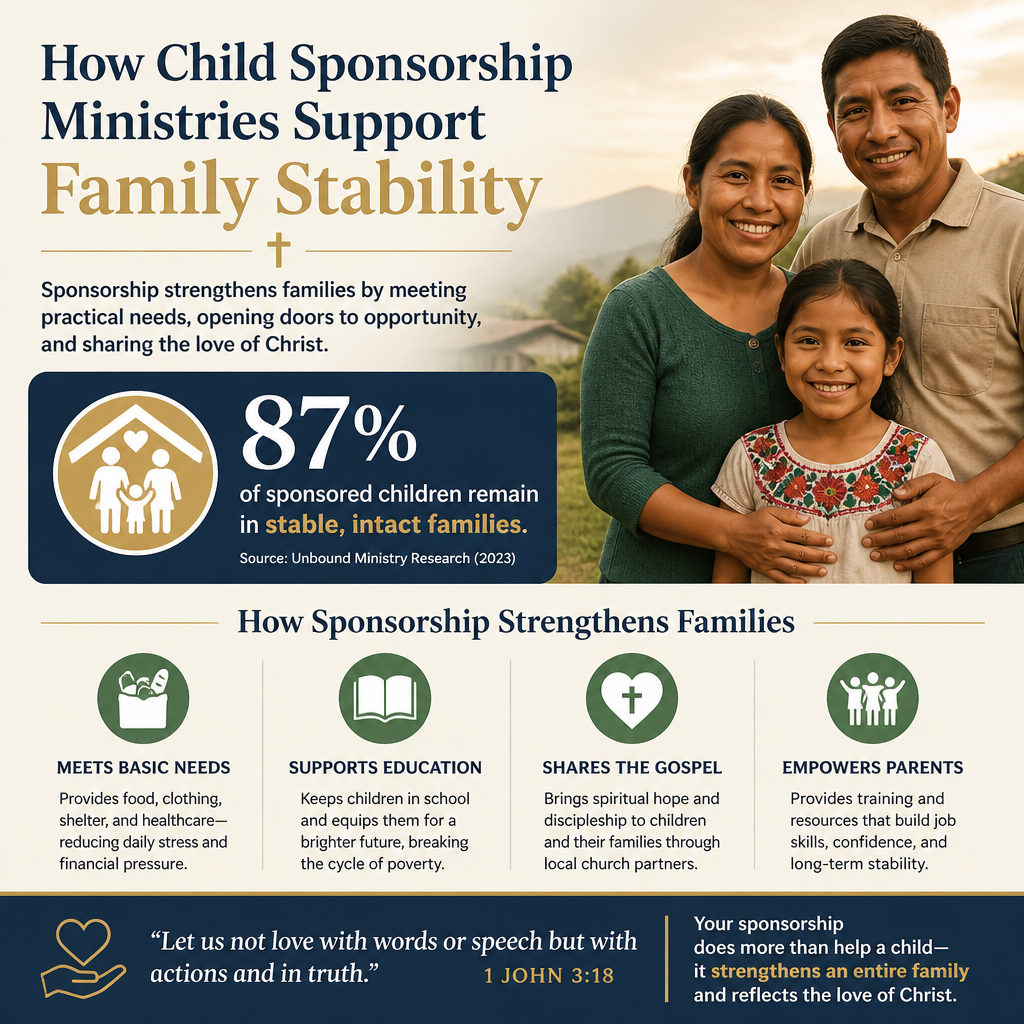
Family stability is not merely an emotional or spiritual category; it is also an economic one. When a ministry helps a household smooth consumption, manage medical shocks, and keep children in school, it often prevents the slow unraveling that leads to family separation. A sponsorship program that includes caregiver engagement, budgeting support, and pathways to increased income generally does more to preserve family cohesion than one that focuses only on the child’s material needs.
At the same time, donors should be wary of simplistic economic claims. Livelihood programs are difficult to do well, and the evidence base varies by context and approach. The ministries that earn donor confidence tend to describe their economic interventions with appropriate specificity: who is eligible, what training is offered, what follow-up exists, and what outcomes are tracked over time.
Caregiver formation and the spiritual ecology of the home
Christian sponsorship often includes spiritual formation for children. A more complete approach also considers the spiritual ecology of the home. When parents are isolated from the ministry, children can experience a split moral universe: one set of expectations in the program and another at home. Programs that strengthen families intentionally include caregiver relationship-building: parenting support, pastoral care, conflict mediation when appropriate, and integration into the local church.
This is not a claim that every family will be healthy if given the right inputs. Abuse, addiction, and exploitation are real. A responsible ministry can both honor family preservation and maintain a clear child protection posture, including mandatory reporting pathways and safe alternatives when a home is not safe.
Measuring family stability requires more than sponsor updates
What donors should expect ministries to track
Sponsor letters and photos can be meaningful, but they are not evidence of family stability. Stability is measured in patterns: school attendance that persists across years, reduced incidence of child labor, fewer emergency placements, healthier caregiver-child attachment, and improved household resilience when crises occur. Ministries that take impact seriously define indicators, collect data consistently, and name limitations.
A credible approach does not require academic complexity, but it does require clarity. For donors who want to go deeper into how programs define and verify outcomes, we publish related analysis within How Child Sponsorship Ministries Measure Impact, including what trustworthy reporting tends to include and what should raise concern.
Evidence, humility, and the discipline of transparency
The field has also learned that good intentions do not immunize programs from harm. The “When Helping Hurts” framework articulated by Steve Corbett and Brian Fikkert has shaped a generation of Christian development practice by emphasizing dignity, local ownership, and the risks of dependency When Helping Hurts. Sponsorship ministries that internalize this framework tend to invest more heavily in local leadership, community participation, and carefully defined assistance.
Transparency is not only financial. It includes candid communication about what sponsorship can and cannot do, what is being measured, how children are selected, and how safeguarding is enforced. These are the kinds of questions The Most Trusted Standard is designed to surface and test, because sophisticated Christian donors deserve more than marketing language.
Verification helps donors fund models that protect families
What strong ministries tend to have in common
Christian donors often ask for a simple rule: “Is this sponsorship program good?” The more responsible answer is that the quality of child sponsorship depends on governance, safeguarding, program design, and honesty in reporting. Across our verification work, we observe that ministries most likely to support family stability share several operational commitments:
- Clear child protection policies, trained staff, and enforced reporting pathways
- Meaningful caregiver engagement rather than child-only programming
- Benefit structures that reduce favoritism and avoid coercive incentives
- Partnership with local churches and community institutions
- Defined outcomes with consistent measurement and candid disclosure of limitations
These commitments are not decorative. They are the difference between a program that quietly stabilizes families and one that unintentionally introduces new pressures into a home.
Where donors should ask harder questions
Some sponsorship practices merit particular scrutiny: exaggerated claims about what a sponsor “provides,” enrollment methods that feel transactional, and reporting that relies heavily on sentiment while avoiding verifiable outcomes. Donors should also pay attention to whether the ministry’s messaging makes parents invisible. A sponsorship model that routinely speaks as though the child has no household, no caregiver, and no community can subtly train donors to fund replacement rather than strengthening.
Most Trusted exists to help donors give with confidence, not merely with sincerity. Our evaluations against The Most Trusted Standard examine faith commitments, financial integrity, governance, and transparency and effectiveness because the health of a sponsorship program is rarely revealed by a single number. The more complex the ministry context, the more donors need coherent, verifiable signals of trustworthiness.
FAQs for How child sponsorship ministries support family stability
Does child sponsorship create dependency for families?
It can, depending on design. Programs that provide long-term assistance without caregiver engagement, realistic graduation pathways, or connection to local services can unintentionally increase reliance on the ministry. Programs that treat sponsorship as a bridge—supporting school participation, basic health, and household resilience while strengthening parents’ capacity—are less likely to produce unhealthy dependency and more likely to support durable stability.
Should donors prefer child-focused sponsorship or community-based sponsorship?
Both models can be faithful and effective, and each carries trade-offs. Child-focused sponsorship can strengthen donor connection and provide tailored support, but it can also heighten inequity and distort family dynamics if benefits are poorly structured. Community-based approaches often reduce favoritism and can strengthen shared local systems, but they require clear communication so donors understand how resources reach children and families. The more important question is whether the ministry can demonstrate safeguarding, honest reporting, and outcomes consistent with preserving family life.
Funding stability is not sentimental work
Child sponsorship is often presented as an uncomplicated good. Christian donors know the world is not that simple, and Scripture does not ask for naïveté. The most faithful sponsorship models strengthen what God ordinarily uses to protect children: parents, households, churches, and communities committed to perseverance. For donors seeking deeper context on the broader landscape of sponsorship ministries, our coverage of Child Sponsorship Ministries addresses how programs vary, what risks recur, and what signals tend to mark trustworthy work.



