

How to write a letter to your sponsored child is a spiritual and ethical question, not merely a communications task. The words a sponsor chooses can strengthen a child’s sense of dignity and hope, or unintentionally add pressure, confusion, or dependency in the name of encouragement.
Child sponsorship is built on a real relationship across distance, culture, and often a profound gap in material conditions. Mature sponsors recognize the tension: we want a child to feel personally known, yet we also want to avoid making promises we cannot keep, centering ourselves, or communicating in ways that undermine the ministry’s work with the child’s family and local community.
Start with a theology of presence and dignity
Christian sponsorship at its best reflects God’s faithful attention. Scripture’s language for love is not abstract; it is steady, truthful, and protective of the vulnerable. A letter is a small act of presence. It can communicate, “You are seen,” without implying, “You are responsible for my feelings,” or, “You must perform gratitude to keep my care.”
Across our verification work at Most Trusted, we see that the healthiest sponsorship programs treat the child as more than a fundraising symbol. They design communications to protect children’s privacy, support healthy boundaries, and keep the center of gravity in the local church and community. Those same values should shape the sponsor’s tone.
Write as a fellow Christian, not a benefactor
Many donors have been formed by a philanthropic script: giver on top, recipient below. Sponsorship letters can quietly reinforce that hierarchy if they focus on what “we are doing for you,” or if they speak as though the child’s future is primarily dependent on us. A more faithful posture is fellowship: we are members of one body, joined in Christ, different in circumstance yet equal in dignity.
That does not require pretending the material gap does not exist. It requires refusing to make the gap the defining feature of the relationship.
Tell the truth and avoid emotional debt
Children, especially those navigating economic vulnerability, can interpret adult language with more weight than we intend. Statements such as “You are the reason we give,” or “We love you like our own child,” may sound warm but can create confusion or a sense of obligation. A letter can be affectionate without making the child carry emotional responsibility for an adult sponsor’s spiritual life or generosity.
When a ministry’s policies feel cautious here, that caution is often protective wisdom learned over time.

Honor the purpose and boundaries of the sponsorship program
Most established child sponsorship ministries use moderated communication, translation, and child-protection safeguards. Sponsors sometimes experience these processes as impersonal. In practice, they are frequently the mechanisms that keep sponsorship from becoming intrusive, coercive, or unsafe.
For donors evaluating sponsorship ministries, this is one of the practical signals of integrity. Programs that meet The Most Trusted Standard tend to show clear child-safeguarding policies, well-defined communications guidelines, and documented accountability in how personal information and contact are handled.
Let the local context remain local
Sponsorship is most constructive when it strengthens what is already healthy in a child’s world: caregivers, teachers, pastors, and community leaders who will remain after our letter is read. Writing that implies we are the primary agent of change can weaken that ecosystem. Writing that honors local leadership can reinforce it.
It is appropriate to express commitment and care. It is not appropriate to position ourselves as rescuer, savior, or decision-maker for the child’s life.
Be careful with gifts, requests, and private contact
Many ministries restrict sending cash, high-value gifts, or contact information. These limits are often tied to child protection and equity. If a few children receive exceptional gifts while others do not, community dynamics can shift quickly. If private contact bypasses safeguards, the risk profile changes for the child.
When sponsors disagree with a policy, the disciplined approach is to ask the ministry to explain the rationale and how it protects children. The field has had to reckon with hard cases, including exploitation, fraud, and unintended harm; safeguards are rarely theoretical.
Write simply, concretely, and in a voice a child can receive
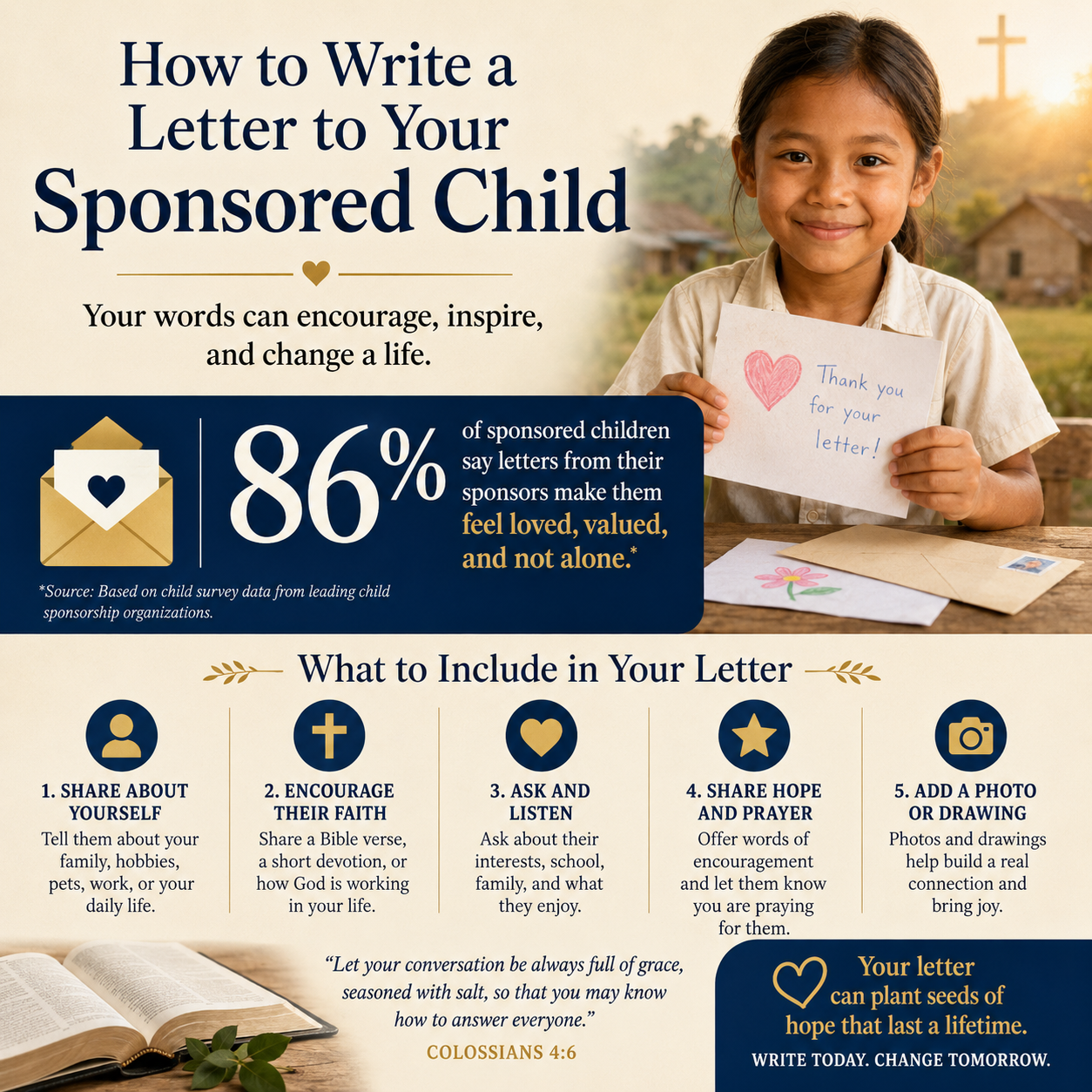
A strong sponsorship letter is usually not long. It is clear. It uses concrete language, asks age-appropriate questions, and leaves room for the child to respond without pressure. Many sponsors overestimate how much of their letter will survive translation and understate how intimidating a dense, adult letter can be to a child.
Choose a few themes and stay with them
Pick two or three themes: school, family, church, friends, and simple joys. Describe your life without turning it into a showcase of comfort. A child can learn about your family, your work, or your congregation without being confronted by an unspoken comparison.
If you mention material details, do it with restraint and purpose. “We went on a trip” is different from “We stayed at a resort and ate at expensive restaurants.” The first is human. The second can be alienating or painful.
Ask questions that invite, not interrogate
Children in sponsorship programs are often asked many questions by adults. The best questions feel like an open door, not a test. Keep them simple and possible to answer. Consider one or two questions rather than a list of ten.
- What is one subject you enjoy in school right now?
- What games do you like to play with your friends?
- Is there a song you enjoy at church?
- What is one food you like to eat at home?
- What is something you hope to learn this year?
When the child answers, respond to what they actually said. Over time, that attentiveness becomes a form of respect.
Pray with theological care, not spiritual pressure
Christian sponsors often want to include Scripture and prayer. This can be a genuine gift, especially when it is offered as encouragement rather than as a demand for a particular spiritual performance. The line is not always obvious, and sophisticated donors do well to name that tension directly.
Prayer in a letter should sound like the prayers of the church: honest, hopeful, and grounded in God’s character. It should not sound like a spiritual transaction in which obedience guarantees prosperity.
Choose Scripture that comforts and strengthens
Promises such as God’s nearness, wisdom, and steadfast love are widely understood across Christian traditions. They also translate well. Avoid proof-texting that can be heard as “If you do X, God will give you Y,” especially in contexts where material deprivation can make that message feel cruel.
Many sponsors find it helpful to paraphrase a passage in simple language and then include a short reference if the program permits. If you quote directly, keep it brief.
Pray without making the child responsible for adult concerns
Some prayer requests are not appropriate for a child: marital conflict, financial anxiety, or adult political fears. A sponsorship relationship is real, but it is not symmetrical. The child is not your counselor.
Better: pray for the child’s protection, learning, friendships, faith, and family. If the ministry is explicitly Christian, it is also appropriate to pray for the child’s church and for wisdom for local leaders serving them.
Strengthen accountability by choosing trustworthy ministries
Even a carefully written letter sits inside a larger system. Donors who take sponsorship seriously eventually ask whether the ministry’s practices deserve trust: how funds are accounted for, how child data is protected, how outcomes are measured, and whether the program avoids manipulative storytelling.
Christian donors sometimes assume that sincerity is a substitute for governance. Scripture treats truthfulness, stewardship, and impartiality as moral requirements, not administrative preferences. That is why Most Trusted evaluates ministries against The Most Trusted Standard, a 15-criteria framework across faith foundation, financial integrity, governance and leadership, and transparency and effectiveness.
What responsible sponsorship organizations tend to make clear
The most credible ministries are usually transparent about where sponsorship dollars go, what “benefits to the child” means in practice, and what is restricted and why. Many use a community-based model rather than direct cash transfer, because predictable program delivery and equity can matter as much as individualized benefit.
For donors comparing options and practices across the field, our coverage of Child Sponsorship Ministries outlines the categories of evidence and accountability that distinguish strong programs from sentimental marketing.
Why communication policies are part of donor due diligence
Child protection is not optional. Sponsorship programs should have clear policies on privacy, photo use, translation, and correspondence review. These policies can feel restrictive, but they often prevent harm that donors never see.
When sponsors want to go deeper in the craft of correspondence itself, we have also addressed practical considerations within Communicating with Your Sponsored Child, including how to stay consistent without turning the relationship into a performance.
FAQs for How to write a letter to your sponsored child
Should we tell our sponsored child about our money or lifestyle?
Selective disclosure is usually wise. A child can know you have a family, a job, and a church without receiving vivid details that intensify comparison or shame. If you mention a purchase, a vacation, or a holiday, keep it modest and relational, and avoid language that implies your comfort is the norm or that their hardship is the defining feature of their identity.
Is it appropriate to promise long-term support or to offer extra help?
Promises create moral obligations, and children tend to hear them as guarantees. Avoid committing to support beyond what the program actually provides, and do not offer extra money or gifts unless the ministry explicitly permits it and can administer it safely and equitably. A better approach is to communicate steady care within the program’s boundaries and to direct any desire for additional generosity through the ministry’s established channels.
Write with steadiness, not sentimentality
A sponsorship letter is a small discipline of Christian love: truthful, bounded, and attentive to the child’s good. The best letters do not attempt to compress a life-changing relationship into a page. They communicate faithful presence over time, aligned with a ministry’s safeguards and with the deeper conviction that every child bears God’s image and deserves to be addressed accordingly.



