
Biblical foundations for child sponsorship are not difficult to locate in Scripture; the harder work is discerning what faithful sponsorship must look like in a world shaped by poverty, migration, conflict, and unequal power. Christian donors often feel a double pressure: the urgency of children’s need and the fear of supporting models that unintentionally harm families or weaken local churches. The Bible gives real clarity about God’s concern for vulnerable children, and it also gives moral guardrails for how Christians should act when money and power are involved.
Child sponsorship is not a single program. It can range from community-based development anchored in local churches to approaches that function more like transactional giving. Scripture does not endorse a modern sponsorship mechanism by name. What it does provide is a coherent theology of the child, the poor, stewardship, and the church’s responsibility to practice mercy with integrity.
God’s character sets the agenda for caring for children
The Bible’s strongest rationale for caring for vulnerable children is not sentiment; it is the character of God. The Lord identifies himself as “Father of the fatherless and protector of widows” (Psalm 68:5). In the Old Testament, this is not poetic flair. It is covenantal self-disclosure: God tells his people who he is, and therefore what his people must reflect.
Orphans and vulnerable children are a recurring test of covenant faithfulness
Israel’s life with God was repeatedly evaluated by how it treated those with the least social power: the sojourner, the widow, and the fatherless (Deuteronomy 10:18–19; 24:17–22). These commands are not limited to personal charity. They assume economic practices (gleaning rights, just courts, protection from exploitation) that preserve dignity and belonging. That matters for child sponsorship because donors are not simply funding services; they are underwriting a moral posture toward children and their families.
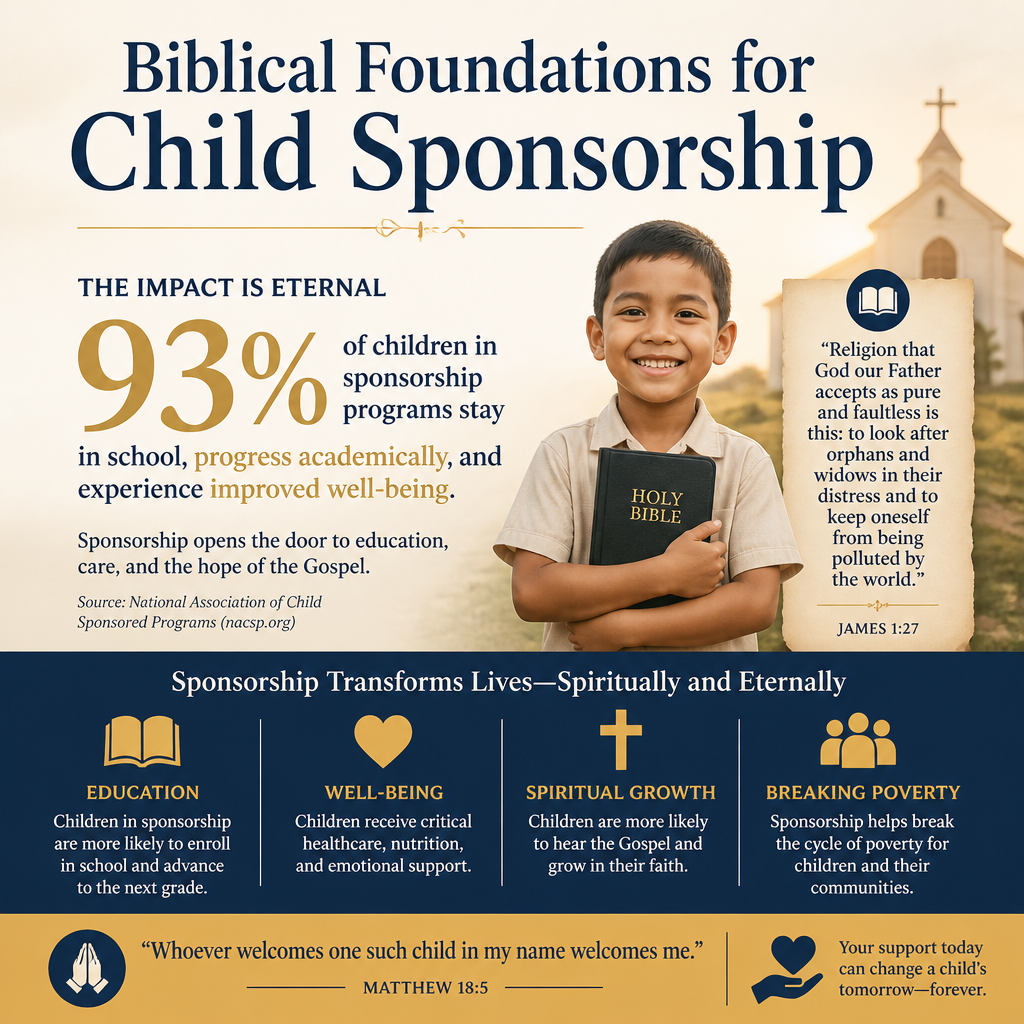
James takes the same theme and places it in the center of Christian ethics: “Religion that is pure and undefiled before God, the Father, is this: to visit orphans and widows in their affliction, and to keep oneself unstained from the world” (James 1:27). The verse joins mercy and moral integrity. A ministry can be emotionally compelling and still be “stained” by practices that distort truth, manipulate donors, or displace families unnecessarily.
Jesus receives children as persons, not projects
In the Gospels, children are not treated as peripheral to the Kingdom. Jesus rebukes disciples who block children from his presence: “Let the children come to me; do not hinder them” (Mark 10:14). The point is not merely that children are “cute” or “innocent,” but that they are recipients of the Kingdom and bearers of dignity. Donor communication in child sponsorship should echo that posture. It should not reduce children to marketing assets or depict them primarily as objects of Western rescue.
What this means in practice is that faithful sponsorship will seek the child’s good as a whole person: spiritual formation, safety, education, health, and family stability. When programs separate those goods—funding school while tolerating coercive fundraising or weak child protection—they drift from the integrated moral vision Scripture requires.

Scripture’s concern for justice requires more than good intentions
Christian donors often assume that because a cause is biblical, any model attached to it must be safe. Scripture does not permit that shortcut. The prophets repeatedly condemn religious action that coexists with injustice: “Is not this the fast that I choose: to loose the bonds of wickedness… to let the oppressed go free… to share your bread with the hungry” (Isaiah 58:6–7). The passage critiques worship that does not reshape economic and social practice.
Power, dependency, and the dangers of paternalism
Child sponsorship sits at a sensitive intersection of compassion and power. Donors typically hold the resources; families and local ministries often carry the risks. Christians genuinely disagree about how much direct donor-child connection is helpful, and the field has had to reckon with cases where sponsorship imagery and storytelling became manipulative. The biblical response is not cynicism; it is truthfulness and justice.
The “When Helping Hurts” framework, articulated by Steve Corbett and Brian Fikkert, has helped many Christian organizations see how assistance can unintentionally create dependency or undermine local initiative when it is not paired with dignity, participation, and accountable relationships. That is not an argument against sponsorship. It is an argument for sponsorship models that strengthen families and churches rather than replacing them.
Truth-telling is a moral obligation, not a communications preference
Scripture binds God’s people to truthful speech and fair dealing. “A false balance is an abomination to the Lord, but a just weight is his delight” (Proverbs 11:1). Donor-facing claims about “your sponsored child” must match the program’s actual mechanics. If funds are pooled for community development, that can still be a faithful model—but it must be explained plainly. If a ministry uses representative photos, composite stories, or restricted access for child protection, those constraints should be disclosed rather than obscured.
What this means for donors is that skepticism is not the enemy of compassion. Discerning questions honor both the child and the integrity of Christian witness.
Faithful stewardship shapes how sponsorship should be evaluated
Child sponsorship asks mature donors to weigh at least three goods at once: immediate relief, long-term development, and spiritual formation within the local church. Scripture does not reduce stewardship to a single metric, such as low administrative cost or rapid expansion. It emphasizes faithfulness, accountability, and fruit consistent with the gospel.
Stewardship in the Bible is accountable, not private
Jesus’ parable of the talents assumes that resources are entrusted and evaluated (Matthew 25:14–30). The point is not to baptize profit-seeking, but to insist that entrusted assets must be handled responsibly and answerably. The New Testament also shows careful financial practice in ministry: Paul takes pains to avoid any suspicion in handling funds, arranging for recognized representatives to accompany the offering “so that no one should blame us about this generous gift” (2 Corinthians 8:20–21). That is governance logic grounded in spiritual credibility.
Across our verification work at Most Trusted, we find that the ministries that meet The Most Trusted Standard are willing to describe their sponsorship economics without defensiveness: how funds are allocated, what is restricted, how child protection is enforced, and what outcomes are tracked. Transparent stewardship is not an add-on to biblical compassion; it is one of its forms.
Wise donors resist simplistic proxies for effectiveness
Many donors were formed in an era when “low overhead” was treated as the primary indicator of virtue. The nonprofit sector has broadly repudiated that assumption, including in the “Overhead Myth” letter jointly advanced by charity evaluators and philanthropy leaders, which argues that overhead ratios can mislead donors and harm organizations by discouraging investment in staff and systems needed for results (Giving Compass).
That caution is especially relevant in child sponsorship. Strong child protection, trauma-informed care, financial controls, and local staff training cost money. Donors should expect a credible ministry to show how its spending supports safety and outcomes, not merely how it minimizes administrative lines.
Verification serves love of neighbor
Christian donors can feel that due diligence is cold, or that asking hard questions signals distrust. Scripture suggests the opposite. Love “rejoices with the truth” (1 Corinthians 13:6). In a world where children are vulnerable to exploitation and where donor narratives can unintentionally distort reality, verification is one practical way to love neighbors we may never meet.
For donors evaluating sponsorship ministries within Child Sponsorship Ministries, The Most Trusted Standard provides a disciplined way to test what is claimed against what is demonstrable: theological commitments, financial integrity, governance and leadership practices, and transparency regarding outcomes and impact. The goal is not suspicion; it is confidence grounded in evidence.
Child sponsorship should strengthen families, local churches, and the Great Commission
The biblical vision for vulnerable children is not merely that they survive; it is that they belong, flourish, and encounter the living God within a community of faith. Sponsorship becomes most theologically coherent when it supports family stability, reinforces local church witness, and contributes to holistic discipleship without collapsing mission into metrics.
Family preservation is often the most child-centered intervention
Scripture consistently treats the family as a primary context for nurture and instruction (Deuteronomy 6:6–7; Ephesians 6:4). That does not mean every family is safe; the Bible is unsparing about human sin and the need to protect the vulnerable. It does mean that ministries should not default to separation when strengthening the household is possible.
In modern practice, the orphan care movement has learned that institutionalization can carry serious developmental harm, particularly for very young children. A major review of early evidence, often associated with the “Bucharest Early Intervention Project,” found significant developmental disadvantages for children raised in institutions compared with family-based care (Harvard University). Donors do not need every technical detail to act wisely, but we should recognize the moral stakes: funding models that unintentionally incentivize institutional care deserve heightened scrutiny.
The local church is not a delivery channel but a spiritual authority
Christian sponsorship often uses local churches for beneficiary identification, mentoring, and discipleship. That can be a strength when churches are treated as partners with genuine agency and supported to exercise pastoral responsibility. It becomes a weakness when churches are instrumentalized—used to validate a program for donors while lacking meaningful oversight, training, or safeguarding capacity.
Scripture’s pattern is that the church bears real responsibility for teaching, discipline, and care (Acts 2:42–47; Galatians 6:10). Donors should look for ministries that invest in local church leadership development, clear child protection standards, and accountable relationships that do not depend on foreign control to function.
Prayer and personal devotion belong alongside financial scrutiny
Child sponsorship invites donors into an unusual form of participation: a long-term commitment to a particular child or community. That commitment should be sustained by prayer, not merely by monthly giving. Paul’s letters show how spiritual partnership works across distance—regular intercession, encouragement, and material support intertwined (Philippians 4:14–19).
The harder question is how to keep prayer from becoming sentimental or disconnected from reality. Faithful prayer asks for protection from harm, for integrity in program leadership, for family stability, for the child’s growth in wisdom and grace, and for the church’s credibility in the community. It also asks God to purify the donor’s motives—away from self-congratulation and toward steady love.
Giving with biblical confidence
Biblical foundations for child sponsorship do not promise that every program bearing Christian language will be faithful, nor do they permit withdrawal into cynicism. Scripture calls Christians to defend the vulnerable, speak truth, steward resources carefully, and honor the local church’s role in God’s mission. For donors, the path forward is neither impulse nor paralysis, but tested generosity—compassion joined to verification, and mercy expressed through ministries that can demonstrate integrity and credible care.



