
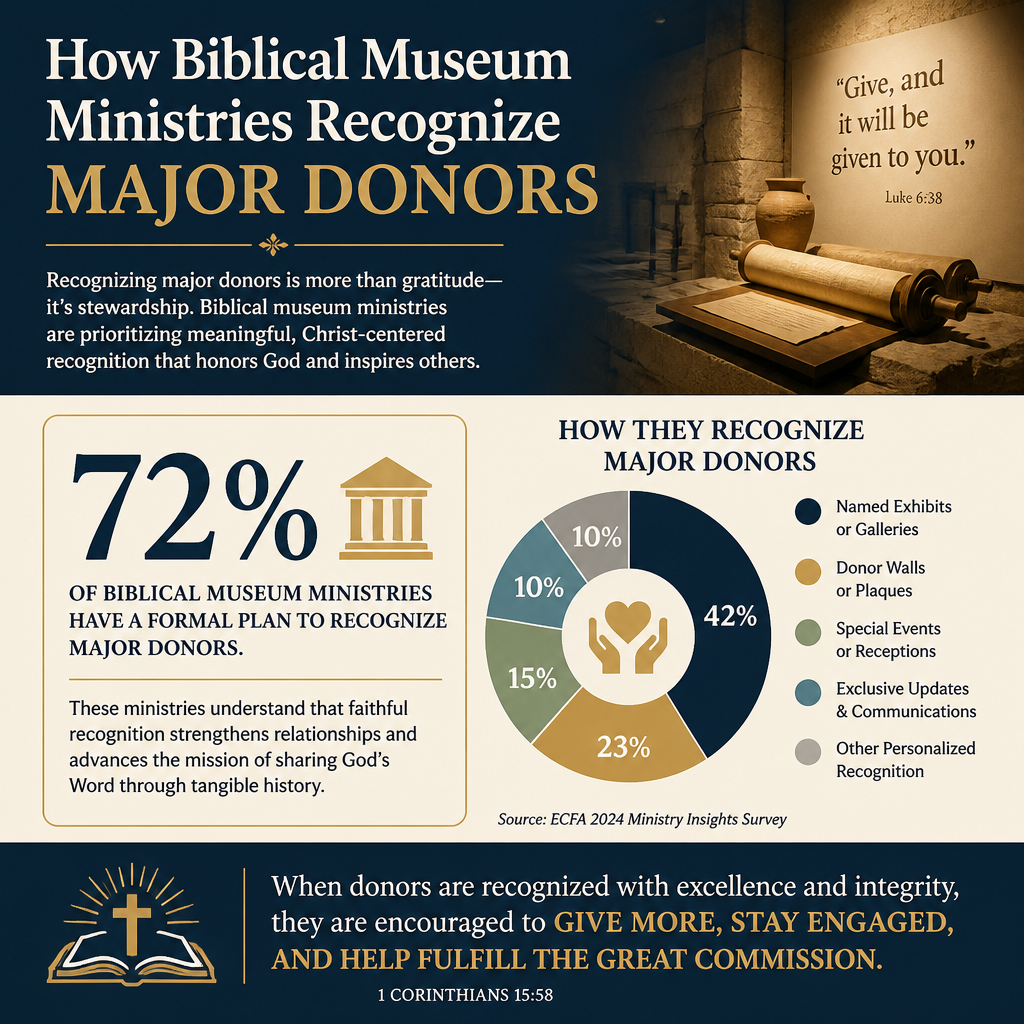
How biblical museum ministries recognize major donors is not a cosmetic question about etiquette. It is a theological and governance question about how an institution that handles sacred history and Scripture-adjacent artifacts honors generosity without turning recognition into spiritual distortion. Major gifts can preserve collections, fund conservation science, underwrite exhibits, and expand educational reach. They can also create subtle pressures: for curators to please patrons, for executives to confuse fundraising success with faithfulness, and for boards to grant influence that does not belong to any donor.
Scripture does not treat giving as morally neutral. Jesus commends generosity while warning against public performance that seeks human praise (Matthew 6:1–4). Paul receives material support and still insists that the gospel not be “peddled” for profit (2 Corinthians 2:17). For museums that serve the church, the question is how to practice gratitude that is honest and proportionate, while guarding the institution’s spiritual integrity and public credibility.
Recognition is gratitude under moral restraint
Honor and humility belong together
The Bible can speak in two directions at once: honor is real, and humility is commanded. Scripture instructs believers to “give honor to whom honor is owed” (Romans 13:7), and churches have long thanked patrons who enabled ministry. Yet Jesus also addresses the temptation to give in order to be seen, and he locates true reward with the Father who sees in secret (Matthew 6:4). A museum ministry can therefore practice recognition as gratitude, not as the manufacture of prestige.
What this means in practice is that healthy donor recognition is less about building a ladder of social status and more about naming a gift’s concrete impact with restraint. The best recognition focuses on what was preserved, taught, or made accessible—not on the donor’s importance. For sophisticated Christian donors, this is not a demand for anonymity so much as a preference for truthfulness: public thanks that does not become spiritual theater.
The institution’s credibility is part of the gift
Biblical museums exist in a contested public space. Christians genuinely disagree about the best ways to present archaeological data, to handle contested provenance questions, and to communicate uncertainty without cynicism. Recognition practices can either strengthen credibility or undermine it. When galleries, plaques, and press releases create the impression that scholarship is “sponsored content,” the institution’s educational mission becomes harder to trust.
Across our verification work at Most Trusted, we observe that institutions with stronger governance tend to treat recognition as one component of donor care, not as a substitute for sound policy. They separate gratitude from decision-rights. They thank donors while making it clear—internally and externally—that curatorial judgment, artifact acquisition standards, and educational content are governed by mission and evidence, not by patron preference.
Wise recognition begins with clear boundaries
Gift acceptance policy is not bureaucratic overreach
A biblical museum can be deeply grateful for major donors and still insist on a rigorous gift acceptance policy. That policy should address restricted gifts, naming opportunities, non-cash gifts, and the institution’s right to decline funds that would compromise mission or credibility. Donors who care about long-term faithfulness often welcome this clarity, because it signals an institution that is governed rather than improvised.
Restricted gifts deserve particular care. A donor may rightly designate funds for a conservation lab, a traveling exhibit, or educational programs for pastors and teachers. Problems arise when restrictions function as control over scholarship, staffing decisions, or public messaging. The boundary is not “no restrictions,” but “no restrictions that displace the institution’s fiduciary and spiritual responsibilities.”
Recognition should never purchase influence
The harder question is influence that arrives informally: access, deference, and implied veto power. Museums can unintentionally teach staff to treat major donors as quasi-board members. Over time, this can weaken internal courage, especially when exhibit narratives touch sensitive topics such as historicity, authenticity debates, or interpretive disagreements among Christians.
We recommend donors ask, directly and respectfully, where authority resides. Does the board approve exhibit standards and acquisition policies? Is there a conflict-of-interest policy that governs board members and major donors alike? When institutions can answer those questions with documentation—not mere reassurance—recognition becomes safer for everyone. For a broader view of how donor relationships fit within this ministry sector, see Donor Partnership with Biblical Museum Ministries.
Common recognition practices and what they signal
What is appropriate to name and what is not
Naming opportunities are not inherently suspect. In higher education and in many museums, they are a normal way to acknowledge large gifts that created durable public goods. The question is what is being named and what that naming implies. Naming a gallery, conservation lab, or educational wing can be appropriate when paired with clear interpretive independence. Naming that appears to brand the biblical message itself, or to attach donor identity to contested truth-claims, is more precarious.
Institutions that handle these questions well often keep recognition in the realm of infrastructure and access rather than interpretation. They may recognize a donor for underwriting an exhibit’s physical production while explicitly maintaining curatorial independence for the exhibit’s content and scholarly claims. The distinction is subtle but important: support for the platform is different from control over the message.
Events and private access require pastoral wisdom
Donor dinners, previews, and behind-the-scenes tours can be legitimate expressions of gratitude. They can also drift into exclusivity that contradicts a museum’s public-serving vocation. When donor benefits begin to feel like spiritual VIP treatment, Christian conscience should be uneasy. James warns the church against honoring the wealthy in ways that shame the poor (James 2:1–4). Museums are not churches, but Christian museum ministries still carry that moral weight.
A constructive approach is to offer access that is educational rather than status-driven: curator briefings that explain the care of fragile artifacts, conservation demonstrations, or discussions of interpretive methodology and its limitations. Such gatherings can form donors into better stewards by deepening understanding of what their giving sustains.
- Impact-forward language that highlights preservation, education, and access rather than donor prestige
- Time-limited recognition for certain campaigns, avoiding perpetual branding where it is not warranted
- Consistent thresholds for naming and listings, published internally and applied evenly
- Clear separation between recognition and governance or curatorial decision-making
- Respect for donor conscience with options for anonymity or limited publicity
How donors can discern healthy recognition
Ask about transparency, not just outcomes
Many Christian donors have learned to ask whether a ministry is “effective.” Fewer ask whether its donor relationships are structurally healthy. A biblical museum may produce compelling exhibits and still carry hidden fragility in governance, finances, or influence. For that reason, donor recognition practices should be read as signals: how an institution thanks donors often reveals how it will treat truth under pressure.
One widely recognized caution in philanthropy is the fixation on administrative ratios as a proxy for virtue. The “Overhead Myth” letter—signed by Charity Navigator, BBB Wise Giving Alliance, and GuideStar—argues that overhead metrics alone can mislead donors and harm nonprofits by discouraging necessary investments in accountability and capacity (Charity Navigator). In the museum context, the analogous temptation is to treat visible recognition as proof of health: a long donor wall can coexist with weak controls and unclear reporting.
Use a verification lens rather than a personality lens
Sophisticated donors often have personal friendships with museum leaders, scholars, or board members. Those relationships can be a gift. They also raise the risk that trust becomes relational rather than verifiable. A healthy institution welcomes respectful scrutiny because it understands that accountability is a form of stewardship, not suspicion.
Most Trusted exists to help donors give with confidence by evaluating ministries against The Most Trusted Standard, a 15-criteria framework spanning faith foundation, financial integrity, governance and leadership, and transparency and effectiveness. When a museum ministry meets high standards, donor recognition tends to be simpler: gratitude is expressed without anxiety, because the institution is not depending on any single donor to survive.
For donors seeking context on the broader sector—its opportunities, constraints, and common governance patterns—see Biblical Museum Ministries.
Recognition that protects the vulnerable and the witness
Provenance, acquisitions, and the ethics donors rarely see
Biblical museums are uniquely exposed to provenance controversies, illicit antiquities trade concerns, and the complexities of collecting in regions with conflict and looting risk. Donors may never see the internal discipline required to verify documentation, consult experts, and decline questionable items, even when doing so disappoints supporters who want dramatic artifacts. Recognition practices should never incentivize speed over ethics.
The Association of Art Museum Directors has articulated guidelines and professional expectations that address collecting and provenance, reflecting a broader museum-sector consensus about ethical acquisition and due diligence (Association of Art Museum Directors). Not every biblical museum aligns formally with AAMD, but donors can still ask whether comparable standards govern acquisitions and whether donors are kept at an appropriate distance from acquisition decisions.
Public communication should serve truth, not fundraising
Christian museum ministries bear a witness responsibility. They communicate to believers, skeptics, students, and journalists. When major donor recognition becomes intertwined with sensational claims or overstated certainty, the institution risks trading long-term credibility for short-term attention. The church has paid dearly for public overclaiming in other domains; museums should not repeat the pattern in the realm of artifacts and history.
Recognition done well supports honest communication: acknowledging donor generosity while preserving editorial independence, scholarly humility, and clarity about what is known, what is debated, and what remains uncertain. That posture aligns with Christian truthfulness, which is not embarrassed by complexity and does not require manipulation to sustain faith.
FAQs for How biblical museum ministries recognize major donors
Should Christian donors insist on anonymity when giving to a biblical museum ministry?
Anonymity can be a wise discipline, especially when a donor senses the temptation toward public approval. It is not, however, a universal requirement. Scripture’s concern is the heart’s posture and the social dynamics created by public honor. Many museum ministries can thank donors publicly in modest ways that do not distort the mission. Donors should feel free to choose anonymity, limited recognition, or public recognition, and ministries should respect that choice without pressure.
What donor recognition practices are warning signs in biblical museum ministries?
Consistent warning signs include recognition that implies control over scholarship, private benefits that feel like spiritual VIP status, and a culture where major donors receive informal veto power. Other concerns include unclear naming thresholds, lack of a published gift acceptance policy, and communications that blur the line between fundraising promotion and truthful representation of evidence. Healthy institutions can explain their boundaries calmly and document how decisions are governed.
A healthier way to be thanked
Major donors deserve sincere gratitude, and biblical museum ministries often depend on significant gifts to preserve fragile material history for the church and the public. The aim is not to eliminate recognition, but to order it properly: gratitude without flattery, honor without influence, and transparency without performance. When recognition is governed by clear policy and theological seriousness, it becomes one more way a ministry can embody faithful stewardship before God and credible service before neighbor.



