

Fundraising costs are part of what Bible translation ministries have to carry if they want Scripture to reach new languages with integrity and staying power. For Christian donors, the moral question is not whether fundraising exists, but whether it is truthful, proportionate to the mission, and governed in a way that keeps financial means from becoming a spiritual end.
Many believers have been trained to treat “overhead” as suspect and fundraising as an unfortunate necessity. The field itself has corrected that instinct in recent years. The most widely cited statement against simplistic overhead ratios came from Charity Navigator, GuideStar, and the BBB Wise Giving Alliance, arguing that judging charities by overhead alone “does more damage than good.” Charity Navigator
What this means in practice is that fundraising can be either a faithful act of stewardship or a subtle deformation of it. Mature Christian giving asks better questions: What does it cost to raise a dollar in this particular ministry model? How is fundraising represented to donors? Does leadership submit fundraising strategy to biblical and organizational accountability? And does the ministry provide enough transparent evidence for donors to assess the trade-offs?
What fundraising costs actually include for Bible translation ministries
Direct fundraising expenses and the people behind them
Fundraising costs are typically reported as a functional expense category in audited financial statements: salaries and benefits for development staff, donor communications, databases, gift processing, events, and sometimes fees paid to outside vendors. In Bible translation ministries, fundraising often also includes donor care for long-term partners, because translation work is sustained over years, not weeks.
In many translation organizations, personnel is the primary line item. That is not inherently problematic; relational fundraising is labor-intensive, especially when donors expect thoughtful reporting about translation progress, literacy work, checking, and distribution. The question is whether staffing levels and compensation are appropriate to the organization’s size and complexity, and whether leadership can articulate why each fundraising function exists.
Shared costs and why accounting choices matter
Some costs sit on the boundary between fundraising and program: newsletters that report translation milestones, prayer updates that also contain giving appeals, trips that combine field briefings with donor meetings, and digital content that both educates the church and invites support. Accounting standards allow shared costs to be allocated when specific criteria are met, but allocation is not a moral blank check.
Across our verification work at Most Trusted, we look for consistency between what a ministry says it is doing and how it categorizes expenses. A ministry may be within accounting rules and still communicate in ways that leave donors with a misleading impression. Transparency is not merely compliance; it is a posture of truthfulness.
Why fundraising is structurally different in Bible translation
A long runway requires durable donor relationships
Bible translation is a multi-year, collaborative endeavor: linguistic analysis, community engagement, drafting, checking, consultant review, and often literacy and Scripture engagement. Fundraising costs rise when the ministry’s work has a long timeline, because keeping donors informed and committed requires sustained communication and reporting systems.
This is one reason comparisons across nonprofit sectors can mislead. A disaster relief organization may see large spikes of restricted giving after a crisis. Translation organizations often build slower, steadier donor bases that underwrite years of technical work. In that setting, development is not merely “asking”; it is maintaining trust through accurate reporting, careful use of restricted gifts, and clear articulation of outcomes.
Support raising models add both costs and complexities
Many Bible translation agencies deploy staff who raise personal support. That model can reduce the need for large centralized fundraising departments, but it does not remove fundraising costs; it moves them. Training, coaching, compliance, gift processing, and pastoral care for field staff are still real expenses, and they are frequently embedded across multiple budget lines.
The harder question is spiritual and ethical: whether the support raising model pushes workers toward pressure tactics or toward resilient, accountable partnership with the church. Christians genuinely disagree about the healthiest way to structure these roles, but most agree that fundraising methods must not trade on guilt, exaggeration, or selective storytelling.
How to judge fundraising costs without falling for the overhead myth
Ratios can inform, but they cannot govern
Donors often look for a single number: “What percentage goes to programs?” That instinct is understandable, but it is not sufficient. Even the best ratios can be manipulated by expense allocation, and even honest ratios can be misread. The joint statement by GuideStar, Charity Navigator, and BBB Wise Giving Alliance is worth taking seriously: it warns donors and nonprofits that overhead fixation can punish needed investments in systems, evaluation, and staffing. GuideStar
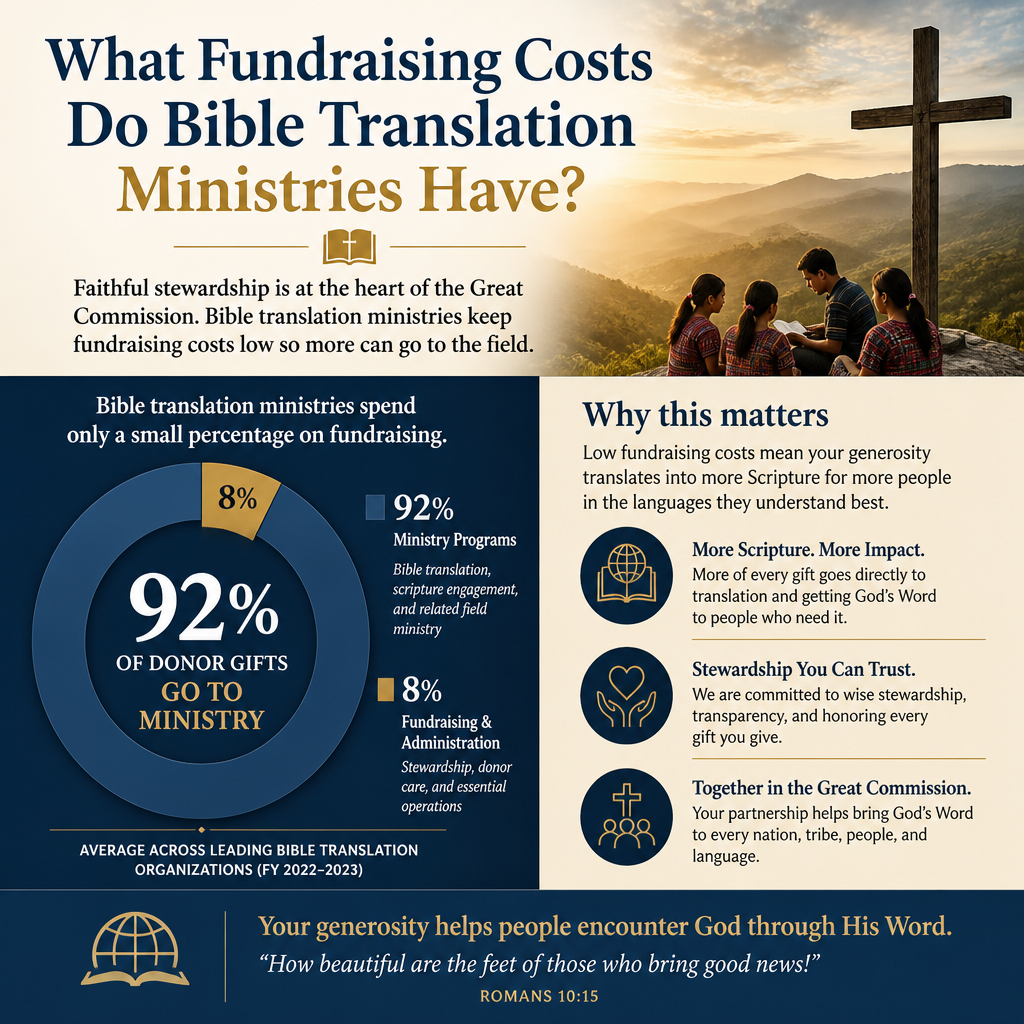
Better questions are comparative and contextual. How does this ministry’s fundraising expense compare to similar organizations? Is it stable over time, or does it spike without explanation? Is fundraising driving the organization’s messaging, or serving the organization’s mission?
Cost to raise a dollar is useful when honestly presented
Many ministries track “cost to raise a dollar” or “fundraising efficiency.” When calculated consistently, it can reveal whether development practices are maturing. But it can also be used as a marketing metric that hides trade-offs. A ministry can slash fundraising costs by starving donor care, reducing reporting, and underinvesting in compliance, then face deeper integrity risks later.
We encourage donors to look for fundraising metrics presented with candor: definitions disclosed, time horizons explained, and limitations acknowledged. A ministry that refuses to speak plainly about fundraising often expects donors to make decisions on sentiment rather than evidence.
- Consistency: The same metric is calculated the same way year over year.
- Context: Leadership explains why the metric looks the way it does for their model.
- Governance: The board reviews fundraising strategy and key risks.
- Truthfulness: Appeals avoid inflated claims or manipulative urgency.
- Transparency: Donors can access audited statements and a clear annual report.
What healthy fundraising looks like under The Most Trusted Standard
Faithful ends never justify faithless means
Scripture does not treat money as neutral. Jesus’ warnings about Mammon were not abstract; they were pastoral realism about what money can do to the human heart and to religious institutions. For ministries that handle sacred texts and invite sacrificial giving, this carries particular weight: fundraising must be shaped by truth, restraint, and reverence.
Under The Most Trusted Standard, we examine whether a ministry’s faith commitments are expressed not only in doctrinal statements but in operational decisions: how it represents needs, how it handles restricted gifts, and whether it tells the whole story about timelines and costs. Bible translation is expensive and slow by nature; strong ministries do not hide that. They explain it.
Board oversight and internal controls are donor protection
Fundraising carries predictable risks: dependence on a few large donors, aggressive contractor arrangements, inadequate review of messaging, and blurry lines between program reporting and solicitations. Strong governance reduces those risks. A board that is engaged, independent, and informed can hold executive leadership accountable for how funds are raised, not only how they are spent.
Donors should also look for credible financial signals: timely audits, meaningful audit committee engagement, documented policies on gifts and conflicts of interest, and clear functional expense reporting. For donors wanting a broader landscape view, our coverage of Bible Translation Ministries addresses the recurring accountability questions that surface across the sector.
Practical benchmarks and questions donors can ask
Reasonable ranges exist, but they are not a verdict
Christian donors often ask for a “safe” fundraising percentage. It is more responsible to ask for a narrative supported by verifiable documents. Some ministries will show higher fundraising costs during a growth phase, a major campaign, or a strategic shift in donor base. Others will show low fundraising costs because they benefit from legacy relationships, denominational pipelines, or unusually concentrated giving.
When donors want comparability, third-party reporting can help. IRS Form 990s (for U.S. nonprofits) show functional expenses, leadership compensation, and governance disclosures. Audited financial statements add another layer of rigor. If a ministry solicits in ways that imply strong accountability but cannot provide basic documentation, donors should pause.
Questions that clarify integrity rather than sentiment
The following questions tend to surface what matters most without reducing stewardship to a single ratio:
- Can the ministry provide its most recent audited financial statements and a current annual report?
- How does the ministry define and track fundraising expenses, including any shared-cost allocations?
- Does the board review fundraising strategy, donor communications, and major risks at least annually?
- Are any fundraising activities outsourced, and if so, what are the fee structures and oversight controls?
- How does the ministry prevent restricted gifts from being used to cover unrelated operating shortfalls?
These questions fit within a broader approach to funding models and accountability. Donors who want to examine how translation work is sustained over time can also consult How Bible Translation Ministries Are Funded for the patterns we most often see in budgets, reporting, and donor communications.
FAQs for What fundraising costs do Bible translation ministries have
Is it a problem if a Bible translation ministry spends a significant percentage on fundraising?
Not automatically. Higher fundraising expense can reflect a ministry’s stage of growth, the long-term nature of translation work, or an intentional investment in donor care and compliance. The more reliable question is whether the spending is governed well, reported transparently, and consistent with truthful appeals. Donors should review audited statements and Form 990 reporting where applicable, then ask leadership to explain trends over several years.
Should donors avoid ministries that do not publish fundraising ratios prominently?
Not necessarily, but donors should expect accessible documentation. A ministry may avoid headline ratios because the sector has recognized the limits of overhead-focused evaluation, including the joint warning from Charity Navigator, GuideStar, and BBB Wise Giving Alliance. BBB Wise Giving Alliance What matters is whether the ministry still provides clear financial statements, explains fundraising strategy in plain language, and invites accountability rather than resisting it.
Giving with confidence about fundraising costs
Bible translation ministries have fundraising costs because the work requires long-term partnership, careful reporting, and accountable administration. Donors honor Christ not by demanding an unrealistically low number, but by insisting on truthfulness, governance, and transparent evidence that funds are raised and spent in ways consistent with the gospel. When ministries treat fundraising as a servant of mission rather than a master of it, donors can give with both generosity and clear conscience.



