

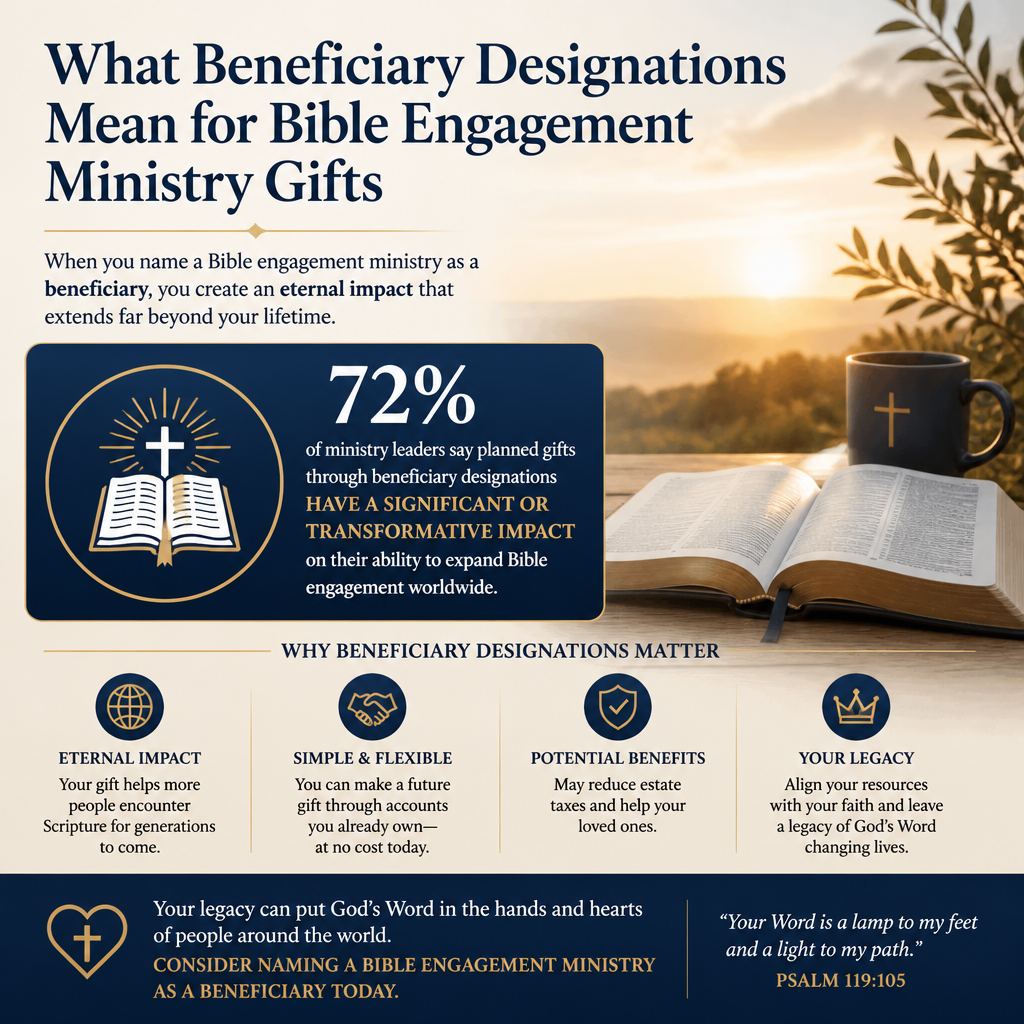
What beneficiary designations mean for Bible engagement ministry gifts is not primarily a technical question. It is a stewardship question: whether the assets God has entrusted will be directed with clarity, charity, and faithfulness when a donor is no longer able to make decisions in real time. Beneficiary designations can fund Bible engagement work for years, but they can also quietly undo a donor’s intent if they are left vague, outdated, or misaligned with the rest of an estate plan.
Many Christians assume a will controls everything. In practice, beneficiary designations on retirement accounts, life insurance policies, and certain bank or brokerage accounts often transfer by contract, outside probate, and without reference to a will. That is why mature planned giving is as much about coordination as it is about generosity, especially when the intended gift supports ministries that translate, distribute, teach, and embed Scripture in communities.
Beneficiary designations are a spiritual and legal instrument of stewardship
Why beneficiary forms often outrank a will
Beneficiary designations are instructions a donor gives to a financial institution or insurer naming who receives an asset at death. For many assets, these designations govern the transfer even if a will says otherwise. The U.S. Supreme Court has recognized that federal law can require distribution according to beneficiary forms for certain retirement plans, even against conflicting state-law claims or other documents, as in Kennedy v. Plan Administrator for DuPont Savings and Investment Plan (2009) (U.S. Supreme Court).
What this means in practice is that a carefully drafted will can be functionally sidelined by a beneficiary form completed years earlier. Christians seeking to support Bible engagement ministries in a lasting way should treat those forms with the same moral seriousness they bring to any major giving decision.
Why this matters uniquely for Bible engagement ministries
Bible engagement work is often slow, multi-stage, and locally contextual: translation and oral Bible storying, Scripture distribution, discipleship pathways, leadership training, and digital engagement in difficult access contexts. Donors are not merely “supporting a program.” They are enabling people to hear and obey the Word of God in their heart language and lived reality.
Scripture frames such giving as a trust. “It is required of stewards that they be found faithful” (1 Corinthians 4:2). Faithfulness includes administrative clarity when clarity is available and negligence carries foreseeable consequences.

Which assets commonly use beneficiary designations and where gifts go wrong
Assets that frequently pass by beneficiary designation
Donors most often encounter beneficiary designations in employer retirement plans and individual retirement accounts, life insurance, and accounts with transfer-on-death or payable-on-death features. These assets can be significant. Retirement assets are widely held in the United States; the Federal Reserve reports that retirement accounts are a common component of household balance sheets (Board of Governors of the Federal Reserve System).
Because these assets may transfer quickly and privately, they are also a common place where charitable intent can be implemented cleanly—or lost without anyone noticing.
How outdated forms and competing claims derail intent
In our review of ministry governance and donor communications, we repeatedly see a pattern: donors make a clear commitment in conversation, but the paperwork never catches up. A named beneficiary could be a former spouse, a deceased relative, or a trust that no longer reflects current wishes. Another frequent problem is overconfidence in informal notes or emails. Financial institutions generally follow their required forms, not a donor’s later explanation.
There is also a theological tension worth naming. Christians can feel uneasy when administrative diligence seems to crowd out spiritual freedom. Yet the New Testament pattern is not carelessness; it is orderly stewardship. Paul organized a multi-church collection with clear accountability and visible integrity so that “no one should blame us about this generous gift” (2 Corinthians 8:20–21). Beneficiary designations are one modern location where that same concern applies.
How to name a Bible engagement ministry well without creating future confusion
Be precise about the legal recipient
“Bible translation” or “Bible engagement” is not a legal entity. A beneficiary designation works best when it names the ministry’s full legal name and, where allowed, a tax identification number. If the ministry operates with affiliated entities—such as a U.S. fundraising organization and an overseas implementing organization—confirm which entity can legally receive the gift and issue the appropriate documentation.
This is also where donors can draw on verified information rather than marketing claims. Most Trusted exists to help donors give with confidence by evaluating Christian nonprofits against The Most Trusted Standard. When a planned gift will be irrevocable at death, questions of legal identity, governance, and financial integrity become more than due diligence; they become a final act of stewardship.
Decide whether the gift is restricted or unrestricted
Many donors prefer to restrict a legacy gift to a particular Bible engagement purpose: Scripture distribution in prisons, translation for an unreached language group, youth discipleship curriculum, or digital Bible access in closed countries. Restrictions can protect donor intent, but they can also create real problems if the ministry’s work evolves, a program sunsets, or a legal or political change makes a particular activity impossible.
We observe that ministries with strong governance tend to handle restricted gifts with clearer internal controls and better donor communication. Still, even well-governed ministries cannot control future circumstances. A disciplined approach is to restrict to a mission-aligned area while allowing the ministry’s board reasonable flexibility if the restriction becomes impracticable. Donors should work directly with a ministry’s planned giving or development team and, for larger gifts, with qualified legal counsel to ensure the restriction is enforceable and workable.
- Name the ministry’s full legal name, not just a brand name.
- Confirm the ministry’s current mailing address and, if appropriate, tax identification number.
- Specify a percentage or a specific dollar amount, not a vague intention.
- Coordinate beneficiary designations with the will or trust so documents do not conflict.
- Revisit designations after major life events and at regular intervals.
Verification and governance matter because beneficiary gifts are difficult to unwind
Why accountability is more urgent in planned gifts
A current-year gift can be adjusted next year if a ministry drifts from its stated purpose or if a donor loses confidence. A beneficiary gift has no such corrective mechanism. That is why board independence, conflict-of-interest controls, audited financial practices, and truthful reporting are not secondary concerns. They are safeguards for the donor’s final act of generosity.
Across our verification work, we see that donors often underestimate how long a ministry’s leadership team, strategy, and even theological posture can shift over a decade. The ministries that meet The Most Trusted Standard tend to show evidence of durable governance and clear faith commitments, not merely charismatic leadership or compelling stories.
Transparency is not cynicism
Some Christians worry that scrutiny signals distrust. Scripture distinguishes between cynical suspicion and wise testing. “Beloved, do not believe every spirit, but test the spirits” (1 John 4:1). When donors verify a ministry before placing it as a beneficiary, they are not abandoning faith; they are practicing prudence on behalf of the people who will be served by that future gift.
For donors evaluating ministries in this space, the broader landscape of Bible Study and Engagement Ministries includes organizations with very different models of translation, distribution, discipleship, and digital engagement. Discernment requires more than admiration; it requires evidence.
Coordinating beneficiary designations with family care, church commitments, and ministry priorities
Honoring household obligations and generous intent
Christian donors often carry competing responsibilities: caring for a surviving spouse, supporting adult children wisely, meeting obligations to a local church, and extending generosity to mission and ministry. Beneficiary designations can express that hierarchy clearly. For example, a donor can name a spouse as primary beneficiary on certain accounts while directing a percentage of other accounts to a ministry, reducing ambiguity and potential family conflict.
Christians genuinely disagree about how to balance inheritance and generosity. Scripture does not offer a single formula, but it does offer moral boundaries: providing for one’s household is weighty (1 Timothy 5:8), and laying up treasure for oneself without being “rich toward God” is condemned (Luke 12:21). Beneficiary decisions should reflect both obligations without turning either into an excuse for the other.
Giving through a church or directly to a ministry
Some donors prefer to leave a beneficiary gift to their local church with the request that the church support Bible engagement work. Others name a specific ministry directly. Each path has trade-offs. A church can provide relational accountability and local discernment, but not every church has the administrative capacity to manage restricted funds well over time. A direct gift to a ministry can be more precise, but it depends heavily on the ministry’s long-term governance and transparency.
For donors engaging these questions within Legacy and Planned Giving for Bible Study and Engagement Ministries, the central discipline is coordination: legal documents, beneficiary forms, and ministry relationships aligned so the gift does what the donor intends and serves the people it is meant to serve.
FAQs for What beneficiary designations mean for Bible engagement ministry gifts
Can a beneficiary designation be used to support a Bible engagement ministry without going through probate?
Yes. Many beneficiary-designated assets—such as retirement accounts, life insurance, and transfer-on-death accounts—typically pass directly to the named beneficiary, outside probate. The rules vary by asset type and jurisdiction, and some employer plans are governed by federal law, so donors should confirm details with their financial institution and qualified counsel.
Should a donor restrict a beneficiary gift to a specific Bible engagement project?
It depends. Restrictions can protect a donor’s intent, but they can also become unworkable if circumstances change. A common approach is to restrict to a mission-aligned area while allowing a board-defined alternative use if the original purpose becomes impracticable. Donors should document any restriction clearly and confirm in writing that the ministry can administer it faithfully.
A beneficiary designation is often the clearest legacy gift a donor can make
Beneficiary designations are deceptively simple forms that can carry lasting spiritual consequence. When coordinated with a thoughtful estate plan and directed to ministries that demonstrate faithful doctrine, financial integrity, and transparent effectiveness, they can strengthen Bible engagement work long after a donor’s lifetime. Stewardship at this level is not anxiety; it is obedience shaped by love, order, and the desire that God’s Word would dwell richly among his people.



