

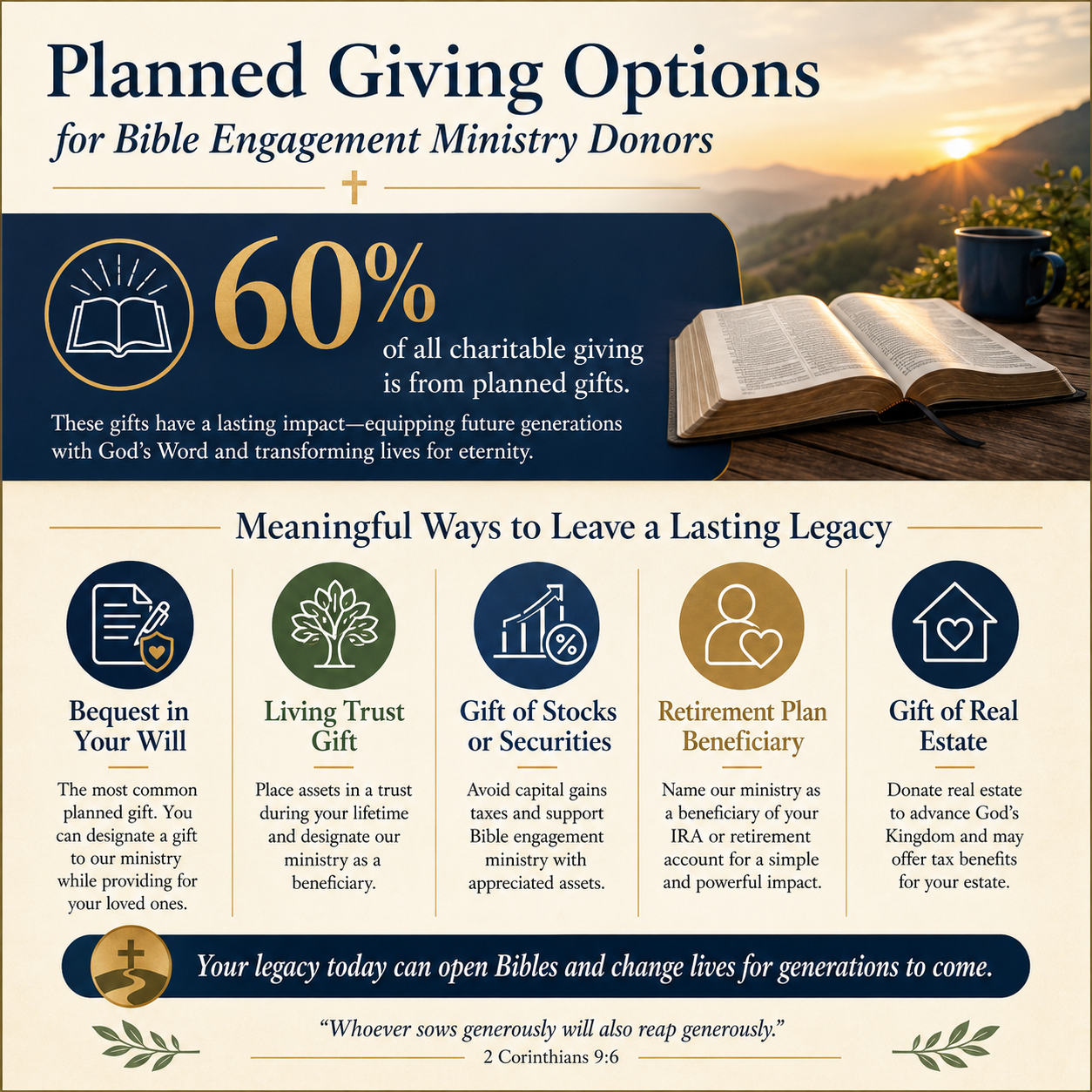
Planned giving options for Bible engagement ministry donors raise a question that is both spiritual and practical: how should a Christian order long-term generosity so that it strengthens the church’s teaching ministry without creating confusion for heirs or instability for the ministry. Scripture treats wealth as stewardship, not possession, and it commends foresight that serves righteous ends (Proverbs 13:22). Yet legacy gifts require more than good intentions; they demand clarity, legal care, and a sober view of institutional trust.
Bible engagement ministries occupy a particular place in Christian philanthropy. Their work is foundational rather than episodic: translation, distribution, training, and discipleship tools often take years to mature, and their fruit can be difficult to measure in a single reporting cycle. That makes planned giving unusually fitting, but it also increases the importance of governance, transparency, and theological integrity. Across our verification work at Most Trusted, we see that the best legacy outcomes come when donors match a well-chosen planned gift with a ministry that can demonstrate durability under scrutiny through The Most Trusted Standard.
Why planned giving fits Bible engagement ministry
Bible engagement is generational work
Most Bible engagement efforts are designed to outlast any single leader, campaign, or donor cohort. Translation projects, curriculum ecosystems, and leader-training pipelines require stable funding and careful institutional memory. Planned gifts can support that long horizon in a way that annual giving sometimes cannot, especially in economic cycles that compress discretionary giving.
There is also a theological dimension: Christians have long understood bequests as a form of testimony. We entrust resources beyond our lifetime because we trust the Lord of history, and we desire to strengthen the church’s access to the Word for those we will never meet. That motive does not remove the need for due diligence; it intensifies it.
Donor intent and ministry integrity can drift over time
The harder question is not whether a donor cares about Scripture, but whether a given organization will continue to embody the donor’s theological and ethical convictions ten or twenty years from now. Leadership transitions, mission creep, and shifting cultural pressures are real. Planned giving should therefore be approached as a partnership with an institution, not only a project.
This is where disciplined verification matters. When we evaluate ministries against The Most Trusted Standard, we are not looking for marketing polish. We are looking for governance that can withstand leadership turnover, financial controls that reduce fraud risk, and transparency practices that allow future donors and heirs to see what is being done in the light.

Core planned giving options and what each signals
Bequests in a will or revocable living trust
A bequest is the most common planned giving instrument because it is straightforward and revocable during life. Donors can name a Bible engagement ministry as a beneficiary of a specific dollar amount, a percentage of the estate, or the residue after other gifts and obligations are satisfied. For many households, a percentage bequest reduces the risk of unintentionally overcommitting when estate values change.
Bequests also surface a practical tension: general versus restricted language. A tightly restricted bequest can protect donor intent, but it can also become unusable if the program ends or the ministry’s structure changes. A well-drafted bequest often includes a clear purpose with a variance clause that allows the board to apply the gift to the closest feasible mission-aligned use if the original purpose becomes impracticable.
Beneficiary designations
Retirement accounts, life insurance policies, and certain bank or brokerage accounts can often pass by beneficiary designation rather than through probate. These gifts can be efficient, but they should be coordinated carefully with heirs, tax planning, and the overall estate plan. For many donors, naming a ministry as a beneficiary of a portion of an IRA can be a particularly tax-wise way to give, because retirement assets can otherwise carry significant income tax consequences for heirs.
Beneficiary gifts also highlight the importance of accurate legal names and addresses. Ministries occasionally have similar names or affiliated entities. A careful donor confirms the exact legal entity and requests correct beneficiary language from the ministry’s planned giving office.
Charitable gift annuities and charitable remainder trusts
Some donors seek both generosity and predictable income. A charitable gift annuity typically provides fixed payments in exchange for a contribution, with the remainder ultimately benefiting the charity. Charitable remainder trusts can provide income for life or a term of years, with the remainder passing to the charity. These can be suitable for donors with appreciated assets who desire both income and philanthropic impact, but they require experienced legal and financial counsel and a sober assessment of administrative complexity.
Because these instruments create long-term obligations, donors should evaluate whether the ministry has the administrative capacity and financial stewardship to manage complex gifts. Some ministries partner with foundations or third-party administrators; that can be wise, but donors should understand the fee structure and oversight.
Practical safeguards for donors who care about Scripture and stewardship
Verify the institution, not only the mission statement
Many ministries describe a commitment to Scripture. Fewer can demonstrate governance practices that keep that commitment stable under pressure. Donors who care about Bible engagement tend to care about doctrinal clarity, but planned giving also requires attention to board independence, conflict-of-interest policy enforcement, audited financial statements where appropriate, and transparent reporting.
The wider nonprofit sector has had to reckon with the “Overhead Myth” debate: simplistic overhead ratios do not, by themselves, signal effectiveness or integrity. The joint letter signed by Charity Navigator, GuideStar, and the BBB Wise Giving Alliance warned donors against using overhead as the primary measure of a charity’s performance (Charity Navigator). What this means in practice is that donors should ask for a fuller picture: outcomes, governance, transparency, and financial controls, not just lean administration.
Align the planned gift with the ministry’s actual work
“Bible engagement” can mean many things: translation, distribution, digital access, literacy, pastoral training, trauma-informed Scripture engagement, and more. Christians genuinely disagree about strategy in some contexts. Some prioritize direct Scripture distribution; others emphasize training and discipleship structures so that distribution is not detached from the life of the church. Planned gifts should reflect the donor’s convictions and the ministry’s demonstrated competence, not a generic category label.
For donors who are weighing specific organizations or approaches, broader context can be helpful. Many donors begin with Bible Study and Engagement Ministries to compare the range of work being done and the common stewardship risks that appear across the field.
Discuss the gift with heirs and document intent
Planned giving often fails relationally before it fails legally. If heirs feel surprised or disregarded, they may contest or resent the gift, even when it is legally valid. Mature stewardship does not require appeasing every preference, but it does require honesty, clarity, and pastoral wisdom. Donors should consider a letter of intent that explains the spiritual reasoning behind the gift and the nature of the ministry’s work.
When donors communicate early, they also protect the ministry from being drawn into family conflict. Most ministries do not want to receive a gift that becomes a source of division, and wise planned giving offices will encourage clarity and appropriate documentation.
- Confirm the ministry’s exact legal name and tax status.
- Decide whether the gift is unrestricted, purpose-restricted, or time-limited.
- Include variance language to protect the gift from becoming unusable.
- Provide the executor or trustee with the ministry’s contact information.
- Tell heirs about the planned gift and the reasons behind it.
Planned giving instruments and common donor concerns
Will the ministry remain faithful and stable
Donors are right to ask whether a ministry will remain doctrinally faithful and institutionally stable. Boards change. Cultural headwinds intensify. Incentives can distort reporting. A planned gift is not merely support for a cause; it is support for a governed body of people making decisions under accountability. For that reason, planned giving fits best with organizations that can demonstrate disciplined governance, clear leadership accountability, and transparent communication.
Some donors also worry about reputational risk. That concern is not cynicism; it is stewardship. When a ministry fails publicly, the damage extends beyond donors to local churches, Scripture credibility in skeptical contexts, and sometimes the safety of partners in restricted nations.
How much restriction is wise
Restrictions can honor a donor’s calling, but they can also bind future leaders to assumptions that no longer hold. Donors should consider a spectrum. At one end is an unrestricted gift, which entrusts the board to allocate resources to the greatest need. At the other end is a narrow restriction that may become obsolete. Many donors choose a middle path: a purpose restriction broad enough to remain relevant (for example, “Bible translation and related Scripture engagement in under-resourced languages”) combined with variance language.
When donors want specificity, they can also split gifts: one portion unrestricted to strengthen the ministry’s core capacity, another directed to a particular initiative. That approach tends to respect both donor intent and operational reality.
How Most Trusted fits into planned giving discernment
Verification supports long-horizon generosity
Planned giving is an act of trust extended into the future. The Most Trusted Standard was built for that kind of trust: it examines faith commitments, financial integrity, governance and leadership practices, and transparency and effectiveness. These are not abstract ideals. They are the institutional habits that allow a ministry to endure and remain accountable when founding leaders retire and when funding environments change.
Across our verification work, we observe that ministries meeting The Most Trusted Standard tend to be clearer about board oversight, more disciplined in financial reporting, and more direct about what they can and cannot claim regarding outcomes. That restraint matters in Bible engagement, where measurable impact is real but not always easily reduced to a single metric.
Legacy giving belongs in a wider stewardship conversation
Planned gifts often sit alongside annual church giving, support for missionaries, and family obligations. The aim is not to maximize the portion that goes to charity at the expense of every other responsibility. Scripture commends provision for one’s household (1 Timothy 5:8) and also commends generosity that reflects the grace we have received (2 Corinthians 9:6–8). The challenge is ordering those goods wisely, with clarity and without manipulation.
Donors who are specifically discerning legacy commitments in this field may also benefit from the broader landscape of options and cautions in Legacy and Planned Giving for Bible Study and Engagement Ministries, especially where planned giving intersects with governance, restrictions, and long-term ministry strategy.
FAQs for Planned giving options for Bible engagement ministry donors
Should a planned gift to a Bible engagement ministry be restricted or unrestricted?
Both can be wise. Unrestricted gifts give a ministry flexibility to meet real needs as they emerge, which is often crucial over a long time horizon. Purpose-restricted gifts can honor a donor’s calling, but they should be drafted broadly enough to remain feasible and should include variance language so the gift can be redirected to the closest mission-aligned use if circumstances change.
What due diligence is appropriate before naming a ministry in an estate plan?
Donors should confirm the ministry’s legal identity, review recent financial statements and governance practices, and assess transparency in reporting and outcomes. Because planned gifts presume long-term trust, it is also prudent to examine leadership succession practices and board accountability. Many donors use independent verification as a discipline to reduce blind spots and to ensure that affection for a mission is matched by evidence of institutional integrity.
A legacy that strengthens Scripture engagement
Planned giving options for Bible engagement ministry donors are not merely financial instruments; they are decisions about the kind of church and witness we hope to strengthen after our lives have ended. The most durable legacy gifts tend to be legally sound, relationally clear, and entrusted to ministries that can demonstrate faithfulness and accountability under examination. That combination protects heirs, honors donor intent, and serves the long, patient work of placing the Word of God in the hands and hearts of future generations.



