

How to donate stock to Bible distribution ministries is, for many Christian donors, a question of stewardship before it is a question of mechanics. Appreciated securities can be one of the more tax-wise ways to fund gospel work, but only when the gift is made with sober attention to integrity, governance, and real ministry fruit.
Stock gifts also surface a deeper tension that mature givers recognize: financial efficiency is not the same as spiritual faithfulness. Scripture presses us toward generosity that is both wise and sincere. “It is required of stewards that they be found faithful” (1 Corinthians 4:2). Faithfulness includes the method of giving, the character of the ministry receiving the gift, and the quiet integrity of our own motivations.
Why stock gifts can be a strong stewardship choice for Bible distribution
The basic tax logic and why it matters
When donors give appreciated stock held longer than one year directly to a qualified charity, they generally may avoid capital gains tax and may be able to deduct the fair market value, subject to IRS limitations. These rules are not a Christian distinctiveness, but they can serve Christian generosity by allowing more resources to move toward ministry rather than toward taxes. The Internal Revenue Service summarizes the charitable contribution rules for stocks and other property in Publication 526.
For Bible distribution ministries, that incremental difference can be meaningful. Many organizations operate with high shipping and customs costs, complicated in-country compliance requirements, and long lead times tied to translation and printing. A gift method that preserves more value can underwrite more Scripture distribution, literacy training, or local church partnerships.
Why simplicity is still a virtue
The caution is that a “more efficient” gift can become unnecessarily complex. Donors sometimes create friction by attempting to donate thinly traded securities, restricted shares, or stock with a complicated cost basis without first confirming the ministry’s ability to receive and liquidate the gift. Efficiency collapses quickly when a ministry lacks a brokerage account, has an underdeveloped gift acceptance policy, or must spend staff time unwinding a gift that arrived without coordination.
Wise donors treat simplicity as a moral good in giving. “Let all things be done decently and in order” (1 Corinthians 14:40) is not a fundraising slogan; it is a principle that protects ministries from avoidable administrative burden.

Confirm the ministry is ready to receive stock and worthy of trust
Operational readiness for non-cash gifts
Before initiating a transfer, confirm that the ministry can accept publicly traded securities and has clear instructions for delivery. Many ministries use a brokerage account dedicated to gifts and liquidate promptly to reduce market risk. Ask whether they have a written gift acceptance policy, whether they accept only publicly traded securities, and how they handle gifts that arrive without identifying donor information.
When donors move first and inform later, ministries can receive “mystery shares” that become difficult to receipt properly. That is not merely inconvenient; it creates compliance risk and can erode trust on both sides.
Trust is not assumed in Christian giving
Christian donors often want to presume the best, and charity is a Christian virtue. But Scripture also honors prudence. “The simple believes everything, but the prudent gives thought to his steps” (Proverbs 14:15). In practice, this means verifying basic marks of financial integrity and governance before making a major gift.
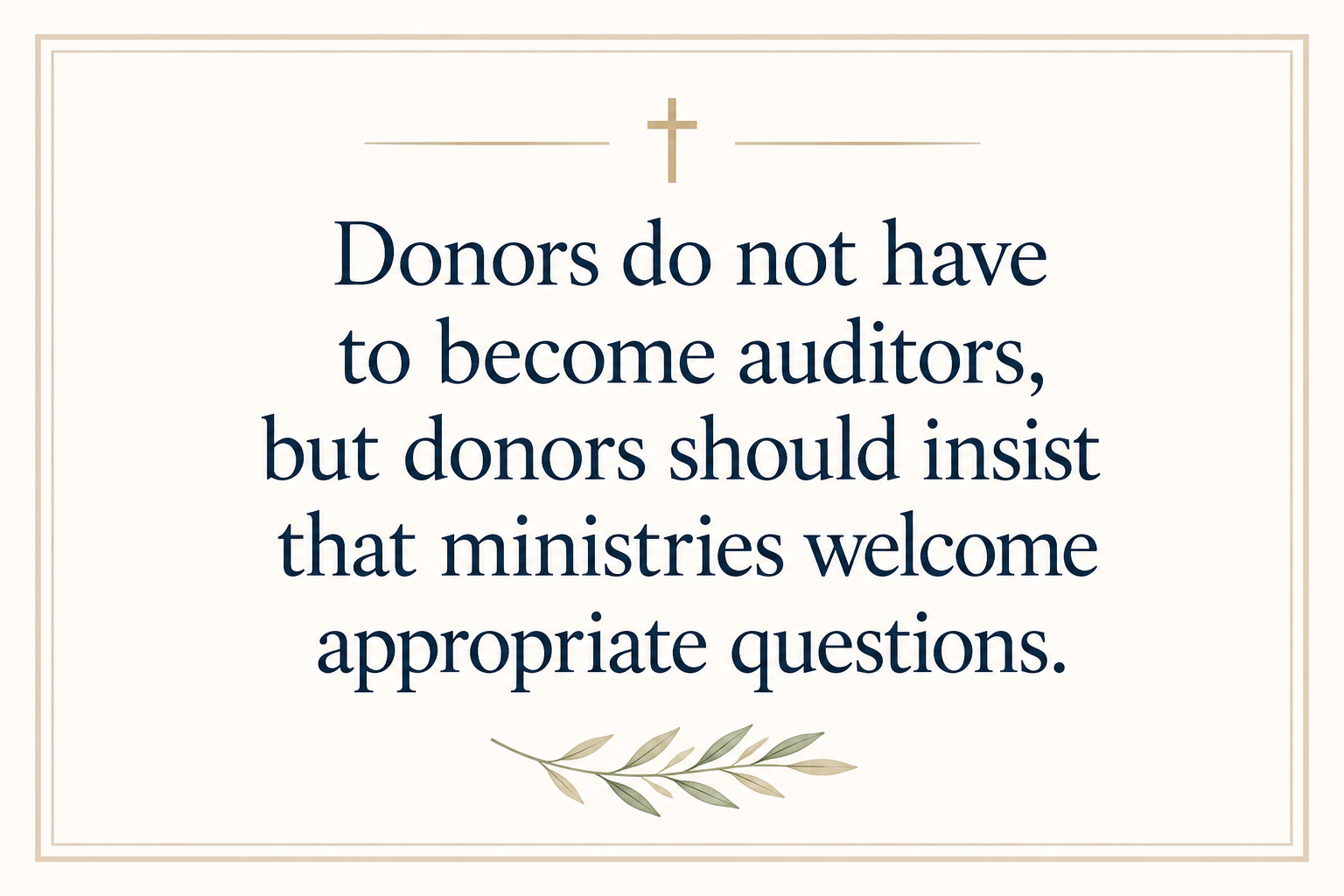
Across our verification work at Most Trusted, the ministries that meet The Most Trusted Standard tend to share several patterns: transparent financial reporting, governing boards that function as real oversight rather than ceremonial support, and clear articulation of what the ministry does and what it does not do. Donors do not have to become auditors, but donors should insist that ministries welcome appropriate questions.
For readers evaluating organizations in this space, it can be helpful to review the broader field of Bible Distribution Ministries with a focus on clarity of mission, integrity in reporting, and evidence of durable local partnerships.
Execute the stock donation with clarity and documentation
What to ask for and what to provide
The mechanics are usually straightforward once the ministry confirms readiness. In most cases, the donor initiates a transfer through a brokerage account using the ministry’s DTC information and account details. The ministry then issues a receipt for the gift.
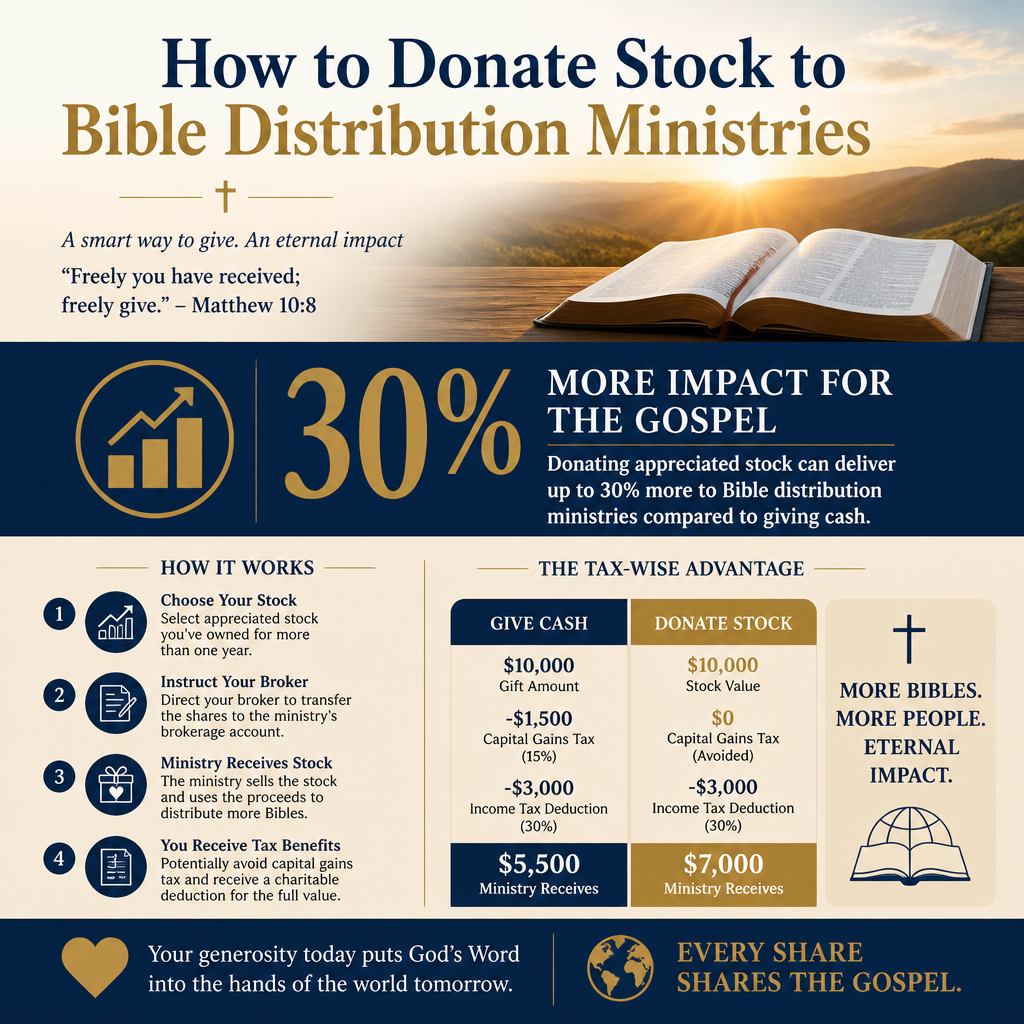
A few details prevent most problems:
- Confirm the legal name and tax status of the receiving entity, especially if the ministry has related organizations.
- Ask for written stock transfer instructions and a contact person who will confirm receipt.
- Provide the ministry with the name of the security, number of shares, and the expected transfer date.
- Include donor identifying information with the transfer when possible, so the gift is not anonymous by accident.
- Request acknowledgement that includes the date received and number of shares, consistent with IRS requirements for substantiation.
Receipting and appraisal considerations
For publicly traded securities, donors typically do not need a qualified appraisal, but they do need reliable documentation. The IRS describes substantiation expectations for charitable contributions, including non-cash gifts, in Publication 561. Donors should also consult their tax advisor about Form 8283 for non-cash charitable contributions when applicable, especially for larger gifts.
Ministries should not provide a dollar valuation for donated stock on the receipt. Their role is to acknowledge what was received. Donors and their advisors determine fair market value for tax reporting. This division of responsibility protects both donor and ministry from inappropriate valuation practices.
Discern whether the ministry’s Bible distribution model is spiritually sound and practically responsible
Distribution is not the same as discipleship, but it is connected
Christians genuinely disagree about emphasis: some prioritize wide distribution to maximize access, while others stress slower, church-anchored approaches tied to literacy, pastoral training, and long-term discipleship. The New Testament does not offer a modern “program model,” but it does bind proclamation and formation together. Scripture distribution that is severed from the life of the church can drift toward counting outputs without nourishing congregations.
Mature donors should ask: How does this ministry partner with local churches? How are translations chosen and vetted? What safeguards exist against creating black markets for subsidized Bibles? How does the ministry handle government restrictions and security concerns without exaggerating risk for fundraising purposes?
Evidence, metrics, and the limits of what can be measured
Bible distribution ministries often report Bibles printed, shipped, or distributed. These are not meaningless metrics; they reflect real costs and logistics. But they are not the same as Scripture read, understood, and embraced. Donors should look for ministries that pair distribution data with credible accounts of local engagement: literacy initiatives, church training, follow-up mechanisms, and independent evaluations where feasible.
In philanthropy more broadly, the field has corrected some simplistic assumptions about evaluating nonprofits. The “Overhead Myth” letter—signed by leading charity evaluators—warned donors against treating low overhead as a proxy for effectiveness, arguing instead for attention to outcomes, transparency, and context. The original signatories and their statement are maintained by BBB Wise Giving Alliance at give.org.
What this means in practice is that donors should not demand unrealistically low administrative costs from Bible distribution ministries that must manage shipping, compliance, translation work, and secure in-country distribution networks. The question is whether those costs are governed well, reported honestly, and directed toward clear ministry ends.
Choose the right giving vehicle and align it with your broader generosity plan
Direct stock gifts, donor-advised funds, and complex assets
Many donors give stock directly to a ministry. Others contribute appreciated securities to a donor-advised fund, then recommend grants to ministries over time. A DAF can be useful when a donor wants to bunch charitable contributions in a single year or when a ministry cannot accept stock directly. Fidelity Charitable’s explainer provides a clear overview of how DAFs handle appreciated assets at fidelitycharitable.org.
There are also more complex cases: closely held business interests, restricted stock, or stock options. These can be valuable, but they require specialized counsel and a ministry with the legal and financial capacity to accept them. A sober rule is to assume complexity is a cost. If the ministry is not equipped, a DAF or community foundation may be a better intermediary.
Integrating verification into decision-making
Donors who care about Scripture distribution often feel the weight of competing needs: local church support, missions, mercy ministries, and Christian education. Stock gifts can increase capacity, but discernment remains necessary. Our counsel is to make verification a normal step, not an emergency step after controversy breaks.
Most Trusted exists to help donors give with confidence by evaluating Christian nonprofits against The Most Trusted Standard, a 15-criteria framework addressing faith foundation, financial integrity, governance and leadership, and transparency and effectiveness. Donors considering major gifts to Bible distribution should expect ministries to welcome these categories of inquiry rather than treating them as suspicion.
For donors who want to compare ministries and giving approaches within a broader set of options, Sponsorship and Giving Programs for Bible Distribution is a helpful reference point for how organizations structure support and how donors can ask consistent, fair questions across different models.
FAQs for How to donate stock to Bible distribution ministries
Do Bible distribution ministries typically sell donated stock right away?
Many do, because ministries generally need cash for printing, shipping, translation work, and in-country partnerships, and because holding stock exposes the ministry to market volatility that is not part of its mission. Donors should ask the ministry’s policy directly. A clear, written practice and timely receipting are signs of basic administrative competence.
Can we restrict a stock gift to a specific country or Bible project?
Sometimes, but restrictions should be approached carefully. A ministry may accept a restricted gift if it fits operational realities and if the restriction is written clearly enough to be administered and audited. Overly narrow restrictions can force inefficient spending or leave funds stranded when conditions change. Many mature donors specify a program area while allowing reasonable discretion if circumstances require adjustment.
A closing word on stock gifts and Christian stewardship
Stock donations can be an unusually fitting expression of Christian stewardship: a quiet, orderly transfer of value from private accumulation to public gospel work. The discipline is to treat the gift as more than a transaction. Donors honor Christ when they give in a way that is wise, verifiable, and attentive to whether a ministry’s Bible distribution efforts are strengthening the church and serving the neighbor with integrity.



