

How Bible distribution ministries handle family sponsorship gifts is not a peripheral administrative question. It is a stewardship question that touches truth-in-communication, donor intent, and the spiritual formation of givers and recipients alike. Mature Christian donors sense the stakes: a sponsorship model can dignify families and extend Scripture, or it can unintentionally encourage dependency, distort local priorities, or communicate more certainty than a program can responsibly deliver.
The New Testament treats financial integrity as part of Christian witness, not merely good management. Paul insisted on careful handling of gifts so that no one could blame the ministry for misuse, sending companions so the offering would be administered honorably “in the sight of the Lord and also in the sight of man” (2 Corinthians 8:20–21). Family sponsorship structures succeed when they embody that same posture: clear promises, disciplined accounting, and verifiable outcomes.
What family sponsorship means in Bible distribution
Different models, similar donor expectations
In Bible distribution, “family sponsorship” is often a donor-facing frame rather than a single technical model. Some ministries designate gifts to equip a household with Scriptures and related discipleship resources. Others connect sponsors to a cohort in a church-planting or literacy initiative where families receive Bibles as part of a broader program. Still others use “sponsorship” language for general support that is then allocated across a region.
These differences matter because donors attach moral weight to sponsorship claims. A sponsor commonly assumes a defined relationship, a predictable flow of support, and updates that correspond to a real family’s experience. When a ministry uses sponsorship language while pooling funds, or when distribution realities prevent individualized reporting, the ethical burden shifts to disclosure. Christians may still choose to give, but they should not be asked to do so under an implied promise the ministry cannot fulfill.
The donor intent question is theological as well as legal
Many donors think about designated giving primarily in legal terms: restricted versus unrestricted gifts, enforceable intent, and accounting categories. Those issues are real. But Christian donors also tend to think covenantally: if a ministry invites a sponsor to support “a family,” the ministry has made a moral claim about how the gift will function. Scripture’s condemnation of false weights and measures applies by analogy to communications that create an impression of precision where there is none (Proverbs 11:1).
In our verification work at Most Trusted, we find that the healthiest programs begin by disciplining their language. They define what sponsorship does and does not mean, what is guaranteed and what is aspirational, and what a sponsor should expect in a typical year when conditions are stable and when they are not.

How gifts are received, restricted, and accounted for
Restricted funds require strong internal controls
A family sponsorship gift can be treated as restricted when the ministry has promised to use the funds for a specific purpose (for example, “Scriptures for the sponsored household and follow-up discipleship materials”). That choice carries operational consequences: separate tracking, documented approvals, and clear policies for exceptions. When restrictions are real, they must be honored even when program realities change.
One common tension is that sponsorship revenue is often monthly, while Bible printing, shipping, and in-country distribution costs are lumpy and seasonal. Strong ministries address this directly: they maintain program reserves appropriate to the timing gap, and they document how sponsorship receipts are matched to distribution cycles. Donors do not need complexity hidden; they need it handled faithfully.
When ministries pool gifts, clarity must increase not decrease
Some Bible distribution settings make individualized allocation impractical or unsafe. Bibles may be distributed through partner churches in areas where public records could endanger recipients, or where families are mobile due to conflict or economic migration. In those contexts, pooling can be reasonable. The ethical requirement is that the ministry’s sponsorship messaging reflect the pooled reality.
Pooling is not automatically inferior. It can reduce administrative cost, protect privacy, and allow a ministry to respond when a shipment is delayed or a community needs more resources than expected. But pooled models must avoid donor-facing personalization that implies one-to-one tracking if the accounting and field practice do not support it.
How ministries deliver donor updates without misleading donors
Storytelling must be bounded by what is verifiable
Donors often value family updates because they want to pray with specificity, not because they demand an emotional experience. The best sponsorship programs understand this and treat reporting as a form of truth-telling. When a ministry provides letters, photos, or testimonies, it should be able to explain how those materials are collected, how consent is obtained, and how the ministry avoids staging or coercion.
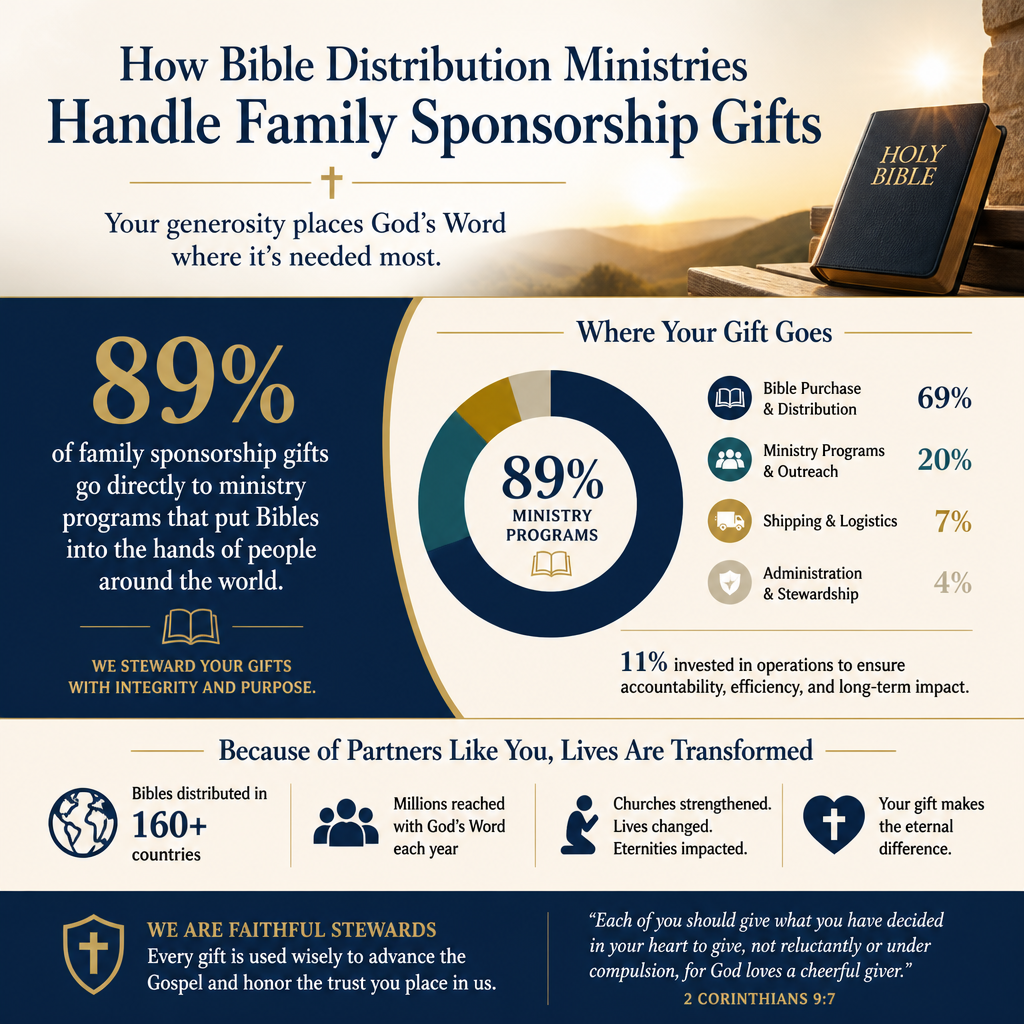
In sponsorship programs broadly, the temptation is to substitute a compelling narrative for measurable disclosure. The Christian donor community has learned, sometimes painfully, that compelling narratives can be curated in ways that do not reflect typical experience. Responsible ministries counter that drift by pairing stories with program-level reporting: how many households were served, what was distributed, what follow-up occurred, and what limitations constrained results.
Privacy and safeguarding shape what should be shared
When the recipients are vulnerable, “more transparency” is not always “more exposure.” A ministry may choose not to publish last names, precise locations, or identifiable photos. That can be a mark of maturity rather than evasion. Donors should expect clear safeguarding policies that explain how children are protected, how data is stored, and how partner churches are trained.
These safeguards also protect donors from participating in harm unintentionally. Many sophisticated givers now ask whether communications align with dignity: whether families are presented as image-bearers with agency, not as marketing objects. That expectation is consistent with the Christian doctrine of humanity and with the discipline of honest reporting.
Common pressure points in family sponsorship and how to evaluate them
The promise problem and the contingency problem
The hardest questions usually surface where certainty meets contingency. Bible distribution depends on printing schedules, customs clearance, in-country transport, security conditions, and partner reliability. Even in stable contexts, last-mile distribution is not a mechanical process. The ethical problem emerges when donor communications speak as if outcomes are guaranteed, rather than prudently intended.
Christians genuinely disagree about how much contingency language is appropriate. Some argue that donors will stop giving if complexity is named. Others contend that spiritual maturity can handle truthful uncertainty. Our view, consistent with The Most Trusted Standard, is that ministries should disclose material contingencies because it trains donors in wise stewardship rather than emotional certainty.
What careful donors can ask without becoming cynical
Donors do not need to interrogate every ministry as if it were guilty. But Scripture commends discernment, and the modern nonprofit environment requires it. When reviewing a family sponsorship program in Bible distribution, a short set of questions often clarifies whether a ministry is operating with integrity.
- Does the ministry define what “sponsorship” means in concrete terms, including what the gift funds and what it does not?
- Are gifts treated as restricted when the ministry promises restriction, and can the ministry explain how it tracks and honors those restrictions?
- What evidence does the ministry provide that Bibles reached the intended communities, and what independent checks exist through partners or audits?
- How does the ministry obtain consent for stories and photos, and how does it protect recipients’ privacy and safety?
- When disruptions occur, does the ministry communicate promptly, or does it continue sending idealized updates that assume best-case conditions?
These questions align with how many ministries are evaluated by foundations and watchdogs. They also align with the spirit of 2 Corinthians 8: to administer gifts in a way that is honorable before God and credible before people.
How Most Trusted assesses sponsorship programs under The Most Trusted Standard
What strong programs tend to show across documentation
Most Trusted exists to help Christian donors give with confidence by evaluating ministries against The Most Trusted Standard, a 15-criteria framework that tests faith commitments, financial integrity, governance practices, and transparency and effectiveness. Sponsorship programs are a proving ground because they put public claims, accounting practice, and field realities into direct contact.
Across our verification work, the ministries that meet The Most Trusted Standard tend to provide three kinds of evidence that can be reviewed without violating recipient privacy: financial documentation that shows how sponsorship revenue is categorized and spent; program documentation that describes distribution and follow-up; and communications policies that discipline fundraising promises and storytelling practices.
How to use verification without outsourcing spiritual responsibility
Verification is not a substitute for discipleship, but it can serve it. Donors remain responsible to give prayerfully, to examine their motives, and to pursue generosity that is both sacrificial and wise. Independent assessment can reduce information asymmetry and lower the likelihood that good intentions will fund weak governance or misleading communication.
For donors comparing Bible distribution efforts in particular, it is often helpful to start with the larger landscape of Bible Distribution Ministries and then focus on programs that explicitly address the complexities of sponsorship. In the sponsorship-specific space, the most relevant comparisons typically sit within Sponsorship and Giving Programs for Bible Distribution, where program claims can be weighed against the kind of documentation sophisticated donors expect.
FAQs for How Bible distribution ministries handle family sponsorship gifts
Does sponsoring a family mean our gift always goes to one specific household?
Not always. Some ministries allocate gifts one-to-one and can document that linkage. Others pool sponsorship revenue to fund a defined program serving many families, especially when privacy or field conditions make individualized tracking unwise. The stewardship issue is not pooling itself; it is whether the ministry clearly discloses the model and then accounts for the gift in a way that matches what was promised.
What should we expect in reporting from a responsible Bible sponsorship program?
Responsible reporting is specific without being exploitative. Donors should expect clear statements about what was distributed, when and where distribution occurred at the appropriate level of detail, and what follow-up discipleship or engagement took place. Donors should also expect transparency about disruptions and constraints, as well as safeguarding practices that protect recipients’ dignity and safety even if that limits individualized updates.
Faithful sponsorship is measured by truthfulness as much as generosity
Family sponsorship in Bible distribution can be a means of real spiritual good: households receiving Scripture, churches strengthened, and discipleship deepened. But those goods are served by candor, not by emotional certainty. When ministries discipline their promises, account for gifts as promised, and report with verifiable integrity, donors are free to give with clear conscience and durable confidence.



