

How Bible distribution ministries communicate with donors is not a peripheral question. It is part of their moral formation and ours, because the way we ask for and give money either clarifies the gospel or quietly distorts it.
Christian donors are often pulled between two pressures: the legitimate urgency of Scripture access, and the equally legitimate concern that communications can become marketing rather than truth-telling. The tension is real. A ministry can be deeply faithful and still communicate poorly; it can also communicate beautifully while obscuring weak governance, unclear outcomes, or practices that should be corrected.
Donor communication is a theological act before it is a fundraising tactic
Bible distribution is rooted in a clear biblical logic: God reveals himself by his Word, and the church is sent to teach all nations. The Great Commission includes “teaching them to observe all that I have commanded you” (Matthew 28:20), which makes Scripture access and Scripture teaching inseparable. When a ministry speaks to donors about that calling, the tone should carry the weight of the task.
The most mature ministries treat donor communication as part of discipleship: truthful, humble, and ordered toward love of God and neighbor. This does not mean they avoid urgency. It means they refuse manipulation, because God does not need falsehood to fund his work.
What faithful urgency sounds like
Faithful urgency is specific. It names a real need, a real plan, and real constraints. It does not treat “Bibles” as a generic unit detached from language, literacy, distribution channels, or church partnerships. It also does not imply that a single gift “changes everything” without explaining what changes, for whom, and through what means.
What manipulation tends to sound like
Manipulative communication often relies on spiritualized pressure: insinuations that hesitation is disobedience, or that donors bear personal responsibility for an entire unreached people group. Christians genuinely disagree about fundraising tone, but Scripture is clear that “we have renounced disgraceful, underhanded ways” and refuse “to tamper with God’s word” (2 Corinthians 4:2). When the message slides into coercion, the problem is not merely aesthetic.

Trust is built through verifiable clarity, not inspirational volume
Many donors have learned, sometimes through painful experience, that compelling stories are not the same as credible reporting. The mature question is not whether a ministry can move the heart; it is whether it can withstand scrutiny. That is where independent verification becomes relevant. Most Trusted exists to help donors give with confidence by evaluating ministries against The Most Trusted Standard, a 15-criteria framework spanning faith commitments, financial integrity, governance, and transparency about results.
The ministries that communicate well do not treat scrutiny as hostility. They treat it as accountability before God and neighbor.
Clarity about what is being funded
In Bible distribution, donors often think they are funding printed Bibles, when the ministry is actually funding a chain of work: translation or licensing, printing, shipping, customs brokerage, warehousing, last-mile delivery, and sometimes training local partners. Clear communications say what portion of donor giving supports which parts of that chain, and why those costs exist.
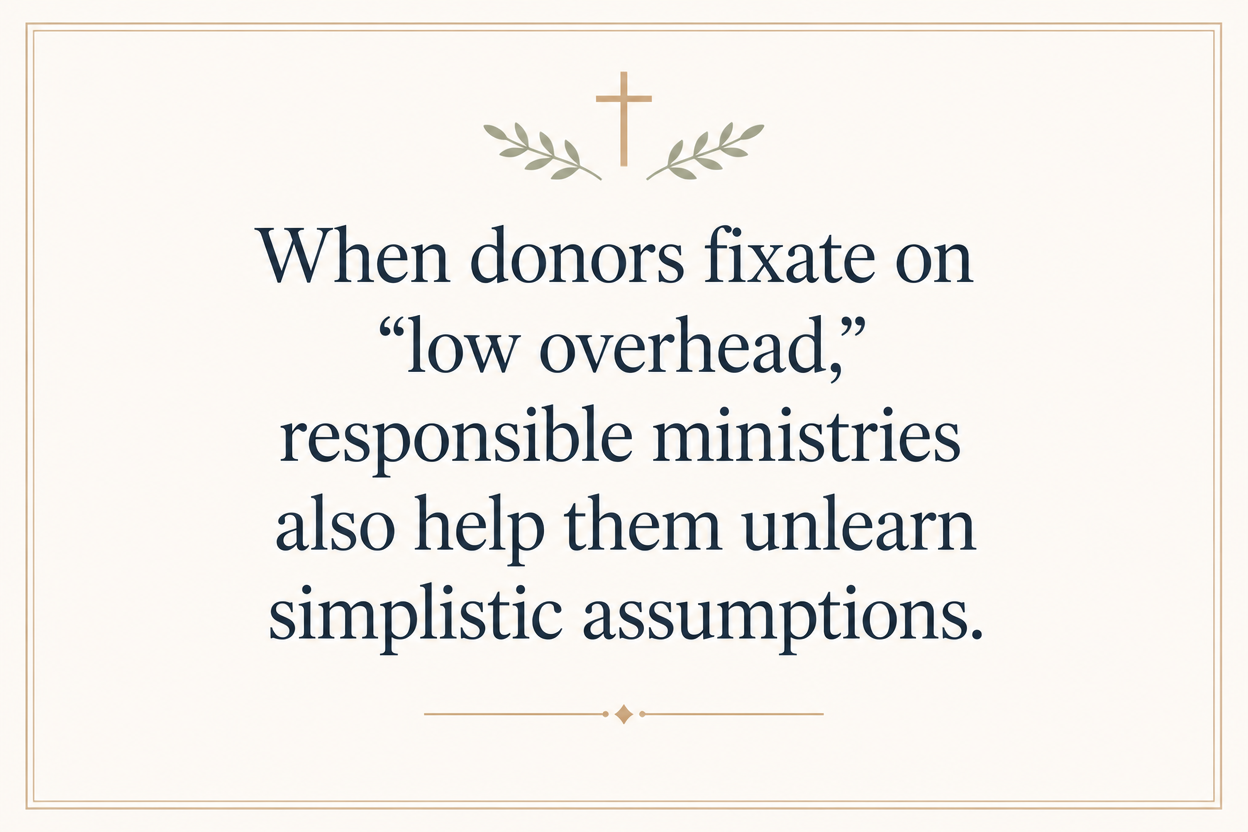
When donors fixate on “low overhead,” responsible ministries also help them unlearn simplistic assumptions. The Overhead Myth statement, signed by Charity Navigator, GuideStar (now Candid), and the BBB Wise Giving Alliance, argued that overhead ratios are a poor proxy for effectiveness and can even create perverse incentives to underinvest in governance and evaluation Candid.
Clarity about what is not being claimed
Healthy donor communications are willing to say, “We do not know yet,” or “We cannot measure that directly.” That restraint is a mark of maturity. Scripture does not require ministries to pretend omniscience. It requires them to speak truthfully. Overpromising may increase short-term revenue, but it corrodes credibility and, eventually, the ministry’s ability to serve.
Numbers can serve truth, but they must be the right numbers
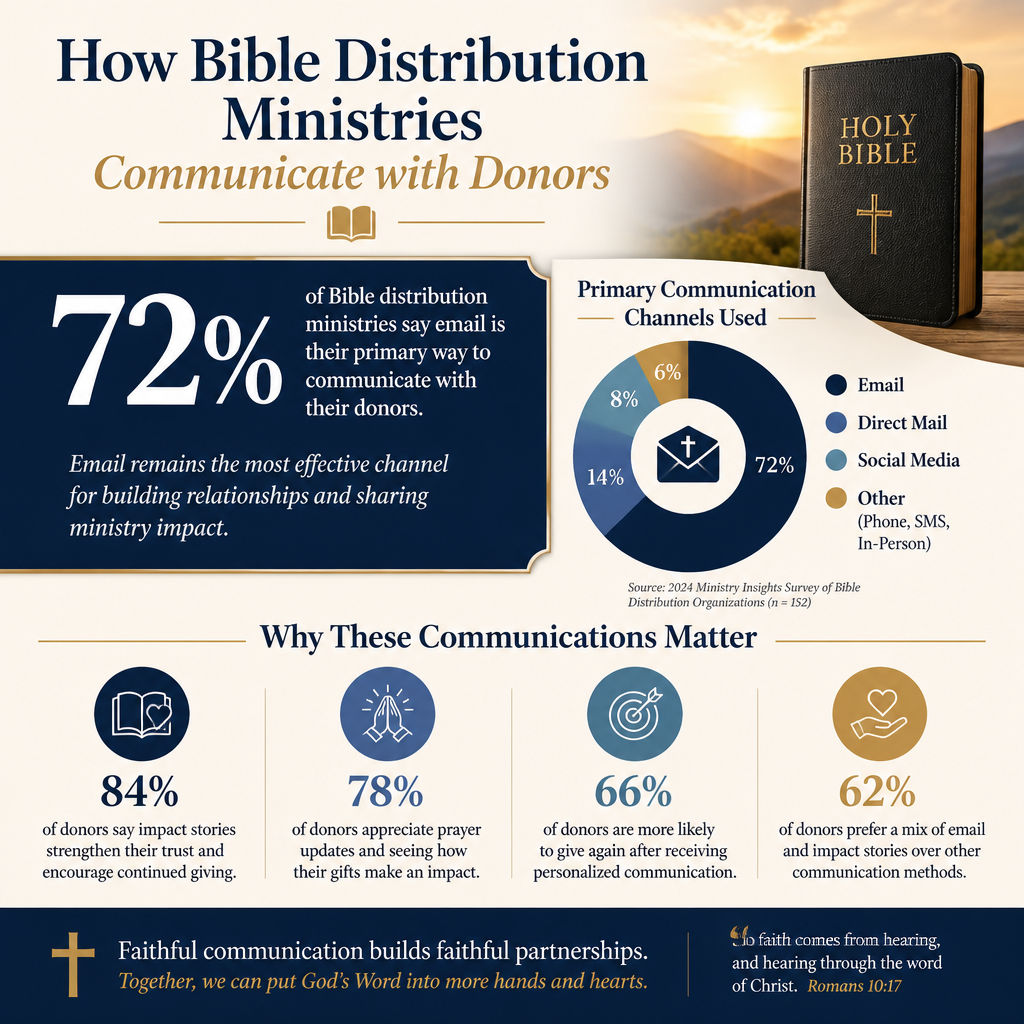
Bible distribution lends itself to clean metrics: Bibles printed, shipped, delivered, and sometimes “placed.” Those numbers matter, but they do not automatically describe spiritual fruit. The deeper question is whether the numbers represent genuine access and faithful use, and whether the ministry communicates the difference.
Output reporting that is honest about limitations
A responsible ministry can report outputs while acknowledging what outputs cannot prove. “Bibles distributed” does not automatically mean “Bibles read,” and “Bibles read” does not automatically mean “disciples formed.” Mature donor communication can celebrate the good without claiming what only God can see.
At the same time, the scale of global Bible access is not imaginary. The most credible communications sometimes draw on widely recognized sector reporting, such as the United Bible Societies’ annual Scripture Distribution Report, which documents global distribution totals across translations, formats, and regions United Bible Societies. When a ministry cites sector-level context like this, it should distinguish clearly between the sector’s totals and its own contribution.
Outcome reporting that respects the church
Outcome reporting is most credible when it is anchored in local partnerships: pastors, congregations, and indigenous Christian leaders. Ministries that communicate well avoid centering the donor or the foreign distributor as the main agent of change. They describe how the Word is received within the life of the local church, and what safeguards exist to prevent dependency or distortion.
- Define the metric precisely: delivered, placed, or distributed through a verified partner.
- Separate outputs from outcomes and outcomes from spiritual fruit.
- Explain data collection: partner reports, spot checks, audits, or third-party validation.
- Publish constraints: access restrictions, security risks, or verification limits.
- Correct past overstatements publicly when discovered.
Donors should expect transparency about methods, not only about need
Because Scripture distribution intersects with politics, security, and local religious dynamics, communications can become evasive for understandable reasons. Some ministries cannot publish names, locations, or photos without endangering believers. Sophisticated donors can honor that reality while still insisting on transparency that is appropriate to risk.
What this means in practice is that ministries should explain their risk posture and confidentiality boundaries, then provide other forms of evidence: governance documentation, audited financials, independent board oversight, and anonymized reporting that still permits evaluation.
Handling restricted-access contexts with integrity
When communications reference closed countries or persecuted believers, donors should listen for two kinds of sobriety. First, restraint about operational details. Second, restraint about heroic narratives. The persecuted church is not a marketing asset. Ministries that treat it that way may still distribute Bibles, but they risk instrumentalizing suffering.
Good communication distinguishes between “we cannot share” and “we will not share.” The former can be an act of protection; the latter can be avoidance. Verification work often turns on that distinction.
Where Most Trusted’s work commonly focuses
Across our verification work, we often find that donor communication problems are not mainly about intent; they are about controllership. Boards may not review messaging claims. Finance teams may not reconcile restricted gifts with what appeals promised. Program teams may not be asked to define measurable outcomes. These are governance and leadership questions as much as communications questions.
Donors exploring Bible distribution work in depth may benefit from the broader landscape of Bible Distribution Ministries, where patterns of practice, accountability expectations, and common failure points become easier to recognize over time.
Healthy communication invites partnership, not a transaction
Many donor communications implicitly treat giving as a purchase: a donor buys Bibles, the ministry delivers them, and the donor receives a receipt and a story. Christian giving is not less than stewardship, but it is more than a transaction. It is fellowship in the gospel (Philippians 1:5), and it binds the giver to the spiritual health of the work supported.
That partnership frame changes how ministries speak. It shifts communication away from constant acquisition pressure and toward honest reporting, prayerful dependence, and durable relationship.
What durable donor care often includes
Durable donor care does not mean constant contact. It means consistent, intelligible reporting; a willingness to answer hard questions; and a respect for the donor’s conscience. It also means acknowledging that Christian donors may want to support multiple parts of the Scripture-access ecosystem: translation, distribution, literacy, pastoral training, and local church strengthening.
For donors comparing approaches within giving programs, the broader context of Sponsorship and Giving Programs for Bible Distribution can clarify how different funding models shape communications, incentives, and accountability pressures.
The harder question donors should ask
The harder question is not “Did my gift do something?” It is “Is this ministry the kind of institution we can entrust with influence, resources, and spiritual credibility?” That question includes financial integrity and outcomes, but also truthfulness, humility, and governance that can withstand growth and stress.
FAQs for How Bible distribution ministries communicate with donors
What should donors expect a Bible distribution ministry to publish publicly?
At minimum, donors should expect clear doctrine and mission, current leadership and board information, recent audited financial statements when feasible for the organization’s size, an understandable description of programs and methods, and reporting that distinguishes outputs from outcomes. In higher-risk contexts, operational specifics may be limited, but governance and financial transparency should not disappear.
How can donors discern whether a ministry’s stories are representative or exceptional?
Donors can ask whether the ministry reports patterns alongside stories: how many partners were served, what proportion of shipments were verified as delivered, what follow-up exists through local churches, and what limitations exist in verification. Stories that are supported by consistent reporting and modest claims tend to be more trustworthy than stories that carry sweeping promises without data, definitions, or accountability.
A mature standard for donor communication
Bible distribution ministries serve a holy purpose, but holiness does not exempt them from ordinary standards of truthfulness and accountability. The ministries that communicate well treat donors as fellow stewards, not as an audience to be managed. They speak with theological seriousness, publish what can be verified, acknowledge what cannot, and submit their claims to scrutiny. That posture does not weaken the work. It strengthens it, because it aligns the ministry’s public words with the integrity Scripture requires.



