
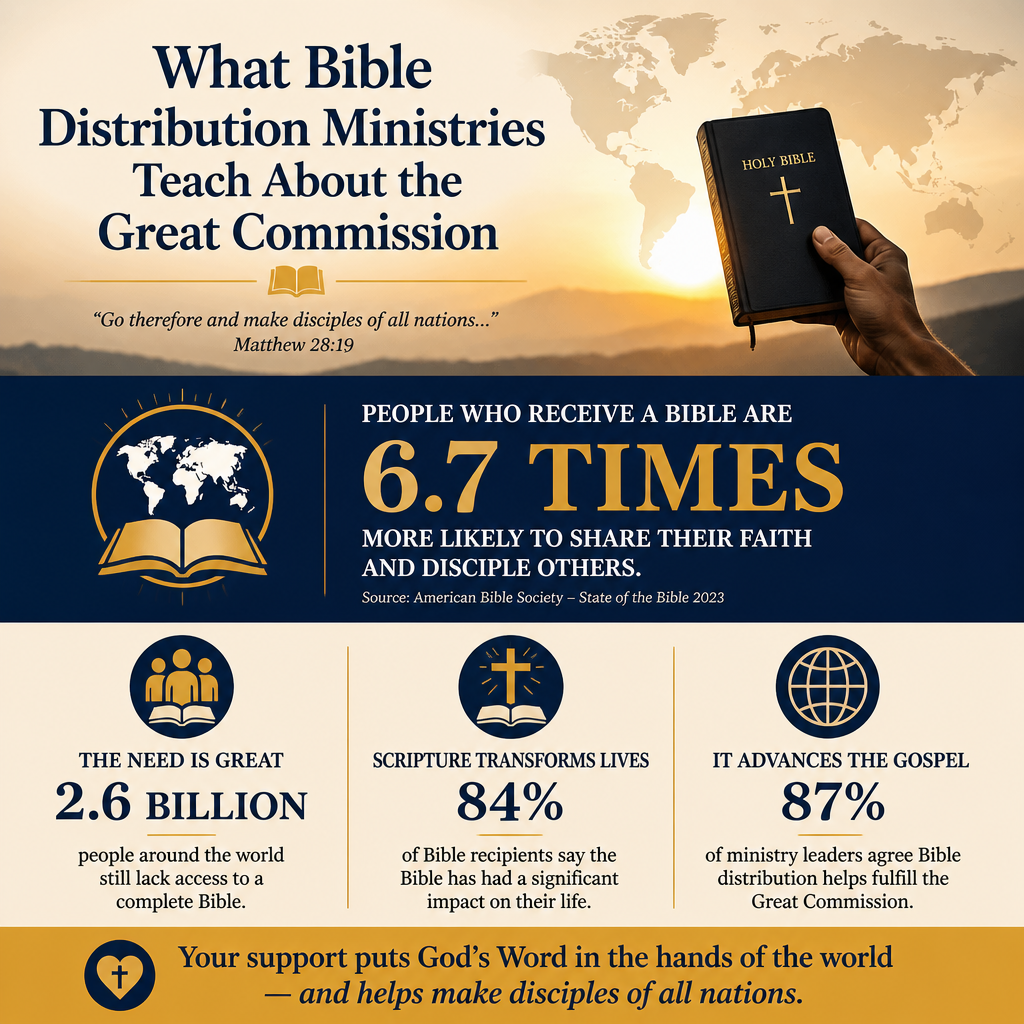
What Bible distribution ministries teach about the Great Commission is that Christian mission is not sustained by sentiment, but by the ordinary means God has ordained: the Word read, heard, and believed. Bible distribution ministries exist because the Great Commission is not merely a command to go, but a command to teach—and teaching requires words that can be understood, trusted, and carried into daily life.
For Christian donors, this ministry category raises unusually practical questions. A printed Bible can be counted, photographed, shipped, and reported. Yet the Great Commission is not fulfilled by logistics. The harder question is whether distribution serves discipleship, whether translation choices preserve doctrinal fidelity, and whether the ministry’s claims about “impact” correspond to verifiable realities on the ground.
The Great Commission is a teaching mandate before it is a distribution project
Teach them to observe implies sustained formation
Matthew 28:18–20 does not command the church to export religious artifacts; it commands the church to make disciples, baptize, and teach obedience to Christ. The Scriptures are not optional to that work. In the history of missions, durable movements of conversion and church formation have been anchored in accessible Scripture in the heart language of the people.
This is where Bible distribution ministries, at their best, clarify donor imagination. Distribution is not an end in itself; it is a means that serves proclamation, catechesis, worship, and spiritual formation. When the Bible is placed into a community without the church’s ongoing teaching, the result can be either a fragile faith or a syncretistic one. Christians genuinely disagree about how much infrastructure should accompany distribution, but the Great Commission itself presses toward long-term teaching rather than one-time delivery.
The Word’s authority shapes the ethics of the work
Bible distribution also teaches that the church’s confidence rests not in the messenger’s charisma but in God’s Word and Spirit. That confidence should create humility in how claims are made. Ministries that present Scripture as a talisman—“a Bible in every hand will change everything”—risk implying that the Great Commission is a mechanical formula. The biblical witness is more sober: some seed falls on rocky ground; some is choked; some bears fruit (Mark 4:1–20).
Donors should therefore expect a theology of the Word that is strong enough to support patient work. When reporting focuses only on the number of units shipped, the ministry may unintentionally train donors to think of mission as output rather than obedience. The ministries most worth supporting are typically those that can speak clearly about how distribution connects to local discipleship and church health, not merely to volume.
Translation and trust are central to discipleship
Language is not a technical detail
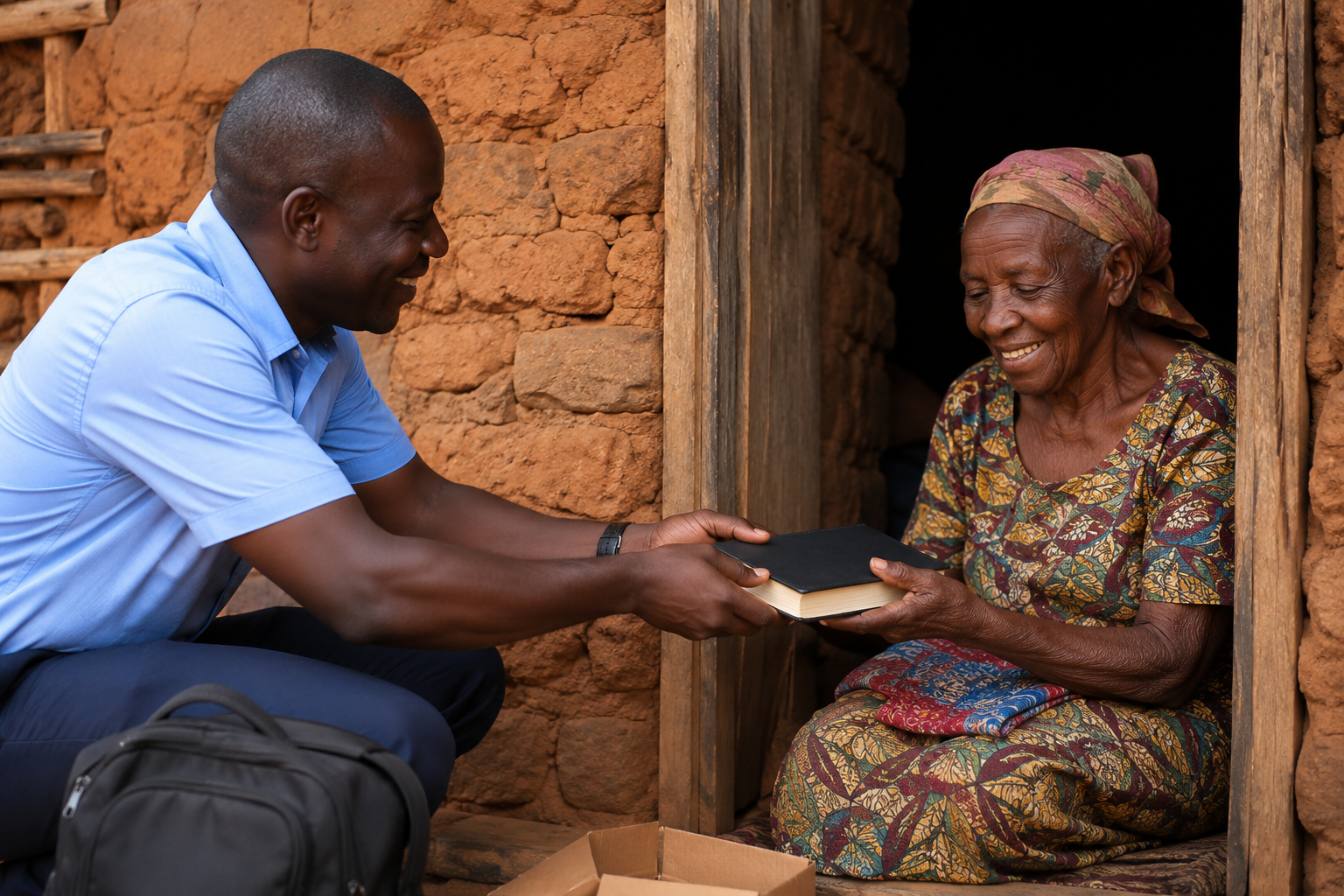
In Acts 2, the gospel is heard in the languages of the people. That is not a sentimental moment; it is a theological claim about accessibility. Translating Scripture is part of honoring the image of God in every people group, and it is also a safeguard against cultural gatekeeping. The modern translation movement is vast, and it includes careful scholarship, local language development, and ongoing revision as languages change.
At the same time, translation is contested terrain. Different philosophies of translation—more formally equivalent, more dynamically equivalent, or mediating approaches—produce different kinds of clarity and different risks. Some donor conversations presume that “more translation” is always better, but mature support asks additional questions: Who is doing the work? What doctrinal commitments govern the translation? What is the relationship between the translation team and local churches? How are disputes adjudicated?
Distribution can strengthen or weaken ecclesial trust
Bible distribution ministries also sit near sensitive questions of authority. In some contexts, rapid distribution outside existing church structures can be interpreted as foreign control, undermining local leadership. In other contexts, distribution through compromised gatekeepers can restrict access for the very people the ministry intends to serve.
For donors, prudence is not cynicism. It is stewardship. The Great Commission creates obligations not only to go, but to go in a way that builds up the church rather than bypassing it. When donors evaluate ministries, it is appropriate to ask how distribution decisions are made, how partnerships are structured, and whether the ministry can demonstrate that local Christian leaders have meaningful voice.
Access is more than supply chains and it is not always legal
Persecution dynamics shape what can be reported
Many Bible distribution ministries serve believers in restricted environments where Bible possession can carry real risk. That reality complicates donor expectations about transparency. Christians should not demand operational details that would endanger partners, but neither should donors accept vague reporting as a permanent substitute for accountability.
There is also a moral difference between discretion and opacity. The Great Commission never authorizes deception for fundraising. Mature ministries can usually explain, without endangering anyone, what safeguards govern their security practices, how they vet partners, and how they confirm that resources reach intended recipients. They can also communicate how they respond when distribution patterns change due to arrests, border closures, or internal conflict.
Digital access is real access but it is not universal
Some donors assume digital Scripture has resolved access. In many places, it has expanded access dramatically. Yet the global picture is uneven, and digital availability does not negate the need for print or audio. Mobile connectivity can be intermittent, devices can be shared, and surveillance can make digital use risky.
What this means in practice is that donors should resist simplistic either-or thinking. Print, audio, and digital distribution each have contexts where they are wise and contexts where they can be counterproductive. The most credible ministries tend to speak with this kind of nuance, because they are driven by pastoral realities rather than by the need to market a single method.
Numbers matter but they are not the same as fruit
The temptation to equate scale with obedience
Bible distribution ministries often report large numbers, and scale can be genuinely meaningful. Yet numbers easily become a surrogate for spiritual categories that cannot be measured cleanly: repentance, perseverance, the formation of elders, the long obedience of ordinary saints. Donors are not wrong to ask for metrics; stewardship requires it. But donors should ask for the right kind of metrics.
Across our verification work at Most Trusted, we observe that ministries under pressure to demonstrate “growth” can drift toward reporting that is impressive but not decision-useful. A donor can responsibly ask how a ministry distinguishes between Bibles shipped, Bibles delivered, Bibles received by intended recipients, and Bibles actually used in contexts of teaching and worship.
What responsible reporting tends to include
In this category, donor clarity often improves when ministries report multiple layers of evidence rather than a single headline number. A short list of indicators that tends to be more meaningful includes:
- Clear definitions for reported counts such as “distributed,” “placed,” and “delivered”
- Partner due diligence processes, including training and accountability expectations
- Evidence of local church integration, such as use in small groups, literacy classes, or discipleship pathways
- Mechanisms for verifying delivery without endangering recipients in restricted contexts
- Feedback loops showing how field realities shape future translation or distribution decisions
The donor’s goal is not to demand laboratory-grade proof of spiritual outcomes. The goal is to discern whether the ministry’s reporting reflects truthfulness, operational competence, and an understanding of the Great Commission that is larger than throughput.
Donor stewardship requires theological clarity and verifiable accountability
The Great Commission shapes what donors should ask
Serious donors tend to ask two questions at once: Is this faithful, and is this trustworthy? Bible distribution ministries are particularly exposed on both fronts because they operate in contested theological and geopolitical environments, while also handling donor funds that can be substantial.
That is why verification matters. Most Trusted exists to help donors give with confidence by evaluating Christian nonprofits against The Most Trusted Standard, a 15-criteria framework spanning Faith Foundation, Financial Integrity, Governance and Leadership, and Transparency and Effectiveness. In practice, the ministries that meet The Most Trusted Standard tend to show doctrinal seriousness without sectarian manipulation, and operational transparency without theatrical reporting.
Where to situate Bible distribution within the larger category
Many donors support Bible distribution alongside related work: evangelism, church planting, leadership development, and support for the persecuted church. The best giving strategies often treat distribution as one essential component within a broader discipleship ecosystem rather than as a stand-alone intervention. For donors seeking a wider view of this ministry field, we maintain an editorially grounded overview of Bible Distribution Ministries that situates common models, risks, and indicators of health.
For donors who are actively discerning how to pray and give, the practical considerations extend beyond choosing a ministry. They include expectations for reporting, security, partnership, and long-term formation. Those themes are developed further in Praying for and Supporting Bible Distribution Ministries, where donor questions tend to converge across traditions.
FAQs for What Bible distribution ministries teach about the Great Commission
Is giving to Bible distribution enough to fulfill our Great Commission responsibility?
Giving can be a real participation in the Great Commission, but Scripture frames the commission as disciple-making through baptizing and teaching (Matthew 28:18–20). Bible distribution serves that calling most faithfully when it is connected to local proclamation and ongoing formation rather than treated as a substitute for the church’s teaching ministry.
How can donors evaluate impact without demanding unsafe details from ministries in restricted contexts?
Donors can ask for accountability that does not expose partners: clear definitions of reported numbers, descriptions of partner vetting and training, governance safeguards, and examples of how the ministry verifies delivery and corrects problems. Healthy ministries can usually provide meaningful evidence of responsible operations while appropriately withholding identifying details that would endanger recipients.
A Great Commission view of Bible distribution is measured, not mechanistic
Bible distribution ministries remind the church that the Great Commission is anchored in teaching and in God’s choice to work through his Word. That conviction should produce urgency without triumphalism, and generosity without naivete. Donors serve this work well when support is joined to questions that honor both theological fidelity and practical accountability, so that distribution strengthens the church and deepens discipleship rather than merely increasing numbers.



