

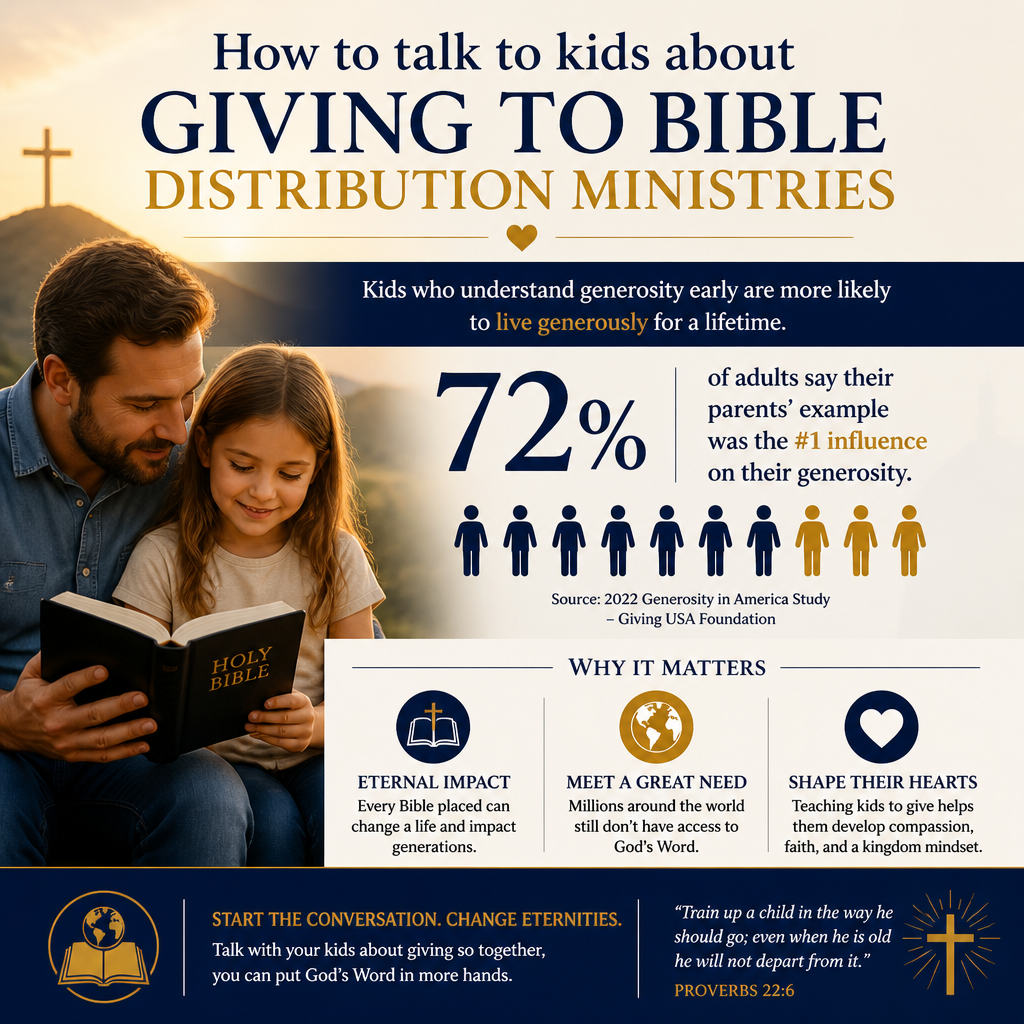
How to talk to kids about giving to Bible distribution ministries is not primarily a question of fundraising technique. It is a discipleship question: whether our children will learn to love God’s Word, to recognize spiritual poverty as real poverty, and to practice generosity as an act of worship rather than self-expression. The church has long treated Bible access as essential to Christian maturity because Scripture is not an accessory to faith; it is one of the ordinary means by which God forms his people (2 Timothy 3:16–17).
Parents and grandparents who give thoughtfully often feel a second burden when the topic turns to children. The burden is not only how to inspire compassion, but how to do it without sentimentality, guilt, or a simplistic “we have plenty, they have nothing” narrative that can distort both global need and Christian stewardship. Bible distribution work is also complex: it ranges from translation for minority language communities to logistics and security in restricted contexts, and Christians genuinely disagree about how to weigh speed, local church partnership, and risk.
Begin with Scripture as formation rather than a project
Teach that the Bible is a gift before it is a cause
Children can quickly learn that “giving” is something we do for other people, while Scripture is something that belongs to our private spirituality. Bible distribution ministries correct that division. The first step is to form reverence: God speaks, and his people live. When we teach children why we read the Bible at home and in church, we also create the moral imagination for why other families should have Scripture in their language.
We can be concrete without being sensational. For younger children, a simple statement is often sufficient: “Some churches do not have Bibles in the language people understand, so Christians work to translate and share them.” For older children, we can add the theological point: Scripture is not merely information; it is how God trains and corrects, comforts and warns, and centers the church on Christ (Psalm 119:105).
Resist manipulation and preserve moral clarity
Children should not be asked to carry adult emotional weight. Graphic stories, exaggerated danger, or guilt-based appeals can produce short-term compliance and long-term cynicism. The aim is not to make children anxious about the world but to make them steady in love. Christians give because God first gave to us, and because generosity is one ordinary fruit of the Spirit formed over time (2 Corinthians 9:7).
The moral clarity is real, though. If we treat Bible access as optional, children learn that spiritual formation is optional. If we treat it as a sacred priority, they learn that the Kingdom of God has claims on our money, attention, and prayers.

Explain what Bible distribution ministries actually do
Translate, print, and deliver in partnership with the local church
Many adults speak about Bible distribution as if it is a single activity: “getting Bibles to people.” Children benefit from understanding that the work often includes multiple stages, each with costs and ethical implications. Translation may take years and requires trained linguists working with mother-tongue speakers and local church leaders. Printing and digital publishing require quality control and durability decisions. Distribution often requires relationships with churches, pastors, and networks that can disciple new readers.
Even a brief explanation can correct common misconceptions. Some children assume Bibles are scarce everywhere; others assume a quick shipment solves everything. A more accurate story is that the work is patient, collaborative, and often hidden, because it is meant to strengthen the church rather than draw attention to the donor.
Address digital access and the real constraints of ministry
Older children may ask why people need printed Bibles when phones exist. The answer is not defensive. In some regions, smartphones are common; in others, they are rare. Even where phones exist, connectivity, cost of data, device sharing, and government surveillance can make digital Scripture complex. Ministries make choices based on context, safety, literacy, and the needs of local churches. Treating those decisions as morally and operationally serious honors both the recipients and the ministry workers.
For donors who want to ground these conversations in the broader landscape of the work, we maintain a reference point on Bible Distribution Ministries that keeps the focus on what the field is attempting to accomplish and why it matters for the church.
Frame giving as stewardship, not a performance
Connect generosity to worship and responsibility
Children in donor families can absorb an unspoken lesson: giving is a way to signal identity. Christian formation calls us to something steadier. The question is not “what makes us feel like good people,” but “what does faithfulness require.” When children see giving integrated into family prayer, budget decisions, and church life, they learn that generosity is part of obedience.
It also helps to name the basic stewardship logic in age-appropriate terms. God entrusts resources; we manage them for his purposes. The parable of the talents does not encourage risk-taking as self-actualization; it teaches accountability before a Master who has rightful claims on all we possess (Matthew 25:14–30).
Practice participation with a defined, limited role
Children should participate, but they should not be asked to function as miniature grantmakers. A defined role protects them from pressure and teaches them that meaningful decisions can be bounded. A family might set aside a small portion of a monthly giving budget for children to allocate, while parents retain responsibility for overall household stewardship and long-term commitments.
What this means in practice is that we can offer children a real choice within wise guardrails. For example:
- Choose between two vetted Bible distribution ministries that align with the family’s theological commitments.
- Decide whether this month’s gift supports translation work, printing, or distribution.
- Write a short note of prayer to include with the gift or in a family journal.
- Track one ministry update each quarter and pray for named people groups or regions.
- Set a modest personal goal from allowance or earnings, with no public recognition attached.
This approach forms agency without inviting pride. It also teaches that generosity is not impulsive. It is patient, accountable, and shaped by truth.
Teach children to ask trust questions without cynicism
Introduce accountability as a Christian duty
Mature donors know that good intentions do not guarantee good outcomes. Children do not need a full lecture on nonprofit failures, but they can learn that integrity matters because God cares about truth. When a child asks, “How do we know the money helps?” it is an opening to teach that Christians should be both charitable and discerning.
Scripture commends honest weights and measures (Proverbs 11:1). In modern terms, that translates into governance, financial accountability, clear reporting, and evidence that work is actually being done as described. Children can understand this at a basic level: “We give where we can trust the people and see what they do.”
Use verification language that is simple and accurate
At Most Trusted, we exist to help donors give with confidence by evaluating Christian nonprofits against The Most Trusted Standard, a 15-criteria framework across Faith Foundation, Financial Integrity, Governance and Leadership, and Transparency and Effectiveness. For families, that can become a simple habit: we do not give based on emotion alone; we give based on mission fit and verifiable integrity.
The harder question is how to communicate nuance when children encounter social media appeals. We recommend naming two truths at once: urgency can be real, and urgency can be exploited. Children can learn to slow down long enough to ask, “Who is accountable? Who is reporting results? Are local churches involved? Is the ministry honest about risks and limits?” That kind of discernment is not cynicism; it is stewardship.
Hold complexity with confidence and keep the focus on the church
Respect the contested questions in Bible distribution
Bible distribution ministries operate in a space where strategy choices have consequences. Some donors prioritize rapid distribution; others emphasize deep partnership with local churches and long-term discipleship structures. Some emphasize printed Scripture as resilient and shareable; others invest heavily in audio Scripture for oral cultures or in secure digital formats. Christians can disagree about these emphases without questioning one another’s orthodoxy.
What children need is not a premature certainty about every method, but confidence that the church is right to care about the Word of God reaching people in a form they can understand. If our conversations imply that methods are everything, children may conclude that giving is a technocratic exercise. If our conversations imply that methods do not matter, they may learn that accountability is optional. Wisdom holds both: the end is clear, and the means deserve scrutiny.
Anchor the giving in prayer and local church rhythms
Prayer keeps Bible distribution from becoming a distant humanitarian project. It locates the work in the spiritual reality Scripture itself describes: the Word runs and is honored, God opens hearts, and the church is built (2 Thessalonians 3:1). Families can pray for translators, pastors, and new believers who will read Scripture for the first time in their mother tongue. That practice quietly teaches children that the giver is not the savior; Christ is.
Many families also find it helpful to connect Bible distribution giving with the broader practice of intercession and support. We have developed resources on Praying for and Supporting Bible Distribution Ministries because prayer, financial stewardship, and discernment belong together in mature Christian generosity.
FAQs for How to talk to kids about giving to Bible distribution ministries
What should we say when a child asks why people do not already have Bibles?
We can answer with clarity and restraint: many communities have not had the Bible translated into their language, some families cannot afford printed copies, and some churches face legal or social restrictions. The appropriate next sentence is theological and pastoral: God has not forgotten them, and the global church works together so that believers can hear and read Scripture in a way they understand.
How can we help our kids choose a ministry without turning it into an emotional contest?
We recommend offering a small set of vetted options that fit your family’s convictions and requiring one non-emotional reason for the choice: clarity of mission, partnership with local churches, transparent reporting, or a defined focus such as translation or distribution. Children learn that compassion matters, but discernment and accountability are part of Christian love.
A disciplined conversation forms a durable generosity
Children will eventually see through shallow stories about giving. They will not outgrow a serious account of why Scripture matters, why the church bears responsibility for its spread, and why Christian money must be handled with integrity. When families talk about giving to Bible distribution ministries with theological seriousness and verifiable discernment, they prepare the next generation to give not as a performance, but as worship offered under the Lordship of Christ.



