

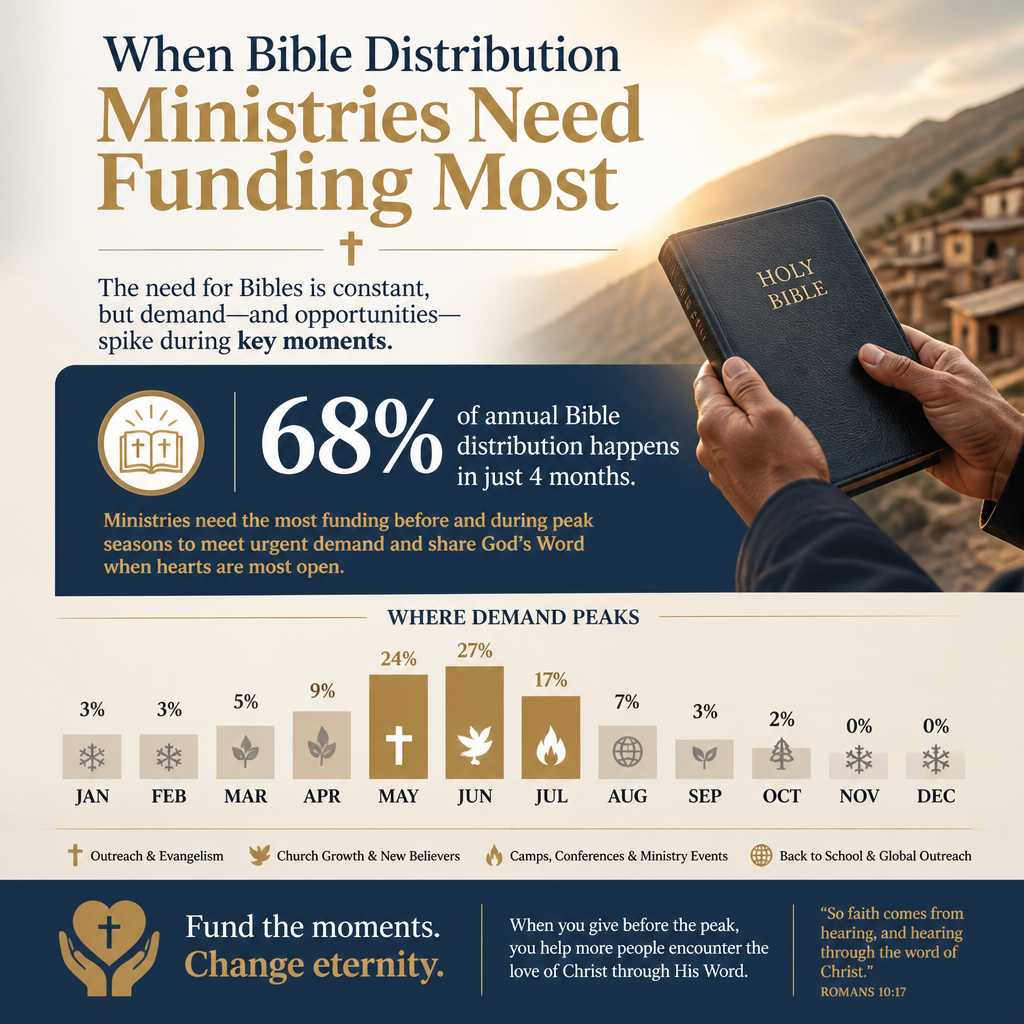
When Bible distribution ministries need funding most is not only a cash-flow question; it is a stewardship question. The New Testament assumption is not that the Word of God is scarce, but that it must be carried, translated, taught, and endured under pressure (2 Timothy 4:2). Donors who want to participate in that work need to understand when funding is truly catalytic, and when it is simply convenient.
Most Bible distribution organizations are mission-driven, but they are also operationally complex. Translation timelines, print and shipping contracts, customs risk, digital platform dependencies, and local church partnerships each create moments when a lack of timely funding does measurable harm. The Christian donor’s task is not to guess; it is to give with eyes open, honoring both faith and diligence (Proverbs 21:5).
1. When upstream work is at risk of stalling
Translation and revision phases rarely fit donor calendars
Some of the most consequential work in Bible access happens long before a single copy is printed: translation, revision, checking, and community testing. These phases are labor-intensive and often proceed in multi-year cycles. When funding is intermittent, teams lose trained personnel, consultants are rescheduled, and momentum breaks in ways that are hard to recover.
The scale of remaining need is still substantial. Wycliffe Global Alliance reports that hundreds of languages still lack a complete Bible, and thousands still lack even a New Testament; their public progress reporting underscores how multi-stage and long-horizon this work is (Wycliffe Global Alliance).
Capacity gaps compound quietly
Translation organizations frequently carry “invisible” capacity needs: training mother-tongue translators, paying for linguistic software and checkers, and sustaining field support. Those line items can look administrative to an untrained eye, but they are often the hinge between steady progress and chronic interruption. Christians genuinely disagree about how much infrastructure is appropriate, yet it is difficult to reconcile underfunded systems with the biblical call to “do all things decently and in order” (1 Corinthians 14:40).

2. When supply chains make Scripture unexpectedly expensive
Paper, printing, and shipping shocks create real ministry risk
Bible distribution depends on physical inputs that ministries do not control. Sudden increases in paper and freight costs can make an existing commitment to print or ship Scripture financially impossible without bridge funding. Donors sometimes assume these are marginal fluctuations; recent history shows they can be material.
For example, the U.S. Bureau of Labor Statistics tracks producer price changes in paper manufacturing, illustrating how input costs can rise sharply over short periods (U.S. Bureau of Labor Statistics). Even when a ministry operates outside the United States, global commodity and shipping markets tend to transmit those costs widely.
Pre-positioning is not waste when it is disciplined
Wise distribution work often includes pre-positioning inventory regionally to reduce customs delays and respond to ministry requests. That practice can become wasteful if it is unmanaged, but it can also be the difference between Scripture arriving in time for a training cycle or arriving after the moment has passed. The harder question is whether an organization demonstrates disciplined demand planning, inventory controls, and clear policies to avoid dumping or misallocation.
Donors who want to compare approaches across the field can situate these questions within Bible Distribution Ministries, where the operational realities differ significantly between translation-first organizations, print-focused distributors, and digital-first networks.
3. When access windows open and close quickly
Regulatory and political shifts can create brief opportunities
In many contexts, “access” is not a permanent condition. Visa rules change. A ministry partner is permitted to import a shipment for a limited period. A conflict subsides enough to allow travel for training and distribution. When these windows open, funding delays can be the difference between lawful, orderly distribution and a missed opportunity that may not recur for years.
Because conditions can deteriorate quickly, mature ministries build contingency plans. That does not excuse poor planning, and it should not invite panic-driven giving. But it does mean that flexible funding—held with accountability—can be uniquely valuable when circumstances shift faster than annual budgets can adjust.
Church-based distribution requires synchronized resourcing
Many of the most credible distribution models run through local churches and trained leaders, not through isolated drop-offs. When a partner network schedules a pastor training cycle, a literacy initiative, or a small-group launch tied to newly available Scripture portions, the ministry must resource the whole chain: materials, training, follow-up, and in some cases trauma-informed pastoral care. Funding that arrives after the training cycle has ended is not merely late; it changes the ministry outcome.
4. When effectiveness depends on more than getting Bibles across a border
Distribution without discipleship can become symbolic
Christians rightly celebrate the power of Scripture itself (Hebrews 4:12). Yet the ministries with the strongest long-term fruit tend to treat distribution as one part of a larger ministry system: equipping the church, training readers, and supporting comprehension, especially where literacy is limited. The field has had to reckon with a simple reality: access is not the same as engagement.
Donors should ask whether a ministry can show evidence that Scripture is being used as intended—read, taught, and integrated into church life—without turning evaluation into a cynical demand for quantifiable “results” that ignores spiritual realities. The goal is not to domesticate God’s work into metrics. It is to confirm that the ministry’s strategy is coherent and that reported outputs correspond to verifiable activity.
Digital distribution introduces new fragilities
Digital Scripture can scale rapidly, but it carries platform risk, privacy concerns, device access inequities, and censorship dynamics. Some digital strategies are remarkably cost-effective; others overpromise and underdeliver. A donor’s responsibility is to distinguish between genuine user engagement and inflated numbers that are easy to report but hard to interpret.
When donors evaluate these questions, it helps to remember the “Overhead Myth” consensus: many nonprofit outcomes depend on appropriate investment in systems, people, and accountability, not only program outputs (BBB Wise Giving Alliance).
5. When donor timing can strengthen or destabilize a ministry
Restricted gifts can unintentionally create starvation cycles
Some donors prefer to fund only printing, only shipping, or only “Bibles in hands.” Those preferences can be honorable, but they can also force organizations into brittle patterns—under-resourcing leadership, compliance, partner care, and monitoring. Stanford Social Innovation Review has described how chronic underinvestment in core capacity can create a “nonprofit starvation cycle,” where organizations appear lean but are structurally weakened (Stanford Social Innovation Review).
What this means in practice is that the season when ministries need funding most is often the season when donors least enjoy giving: when an organization is strengthening governance, upgrading financial controls, investing in safeguarding, or building the data integrity needed for honest reporting.
What we look for when donors ask when to give
Across our verification work at Most Trusted, we see that the organizations best positioned to use timely funding well tend to demonstrate a few consistent signals. These are not guarantees, but they are meaningful indicators of preparedness and integrity.
- Clear articulation of the access problem: language need, geography, literacy, persecution risk, or church capacity
- Documented partnerships with local churches or credible local institutions, with defined roles and accountability
- Realistic budgets that connect translation, production, distribution, and follow-up rather than treating them as unrelated projects
- Evidence of financial controls suitable to the context, including segregation of duties and third-party review where feasible
- Transparent reporting that distinguishes between shipped, distributed, and actively used Scripture resources
Donors can press for these signals without suspicion. Scripture commends trustworthiness, and it also commends examination (Acts 17:11). The purpose of due diligence is not to withhold generosity, but to direct it toward faithful work.
For donors comparing approaches and deciding what questions to ask, How to Give Wisely to Bible Distribution Ministries frames the practical trade-offs that often sit beneath polished appeals.
FAQs for When Bible distribution ministries need funding most
Should donors prioritize emergency shipments over long-term translation work?
Both can be faithful, and the priority depends on the ministry’s theory of change and the context on the ground. Emergency shipments can matter when a church network is prepared to receive and distribute responsibly, or when displacement and crisis have severed ordinary supply. Long-term translation work is often less visible but foundational, and delays can set back progress for years. We recommend aligning giving with a ministry’s demonstrated capacity to execute well in its chosen lane, rather than treating urgency as a substitute for strategy.
Is it better to give restricted or unrestricted funding to Bible distribution ministries?
Restricted giving can be appropriate when a donor has a clear theological or strategic rationale and the ministry can account for it cleanly. Unrestricted or flexible funding is often most needed when ministries are strengthening controls, staffing, partner care, and the operational resilience that keeps distribution faithful over time. We recommend asking how leadership allocates flexible dollars, what guardrails govern that discretion, and whether reporting shows consistency between stated priorities and actual spending.
Giving when it matters most
When Bible distribution ministries need funding most is usually when the work is hardest to see: sustaining translation teams, absorbing supply-chain shocks, resourcing disciplined distribution through the local church, and investing in the integrity systems that keep the mission honest. Christian donors need not choose between zeal and prudence. Faithful giving can honor the urgency of the Great Commission and the biblical demand for trustworthy stewardship at the same time.



