

Choosing a trustworthy Bible distribution ministry requires more than confirming that Bibles are being printed and shipped. The harder question is whether a ministry’s work is faithful to the Church’s calling, honest about results, and governed with the kind of integrity that can bear scrutiny over years rather than campaigns. The Word of God is not merchandise; it is a deposit entrusted to the Church, handled with reverence, accuracy, and accountability.
Scripture commends the spread of God’s Word without romanticizing the means. Paul rejoiced that Christ was preached even when motives were mixed, yet he also warned that some “peddle the word of God” rather than speak “with sincerity” (2 Corinthians 2:17). Donors should not assume that good intent automatically yields good practice. The field is complex: translation, local church partnership, government restrictions, data privacy, and the realities of global logistics all introduce real ethical and operational risks. A mature approach to giving begins with asking better questions.
Start with the theological and ecclesial commitments
Clarify what the ministry means by Bible distribution
“Bible distribution” can mean dramatically different things: shipping printed Bibles into a region, producing Scripture in minority languages, resourcing local churches for discipleship, or enabling secure digital access under persecution. Each approach carries distinct theological assumptions about how Scripture functions in the life of the Church and how conversion and discipleship ordinarily take root.
A trustworthy ministry can articulate a coherent theology of Scripture and mission. It should be able to answer, without marketing haze, how it understands the relationship between Bible access, evangelism, discipleship, and the local church. Mature ministries resist the temptation to treat distribution as a finish line. They speak about formation, pastoral care, and the ordinary means of grace, even when their particular role is specialized.
Test the ministry’s posture toward the local church
Christians genuinely disagree about the best models for cross-border ministry, especially in restricted contexts. Yet in most places, credibility can be measured by proximity to local pastors and accountability to local believers. A trustworthy Bible distribution ministry will not bypass local shepherds as obstacles to efficiency. It will describe how local church leaders participate in planning, translation decisions, distribution channels, and follow-up.
Where partnerships are sensitive, donors can still ask for verifiable indicators: the presence of local advisory input, documented relationships with indigenous church networks, and a clear rationale for when details must remain confidential. Security can justify discretion; it cannot justify vagueness about governance, controls, or doctrine.

Assess integrity in reporting and fundraising claims
Demand clarity on what is counted and what is assumed
Many ministries report outcomes in “Bibles distributed,” “people reached,” or “Scriptures provided.” Those numbers can be meaningful, but they are also easy to inflate through imprecise counting. Donors should ask: What exactly counts as “distributed”? Is it printed, shipped, delivered to a partner, handed to an individual, or used in a discipleship setting? Are New Testaments counted the same as full Bibles? Are digital downloads unique users or total file transfers?
Trustworthy ministries define their metrics in writing and keep those definitions stable over time. They disclose limitations: customs seizures, duplication, re-sales, or the unavoidable uncertainty when operating through indirect channels. A ministry that only reports large, round numbers without methodological detail is asking donors to trade stewardship for sentiment.
Watch for fundraising that trades on urgency without accountability
Bible poverty is a real concern, and the global Church does face profound access constraints in certain regions. Donors should still be cautious when appeals rely chiefly on crisis language, dramatic persecution imagery, or simplistic “$X buys a Bible” claims without disclosing the true cost structure and context. A single Bible’s cost varies widely depending on paper, printing location, shipping, language, and the operational security required to place it safely in a believer’s hands.
It is also wise to remember how religion is discussed in parts of the world. Pew Research documents that government restrictions on religion and social hostilities affecting religious groups remain significant in many countries, shaping how ministries must operate and what can safely be disclosed publicly. Pew Research Center
Look for disciplined financial integrity without overhead superstition
Read financials with stewardship categories, not cynicism
Christian donors often want a simple ratio: “How much goes to programs?” The nonprofit field has spent years correcting this instinct because it can punish ministries for building the internal controls, cybersecurity, audit quality, and staff competence that protect the mission. The “Overhead Myth” letter, signed by leading charity evaluators, argued that overhead ratios are a poor proxy for effectiveness and can distort donor decision-making. Candid (GuideStar)
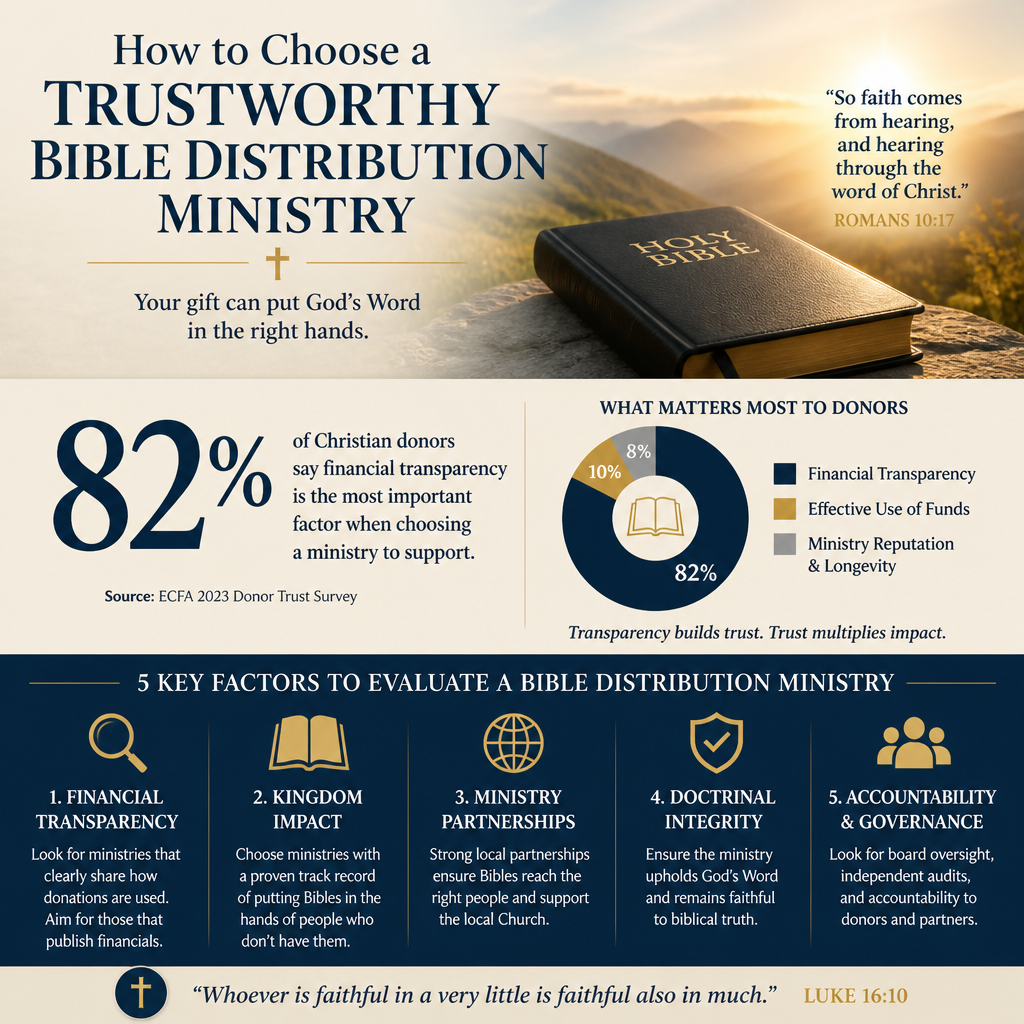
That does not mean overhead is irrelevant. It means it should be interpreted. Trustworthy Bible distribution ministries typically show a consistent pattern of clean audits or credible financial reviews, transparent classification of costs, and a demonstrated ability to steward restricted gifts according to donor intent. Where the ministry is small, the question becomes whether governance and controls are proportionate to risk, not whether the budget looks impressive.
Ask how restricted giving is handled
Bible projects are frequently funded through designated gifts: a particular language, a specific country, a shipment, or a digital initiative. A trustworthy ministry has written policies for gift acceptance and restriction management, and it can explain what happens when circumstances change: a route closes, a government policy shifts, or a local partner requests a different form factor. Donors should expect a clear process for donor consent when material changes occur, and a clear audit trail when they do not.
Across our verification work at Most Trusted, we observe that ministries with mature financial integrity rarely promise precision they cannot deliver. They commit to faithfulness in stewardship, careful documentation, and prompt correction when errors occur.
Examine governance and leadership for accountability and restraint
Board independence and real oversight matter
The spiritual language surrounding Bible distribution can discourage healthy skepticism. Yet Scripture assumes the need for accountability in handling resources (2 Corinthians 8:20–21). Donors should ask who governs the ministry and whether that governance is real. A trustworthy ministry will identify its board, disclose whether board members are independent, and describe how the board oversees executive compensation, financial controls, and risk management.
Governance is also where many failures hide. Ministries can do meaningful work and still drift into conflicts of interest, insider transactions, or decision-making that lacks checks and balances. The presence of an independent audit committee, conflict-of-interest policy, and documented board minutes are not bureaucratic ornaments; they are guardrails for long-term faithfulness.
Leaders should speak with theological sobriety, not personal centrality
The most credible Bible distribution leaders tend to minimize personal brand and maximize institutional clarity. They speak about the Church, the Word, and the people served with humility, and they treat donors as partners in stewardship rather than an audience to be mobilized. In restricted contexts, leaders should also demonstrate restraint in public storytelling, avoiding details that could endanger local believers or expose distribution channels.
When a ministry’s public voice consistently centers the leader’s access, heroism, or unique anointing, donors should pause. The gospel does not require exaggeration to advance; it requires truth.
Evaluate transparency, effectiveness, and risk in real operating conditions
Transparency is not maximal disclosure, but it is verifiable disclosure
In Bible distribution, transparency has to be calibrated. Some details cannot be published without risking persecution or legal penalties for local Christians. The right question is whether the ministry provides sufficient evidence to establish credibility without compromising security. Trustworthy ministries distinguish between public-facing summaries and controlled-access documentation for serious donors, auditors, or verification partners.
This is where independent verification can serve donors well. Most Trusted exists to help Christian donors give with confidence by evaluating ministries against The Most Trusted Standard, a 15-criteria framework across Faith Foundation, Financial Integrity, Governance and Leadership, and Transparency and Effectiveness. Verification is not a substitute for discernment, but it can reduce the likelihood that donors are funding avoidable dysfunction.
Effectiveness includes appropriate follow-up and responsible distribution channels
Bibles can be distributed in ways that unintentionally create harm: undermining local churches through parallel systems, provoking avoidable conflict with authorities, or creating black-market incentives when free materials are widely resold. The most careful ministries describe their distribution channels and safeguards. They may use church-based distribution, vetted local partners, and contextual training so Scripture is received within a community capable of teaching and discipleship.
Donors should look for a ministry that can answer operational questions plainly, including:
- How are translation and doctrinal decisions made and reviewed?
- What controls prevent diversion, resale, or duplication?
- What is the plan for discipleship support or connection to local churches?
- How does the ministry evaluate partner integrity and security practices?
- What evidence is available that shipments or digital access reached intended recipients?
For donors seeking a broader map of this field and the variety of models used, our coverage of Bible Distribution Ministries provides helpful orientation without reducing discernment to a single metric.
FAQs for How to choose a trustworthy Bible distribution ministry
Is it reasonable to ask for proof when a ministry works in restricted countries?
Yes. The form of proof may differ, but accountability should not disappear. Responsible ministries protect sensitive details while still providing verifiable evidence: consistent financial reporting, documented internal controls, third-party audits or reviews where feasible, and coherent explanations of distribution channels and safeguards. Donors can also seek independent assessment from organizations equipped to review information under confidentiality.
Should we prioritize the lowest cost per Bible?
Not automatically. Cost matters, but cost alone can hide risk. The cheapest unit cost may reflect lower paper quality, weak security practices, inadequate partner vetting, or minimal follow-up. Mature stewardship weighs cost alongside governance, doctrinal fidelity, accuracy in translation, and the likelihood that Scripture is received and used in the context of the local church. For further guidance on disciplined giving within this cause area, see How to Give Wisely to Bible Distribution Ministries.
A faithful choice is a tested choice
Choosing a trustworthy Bible distribution ministry is ultimately an exercise in Christian stewardship: love ordered by truth. The ministries most worthy of confidence are rarely those with the most stirring appeals, but those willing to be examined. They speak carefully, count honestly, govern transparently, and treat the Word of God with the reverence it deserves. When donors give with that level of discernment, generosity becomes not only heartfelt, but reliable.



