
Why transparency matters in orphan care ministries is not primarily a branding question. It is a discipleship and stewardship question, because orphan care sits at the intersection of vulnerable children, cross-cultural power dynamics, and donor emotion. When donors cannot see clearly what a ministry is doing, who benefits, and what is changing, good intentions can fund programs that quietly produce harm.
Scripture consistently treats hiddenness in the use of resources as spiritually dangerous. Paul describes careful, public accountability in administering gifts “to avoid any criticism” and to do what is right “not only in the Lord’s sight but also in the sight of man” (2 Corinthians 8:20–21). The issue is not mistrust as a posture; it is clarity as a form of love. Vulnerable children deserve it, local families deserve it, and Christian donors deserve it.
Transparency is a child protection issue before it is a reporting issue
Opacity creates predictable risk in settings with unequal power
Orphan care ministries often operate where children have limited advocates, where legal systems may be overburdened, and where foreign funding can shape local incentives. In that environment, opacity is not neutral. It increases the risk of misconduct, poor safeguarding, and institutional drift, because there are fewer external constraints when internal culture weakens.
Transparency does not guarantee safety, but it creates conditions where safety can be tested. Donors should be able to identify whether a ministry has written child protection policies, background screening practices, incident reporting protocols, and independent oversight. Mature ministries make these visible because they understand that safeguarding must withstand scrutiny.
Institutional care can be necessary, but it must be accountable
Christians genuinely disagree about the role of residential care. Some contexts have no functioning foster system, and temporary residential settings can be a bridge during family crises. The harder question is whether residential programs are structured and monitored to prioritize family reunification and long-term stability rather than institutional permanence.
Basic transparency in this debate includes admissions criteria, length-of-stay data, reunification processes, and who is making decisions about each child. Without those facts, donors can unintentionally fund models that keep children separated from kin because separation is what sustains the budget.

Transparency clarifies whether a ministry is strengthening families or replacing them
Donors should ask what problem is being solved
“Orphan care” language can describe very different realities: children with no living relatives, children with living relatives in crisis, children at risk of trafficking, or children whose parents are alive but economically unable to provide stable care. When donors do not have a clear definition of the need being addressed, they cannot evaluate whether the intervention fits the actual problem.
Many credible global organizations have argued that family-based care should be the norm and institutionalization the exception. UNICEF has repeatedly emphasized family-based care and the risks of institutionalization for children’s development (UNICEF). What this means in practice is that transparent ministries can explain why a specific child is not safely with extended family, what steps are being taken toward reunification when possible, and how the ministry supports kinship care, foster care, and family strengthening.
Beware the incentives created by donor storytelling
Donor communications in orphan care carry unusual moral weight. A photo, a child’s name, and a dramatic narrative can move a church quickly. Yet those same tools can pressure ministries to keep a pipeline of “cases” that fit donor expectations, and they can compromise children’s privacy and dignity.
Transparency includes ethical storytelling standards: informed consent when appropriate, strong privacy practices, and a refusal to market children as objects of rescue. Donors can ask whether the ministry follows child-focused safeguarding norms for communications, including limits on identifying information and clear policies for visiting teams.
Financial transparency is necessary, but it is not the only transparency that matters
The goal is not low overhead, but honest cost
Christian donors often want to know, first, how much goes “to the children.” That instinct is understandable, but it can be shaped by a false premise: that administrative spending is inherently suspect. The philanthropic sector has tried to correct that assumption. A well-known public letter signed by GuideStar, Charity Navigator, and the BBB Wise Giving Alliance warned against evaluating charities primarily by overhead ratios, because it can distort behavior and obscure effectiveness (Candid GuideStar).
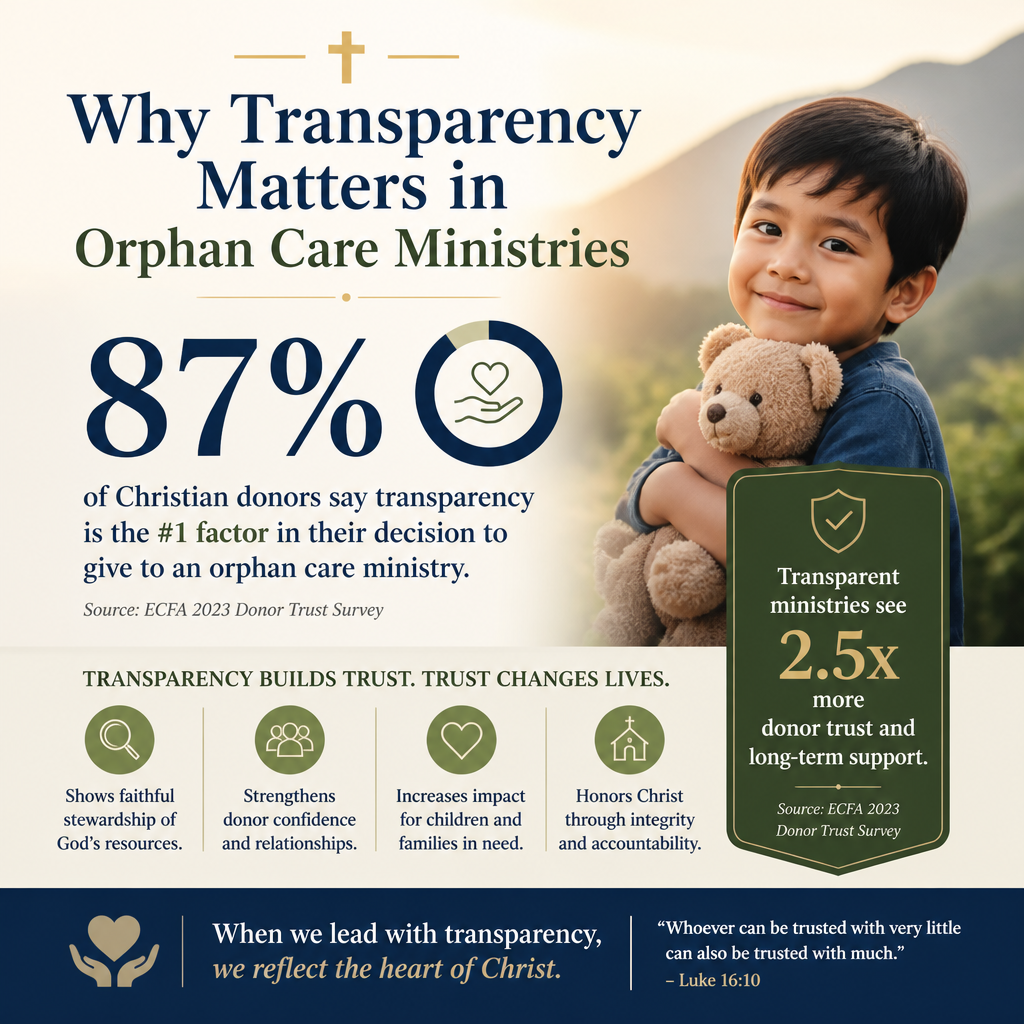
Orphan care ministries require competent staff, safeguarding systems, monitoring, accounting, and local partnership management. Those costs can be signs of seriousness. Transparency means the ministry can explain its cost structure and defend it theologically and practically, not hide it or manipulate it.
Donors should be able to follow the money across borders
Cross-border ministry adds complexity: exchange rates, subgrants to local partners, in-kind contributions, and compliance with both U.S. and local reporting norms. Transparent organizations provide audited financial statements when feasible, clear explanations of restricted funds, and descriptions of how money reaches the field.
Across our verification work at Most Trusted, we observe that the healthiest ministries treat donor questions as part of accountability, not as an interruption. They publish clear financials, disclose related-party transactions, and explain how board oversight functions. The ministries that meet The Most Trusted Standard tend to view transparency as ongoing formation in integrity rather than a one-time disclosure.
Program transparency separates measurable care from impressive activity
Outputs are easy to publish; outcomes require humility
Many orphan care ministries can report outputs: number of children served, beds provided, meals distributed, volunteers hosted, or school fees paid. Outputs are not meaningless, but they do not answer the donor’s central stewardship question: what changed for the child and the family, and what would have happened otherwise?
Outcome transparency is harder because it requires admitting limits, failures, and trade-offs. Donors should look for evidence of monitoring and evaluation appropriate to the ministry’s scale: school retention, placement stability, reunification durability, mental health support utilization, or other indicators tied to the program model. Strong ministries also explain what they do when a placement breaks down or when reunification proves unsafe.
Transparency requires clarity about what cannot be measured well
Some dimensions of healing and family stability resist clean measurement, and ministries should not fabricate precision. Christians should be wary of “impact theater” that produces polished dashboards without credible data collection. A transparent organization states what it measures, how it measures it, what it does not measure, and why.
Within Orphan Care Ministries, donors will encounter models ranging from residential care reform to family preservation, foster care development, and post-care transition support. The best questions change by model, but the principle remains: without transparent program logic and evidence, donors are asked to give on sentiment rather than stewardship.
What discerning transparency looks like for Christian donors
A short set of questions that reveal whether accountability is real
Discerning transparency is more than asking for a brochure or an annual report. It is looking for verifiable information that a board can stand behind and that a field team can explain without evasion. Donors can begin with a small set of questions that tend to surface whether transparency is cultural or cosmetic:
- Can the ministry explain its care model and how it prioritizes family-based solutions when safe?
- Does it publish clear financial statements and describe how funds move to field programs and partners?
- Are child safeguarding policies available, including incident reporting and volunteer boundaries?
- Does the board provide meaningful oversight, with independence and documented accountability?
- Can the ministry show evidence of outcomes and explain how it learns from failure?
How Most Trusted evaluates transparency in orphan care contexts
Most Trusted exists because many donors want to give with confidence but do not have time to conduct deep diligence on every organization. We evaluate Christian nonprofits against The Most Trusted Standard, a 15-criteria framework spanning Faith Foundation, Financial Integrity, Governance and Leadership, and Transparency and Effectiveness. In orphan care, that evaluation is especially consequential because the ministry’s beneficiaries are often not positioned to advocate for themselves.
What this means for donors is not that independent verification replaces prayerful discernment. It strengthens it. Verification can clarify whether a ministry’s claims are supported by documentation, whether its governance matches its fundraising, and whether its practices protect children while honoring local families and churches. For donors weighing competing appeals, How to Give Wisely to Orphan Care Ministries is a practical starting point for aligning compassion with careful stewardship.
FAQs for Why transparency matters in orphan care ministries
Is asking for transparency uncharitable or distrustful?
Not when it is done with respect and clarity about purpose. Scripture commends accountable administration of gifts (2 Corinthians 8:20–21), and wise stewardship is a form of love toward both donors and beneficiaries. Mature ministries generally welcome informed questions because transparency protects children, strengthens governance, and builds long-term trust.
What if a ministry says it cannot share details because of child privacy or security?
That concern can be legitimate. Protecting a child’s identity, location, or legal status may require discretion. Transparency does not mean publishing sensitive case files; it means providing enough verifiable information to evaluate policies, safeguards, governance, financial integrity, and credible outcomes without exposing children to risk. A responsible ministry can explain what it cannot share and still offer audited financials, safeguarding documentation, and aggregated program results.
Transparency is how compassion stays aligned with truth
Christian donors give to orphan care because the gospel forms a people who defend the vulnerable. Transparency matters in orphan care ministries because love is not only intention; it is faithfulness in what can be seen and tested. When ministries practice transparent governance, finances, safeguarding, and outcomes, donors can give not merely with hope, but with warranted confidence that their giving is strengthening children and families rather than funding a system that depends on their separation.



