

Why military outreach ministries emphasize discipleship over events is not a branding preference; it is a theological and pastoral judgment about what actually sustains faith under pressure. Service members live inside a formation system already—orders, unit culture, training cycles, deployments, and reintegration shape habits and loyalties with relentless consistency. A ministry that answers that reality with occasional inspirational programming may offer real encouragement, but it will rarely produce resilient Christian maturity.
Donors often ask for visible fruit: attendance counts, big nights, compelling stories. Those are not illegitimate desires. Yet Scripture’s emphasis falls on formation over spectacle. Jesus gathered crowds, but he built the church through disciples who learned to obey everything he commanded (Matthew 28:19–20). In military contexts, where isolation, moral injury, and transience are common features, the logic of discipleship becomes even more pronounced.
Discipleship addresses the military realities that events cannot carry
The operational tempo creates spiritual discontinuity
Events assume stable proximity: the same people can show up again next week, relationships can deepen organically, and follow-up is straightforward. Many service members cannot offer that stability. A single duty schedule change can sever a new connection; a PCS move can end a promising relationship overnight. Discipleship models that are portable—Scripture intake, prayer rhythms, accountable relationships, and leadership development—travel with the person rather than depending on a venue.
What this means in practice is that a strong military outreach ministry will invest in leaders who can disciple in small, repeatable settings: barracks rooms, chow halls, base chapels, field environments, and encrypted group threads that survive geography. It is less photogenic than a large event, but more aligned with the lived constraints of military life.
Moral injury and trauma require sustained pastoral presence
Christians genuinely disagree about the best language to use for combat-related guilt, shame, and grief. Some prefer clinical terms; others are wary of importing frameworks that downplay sin or agency. Yet the pastoral reality remains: many service members carry burdens that do not resolve with a single altar call or emotional high point.
The Department of Veterans Affairs has documented elevated suicide risk among veterans compared to non-veteran adults, underscoring the seriousness of the mental health landscape in which many military ministries operate U.S. Department of Veterans Affairs. Discipleship does not replace clinical care when needed, but it creates a relational and theological context in which confession, lament, repentance, and hope can be practiced over time with trusted leaders.

Scripture prioritizes ordinary faithfulness over episodic intensity
Jesus formed disciples through life-on-life obedience
In the Gospels, Jesus did not mainly build his mission through large gatherings. He taught crowds, but he devoted concentrated attention to a smaller number who learned his ways through shared life, correction, and commissioning. The Great Commission’s language is explicit: “make disciples… teaching them to obey” (Matthew 28:19–20). Obedience is learned; it is not downloaded in a single evening.
Military outreach ministries that center discipleship are not dismissing evangelistic moments. They are resisting an unspoken assumption that intensity equals transformation. The New Testament’s pattern is steadier: the word of Christ dwelling richly (Colossians 3:16), saints being equipped for ministry (Ephesians 4:11–13), and believers persevering through trials with tested faith (James 1:2–4).
The church grows through mature members, not perpetual consumers
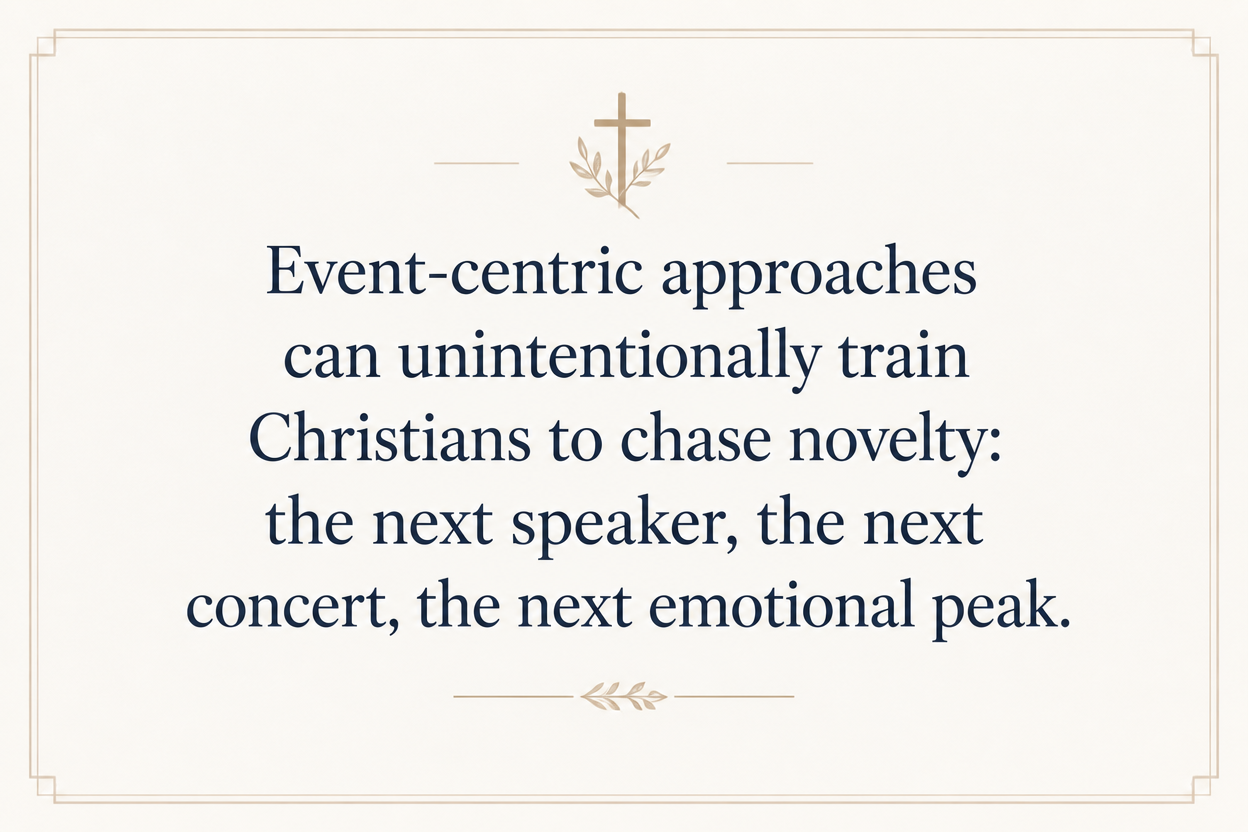
Event-centric approaches can unintentionally train Christians to chase novelty: the next speaker, the next concert, the next emotional peak. That dynamic is not unique to military ministry, but the military environment can amplify it because people are already conditioned to cycles of adrenaline and decompression. Discipleship confronts that pattern by offering a different kind of “training”—not for physical readiness, but for godliness (1 Timothy 4:7–8).
For donors, the implication is practical. When a ministry reports fewer headline events but can show consistent small-group multiplication, leader development, and pastoral care pathways, it may be closer to the New Testament pattern than a ministry with larger crowds and thinner shepherding.
Events can serve discipleship, but they cannot substitute for it
Well-designed events can gather, identify, and invite
Events have legitimate strengths. They create low-barrier entry points for skeptics, help isolated believers realize they are not alone, and can catalyze relationships that become discipling relationships. In military settings, a one-time gathering may be the only feasible first contact for a service member who is wary of overt faith commitments.
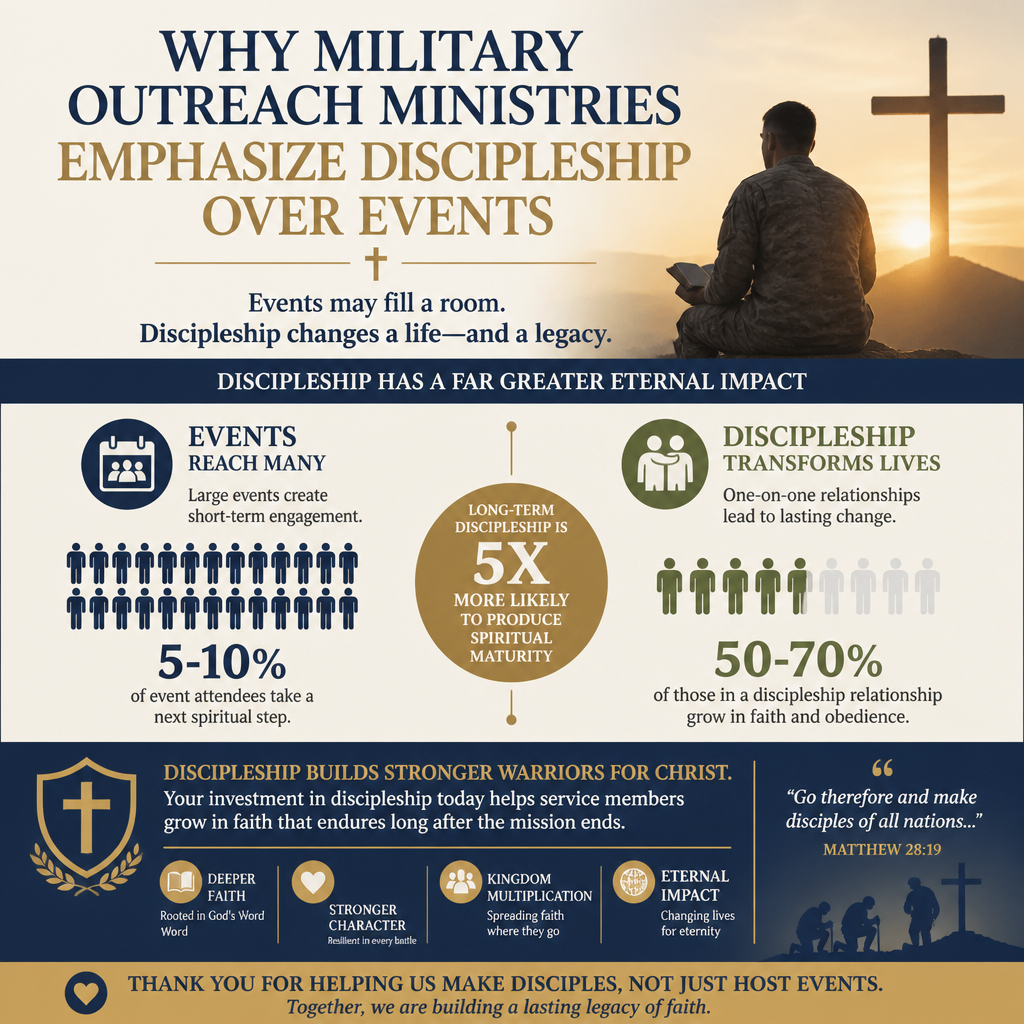
The donor temptation is to treat the event as the ministry. The healthier posture is to treat the event as one instrument inside a larger ecclesial and discipling ecosystem. The question is not whether a ministry hosts events, but what the events are for and what happens next.
The follow-through problem is predictable and solvable
When ministries emphasize events without commensurate discipling infrastructure, predictable problems follow: inconsistent follow-up, shallow spiritual care, and leaders burning out as they try to carry too many relationships alone. Ministries that think clearly about discipleship design tend to build repeatable pathways.
- Clear next steps from first contact to ongoing community
- Training for peer disciplers and small-group leaders
- Pastoral referral networks for complex counseling needs
- Partnership with local churches near installations and bases
- Practices that can survive deployment, TDY, and PCS moves
The harder question is whether a ministry can document these pathways with evidence rather than aspiration. This is one reason donors increasingly value verification work that tests claims against observable practices and governance controls.
For donors, discipleship is also a stewardship question
Durable impact is harder to measure but more faithful to the task
Many donors have been conditioned to evaluate ministries with metrics that are easiest to count: attendance, decisions, social media reach. Those measures can matter, but they can also mislead. Mature Christian philanthropy has learned—sometimes painfully—that what looks efficient can be spiritually thin, and what looks slow can be substantively transformative.
Across our verification work at Most Trusted, the ministries that meet The Most Trusted Standard tend to articulate outcomes that connect to formation: doctrinal clarity, leadership development, pastoral care practices, and partnerships that keep believers tethered to the local church. They also acknowledge limitations. Discipleship is never fully controllable; the Holy Spirit’s work cannot be reduced to a dashboard. But ministries can still be accountable for their methods and integrity.
Discernment requires attention to theology, governance, and transparency
Military outreach sits near sensitive ethical questions: authority structures, access to vulnerable populations, and the risk of conflating Christian witness with institutional power. Donors should not treat these as secondary. A ministry can be passionate about discipleship and still mishandle money, leadership authority, or reporting.
Responsible giving asks more than “Do they host meaningful events?” It asks: Is the ministry doctrinally rooted and church-connected? Are financial statements clear and independently reviewed? Is the board functioning with real oversight? Are outcomes reported honestly, including challenges? These questions belong to the same moral universe as Jesus’ teaching about stewardship and accountability (Luke 16:10–12).
Donors who want a broader view of the field often begin with Military Outreach Ministries, then examine how specific programs integrate spiritual care with operational realities. Prayer, confession, pastoral presence, and Scripture meditation are not ancillary to mission in this context; they are often the means by which mission becomes sustainable.
Discipleship-centered military ministry depends on prayer and spiritual care
Prayer is not a prelude but a primary practice
In military environments, prayer can become transactional: a quick request before a mission, an urgent plea in crisis, a grateful word upon return. Those are real prayers, and God hears them. But discipleship teaches prayer as communion with God, not only crisis management. It forms service members to bring fear, anger, remorse, and fatigue into the presence of the Lord with honesty and reverence.
This is one reason strong ministries train leaders to practice and teach the Psalms. Lament is biblical, not a failure of faith. “How long, O Lord?” is part of the canon. For many service members, learning to lament with Scripture is one of the most concrete ways discipleship becomes pastoral care.
Spiritual care must be credible inside military culture
Military culture prizes competence, discretion, and loyalty. Ministries that speak only in clichés lose credibility quickly. Discipleship built on patient listening, doctrinal clarity, and confidentiality can earn trust that an event-driven approach may not. At the same time, ministries must avoid creating parallel churches detached from congregational authority. The healthiest models seek cooperation with chaplains where appropriate and connection to local churches wherever possible.
Donors who want to explore this dimension more closely can focus on Prayer and Spiritual Care in Military Outreach Ministries, where the contours of pastoral practice, accountability, and theological seriousness become easier to evaluate.
FAQs for Why military outreach ministries emphasize discipleship over events
Are events a poor use of donor funds in military outreach?
Not necessarily. Events can be strategically wise when they function as entry points into ongoing discipling relationships and when the ministry can demonstrate consistent follow-up. The concern is not the existence of events, but whether they consume disproportionate resources while producing shallow, hard-to-verify spiritual fruit.
What should donors ask to determine whether a ministry is truly discipleship-centered?
Donors should ask for concrete pathways and evidence: how newcomers are connected to small groups, how leaders are trained and supervised, how pastoral care is handled for trauma and moral injury, how the ministry partners with local churches, and how outcomes are reported with candor. Financial transparency and governance oversight matter as much as spiritual intent, which is why many donors use independent verification aligned with The Most Trusted Standard.
Why this emphasis is worth supporting
Military outreach ministries emphasize discipleship over events because the mission field is shaped by transience, stress, and the need for durable spiritual formation. Events can open doors, but discipleship keeps doors open through deployments, relocations, and the long work of healing. For donors seeking faithful stewardship, ministries that invest in sustained formation, credible spiritual care, and accountable leadership often represent the more demanding—and more biblically coherent—work.



