

How military outreach ministries handle security and background checks is not an administrative afterthought; it is a moral question that touches the dignity of service members, the safety of families, and the credibility of Christian witness. Donors who care about faithful ministry should also care about whether a ministry’s compassion is disciplined by prudence, because trust is never a substitute for due care.
Military communities live with real operational risk, heightened privacy concerns, and complex authority structures. A chapel volunteer, a counseling referral, a care-package coordinator, or a contractor-like volunteer on a base may be exposed to personal data, vulnerable spouses, and the rhythms of deployment. Ministries that treat screening as mere bureaucracy tend to stumble into avoidable harm. Ministries that treat it as discipleship—guarding others with sober-minded love—usually build safer programs and more durable relationships with commanders and chaplains.
Why security screening is a ministry issue, not merely a legal one
Love of neighbor requires more than good intentions
Scripture places weight on the protection of the vulnerable and the sober exercise of authority. “Love does no wrong to a neighbor” (Romans 13:10) is not sentimental; it is practical. When a ministry enters a military context, the “neighbor” may include a young enlisted service member far from home, a spouse managing a household alone, or a child in a youth program. The more a ministry’s work touches people in fragile seasons, the more screening becomes part of pastoral responsibility.
The harder question is how to do this without sliding into suspicion as a posture. Christian ministries can be tempted toward two errors: naïveté (“we are all believers here”) or cynicism (“assume the worst”). Wise screening avoids both. It treats people as image-bearers while acknowledging that sin is real, grooming behaviors exist, and institutions have learned hard lessons about access and power.
Military access changes the risk profile
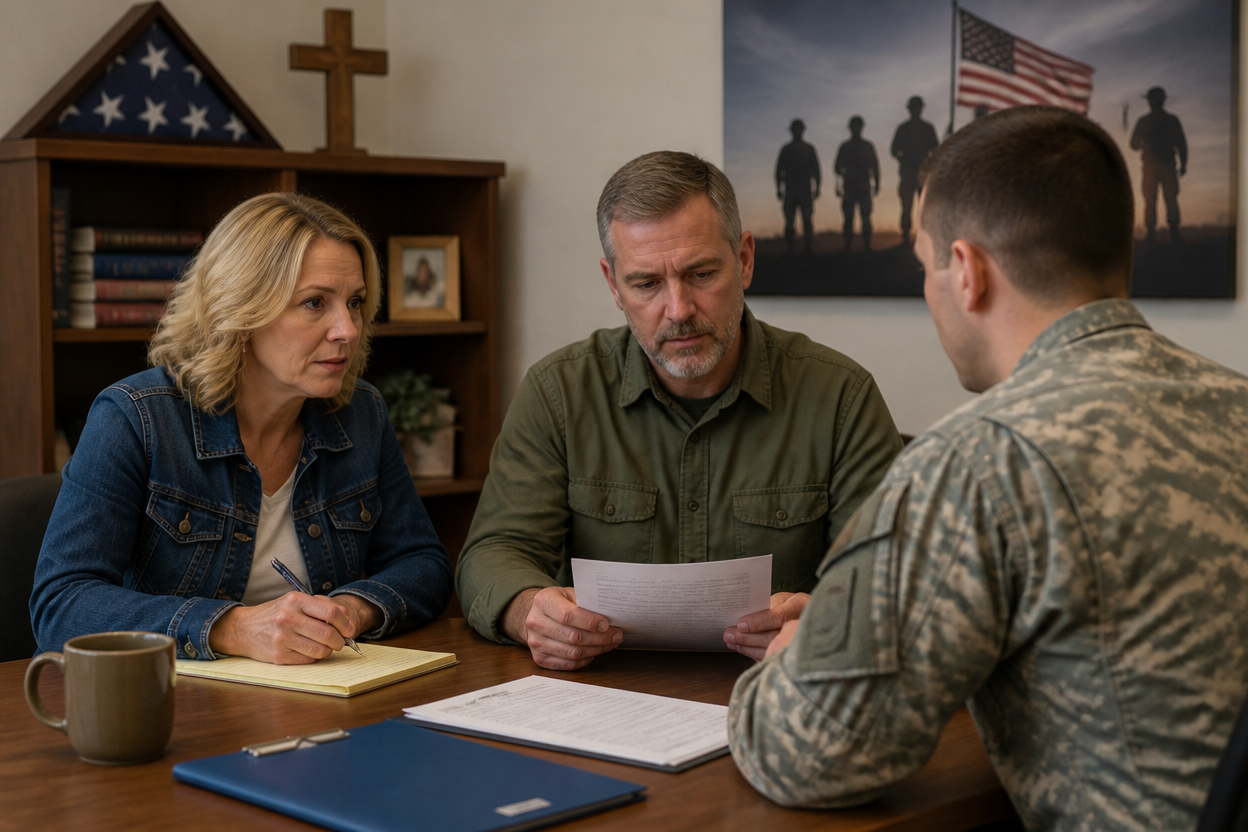
Some ministries operate off-base with service members who attend local churches; others seek on-base access through chaplain channels; others partner with established military-serving nonprofits. Each step closer to controlled spaces—installation events, family readiness settings, youth gatherings, or counseling networks—raises the stakes. The Department of Defense has long emphasized personnel security as a condition for protecting missions and people, and donors should expect ministries to respect that environment rather than demand exemptions from it. The Department of Defense notes that the personnel security program is designed to ensure individuals “are reliable, trustworthy, of good conduct and character” for access to sensitive roles and information (U.S. Department of Defense).
What strong ministries actually do in practice
They define roles and match screening to exposure
One sign of maturity is role-based screening. A volunteer who sorts donated items in a warehouse is not screened the same way as a volunteer who drives families, mentors teens, or enters homes during deployment cycles. Ministries that meet The Most Trusted Standard tend to document roles, define boundaries, and then align checks to the foreseeable risk of each role.
What this means in practice is that a donor should hear a ministry speak in concrete terms: “This role has supervised contact only,” “This role includes one-on-one ministry,” “This role includes access to addresses or schedules,” “This role requires base entry.” Vague language—“we screen our volunteers”—often hides uneven practice.
They combine multiple safeguards rather than trusting a single gate
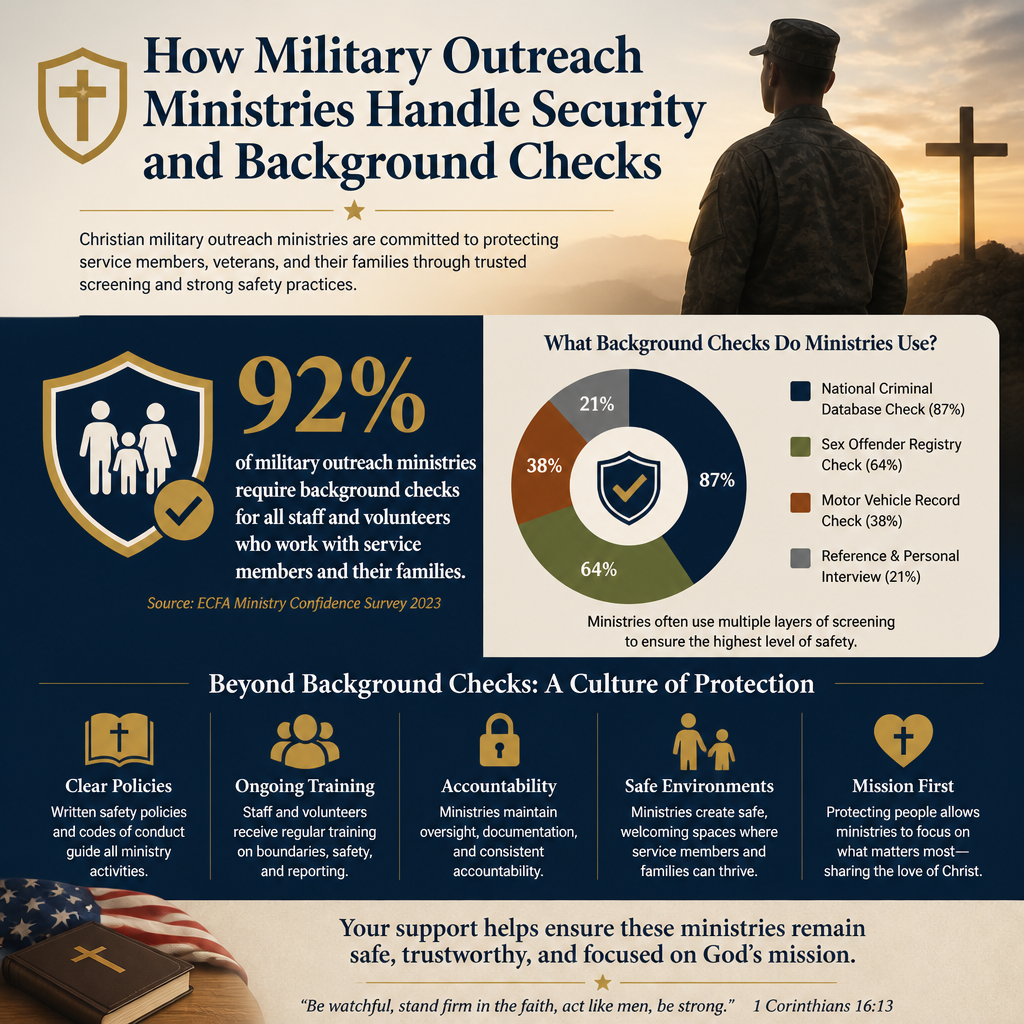
Background checks have limits: they mostly detect known, reported offenses. Strong ministries layer protections so that a single failure does not become a catastrophe. A credible approach often includes several of the following:
- Identity verification and a written application with signed disclosures
- Criminal background check appropriate to the role and jurisdiction
- Reference checks that ask behavior-specific questions
- Training on boundaries, grooming patterns, and mandatory reporting
- Two-adult rules or supervision requirements for work with minors
- Clear incident reporting pathways and documentation standards
Donors sometimes worry that layered safeguards signal distrust. Mature leadership frames them differently: safeguards protect service members and volunteers alike, prevent false allegations through clear procedure, and preserve the ministry’s ability to serve over the long term.
How background checks intersect with military rules and chaplain relationships
Command authority and chapel processes matter
On-base ministry rarely functions like a typical church volunteer program. Installations operate through command authority, with chaplains serving in defined roles, and access to facilities governed by regulations. Some ministries operate only through invitation and sponsorship; others support chaplains with resources while remaining off-base. Donors should expect ministries to demonstrate a respectful understanding of these lines.
Christians genuinely disagree about how formal a ministry should become to gain access. Some prefer informal relational ministry through local congregations near bases. Others argue that formal agreements and compliance are necessary to prevent confusion and protect the witness of the church. The wiser ministries do not treat military requirements as an adversary; they treat them as a context to be honored, much like the Jerusalem church navigated public order while maintaining spiritual fidelity.
Data protection is part of honoring the people served
Many military families are justifiably sensitive about information: addresses, deployment timelines, counseling needs, family stressors, or financial hardship. Ministries that gather personal data without strong controls create unnecessary risk. Donors can ask whether data is minimized, stored securely, and shared only with consent and clear purpose.
Federal privacy frameworks are not merely for government agencies; they reflect a wider principle: personal information is not a ministry commodity. The Federal Trade Commission has emphasized that organizations should take reasonable measures to secure sensitive information and reduce unnecessary collection (Federal Trade Commission).
Governance and accountability signals donors should watch for
Policies are meaningful only when leadership owns them
The difference between a policy binder and a safe ministry is governance. A board that receives regular reporting on incidents, training completion, and screening compliance is doing more than risk management; it is exercising stewardship. Donors should look for a ministry that can describe who is accountable for screening decisions, how exceptions are handled, and what happens when someone violates boundaries.
Across our verification work at Most Trusted, we find that ministries with strong governance treat screening as a board-level responsibility rather than an HR formality. That aligns with The Most Trusted Standard’s insistence that leadership oversight and documented controls are not in tension with faith—they are part of faithful stewardship.
Transparency is not the same as publishing sensitive details
Military-connected contexts add an understandable reluctance to disclose internal processes. Donors should not expect ministries to publish every procedure or identify partner installations. But there is a meaningful middle ground between secrecy and oversharing: a ministry can explain its screening philosophy, name the types of safeguards used, and describe accountability pathways without exposing operational details.
We also recommend donors resist a common distortion in charitable evaluation: demanding low “overhead” at the expense of safety. Screening, training, and compliance cost money. The nonprofit sector has repeatedly warned against simplistic overhead metrics that punish necessary infrastructure, including the joint “Overhead Myth” statement originally issued by GuideStar, Charity Navigator, and the BBB Wise Giving Alliance (Candid GuideStar).
Questions donors should ask before funding military outreach
Due diligence can be pastoral, not adversarial
Donors sometimes hesitate to ask detailed questions because the cause is emotionally weighty and the people served have sacrificed. Yet honor does not require credulity. The New Testament commends careful testing—“test everything; hold fast what is good” (1 Thessalonians 5:21)—especially where power and vulnerability intersect.
As donors evaluate programs in Military Outreach Ministries, we recommend asking questions that reveal how a ministry thinks, not merely what it claims. A credible leader will answer calmly and concretely, without defensiveness or evasive language.
Practical donor questions that surface real safeguards
These questions are direct, fair, and difficult to fake well:
- Which volunteer roles require a background check, and what level of check is used for each?
- How do you prevent one-on-one unsupervised access to minors or vulnerable adults?
- What training do volunteers receive on boundaries, grooming behaviors, and reporting?
- Who reviews screening results, and what criteria trigger disqualification or restrictions?
- How do you handle incidents, allegations, or policy violations, including documentation?
Donors who want to go further can ask how the ministry adapts screening for different contexts: on-base versus off-base, international deployments, or partnerships with churches. Strong answers reflect role clarity, written procedure, and humble respect for military protocols rather than improvisation.
For donors especially attentive to volunteer pathways and program operations, we also track recurring patterns across Volunteering with Military Outreach Ministries, where screening practices often reveal whether a ministry has thought carefully about risk, authority, and care.
FAQs for How military outreach ministries handle security and background checks
Do military outreach ministries need the same kind of background checks as churches?
Often they need the same core safeguards and, in some settings, additional controls. If a ministry involves work with minors, one-on-one mentoring, transportation, or access to sensitive family information, the underlying risks resemble those in church-based youth and pastoral contexts. If the ministry operates on or near installations, access rules, sponsorship expectations, and privacy constraints can add layers that a typical church program does not face.
Should donors fund the cost of screening and compliance?
Yes, when the safeguards are credible and proportionate to the ministry’s activities. Screening, training, documentation, and secure data handling are part of protecting those served and sustaining long-term access and trust. Donors can reasonably ask how the ministry budgets for these safeguards and whether leadership receives meaningful oversight reports, but cost alone is not a faithful reason to weaken protections.
Security as stewardship of trust
Military outreach is often conducted among people carrying heavy burdens: moral injury, family strain, loneliness, grief, and the disorientations of transition. A ministry that enters that space inherits a responsibility to be worthy of trust, not merely warm-hearted. When screening, boundaries, and accountability are treated as part of Christian stewardship, donors can give with clearer conscience—and service members and families can receive care without being exposed to unnecessary risk.



