
Marriage retreats strengthen military families because they create protected time for honest repair in a vocation that routinely disrupts ordinary rhythms of intimacy, parenting, and church life. For Christian donors, the question is not whether marriage matters for military readiness or family stability, but whether the ministries inviting couples away for a weekend are spiritually serious, clinically responsible, and accountable with the resources entrusted to them.
Military life compresses stressors that civilian couples may face only intermittently: extended separations, frequent moves, secondary trauma, and the strain of maintaining community when every friendship is provisional. The Christian tradition has long treated marriage as covenantal, public, and spiritually formative, not merely private. That theological claim has practical implications: if we want military families to flourish, we cannot treat marriage support as optional or sentimental.
Military marriages carry distinctive stress that retreats can address directly
Separation and reintegration are predictable pressure points
Deployment and reintegration often expose cracks that were previously masked by routine. Couples can spend months operating as functional single parents, then suddenly face the relational whiplash of reuniting. When communication has been reduced to sparse messages and necessary logistics, deeper patterns of misunderstanding can harden into distrust. A retreat offers structured space to name those patterns without the constant interruption of duty schedules, childcare, or the social expectation that everyone should be grateful and fine.
We should also acknowledge a tension donors sometimes miss: not every marital strain in the military is caused by the military. Personality, prior trauma, addiction, and ordinary sin patterns do not disappear when a couple changes stations. The value of a good retreat is not that it blames the institution, but that it brings the whole truth into the light and treats couples as responsible moral agents who still need support.
Military culture can discourage vulnerability
Many service members are trained to manage pain, solve problems, and keep moving. Those virtues can become liabilities at home. Spouses may feel unseen or emotionally alone, even when there is no overt conflict. A well-designed retreat creates permission to be human again: to grieve, to apologize, to listen, and to ask for help without fear that weakness will be punished.
Theologically, that posture aligns with Scripture’s insistence that confession and truth-telling are not self-indulgent but restoring. “Therefore, confess your sins to one another and pray for one another, that you may be healed” (James 5:16). A retreat cannot manufacture repentance, but it can lower the barriers to it.
Retreats work best when they combine spiritual formation with practical tools
Marriage is covenant, but it also requires skills
Christian donors sometimes divide marriage care into “biblical” counsel on one side and “secular” technique on the other. In practice, the strongest military marriage retreats refuse that false choice. Scripture speaks directly to covenant fidelity, sacrificial love, and the refusal to weaponize power in the home (Ephesians 5:25). But couples also need concrete tools: how to handle conflict escalation, how to manage finances under stress, how to rebuild intimacy after long absence, and how to co-parent amid fatigue.
When retreats are led by trained facilitators who respect both pastoral wisdom and evidence-based relationship education, couples are more likely to leave with habits they can sustain. Donors should not be embarrassed to ask whether a retreat uses a coherent curriculum, whether facilitators are properly trained, and how referrals are handled for couples facing domestic violence, severe mental illness, or substance abuse. Spiritual language is not an adequate substitute for safeguarding.
The best retreats anticipate the full family system
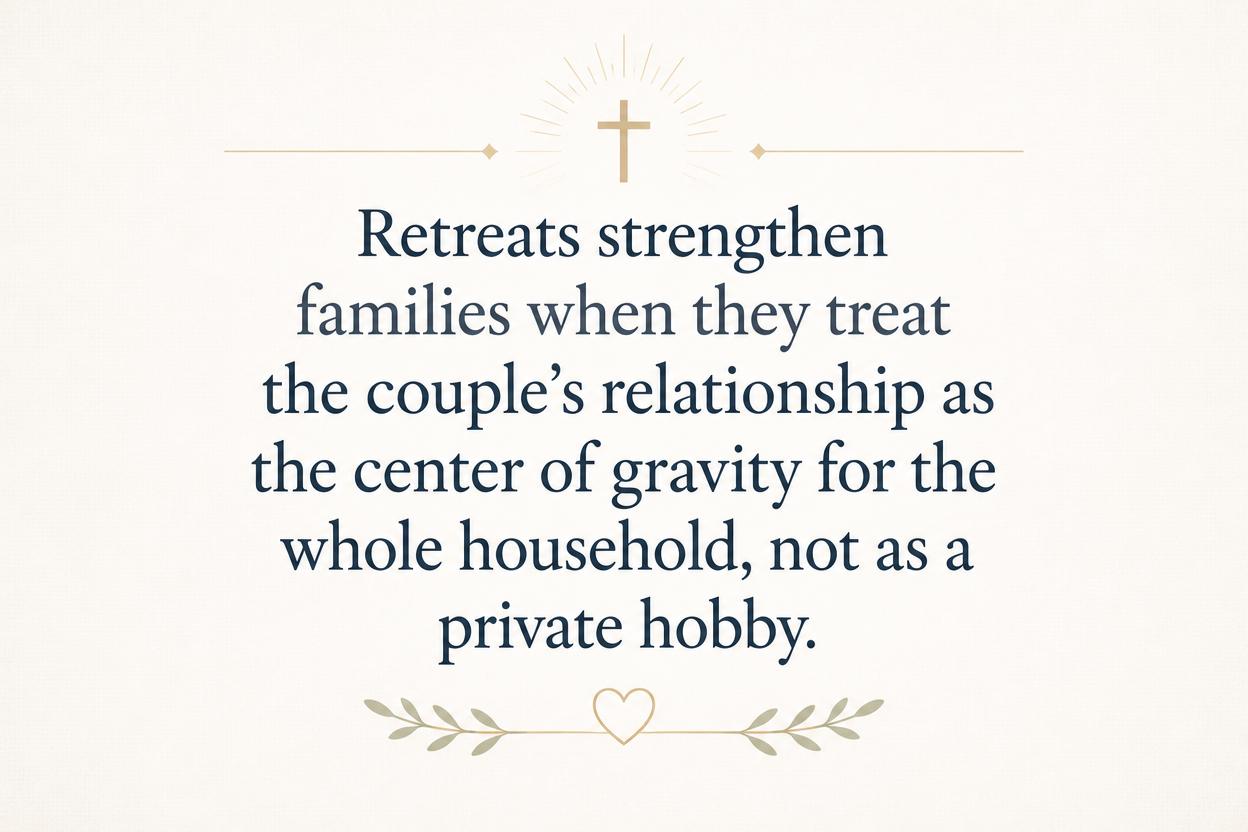
Military marriages exist inside a larger ecosystem: children absorbing stress, extended family at a distance, and churches that may or may not know how to welcome transient members. Retreats strengthen families when they treat the couple’s relationship as the center of gravity for the whole household, not as a private hobby. That often includes parenting conversations, boundary-setting with family-of-origin, and building a plan for church community on the next assignment.
Many donors also want to know whether such interventions are credible in the broader landscape of military family support. The U.S. Department of Defense itself has invested heavily in relationship education, reflecting the reality that marital and family stability affect force readiness and long-term well-being (U.S. Department of Defense).
Healthy retreats are trauma-aware without reducing everything to trauma
Trauma can shape communication, intimacy, and faith
Combat exposure and secondary trauma can affect sleep, irritability, emotional regulation, and the ability to feel safe. These realities often show up first in the marriage. A retreat that ignores trauma may unintentionally shame couples for symptoms they do not understand. But a retreat that explains everything as trauma can remove moral agency and spiritual responsibility. Christian ministry must hold both: human fragility and real accountability.
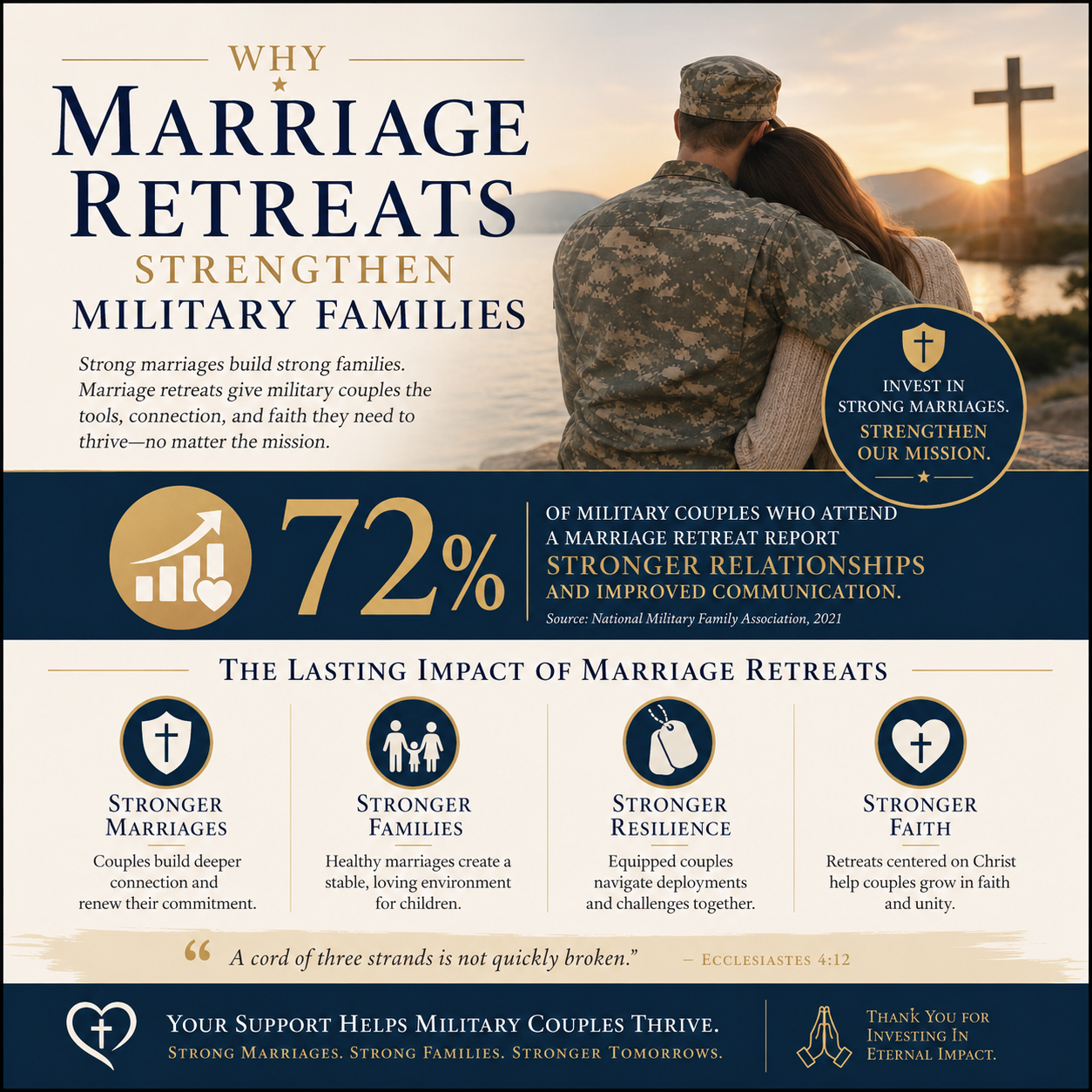
Research on military families has consistently recognized that deployments and related stressors can be associated with increased relational strain, though outcomes vary widely depending on support and context (RAND Corporation). The relevant takeaway for donors is not a single number but a practical principle: retreats should be designed to normalize help-seeking and to connect couples with appropriate care when deeper clinical needs are present.
Safeguards matter more than stage presence
Because retreats can feel emotionally intense, safeguards are not a bureaucratic add-on. They are part of loving the vulnerable. Donors should expect ministries to disclose who leads sessions, what training they have, how confidentiality is handled, and how they respond to disclosures of abuse or self-harm risk. The ministries that meet The Most Trusted Standard tend to treat governance and risk management as a spiritual obligation, not merely institutional self-protection.
What this means in practice is that retreat programming should have clear boundaries: no manipulative public “confessions,” no pressure to share traumatic details with strangers, and no promises that a weekend fixes what has taken years to fracture. A retreat is often a catalytic moment, but it is rarely the entire solution.
For donors, the central question is not inspiration but trustworthiness
Good intentions are common; reliable stewardship is rarer
Marriage retreats naturally draw donor affection because they are tangible: a weekend away, a renewed vow, a hopeful photo. But donors who want to fund long-term strength in military families should ask deeper questions. How are scholarships administered? Are funds restricted to retreat costs or diverted to overhead without clarity? Does the ministry have an accountable board? Are leaders compensated transparently and reasonably? Are outcomes measured with honesty, without exaggeration?
At Most Trusted, we evaluate Christian nonprofits against The Most Trusted Standard, a 15-criteria framework spanning faith commitments, financial integrity, governance, and transparency and effectiveness. Those categories are not abstract. They directly shape whether a retreat remains faithful and safe over time, especially when a ministry grows or faces leadership transition.
Signals donors can look for before funding retreat-based programs
Across our verification work, several practices correlate with ministries that serve military couples well and endure with integrity:
- Clear statement of faith and a theologically coherent approach to marriage and discipleship
- Documented safeguarding policies, including mandatory reporting and referral pathways
- Transparent financial reporting, including how scholarship funds are used
- Qualified leadership: pastoral oversight alongside trained marriage educators or counselors
- Defined follow-up plan with local church connection and ongoing coaching or small-group support
Donors exploring this space will often find it helpful to understand the wider landscape of Military Outreach Ministries, where marriage support is one part of a broader set of spiritual and practical needs.
Retreats strengthen families most when paired with local church and ongoing care
A weekend can open a door; discipleship sustains the change
Retreats are sometimes criticized as episodic: intense experiences followed by relapse into old habits. That critique is not wrong when ministries treat the retreat as the product rather than the beginning of a process. Military couples need durable communities: pastors who can walk with them through moves, mentors who understand military rhythms, and peers who can speak candidly about reintegration and parenting.
When a retreat is paired with follow-up coaching, small groups, or church-based mentoring, it can function as a hinge point rather than a high point. Theologically, this reflects a sober ecclesiology: Christ forms his people over time, through ordinary means of grace and mutual responsibility, not only through extraordinary events.
Military families need ministries that understand their constraints
The harder question is how to build continuity when families PCS every few years, when schedules change weekly, and when confidentiality concerns are real. Ministries that serve well often offer portable resources: virtual coaching, standardized small-group material, and partnerships with chaplains and local churches near installations. They also recognize the distinct burdens carried by spouses, who may experience isolation and decision fatigue that is invisible to their congregations.
Donors who want to fund this kind of durable support can learn more about approaches under How Military Outreach Ministries Serve Military Families, where the conversation extends beyond events to sustained pastoral care and measured effectiveness.
FAQs for Why marriage retreats strengthen military families
Do marriage retreats actually help, or are they mainly an emotional lift?
A retreat can be an emotional lift, but its lasting value depends on design and follow-through. Retreats tend to help most when they provide structured relationship education, create space for spiritual reflection and repentance, and connect couples to ongoing support. Donors should look for ministries that measure participation and follow-up engagement honestly and that maintain clear safeguarding and referral practices for couples with serious clinical or safety concerns.
What should Christian donors ask before funding a military marriage retreat ministry?
Donors should ask how the ministry defines success, how scholarship funds are tracked, who leads sessions and with what training, what safeguarding policies govern disclosures of abuse or self-harm risk, and what follow-up care is offered after the weekend. We also recommend evaluating whether the organization meets The Most Trusted Standard in governance, financial integrity, and transparency, because retreat settings can amplify both the benefits of wise leadership and the harms of poor accountability.
Why this category of giving deserves serious attention
Marriage retreats strengthen military families when they tell the truth about stress, honor the covenant nature of marriage, and provide tools and community that outlast a single weekend. For Christian donors, the opportunity is to fund ministries that combine theological seriousness with disciplined stewardship and real safeguards. The goal is not a moment of inspiration, but a pattern of faithfulness that protects spouses, steadies children, and sustains Christian witness in a demanding vocation.



