
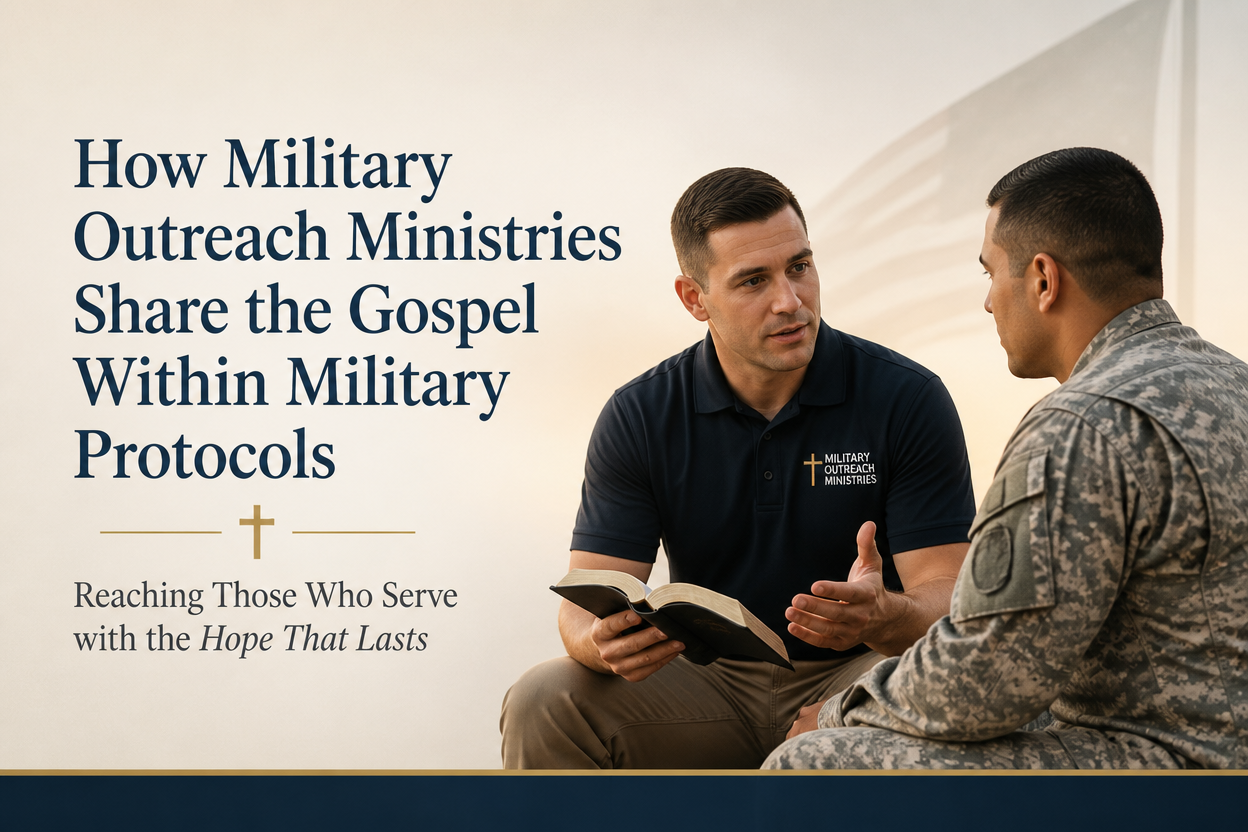
How military outreach ministries share the Gospel within military protocols is not a marketing problem. It is a discipleship problem shaped by moral seriousness, constitutional law, and a chain of command that exists to keep people alive. Christian donors who fund this work deserve more than inspirational stories; they deserve clarity about what is permitted, what is wise, and what is faithful when evangelism happens inside one of the most regulated institutions in American life.
The New Testament does not treat soldiering as outside the reach of grace. John the Baptist did not tell soldiers to abandon their vocation; he told them to practice justice and restraint (Luke 3:14). At the same time, the Church has long understood that authority can be misused. In military settings, spiritual care must be offered in a way that honors conscience, avoids coercion, and respects lawful orders. Ministries that keep those tensions in view tend to serve service members with deeper credibility and longer-term fruit.
Military protocols define the ministry environment, not the mission
Military protocols exist because the armed forces operate on command authority, not consumer choice. That is precisely why spiritual influence can become ethically compromised if it is tied to rank, evaluation, or access to resources. The Gospel is good news offered freely; it is not a compliance requirement, and it cannot be treated as one more institutional program.
What this means in practice is that effective outreach ministries become students of policy, not to evade it but to serve within it. The foundational legal framework is the First Amendment: service members do not shed religious liberty at the gate, yet the government must avoid establishing religion. That balance is mediated through Department of Defense and service-specific instructions, local installation commanders, and the professional ethics of chaplains and endorsing bodies.
Why donors should care about policy competence
Policy ignorance tends to create two predictable failures. One is overreach: public events or leader-led settings where attendance feels required, and spiritual invitation becomes indistinguishable from official endorsement. The other is retreat: ministries that assume anything explicitly Christian is prohibited, leaving service members with little more than generic moral encouragement. Mature ministry learns the difference between protected religious expression and inappropriate coercion.
The Department of Defense publicly affirms that service members have the right to observe their faith, subject to military necessity and good order. The best donors ask ministries to show how they interpret and apply that principle with real operational constraints. For DoD reference context, see the Department’s public site at https://www.defense.gov/.
The practical center of gravity is command climate
Policies are interpreted through local leaders. A command climate that values pluralism and readiness can either make space for voluntary faith gatherings or restrict them out of fear of complaints. Outreach ministries that endure tend to build trust with installation leadership by being predictable: they follow base access procedures, respect scheduling constraints, and avoid forcing commanders into religious controversies they did not seek.

Chaplains hold a unique role that ministries must not blur
Chaplains are commissioned officers tasked to provide for the free exercise of religion and to advise commanders on matters of religion, ethics, and morale. They operate under both military authority and ecclesial endorsement. When ministries treat chaplains as simply “platform providers,” they misunderstand the vocation and can unintentionally create conflicts of interest for the chaplain.
Supporting chaplains without commandeering their office
The healthier pattern is partnership that preserves lines: ministries provide resources, volunteers, and off-base networks, while the chaplain retains responsibility for what happens under the chapel’s auspices. In settings where attendance could be confused with official preference, chaplains are often the most careful guardians of voluntariness, because they understand both the legal boundaries and the spiritual stakes.
We also find that the ministries most trusted by chaplains are the ones that serve beyond a single tradition when asked, without diluting their convictions. A Protestant outreach ministry can remain explicitly evangelical while still treating Catholic, Orthodox, and non-Christian service members with dignity. That posture is not relativism; it is neighbor-love in an institution that includes the whole nation.
Common misconceptions donors should resist
Some donors assume that any ministry presence on a base implies official endorsement. Others assume chaplains are agents of proselytism. Neither is accurate. The military chaplaincy exists precisely to keep religious care from being pushed to the margins or captured by unofficial power. The question is not whether the Gospel can be proclaimed, but whether it is proclaimed in a way that honors conscience and does not trade on rank or access.
Evangelism is strongest when it is voluntary, relational, and off-duty
Military protocols do not eliminate evangelism; they change its posture. The most faithful witness in uniform is often personal: conversations between peers, Bible study among friends, and prayer offered in moments of fear or grief when it is requested and welcomed. Ministry leaders who insist on high-visibility events at the expense of patient discipleship often discover they have created heat rather than light.

Why voluntariness is a theological requirement, not only a legal one
Coercion is not merely a compliance risk; it is a discipleship distortion. Jesus’ invitations are direct, but they are not enforced by institutional power. When service members feel pressured to participate in religious activity to gain favor, avoid scrutiny, or belong socially, the ministry may gain attendance while losing integrity.
Research on religion in the military consistently notes that chaplains and faith practices can support resilience and meaning-making, especially under stress and deployment conditions. The empirical findings are complex and not reducible to simplistic cause-and-effect, but they help donors understand why this work matters beyond sentiment. For peer-reviewed context, see the American Psychological Association’s publications portal at https://www.apa.org/.
Where ministries often do their best work
Many of the most effective outreach touchpoints are outside the formal duty day: off-base dinners, marriage enrichment led by qualified couples, mentorship for young enlisted service members navigating first assignments, and quiet pastoral triage during crises. In these settings, the ministry’s Christian identity can be explicit without being imposed, because participation is clearly optional and not mediated through the chain of command.
Donors who want to understand the broader landscape of this field can review our coverage of Military Outreach Ministries, where we track patterns that distinguish durable, accountable work from well-meaning efforts that struggle under the weight of military realities.
Accountability is part of Gospel witness in a high-trust environment
Military communities operate on trust, and violations of trust carry heavy consequences. Ministries that solicit funds in the name of service members, veterans, or “the troops” carry an added moral burden to be financially straightforward, govern well, and report outcomes honestly. Donors often assume that patriotic alignment implies institutional credibility. It does not.
What we look for when assessing military outreach ministries
At Most Trusted, our verification work evaluates nonprofits against The Most Trusted Standard, a 15-criteria framework covering faith commitments, financial integrity, governance and leadership, and transparency and effectiveness. Military outreach ministries that meet this standard tend to be disciplined about permissions, careful about conflicts of interest, and clear about what programs occur on installations versus off-base.
We also ask whether ministry leaders have adopted the wider sector’s best learning about nonprofit reporting. The “Overhead Myth” conversation, advanced by leaders including Charity Navigator and BBB Wise Giving Alliance, has helped donors understand that low administrative cost is not the same as trustworthiness. Responsible military outreach may require training, background checks, and compliance work that is not cheap, and those costs are sometimes the price of integrity. For the sector statement context, see BBB Wise Giving Alliance at https://www.give.org/.
Questions disciplined donors ask
Because service members can be vulnerable to spiritual and financial manipulation, donors should expect ministries to have explicit safeguards. A ministry does not need perfect control over every volunteer interaction, but it does need a coherent system of accountability.
- Are all base-access and event-approval procedures documented and followed?
- Is participation clearly voluntary, with no linkage to rank, evaluation, or benefits?
- Are chaplains treated as partners with defined authority, not as promotional channels?
- Are safeguarding and reporting policies in place for counseling, mentorship, and crisis care?
- Do financial statements and fundraising claims match the actual scope of programs?
Faithfulness requires refusing the false choice between courage and restraint
Christians genuinely disagree about where restraint becomes timidity. Some fear that careful compliance is a cover for embarrassment about Christ. Others fear that boldness in institutional spaces easily becomes a misuse of power. Both concerns can be sincere, and both can be spiritually dangerous when they harden into reflexes.
The discipline of speaking plainly without speaking presumptuously
Within military protocols, ministries can speak plainly about sin and grace, the cross and resurrection, repentance and faith. What they cannot do is recruit through coercion or trade on official status. The line is not “explicit vs. implicit,” but “invitation vs. pressure.” Wise ministries treat that distinction as sacred.
Scripture supports this posture. Peter exhorts believers to give a reason for the hope within them “with gentleness and respect” (1 Peter 3:15). Paul refuses to traffic in manipulation: “We have renounced disgraceful, underhanded ways” (2 Corinthians 4:2). In a military environment, that gentleness and transparency are not only spiritual virtues; they are practical necessities for maintaining access and trust.
Why donors should fund formation, not only events
Event-driven outreach can have a place, especially when coordinated through chaplains and clearly voluntary. But formation is the durable work: equipping believers in uniform to live as Christians in their vocations, to resist cynicism, to pursue holiness under stress, and to care for their peers without violating trust. That is where donors can have generational impact, because discipleship persists when deployments, duty stations, and command structures change.
Those seeking a fuller view of how these ministries serve service members across contexts can also consult How Military Outreach Ministries Support Service Members, where we examine the range of programs donors commonly underwrite and the accountability signals worth demanding.
FAQs for How military outreach ministries share the Gospel within military protocols
Can a Christian ministry evangelize on a military installation?
In many cases, yes, but the form matters. The military generally permits religious activities and speech that are voluntary and do not imply official endorsement or pressure through rank or duty requirements. Effective ministries work through appropriate approval channels, partner carefully with chaplains, and design participation so that a reasonable service member would understand it as optional.
What should donors look for to ensure outreach is ethical and compliant?
Donors should expect clear documentation of base access and event approvals, explicit statements about voluntariness, safeguards against rank-based influence, and strong governance and financial transparency. At Most Trusted, we encourage donors to prioritize ministries that can explain how their practices align with The Most Trusted Standard and that report outcomes without inflating claims or trading on patriotic sentiment.
A faithful witness that honors both conscience and command
Military outreach is credible when it refuses shortcuts. The Gospel does not require institutional pressure to advance, and the military does not require spiritual silence to preserve readiness. Ministries that learn the protocols, honor the chaplaincy, and build voluntary pathways for relationship-based discipleship tend to serve service members with integrity. Donors who fund that kind of work are not merely supporting programs; they are underwriting a form of Christian presence that can withstand scrutiny, protect the vulnerable, and commend Christ in a place where trust is life-critical.



