
Why housing is central to post-prison ministry is not a sentimental question; it is a structural one. If a returning citizen cannot secure stable housing, nearly every other reentry intervention becomes harder to sustain—employment, sobriety, family reunification, church participation, and compliance with supervision requirements.
Scripture frames this as more than social service. God “executes justice for the fatherless and the widow, and loves the sojourner, giving him food and clothing” (Deuteronomy 10:18). The biblical vision of mercy is concrete. It moves toward bodies in real places, not merely toward good intentions. For donors seeking to fund post-prison ministry with integrity, housing is often the difference between episodic help and durable restoration.
Housing is the reentry hinge point where risks compound
Without a stable address, reentry plans collapse into crisis management
Reentry is frequently described as a “web” of needs, but housing functions more like a hinge. A returning citizen without housing is not simply “unhoused”; they are frequently disconnected from transportation, medication management, child visitation, employment onboarding, and the basic rhythms that make spiritual and emotional formation possible.
Practical constraints matter. Parole and probation often require a verified address and may restrict where someone can live. Even when supervision permits a housing option, landlords may not. Many public housing authorities have eligibility restrictions related to criminal history. A ministry can provide mentoring, job referrals, and discipleship, but if a person is sleeping in a car or cycling through couches, the ministry is effectively working against the current.
Family reunification is frequently downstream of housing
Donors often care deeply about reconciliation between returning citizens and their children. That desire is right, but it needs to be tethered to realities of family systems, trauma, and child welfare. Courts and case plans frequently evaluate whether a parent has stable housing before considering expanded visitation or reunification.
When stable housing is absent, “family reunification” can become a slogan that pressures vulnerable families to absorb unsafe instability. Mature post-prison ministries do not confuse reconciliation with premature reunification; they build the conditions for trust over time, and housing is one of those conditions.

Housing barriers are unusually severe for returning citizens
Stigma and screening systems are more powerful than most donors realize
Many donors assume that the primary obstacles are personal choices. Personal responsibility matters, but the housing market is governed by screening tools, insurance requirements, and liability concerns that apply long before a relationship is built. Background checks can trigger automatic denials, and “blanket bans” can function as de facto exclusion even when a person’s offense is decades old.
The federal government has explicitly warned that broad criminal-record exclusions in housing can violate the Fair Housing Act when they have unjustified discriminatory effects. The U.S. Department of Housing and Urban Development’s guidance clarifies that housing providers should avoid blanket prohibitions and should consider individualized assessments in many cases. U.S. Department of Housing and Urban Development
Homelessness and re-incarceration are tightly linked
When a person exits prison into homelessness, the risk of cycling back into custody rises. This is not only about new crimes. It includes technical violations: missing appointments, failing to maintain a verifiable address, or being present in prohibited locations because there is nowhere else to go.
The public evidence is stark. The U.S. Interagency Council on Homelessness has documented that people leaving incarceration are at high risk of homelessness, and that homelessness can contribute to re-incarceration dynamics. U.S. Interagency Council on Homelessness
For Christian donors, this is where compassion and prudence meet. Funding housing is not merely “being nice.” It is funding the conditions under which a returning citizen can keep commitments, obey lawful authority, and rebuild a life that does not constantly collapse back into emergency.

Christian theology makes housing a discipleship issue, not only a service issue
The gospel forms people in communities with stable places
The New Testament does not treat material needs as distractions from “spiritual ministry.” The early church organized tangible care for vulnerable members (Acts 6), and James rebukes a faith that offers words without provision (James 2:15–17). That does not mean the church is responsible for everything, but it does mean we cannot separate discipleship from the material conditions that shape a person’s daily obedience.
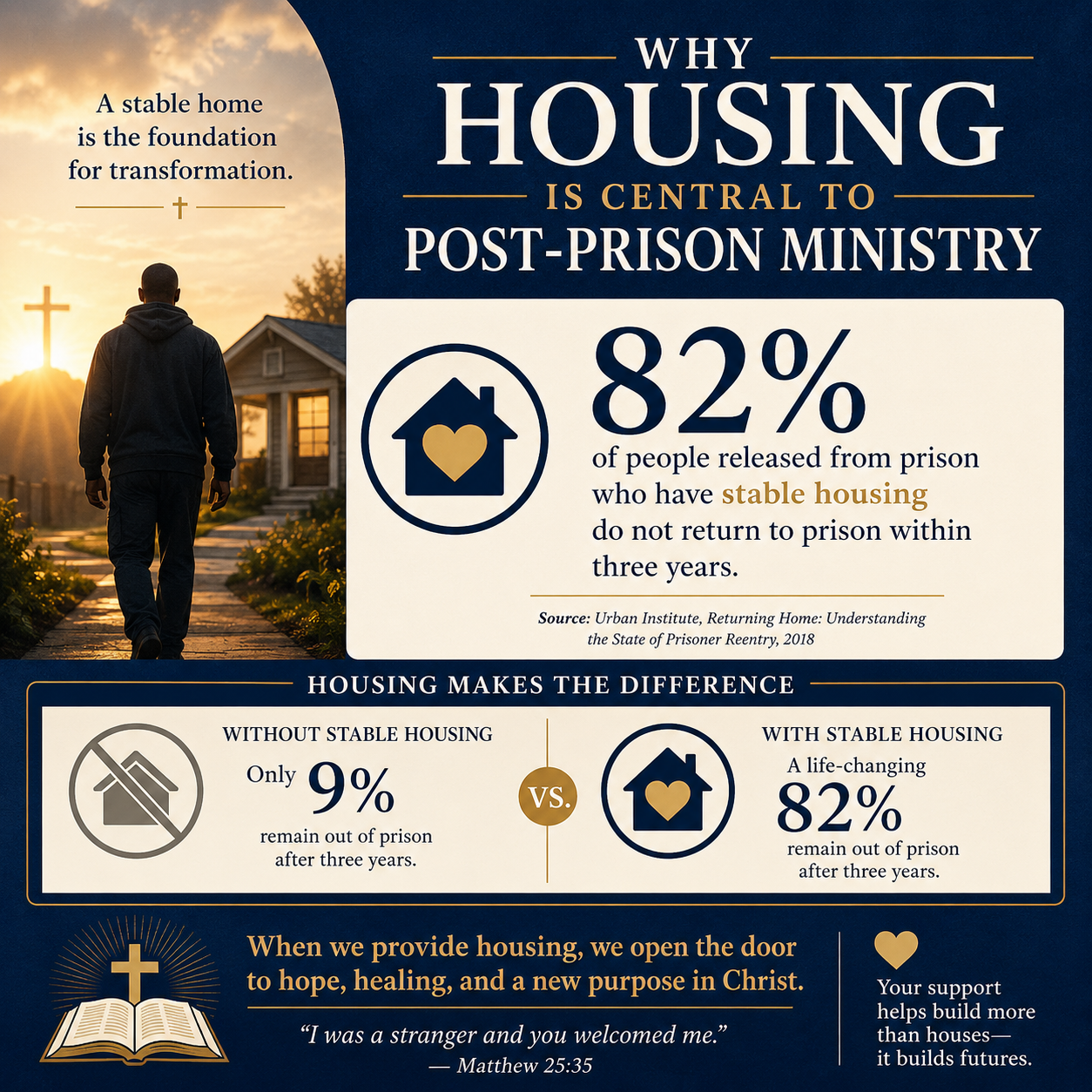
Housing is where habits either form or fracture. Stable housing creates the possibility of regular worship attendance, consistent employment, sobriety supports, and predictable parenting time. Instability creates a continuous state of hypervigilance, which is the opposite of the peace in which repentance, learning, and relational repair typically take root.
Hospitality is not identical to housing, but it points toward it
Christians sometimes reduce “housing ministry” to a narrow debate about whether churches should open their buildings overnight. That question has legitimate safety and liability complexities, and Christians genuinely disagree about best practices. Yet Scripture’s call to hospitality remains (Romans 12:13), and hospitality has institutional expressions: transitional homes, carefully governed host-home programs, or partnerships that secure leases for vetted residents.
When done well, housing ministry is not a sentimental bypass of accountability. It is an embodied form of mercy that can be structured with expectations, case management, and pastoral care.
What effective housing-centered reentry ministries tend to do
They build pathways, not just beds
A bed for a night can be lifesaving, but the long-term goal is stable, lawful, affordable housing with a credible plan for income and community support. Across our verification work at Most Trusted, the ministries that meet The Most Trusted Standard tend to define housing outcomes clearly and to show how housing integrates with discipleship, employment, and mental health supports rather than operating as a detached program.
Housing interventions usually fall into several models, each with trade-offs. Transitional housing can provide structure but can also become a bottleneck if move-out pathways are weak. Scattered-site housing vouchers can reduce institutionalization but require strong landlord relationships and tenant supports. Recovery housing can be transformative for some and inappropriate for others if it becomes a one-size-fits-all requirement.
They attend to safety, trauma, and neighbor impact without moral panic
The harder question is how to fund housing that protects both residents and surrounding communities. Wise ministries do not dismiss safety concerns as unspiritual, and they do not exploit fear to justify exclusion. They use screening appropriate to their setting, written house expectations, conflict-resolution processes, and partnerships with professional providers when clinical needs exceed a ministry’s competence.
Donors should expect clarity on policies that are often unspoken: whether residents with certain offense histories are eligible; how the ministry handles relapse; what supervision and curfews exist; and how resident dignity is protected in discipline processes.
- Clear eligibility criteria that avoid blanket assumptions while protecting vulnerable residents
- A documented pathway from intake to stable housing, not indefinite transitional stays
- Integrated case management that coordinates employment, IDs, transportation, and supervision requirements
- Trauma-informed practices that reduce chaos without infantilizing adults
- Meaningful spiritual care that respects conscience and avoids coercion
These are not merely program details. They are indicators that a ministry is treating housing as a stewardship trust rather than as an improvised act of compassion.
How donors can evaluate housing work with confidence
Apply a verification mindset to a compassion-heavy domain
Housing for returning citizens attracts both deep compassion and genuine risk. That combination can tempt donors toward two errors: cynicism that assumes failure is inevitable, or sentimental funding that assumes good intentions are enough. Most Trusted exists to help donors give with confidence by evaluating ministries against The Most Trusted Standard, a 15-criteria framework that tests whether a ministry’s theology, governance, financial integrity, and public claims cohere.
Because housing is expensive and operationally complex, it is a setting where governance and transparency are not optional. Donors should look for audited financials or credible independent reviews when available, clear conflict-of-interest policies, and a board with the capacity to oversee a property-intensive program. Ministries that publicly report measurable outcomes and explain their limitations candidly are often more trustworthy than those that only tell success stories.
Ask for evidence of effectiveness that matches the ministry’s claims
Some reentry programs promise dramatic reductions in recidivism, but the research landscape is complex. Definitions of “recidivism” vary, comparison groups matter, and selection effects are real. Mature ministries resist overstating results. They track what they can track, they distinguish between outputs and outcomes, and they partner with researchers when feasible.
For donors who want broader context on ministry to incarcerated and returning citizens, we maintain editorial coverage of Prison and Post-Prison Ministries, including the theological case for engagement and the practical questions that shape effectiveness over time.
For donors specifically focused on returning citizens, our work on Post-Prison Reentry Support for Returning Citizens addresses the interconnected interventions—housing, employment, documentation, mentoring, and church integration—that form a credible reentry pathway.
FAQs for Why housing is central to post-prison ministry
Is housing really a ministry priority, or should donors focus on evangelism and discipleship?
Christian ministry does not need to choose between spiritual care and material stability. Scripture refuses that separation. The church’s mercy has always been embodied, and stable housing often creates the conditions in which discipleship can be sustained over months and years rather than reduced to crisis visits. The most credible post-prison ministries integrate clear gospel proclamation with practical care, without coercion and without pretending that shelter alone is transformation.
What should donors ask before funding a transitional home or reentry housing program?
Donors should ask how residents are screened and supported, what the pathway is from transitional to permanent housing, how safety is handled for residents and neighbors, and what oversight exists for finances and property decisions. It is also wise to ask what outcomes are tracked and how the ministry defines success. Programs that can explain their policies and measurements plainly, and that submit to independent accountability consistent with The Most Trusted Standard, are generally better positioned for durable impact.
Housing is where credibility and compassion meet
Why housing is central to post-prison ministry is ultimately a question about whether we will address the concrete conditions that make repentance, responsibility, and restoration practicable. Stable housing does not save souls, but chronic instability reliably erodes the ordinary disciplines through which people rebuild a life. Donors who fund housing wisely are not stepping away from the heart of Christian ministry; they are underwriting one of the most decisive contexts in which that ministry can bear lasting fruit.



