
Why facility maintenance matters for Christian camps is not primarily an operational question. It is a spiritual stewardship question that shows up in roofs that hold, water that runs safely, cabins that meet code, and spaces where a teenager can hear the gospel without distraction or danger.
Donors often prefer funding what feels visibly “missional”: scholarships, evangelism programs, curriculum, or new construction. Yet the more mature camp ministries will say plainly that deferred maintenance can quietly erode every one of those aims. A camp can have faithful teaching and sincere leaders, and still place campers and staff at unnecessary risk if basic systems are neglected.
Facility maintenance is a form of neighbor love, not merely upkeep
Safety is not a secondary virtue
Christian camps exist to form disciples and create a setting where young people can encounter Christ with clarity. That purpose does not permit indifference to ordinary safety. Scripture binds love of God and love of neighbor together (Matthew 22:37–40). In a camp setting, “neighbor” includes children sleeping in cabins, seasonal staff cooking meals, and volunteers supervising waterfront activities.
What this means in practice is that maintenance is not a distraction from ministry; it is one of the ways ministry is made credible. A ministry that teaches the dignity of the person but tolerates exposed wiring, failing smoke alarms, mold, or unsafe docks is communicating a different doctrine with its buildings than with its words.
Christian camps carry heightened duty of care
Most camps serve minors and invite families to trust them with what is precious. That moral trust includes a heightened duty of care. Many states regulate camps through health departments, labor agencies, and building code enforcement; accreditation bodies add additional standards. Donors do not need to be experts in compliance, but we do need to recognize that maintenance is where compliance becomes concrete: inspections passed, hazards corrected, and incident risk reduced.
Deferred maintenance becomes a hidden tax on mission
The repair bill rarely shrinks with time
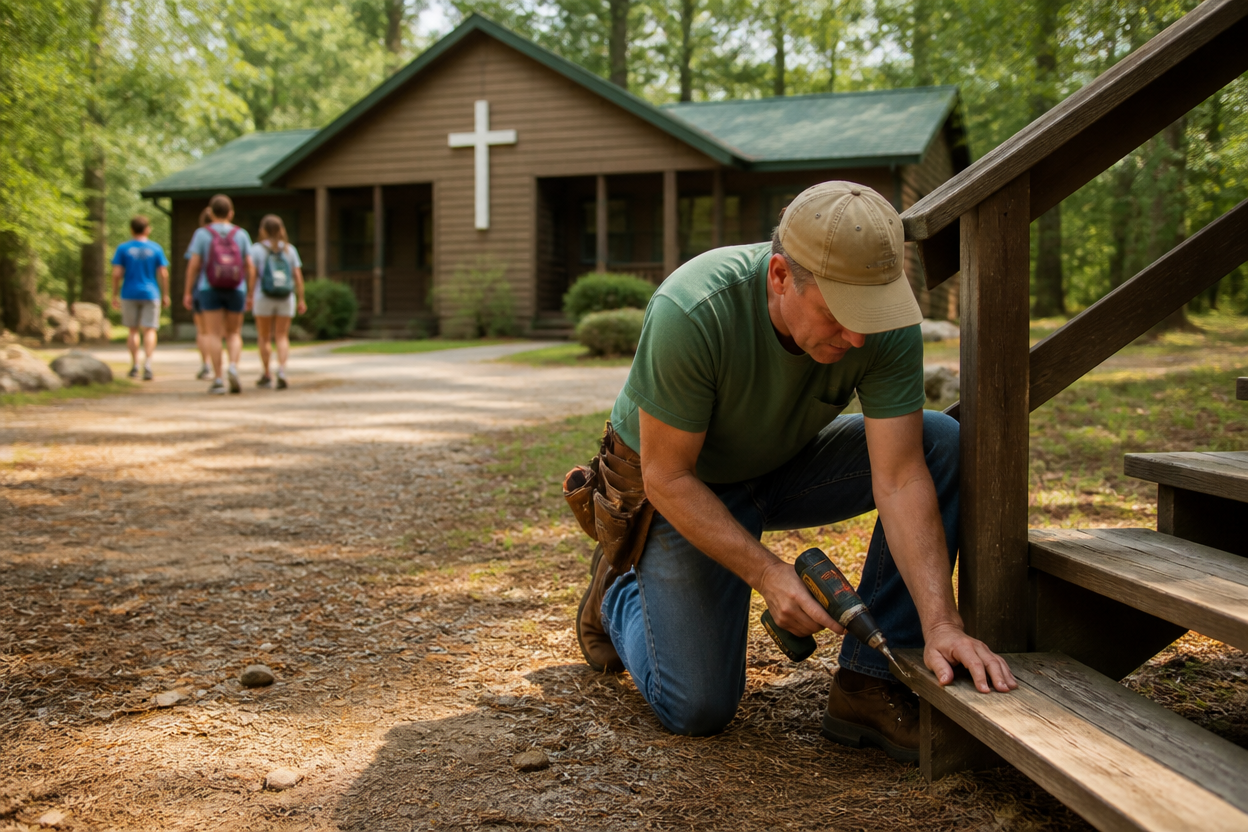
Deferred maintenance often looks like prudence in a tight year. It can also become a compounding liability. A small roof leak becomes structural damage; an aging HVAC system becomes a repeated emergency call; a failing septic system becomes a program shutdown. Wise boards treat maintenance less like a discretionary line item and more like an expected cost of operating a ministry campus.
Across our verification work at Most Trusted, we observe that ministries with consistent, planned maintenance funding tend to avoid the most destabilizing capital crises. The opposite pattern is also common: a ministry that underfunds maintenance for years eventually faces a single, urgent project so large that it crowds out scholarships, staffing, and programming.
Emergency repairs distort budgets and donor expectations
Donors regularly ask whether a ministry is “spending too much overhead.” The field has had to reckon with how that question can be misunderstood. Charity Navigator, Candid, and the BBB Wise Giving Alliance publicly rejected the simplistic idea that low overhead is a reliable measure of effectiveness in their “Overhead Myth” statement Charity Navigator. That does not mean spending is irrelevant; it means the category labels can conceal what actually strengthens mission.
Facilities spending is a clear example. Preventive maintenance can look like “overhead” on a pie chart, while the benefits show up as fewer injuries, fewer cancellations, and a campus that remains usable for decades. Conversely, emergency repairs can force ministries into unplanned borrowing, rushed contractor decisions, and restricted fundraising that feels perpetually urgent.
Maintenance shapes formation, not only functionality
Place teaches, even when no one is speaking
Christian camps are immersive environments. They form young people through teaching and worship, but also through rhythm, community, beauty, and order. A campus can quietly communicate whether we believe bodies matter, whether we expect truth to be lived, and whether our commitments endure beyond a single season.
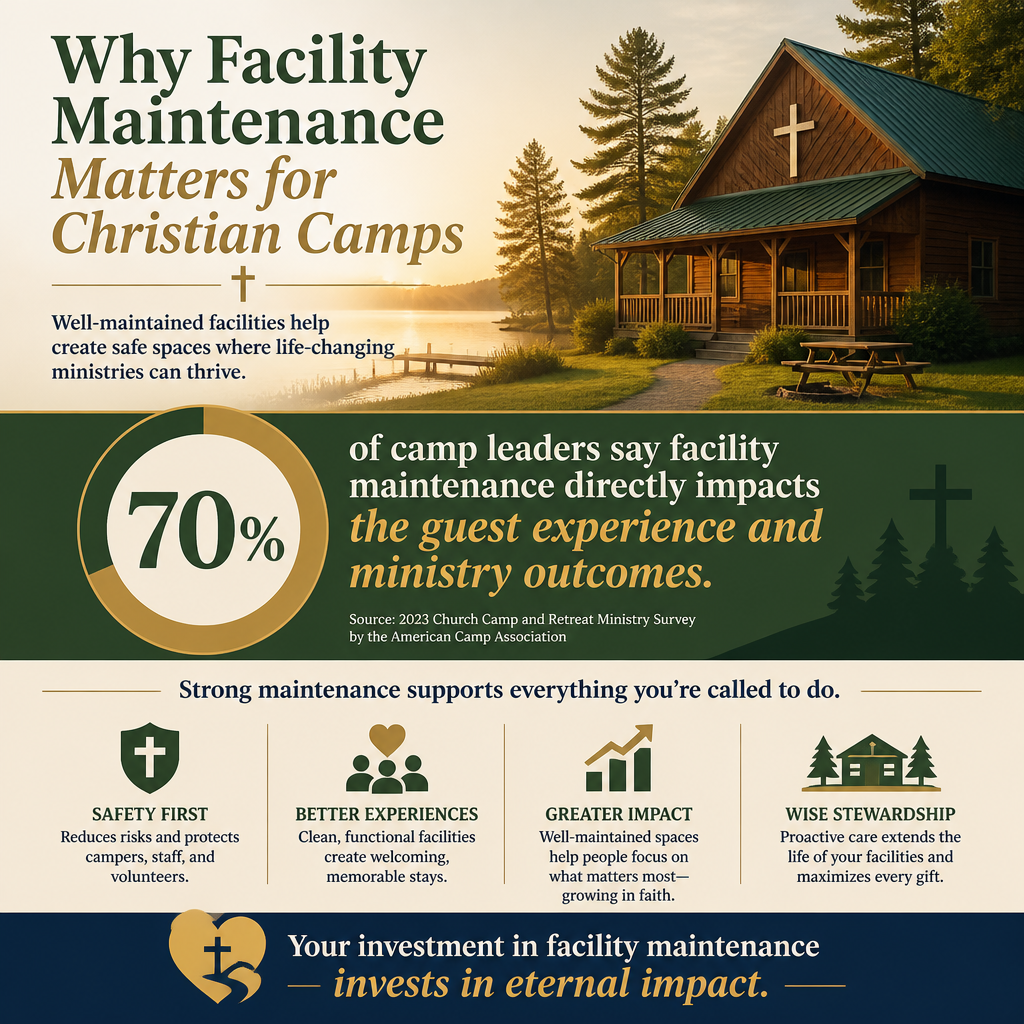
This is not an argument for luxury. It is an argument for integrity. Cleanliness, working bathrooms, safe bunks, and well-kept trails are not aesthetic indulgences; they are a practical affirmation that campers are worth careful attention. Camps often serve families who cannot afford many enriching experiences. Neglect can communicate to those families that they should accept less than dignifying care.
Staff retention and volunteer capacity are materially affected
Camps frequently rely on young adult staff and seasonal workers. Housing quality, reliable utilities, functional kitchens, and safe equipment all affect staff morale and retention. When a camp loses experienced staff, it loses program continuity and safety competence, and it spends more on training. The hidden cost of poor maintenance often shows up as turnover, not as a line item.
In donor terms, maintenance is one of the more direct ways a gift can stabilize a ministry’s capacity. Not every donor wants to fund staff housing repairs or a water heater replacement. Yet many donors do want to fund excellence and safety, and those goals depend on the physical campus.
Donors should evaluate maintenance through governance and transparency
The harder question is whether the board treats facilities as a fiduciary responsibility
Some maintenance needs are unpredictable. Many are not. A board that takes fiduciary responsibility seriously will expect a facilities condition assessment, a multi-year capital plan, and clear policies for reserves and restricted gifts. The ministries that meet The Most Trusted Standard tend to show evidence of planning rather than surprise: documented priorities, realistic timelines, and budgets that reflect lifecycle costs.
For donors, the key is not to demand perfection, but to look for candor and competence. When a ministry can name its top deferred maintenance risks, explain why they exist, and articulate a plan to address them, donors can give with clearer confidence. When leadership cannot answer basic questions about roofs, electrical capacity, fire suppression, waterfront safety, or ADA access, donors should slow down and ask why.
What donors can ask without drifting into micromanagement
Sophisticated donors do not need to manage a camp. We do, however, need to ask the kinds of questions that reveal whether a ministry is truthful about its risks and disciplined about stewardship. The aim is not suspicion; it is clarity.
- Do you have a current facilities assessment or capital plan for the next three to five years?
- Which systems are highest risk right now: roofs, electrical, plumbing, HVAC, waterfront, vehicles?
- How do you fund preventive maintenance, and what is your policy for reserves?
- What inspections or accreditations apply to your camp, and were there any recent findings?
- How do you decide whether a project should be funded through operations, a capital campaign, or restricted gifts?
As donors engage this category of giving, it is often helpful to understand the broader landscape of camp ministry and how facilities relate to program outcomes. Many readers begin with Christian Camps and Conferences as a context for how ministries describe impact, safety, and formation in an environment built around place.
Funding maintenance can be one of the most strategic gifts
Maintenance gifts protect scholarships and spiritual programming
Donors sometimes worry that a maintenance gift is merely “keeping the lights on.” That concern is understandable; Christian donors have seen ministries raise funds for operations without a clear account of results. Yet in camps, “keeping the lights on” is often what keeps the waterfront open, the dining hall in compliance, and the cabins habitable. It also keeps scholarship dollars from being diverted into crises.
A strategic donor can treat maintenance as protective capital: it safeguards what already works. Many camps have a long track record of faithful teaching and measurable spiritual fruit. The most responsible way to honor that fruit may be to ensure the campus remains safe and functional for the next generation of campers.
Restricted gifts require clear reporting and disciplined execution
Maintenance funding is also an area where restricted gifts can either help or complicate. A donor may want a gift restricted to “the roof on Cabin 7” or “the septic system.” That can be appropriate when the project is clearly defined. But overly narrow restrictions can trap a ministry if bids come in higher than expected, if permitting changes the scope, or if a different failure becomes urgent.
Wise ministries communicate this complexity before money is accepted: they define project scope, contingencies, and reporting cadence. Wise donors ask for that clarity and allow enough flexibility for responsible execution. Our category coverage on Funding Christian Camp Facilities and Capital Needs addresses how donors can fund facilities without creating perverse incentives or chronic crises.
FAQs for Why facility maintenance matters for Christian camps
Should donors prioritize programs over facility maintenance at Christian camps?
Not as a blanket rule. Programs are central, but programs depend on safe, compliant, and functional spaces. When maintenance is neglected, the eventual crisis often absorbs far more funding than steady preventive work would have required, and it can force program cuts or cancellations. The better donor question is whether the camp has a disciplined plan that integrates program goals with lifecycle costs for its campus.
How can donors tell whether a camp is managing facilities responsibly?
Responsible camps can describe their highest facility risks, show evidence of planning, and report clearly on how funds are used. Donors can ask for a facilities assessment or capital plan, recent inspection outcomes, and the ministry’s policy for reserves and preventive maintenance. In our verification work, transparency and governance discipline are often the clearest indicators that facilities dollars will be stewarded well.
A well-kept campus is often the quiet difference between fruitfulness and fragility
Christian camps are places where the Word is preached, friendships are forged, and many vocations are quietly redirected toward Christ. Facility maintenance matters because it protects those holy opportunities from preventable disruption. For donors who want to give with confidence, funding maintenance is not settling for the mundane; it is investing in stewardship that makes ministry durable, safe, and credible.



