

How much does it cost to sponsor a Christian camper? In most cases, a meaningful sponsorship ranges from a few hundred dollars for partial aid to roughly a thousand dollars or more for a full week of camp, depending on the camp’s staffing model, facilities, and scholarship philosophy.
For Christian donors, the harder question is not only the dollar figure. It is whether a sponsorship is structured as faithful mercy and wise stewardship: meeting a real need without creating dependency, honoring family dignity, and supporting a ministry that is governed and reported with clarity.
What donors are usually paying for when they sponsor a camper
Camp scholarships are often described as “sending a child to camp,” but the underlying cost is a bundle of real inputs. The typical fee covers food service, cabins and maintenance, trained summer staff, program materials, insurance, background checks, and year-round administration. Many camps also carry significant fixed costs that remain whether a session is full or not.
Across the Christian camp landscape, scholarship dollars commonly function in one of two ways: they either offset a specific camper’s tuition, or they underwrite the camp’s ability to maintain lower prices for everyone through broader fundraising. Both approaches can be honorable, but they have different implications for transparency and for the kind of reporting a donor can reasonably expect.
Typical price ranges and what drives them
Camps vary widely. Regional day camps can be materially less expensive than residential camps. Specialty camps with waterfronts, equestrian programs, or high staff-to-camper ratios tend to cost more. Accreditation, medical staffing, and safety protocols also carry real costs that do not show up in promotional copy.
One credible way to estimate the “all-in” environment is to look at the broader market for resident youth camps. The American Camp Association’s camp trends reporting reflects that camps have faced rising costs and have passed a portion to families through tuition increases over time American Camp Association. That does not tell a donor what any specific Christian camp charges, but it explains why scholarship needs persist even when a camp seems well attended.
Partial sponsorship, full sponsorship, and the common gap
Many camps use a “shared sacrifice” model: the family pays something, the church or donor pays something, and the camp carries a portion through fundraising or discounted rates. This matters because it shapes whether a $250 gift is decisive or merely helpful. Mature scholarship programs clarify the expected family contribution and explain how donor support fits into the financial architecture.

How to translate a gift amount into a realistic sponsorship plan
Donors tend to prefer clean narratives: “$X sends one child.” The field is often more complex. A camp may offer a published “sponsor a camper” amount that reflects an average scholarship, not the full tuition. That is not inherently misleading, but it can be unclear if a donor assumes a one-to-one relationship between gift and outcome.
What this means in practice is that donors should treat sponsorship as a plan rather than a slogan: decide what level of impact is intended, and then ask the camp to define what that level funds.
A practical giving ladder
- $100–$250: helps close smaller gaps, covers deposits, or offsets transportation and gear for low-income families
- $250–$600: commonly funds a partial scholarship for a week of resident camp or a substantial portion of day camp
- $600–$1,200: often aligns with a full week of resident camp tuition in many regions and traditions
- $1,200+: may cover tuition plus extras such as medical fees, travel assistance, or a second child from the same household
Those ranges are intentionally broad because tuition is not standardized. The donor’s most faithful next step is to ask for the camp’s current schedule and scholarship policy, including whether the published amount includes registration fees, activity fees, or required add-ons.
Why “full sponsorship” can be a misleading phrase
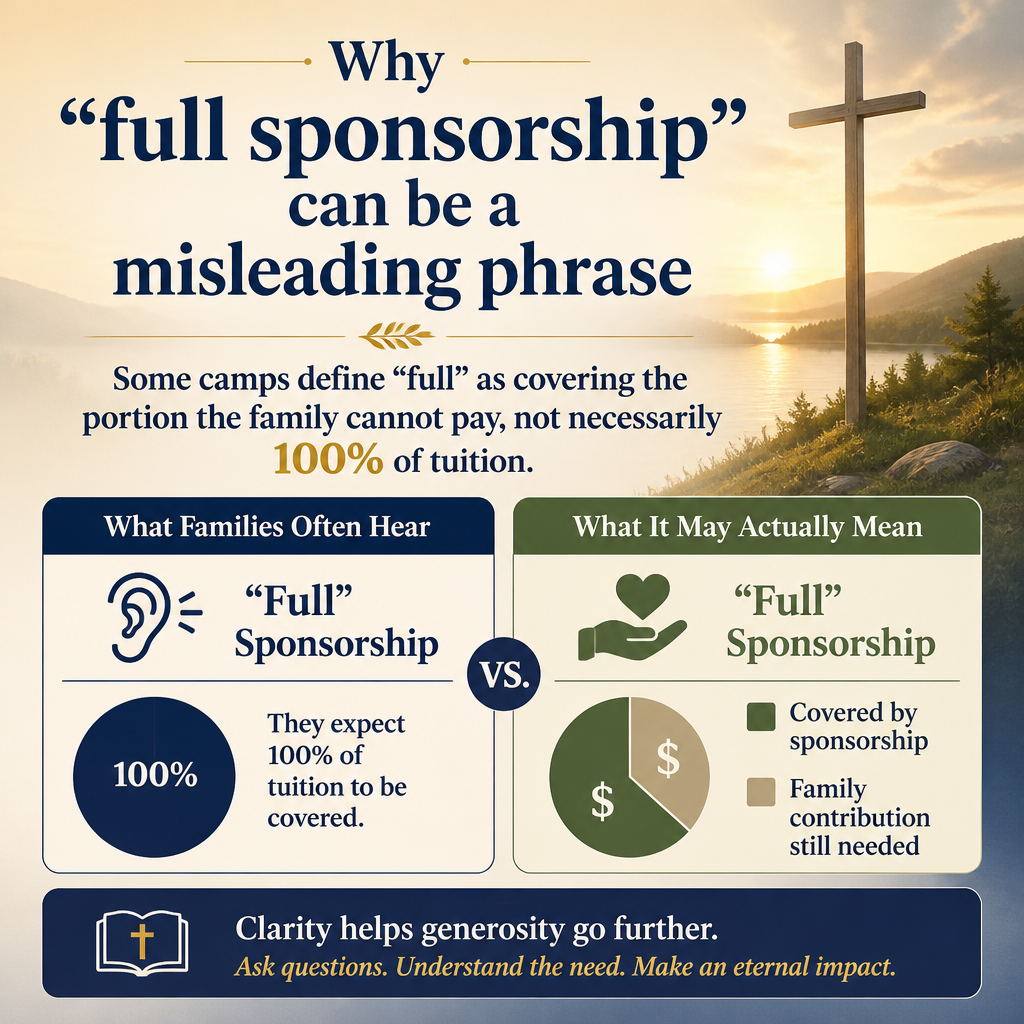
Some camps define “full” as covering the portion the family cannot pay, not necessarily 100% of tuition. Others use “full scholarship” to mean the camp waives tuition while raising replacement revenue through general fundraising. The ethical issue is not which model is used; it is whether the camp communicates plainly and reports consistently. Donors can support either model with a clear conscience when the ministry is transparent about where the funds go and what outcomes are being claimed.

Scholarships, dignity, and spiritual formation are linked
Christian camp is not merely recreation. Many camps understand themselves as a ministry of the Word: teaching Scripture, forming habits of prayer, and placing young people in a Christian community away from ambient pressures. Sponsorship becomes a form of discipleship support, even if the donor never meets the camper.
Scripture’s insistence on justice and mercy does not permit sentimental giving that bypasses discernment. “Whoever is generous to the poor lends to the LORD” (Proverbs 19:17), yet generosity is not the same as naivete. A scholarship program should protect families from shame, avoid coercive spiritual tactics, and treat the camper as a person to be served rather than a story to be marketed.
Shared sacrifice and the danger of extraction
Christians genuinely disagree about the right family contribution in scholarship models. Some argue that any required payment can exclude the poorest families; others argue that a meaningful contribution preserves agency and reduces no-show rates. Both concerns have merit. What we recommend is that camps articulate their rationale and make exceptions with pastoral discretion.
The more serious danger is “extraction”: collecting emotionally compelling testimonies as a condition of aid, or using identifiable photos of minors in fundraising without careful consent. Donors can insist on better. A camp can report impact in aggregate and still be transparent.
When Helping Hurts and the scholarship question
The When Helping Hurts framework, articulated by Steve Corbett and Brian Fikkert, has shaped Christian thinking about assistance by emphasizing that poverty is often relational and that help can unintentionally harm when it undermines responsibility or community ties When Helping Hurts. Camp scholarships are not identical to international relief, but the same moral logic applies: assistance should strengthen, not replace, the responsibilities and relationships that God has assigned to families, churches, and communities.
For donors, this often means preferring scholarship programs that are coordinated with local churches, that have clear expectations, and that avoid treating the scholarship as a transactional purchase of spiritual outcomes.
What trustworthy camps disclose before accepting scholarship dollars
Because donors are funding ministry to minors, the bar for clarity should be high. A camp does not need to disclose private family details, but it should disclose policies, financial practices, and safeguards. Across our verification work at Most Trusted, we observe that ministries that meet The Most Trusted Standard tend to publish more than inspiring stories: they provide concrete governance information, financial reporting, and clear explanations of how restricted gifts are handled.
Donors evaluating Christian camp giving may find it helpful to understand the broader context of Christian Camps and Conferences, including how different ministry models handle tuition, fundraising, and reporting.
Documents and answers donors should expect
Before giving at meaningful scale, donors can reasonably ask for:
- The current tuition schedule and what is included
- The scholarship policy, including eligibility and expected family contribution
- Whether a gift will be treated as restricted to scholarships or as general support
- Basic financial statements or a recent annual report
- Governance disclosures: board oversight, conflict-of-interest policy, and who sets compensation
Many donors have been trained to fixate on administrative overhead. The sector has had to correct that impulse. Charity Navigator, Candid, and the BBB Wise Giving Alliance jointly argued that overhead ratios are a poor proxy for effectiveness and can pressure nonprofits into underinvesting in accountability and infrastructure Charity Navigator. Camps, in particular, require serious spending on safety, training, and facilities. The appropriate question is whether spending is truthful, governed, and aligned with mission.
Restricted gifts and the ethics of designation
Designating a gift “for scholarships” can be wise, but donors should confirm how restrictions are honored. Some camps treat scholarship giving as a general scholarship fund used across the summer; others allow designation to a specific camper identified through a church. Either can be appropriate if the camp is clear and does not make promises it cannot keep (for example, guaranteeing one camper’s attendance when enrollment depends on medical forms, family follow-through, and child protection policies).
Those who want a deeper view into the mechanics can consult How Christian Camp Scholarships Work, where the underlying decisions—eligibility, reporting, and stewardship—become visible.
How we recommend donors sponsor a camper with confidence
A sponsorship is most faithful when it is both generous and accountable. The donor’s goal is not control, but clarity: understanding what is being funded and what claims are being made in Christ’s name.
For many donors, the most effective posture is to commit to a scholarship fund for multiple seasons, ask for aggregated reporting, and encourage the camp to coordinate with local churches. That respects the camp’s operational reality and avoids pressuring staff into performative storytelling.
Questions that surface stewardship without suspicion
These questions tend to clarify the sponsorship relationship quickly:
- What is the average scholarship amount awarded per camper, and what range is typical?
- What percentage of scholarship recipients come through churches versus direct applications?
- How do you protect camper privacy while reporting impact to donors?
- What safeguards are in place for staff screening, child protection, and incident reporting?
- If a donor designates a gift for scholarships, how is that restriction tracked and reported?
We also recommend donors watch for internal coherence: the camp’s theology of discipleship should match its financial practices. A ministry that speaks with gravity about spiritual formation should also treat donor funds with the same seriousness.
FAQs for How much does it cost to sponsor a Christian camper
Can $100 make a meaningful difference, or is that too small to matter?
$100 can matter materially when a scholarship program is designed to close gaps rather than fund only full rides. It may cover registration deposits, required gear, or transportation assistance that blocks attendance for families with constrained cash flow. Donors can ask the camp how smaller gifts are applied so the impact is concrete rather than symbolic.
Should we sponsor one camper fully or contribute to a general scholarship fund?
Both can be faithful choices. Sponsoring a specific camper can be appropriate when a church or trusted partner is coordinating the relationship and privacy is protected. Contributing to a general scholarship fund often gives the camp flexibility to allocate aid where the need is greatest and to manage last-minute changes in enrollment. The deciding factor is not sentiment but transparency: whether the camp can explain how funds are tracked and what it will report back.
A sponsorship cost is only the beginning of the stewardship question
The cost to sponsor a Christian camper is usually measured in hundreds of dollars, sometimes more. The deeper measure is whether the gift strengthens a ministry that is spiritually serious, operationally safe, and transparent about finances and outcomes. When donors give with both mercy and discernment, camp scholarships can become a quiet instrument of discipleship that honors Christ and protects the vulnerable.



