
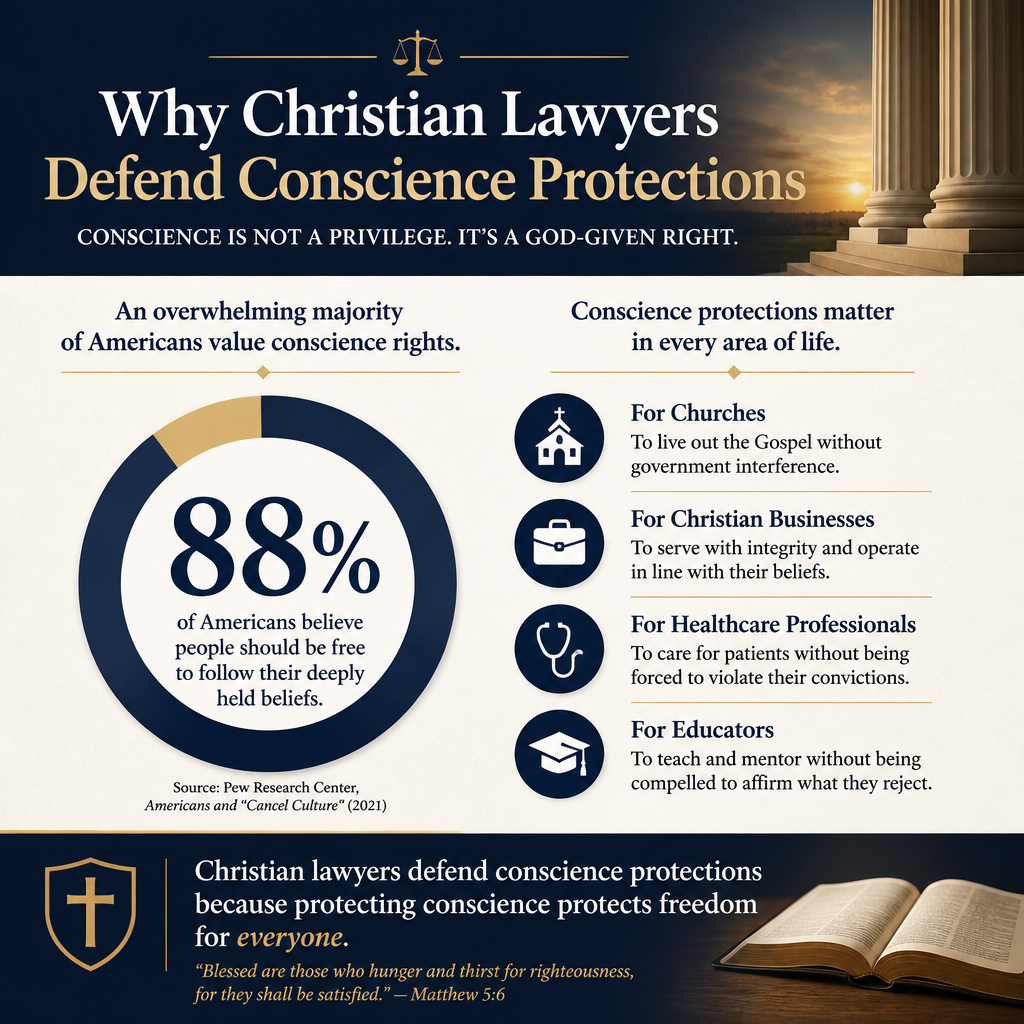
Why Christian lawyers defend conscience protections is not a niche question for culture-war enthusiasts. It is a practical question of whether Christian institutions and Christian neighbors can continue to act with integrity when law, professional licensing, and public funding increasingly require moral conformity.
For Christian donors, the stakes are rarely abstract. Conscience conflicts surface in adoption and foster care, health care, education, employment policy, prison ministry, and ordinary commerce. When ministries face investigations, de-licensing, or compelled speech, the immediate temptation is to treat legal defense as a distraction from “real ministry.” The harder truth is that legal clarity can be one of the conditions that makes long-term ministry possible.
Conscience protections are about integrity before God and neighbor
Conscience is not preference
In Christian moral tradition, conscience is not a personal brand or a shield for eccentricity. It is the faculty by which a person stands accountable before God in obedience to truth rightly understood. Scripture assumes that conscience can accuse or excuse (Romans 2:15), can be seared by habitual sin (1 Timothy 4:2), and can be strengthened by truth. In other words, conscience is morally weighty precisely because it is answerable to something beyond the self.
That is why Christian legal advocates speak carefully about conscience protections. The point is not that Christians deserve a private exemption from public life. The point is that a free society should resist coercing people to speak, participate, or materially cooperate in what they believe God forbids, especially when there are workable alternatives that preserve both equal access and moral integrity.
Pluralism requires room for conviction
Christians genuinely disagree about the best policy mechanisms for protecting conscience. Some emphasize broad statutory protections. Others fear that poorly drafted exemptions can be weaponized or can undercut legitimate civil rights claims. Serious Christian lawyers generally share a narrower concern: when the law collapses the category of moral conviction into mere bias, it becomes difficult to preserve a principled pluralism.
The modern jurisprudence of “compelled speech” reflects this tension. The Supreme Court has repeatedly affirmed that the First Amendment protects against being forced to speak messages one does not believe, including in highly contested moral contexts. The Court’s decisions are debated, but the underlying principle is not frivolous: the state should be cautious about drafting law in a way that requires persons or organizations to affirm contested moral claims as the price of participation in public life.

Family and life ministries face recurring legal pressure points
Adoption and foster care and the problem of exclusion by contract
Few donor communities have supported family ministry as consistently as Christians. Yet adoption and foster care providers operate under state contracts, licensing standards, and nondiscrimination rules that can change quickly. Where governments treat historic Christian teaching on marriage and sexual ethics as disqualifying, ministries may be pressured to close, to withdraw from public partnerships, or to abandon their confession in practice.
The most cited recent example is Fulton v. City of Philadelphia (2021), where the Supreme Court held that Philadelphia violated the Free Exercise rights of Catholic Social Services by refusing to contract with them unless they agreed to certify same-sex couples as foster parents. The Court’s opinion turned on the city’s discretionary exemptions, but the practical implication was plain: governments cannot casually use contracting power to require religious organizations to contradict their faith. The Court’s decision is publicly available through the Supreme Court’s site at the Supreme Court of the United States.
For donors who care about children, this is not theoretical. When faith-based providers exit, communities lose experienced recruiters of foster families, stable case-management capacity, and long-standing relationships with churches. Conscience protections in these settings are often less about “winning” and more about keeping more faithful providers in the system.
Health care and the challenge of moral complicity
Health care ministries and Christian clinicians also encounter conflicts around abortion, sterilization, assisted suicide, and gender-related medical interventions. Federal and state conscience statutes exist, but their application can be uneven. The details matter: protections for refusal to perform a procedure are not always the same as protections against referrals, insurance coverage mandates, or training requirements.
Christian lawyers tend to frame these disputes in terms of material cooperation and moral complicity. Donors may not use those theological categories in daily conversation, but they recognize the human reality: a Christian nurse should not have to choose between feeding a family and participating in what she believes is the taking of innocent life. That conviction has deep roots in Christian ethics and, historically, in American law’s respect for religious exercise.
Those who give within the world of family and life work often want a map of the landscape. We publish related analysis and ministry verification within Christian Legal Services for Family and Life Issues because these pressures tend to concentrate there.
Christian lawyers defend conscience because the law teaches the culture
Rights language can be thin and still necessary
Some Christian donors have legitimate discomfort with rights-centered rhetoric. Scripture frames human dignity in creation and redemption, not in autonomous self-assertion. Yet in a constitutional order, rights language is one of the primary tools available to restrain state coercion. Christian legal work in this area often functions as a kind of defensive apologetic for public life: it does not claim that courts can make people virtuous, but it does insist that government should not punish conscience simply because it is inconvenient.
When legal regimes normalize compelled participation, they do not remain confined to rare edge cases. They shape professional accreditation standards, human resources policies, and the moral assumptions embedded in public institutions. That is why legal defense can have disproportionate influence: it clarifies whether space remains for moral dissent without social exile.
Compelled speech and compelled association are not academic concerns
Speech cases are frequently caricatured, including by Christians. The core question is usually straightforward: can the state require a person or organization to use words, symbols, or professional services to communicate a message that violates conviction? One does not need to agree with every litigant’s posture to see the danger of an expansive compelled-speech doctrine.
The American tradition has long treated compelled speech as a serious threat to liberty. That tradition is not uniquely Christian, but Christians have often benefited from it. When ministries can articulate what they believe without being forced to affirm what they do not, they can serve their neighbors with candor rather than with double-speak.
Donors should weigh both mission clarity and public credibility
There are real risks of overreach and unforced error
Legal advocacy can be done well or poorly. Some organizations adopt maximalist postures that read more as partisan performance than moral seriousness. Others fail to anticipate how a case will be heard by those outside the Christian community, undermining credibility and making future protection harder. Christians should not pretend these temptations do not exist.
The ministries that sustain long-term trust tend to pair principled conviction with careful fact patterns, disciplined public communication, and a realistic assessment of what courts can and cannot do. In our verification work at Most Trusted, we often find that the most durable legal ministries are not the most incendiary. They are the ones with stable governance, transparent finances, and clear theological commitments that are consistently reflected in policy and practice.
What faithful support can look like
Christian donors are not obligated to fund every legal fight. But donors who care about conscience should ask whether the organization’s work reflects Christian moral reasoning, legal competence, and an institutional posture that honors both truth and neighbor-love. Practical indicators include:
- Clear theological commitments that are publicly stated and consistently applied
- A track record of careful case selection, not constant emergency fundraising
- Transparent reporting on outcomes and litigation posture
- Governance structures that reduce founder-centric risk and ensure accountability
- Financial integrity that avoids inflated claims and opaque related-party transactions
These are not merely technical concerns. They are stewardship concerns. When donors fund legal work, they fund an organization’s judgment as much as its mission. That is one reason we evaluate ministries against The Most Trusted Standard, so givers can distinguish durable institutions from moment-driven advocacy.
Verification matters because legal ministries trade in trust
Litigation creates incentives that can distort ministry
Public-interest law is an unusual sector. It can reward attention more than accuracy, and crisis more than patience. A fundraising email can be written in five minutes; the credibility cost of exaggeration can last for years. Donors should assume that incentives toward simplification exist on all sides of contested cases, including within Christian ecosystems.
That does not mean Christian legal ministries are untrustworthy. It means donors should apply mature due diligence. The church has learned in other domains that urgency can be exploited. Legal work is no exception, especially when issues touch family, sexuality, and life.
How Most Trusted approaches conscience-related ministries
Most Trusted exists to help donors give with confidence to Christian nonprofits by assessing them against The Most Trusted Standard, a 15-criteria framework across faith commitment, financial integrity, governance and leadership, and transparency and effectiveness. Across our verification work, we observe that the healthiest legal services ministries tend to do three things well: they state their theology without evasiveness, they document their work without theatrics, and they maintain governance practices that can withstand public scrutiny.
When a ministry’s public claims outpace verifiable evidence, the credibility cost is not confined to that organization. It spills into the wider Christian witness. By contrast, when a ministry can show careful documentation, measured communication, and accountable leadership, it strengthens the plausibility of conscience itself as a serious moral category.
Donors who want to explore this field more broadly can review our coverage of Christian Legal Services Ministries, where we track patterns of strength and risk across the sector.
FAQs for Why Christian lawyers defend conscience protections
Are conscience protections simply a way to avoid serving certain people?
They can be misused that way, and Christians should say so plainly. Properly framed, conscience protections are aimed at preventing compelled participation in specific acts or messages, not at denying the dignity of persons. Many disputes hinge on whether the law is targeting identity-based exclusion or coercing moral endorsement. The moral and legal analysis differs, and wise policy tries to protect equal access while also preserving space for deep conviction.
Should Christian donors prioritize legal defense over direct service?
Direct service remains central to Christian love of neighbor, and legal defense is not a substitute for mercy. Yet legal defense can preserve the institutional freedom that makes direct service possible over decades. Donors can think in terms of complementarity: some gifts sustain frontline care, and some gifts sustain the conditions under which that care can remain faithful and publicly accessible.
A faithful public square requires room for conscience
Christian lawyers defend conscience protections because coerced speech and compelled participation erode integrity, and integrity is not optional for the church. A society that makes moral conformity the price of ordinary participation will eventually force Christians to choose between public service and truthful witness.
For donors, the question is not whether every claim made in the name of conscience deserves support. The question is whether the ministries defending conscience do so with theological seriousness, legal competence, and accountable institutional life. Where those marks are present, supporting conscience protections can be a form of long obedience that serves both the church and the common good.



