
Understanding how pro-life legal cases move through court is not merely civic literacy; it is a stewardship issue for Christian donors. Court decisions reshape what pregnancy help, adoption, and family-serving ministries may do, what they must document, and how they can speak. For donors who want to protect the vulnerable without confusing political victory with gospel faithfulness, a clear view of the legal process is part of giving with discernment.
Christians genuinely disagree about strategies, tone, and policy details in the public square. Yet Scripture’s insistence that every human being bears God’s image (Genesis 1:27) gives pro-life advocacy its moral gravity, and the command to seek justice for the oppressed places obligations on institutions as well as individuals (Isaiah 1:17). The courts are one of the primary institutions through which those obligations are contested, clarified, and enforced.
1. Cases begin as real disputes with real plaintiffs
Standing, injury, and why courts do not issue moral essays
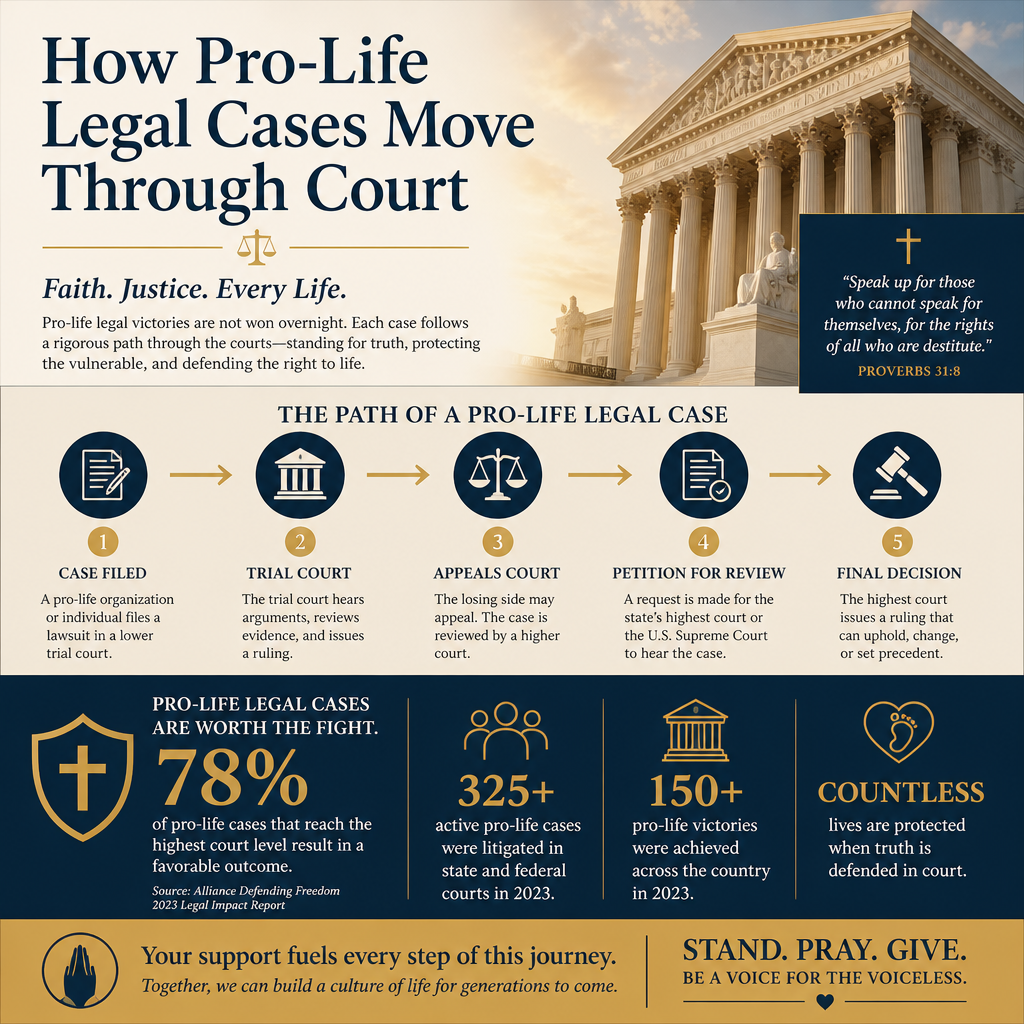
Pro-life cases do not start as abstract debates; they begin with a plaintiff claiming a legal injury and asking a court for relief. In federal court, the Constitution requires “standing”—a concrete, particularized injury that is fairly traceable to the defendant and likely to be redressed by the court’s decision. That threshold shapes pro-life litigation: a ministry may be deeply burdened by a policy in principle, but if it cannot show a legally cognizable injury, the courthouse doors may remain closed.
This is one reason many pro-life legal disputes are brought by regulated entities: physicians, clinics, hospitals, state agencies, or pregnancy help organizations. The case is not “Is abortion right?” but “Is this statute constitutional?” or “Did this regulation exceed statutory authority?” That does not reduce the moral stakes; it clarifies what judges are permitted to decide.
State courts, federal courts, and the path chosen at the start
Pro-life litigation often begins in state court because many post-Dobbs conflicts are grounded in state constitutions and state statutes. Other cases begin in federal court because plaintiffs raise federal constitutional claims or because federal agencies and regulations are implicated. The choice matters: different procedural rules apply, and the appellate path will differ.
For donors, what this means in practice is that a ministry’s legal strategy should be intelligible in light of its mission. Across our verification work at Most Trusted, we observe that well-governed legal ministries can explain why they filed where they did, what relief they sought, and what trade-offs they accepted rather than treating litigation as a communications campaign.

2. Early stages shape the case more than most headlines admit
Emergency relief and the power of the first hearing
Many high-profile pro-life cases are effectively decided at the emergency stage. A temporary restraining order or preliminary injunction can freeze enforcement of a law for months or years while the case proceeds. Courts apply specific standards when issuing preliminary injunctions, including likelihood of success on the merits and irreparable harm, and those early findings can influence settlement dynamics and later rulings.
The public often experiences this as whiplash: a law passes, then a judge blocks it, then an appellate court partially reinstates it. The legal system is not designed for instant finality; it is designed to test claims through adversarial process while limiting irreversible harms. The tension for pro-life advocates is that the very harms at stake—death, disability, coercion, and conscience violations—are not easily “paused.”
Discovery and the battle over facts
Not every case turns on disputed facts, but many do. Discovery can include depositions, document production, expert testimony, and statistical evidence. In a pro-life context, disputes can involve medical standards, fetal development, the availability of emergency care, coercion and trafficking indicators, and the real-world effects of regulatory regimes on women and families.
Donors should expect that serious legal work is slow and costly partly because it must be. Weak factual development invites judicial skepticism and can create precedents that harm the movement for decades. Ministries that treat evidence as a moral inconvenience rather than a legal necessity put their own cause at risk.
3. Appeals are not a reset; they are a narrowing of issues
Appellate courts review what happened below
When a case is appealed, appellate judges usually do not rehear the case from scratch. They review the record created in the trial court. They apply different “standards of review” depending on the issue—legal questions are reviewed more freely; factual findings and discretionary decisions receive more deference. This is why decisions made early—what claims were preserved, what evidence was introduced, what objections were raised—often matter as much as the eventual legal theory.
Pro-life donors sometimes assume that a “bad judge” can be easily corrected on appeal. Sometimes that is true. But appellate outcomes are constrained by the record and by procedural posture. An organization that overpromises certainty in litigation is usually selling confidence rather than practicing it.
The Supreme Court hears few cases, and timing is a discipline
The U.S. Supreme Court receives thousands of petitions each term and grants review in a small fraction. According to the Court’s own published statistics, it typically hears on the order of several dozen cases per term rather than hundreds (Supreme Court of the United States). That reality disciplines pro-life strategy: most legal outcomes are determined in state supreme courts, federal circuit courts, and through legislation and administrative action that never reaches the nation’s highest court.
This also means that “winning” in a lower court can be a fragile victory if the reasoning is narrow or the record is thin. Conversely, a loss can become an opportunity to clarify arguments, refine legislative drafting, and prepare better cases that will withstand higher review.
4. After Dobbs, the arena shifted to states and administrative law
State constitutions, ballot measures, and statutory drafting
Dobbs returned significant authority to the states, and the immediate result has been a patchwork of statutes, constitutional interpretations, and ballot initiatives. The legal arguments now often involve state constitutional privacy clauses, equal protection theories under state law, and the meaning of health exceptions. These are not merely legal technicalities; they are the mechanisms by which communities set boundaries around coercion, medical judgment, and the rights of the unborn.
For donors, the harder question is how to fund work that is both principled and patient. Litigation can stop or permit particular practices, but it rarely forms the social conditions that make abortion unthinkable. Churches and ministries must still do the long work of material support, discipleship, and protection for women and children.
Federal agencies and the influence of regulation
Many pro-life disputes now arise through administrative action: agency rules, enforcement priorities, guidance documents, and funding conditions. These often move faster than legislation and can affect conscience protections, hospital obligations, and grant requirements for social services. Administrative law has its own doctrines—statutory authority, arbitrary-and-capricious review, and procedural compliance—that can be decisive regardless of the moral seriousness of the underlying issue.
Those who fund legal work should be attentive to whether a ministry has the capacity to engage both courts and rulemaking processes. Filing public comments, building coalitions, and monitoring agency actions can prevent harmful policies from hardening into entrenched practice.
5. Donor due diligence for legal ministries requires more than shared convictions
What fruitfulness looks like in court-centered work
Legal advocacy is unusually vulnerable to performative incentives: press cycles, fundraising spikes, and the temptation to equate publicity with impact. Christian donors have every right to ask for measurable indicators of competence: quality of filings, credible partnerships, careful selection of plaintiffs, and a willingness to accept incremental victories when the law requires them.
A useful discipline is to examine whether a ministry can articulate its theory of change beyond “win the case.” Court victories can be narrow and still strategically meaningful; losses can be anticipated and still necessary to clarify a conflict. The key is whether leadership treats litigation as a form of stewardship rather than a stage.
Practical questions we recommend donors ask
Across our verification work at Most Trusted, the ministries that meet The Most Trusted Standard tend to show clarity in mission, documentation, and governance precisely because litigation magnifies risk. When evaluating Christian legal services ministries working on family and life issues, we recommend asking:
- How does the ministry choose cases, and what criteria disqualify a potential case?
- Who bears legal risk and reputational risk, and how is the client protected?
- What is the ministry’s posture toward truthfulness in public communications when facts are contested?
- How does the organization measure impact beyond courtroom outcomes?
- What safeguards exist for conflicts of interest, board oversight, and financial accountability?
Donors who want broader context on the landscape can consult Christian Legal Services Ministries for how different organizations focus their work, from litigation and policy to direct client representation. For donors comparing approaches across issues, Christian Legal Services for Family and Life Issues helps situate pro-life legal advocacy alongside related areas such as parental rights, religious liberty, and child welfare.
FAQs for How pro-life legal cases move through court
Why do pro-life cases take so long to resolve?
Courts require an orderly process: pleadings, evidence development, hearings, and appellate review. When emergency injunctions are involved, the timeline can lengthen further because higher courts may intervene multiple times as the case develops. The time is not only procedural friction; it is the system’s attempt to decide lawfully while limiting irreversible harm.
Does a Supreme Court case settle the issue permanently?
A Supreme Court decision can settle a federal constitutional question for a generation, but it rarely ends all legal conflict. States may adjust statutes to fit new boundaries, new factual circumstances can generate fresh cases, and administrative agencies can change enforcement and funding conditions. For donors, the practical implication is that long-term pro-life work requires both legal capacity and sustained ministry to women, children, and families beyond any single ruling.
A faithful posture toward courts and stewardship
Courts can restrain injustice and clarify lawful boundaries, but they cannot bear the full weight of Christian moral responsibility. The work of honoring life requires legal courage and institutional competence, and it also requires the quiet durability of care: housing, medical support, mentoring, and churches ready to receive mothers and children without condition. Donors serve the cause of life best when giving reflects both conviction and verification, supporting ministries whose integrity can withstand the scrutiny that courtrooms inevitably bring.



