

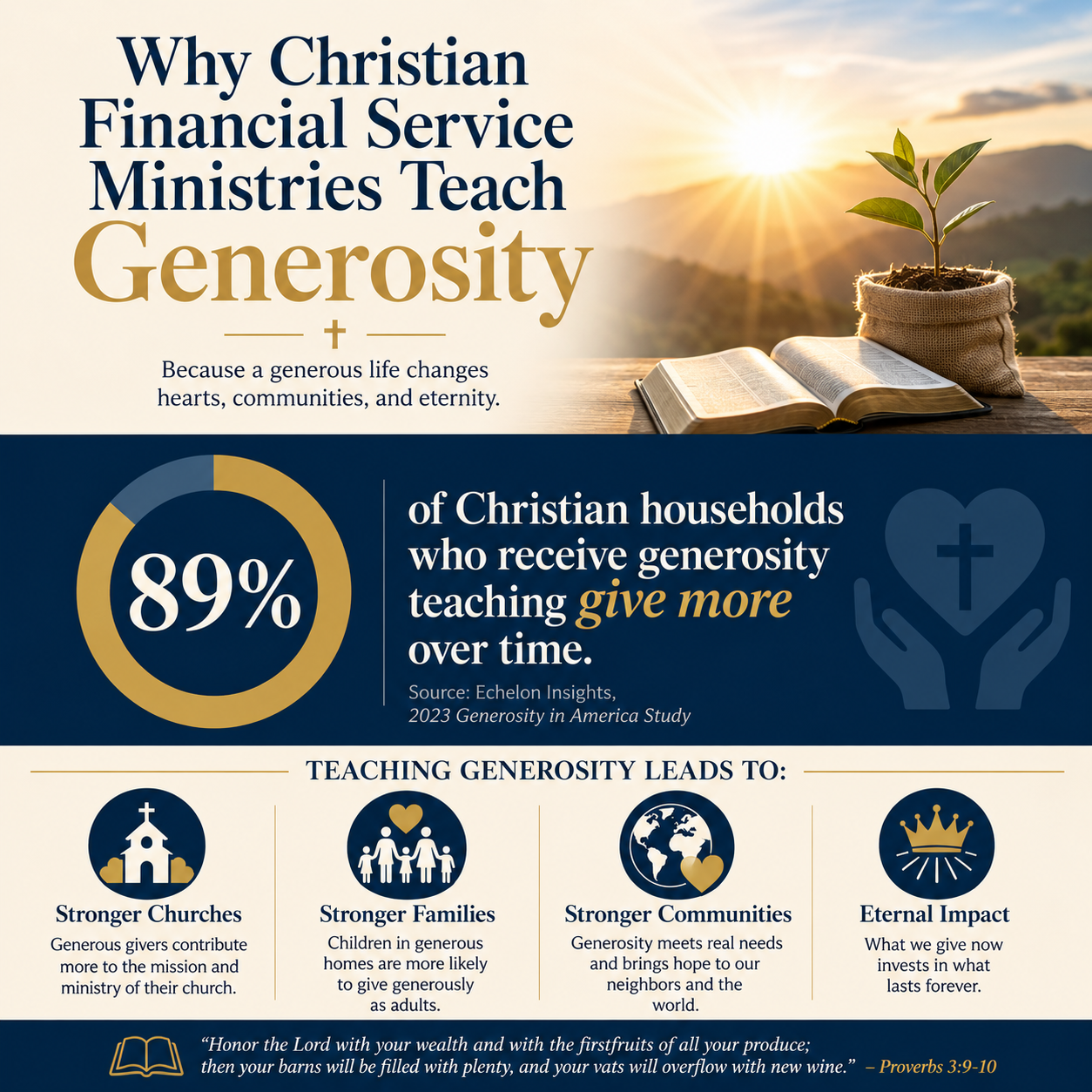
Why Christian financial service ministries teach generosity is not a marketing question. It is a discipleship question, rooted in Scripture’s insistence that money is never morally neutral in the human heart. A ministry that helps Christians borrow, save, insure, invest, or give is necessarily dealing with worship, trust, and the formation of desire.
For mature donors, the stakes are practical as well as theological. Many households can describe the quiet pressure of debt, lifestyle expectations, medical uncertainty, and the fear that generous giving will eventually collide with real obligations. Christian financial service ministries, at their best, do not treat generosity as an optional add-on after “financial health” has been achieved. They teach it because the New Testament treats generosity as one of the central marks of conversion and maturity, and because financial tools without spiritual formation tend to strengthen whatever loves already rule the heart.
Generosity is a theological claim about God and the Kingdom
Scripture frames money as a rival allegiance
Jesus’s most direct language about money is not technical but spiritual: “You cannot serve God and money” (Matthew 6:24). That claim is absolute, not advisory. It explains why Christian financial service ministries that take the faith seriously speak about generosity early and often. Without a re-ordered loyalty, “financial planning” easily becomes a baptized form of anxious self-protection.
In the Gospels, money reveals what is otherwise hidden. The rich young ruler’s refusal (Mark 10:17–22) is not presented as an unfortunate footnote; it is presented as exposure. Zacchaeus’s restitution and generosity (Luke 19:1–10) are not presented as eccentric personality traits; they are presented as evidence that salvation has taken root. Christian financial teaching that avoids generosity ends up avoiding some of Jesus’s clearest diagnostic categories.
Generosity is participation, not mere redistribution
Paul grounds Christian giving in the self-giving of Christ: “Though he was rich, yet for your sake he became poor” (2 Corinthians 8:9). The logic is not that Christians give because needs exist—needs will always exist. The logic is that Christians give because God has given, and because the church’s material life is meant to display the gospel in public. This is why the New Testament treats generosity as communal formation, not simply a private virtue.
Christians genuinely disagree about mechanisms—tithing norms in the New Covenant, how to prioritize local church giving versus parachurch ministry, and how to balance immediate relief with long-term development. But there is far less disagreement about the underlying direction: a Christian’s money should increasingly be set free from fear and redirected toward love of God and neighbor.

Financial formation fails when it treats wealth as the goal
Tools amplify what a household already believes
Budgeting systems, debt instruments, investment platforms, and insurance products can be morally useful. They can also become sophisticated ways of insulating a person from dependence on God. Christian financial service ministries teach generosity because they have to locate “financial success” inside a moral frame. Otherwise, the implied telos is accumulation, and the implied gospel is control.
That tension is intensified in a consumer economy trained to interpret restraint as deprivation. A household can build an impressive balance sheet while quietly shrinking in courage, hospitality, and mercy. A ministry that never speaks about generosity will often drift into the same functional assumption as the wider market: that the highest good is optionality, and the highest virtue is personal security.
The formation gap in the American church is real
Many donors sense a disconnect between biblical teaching and contemporary practice, but they do not always have language for it. Research regularly documents a gap between professed belief and giving behavior. For example, one widely cited estimate is that U.S. Christians give a small share of their income on average, despite high levels of stated religious commitment; see the overview of research compiled by the Barna Group at barna.com.
We should be careful not to weaponize those findings. Aggregate data does not capture differences in age, income volatility, caregiving burdens, or the lingering effects of financial trauma. Yet the broad pattern helps explain why ministries that handle Christian money must teach generosity: if giving is left to impulse and sentiment, it tends to become sporadic, vulnerable to manipulation, and detached from disciplined stewardship.
Generosity protects donors from manipulation and protects ministries from drift
Christian giving is vulnerable to emotional leverage
Mature donors have seen enough appeals to know how easily compassion can be recruited by urgency. A healthy theology of generosity does not make donors more gullible; it makes them more discerning. It insists that giving must be truthful, voluntary, and ordered toward love, not guilt. It also insists that a donor’s conscience should not be held hostage by a ministry’s cash-flow anxieties.
Many Christian financial service ministries teach generosity alongside caution because they understand a basic fact: generosity without wisdom can become a form of self-deception, and wisdom without generosity can become a form of unbelief. The two must be held together.
Accountability strengthens the credibility of generosity teaching
This is where verification becomes practical. At Most Trusted, we evaluate ministries against The Most Trusted Standard, a 15-criteria framework spanning faith commitments, financial integrity, governance and leadership practices, and transparency and effectiveness. When a ministry urges donors toward generosity, it is implicitly asking donors to trust its stewardship, reporting, and decision-making. That trust should be earned through verifiable practices rather than assumed through spiritual language.
Donors who want a wider view of the landscape can situate these questions within Christian Financial Service Ministries, where the theological and operational issues tend to recur across organizations with very different business models.
Christian financial service ministries teach generosity as a discipline of freedom
Generosity interrupts the tyranny of scarcity
The Bible does not deny that material needs are real. It does, however, deny that scarcity is an ultimate master. The manna narrative trains Israel to live by daily dependence rather than hoarding (Exodus 16). Jesus teaches his disciples to pray for daily bread, not lifelong insulation (Matthew 6:11). Generosity fits within that tradition as a concrete refusal to let fear dictate one’s horizons.
In pastoral reality, donors often carry legitimate responsibilities: aging parents, tuition, medical expenses, and obligations arising from past decisions. Christian ministries that teach generosity responsibly will address those constraints directly. They will distinguish between reckless giving that ignores duties and sacrificial giving that is planned, prayed through, and aligned with covenantal responsibilities.
Practices matter more than slogans
Generosity is usually formed through repeatable habits, not occasional large gifts. The ministries that handle Christian finances often teach patterns that are simple enough to sustain and rigorous enough to shape. In practice, responsible generosity guidance often includes:
- Giving as a first priority in the budget, not merely as leftover margin
- Clear distinction between compassion-driven one-time gifts and long-term commitments
- Guardrails against debt that crowds out future generosity
- Discernment between legitimate need and manipulative urgency
- Periodic review of giving in light of changing life seasons and responsibilities
These are not uniquely “financial” insights. They are applications of discipleship to a domain where many Christians have learned their habits from the market rather than from the church.
Donors should evaluate generosity teaching by fruit and by governance
Healthy teaching produces clarity, not pressure
Teaching that is faithful to Scripture and careful with donors tends to produce greater clarity: about the difference between God’s promises and implied guarantees, about the moral limits of debt, and about the purpose of wealth. It also tends to avoid coercive techniques. The Apostle Paul explicitly rejects compulsion: “Each one must give as he has decided in his heart, not reluctantly or under compulsion” (2 Corinthians 9:7). When a ministry’s fundraising culture routinely violates that principle, “generosity” language becomes a cover for pressure.
The harder question is how to assess this at a distance, especially when the ministry’s public communication is polished. Donors can look for concrete signals: audited financial statements where appropriate, transparent reporting on program outcomes, board independence, conflict-of-interest policies, and plain explanations of how funds are used. These are not secular add-ons. They are part of loving one’s neighbor with truth.
Trustworthy ministries invite scrutiny
Across our verification work, we observe that the ministries most serious about generosity tend to be serious about transparency as well. They treat donor questions as stewardship, not suspicion. They welcome careful reading of financials, clear explanations of reserves and risk, and candid discussion of what their programs can and cannot accomplish.
For donors wanting to place this topic within a broader stewardship conversation, Biblical Stewardship and Christian Financial Service Ministries is often the most useful frame. It keeps the discussion anchored to Scripture while still engaging the operational realities that determine whether a ministry deserves confidence.
FAQs for Why Christian financial service ministries teach generosity
Does teaching generosity risk pressuring donors who are already financially strained?
It can, and responsible ministries should name that risk rather than dismiss it. Biblical generosity is not a demand for performative giving that ignores obligations; it is a call to worship expressed through material faithfulness. Healthy teaching makes room for difficult seasons, emphasizes voluntary decision-making (2 Corinthians 9:7), and encourages donors to plan giving in ways that do not conceal debt, neglect family responsibilities, or substitute guilt for obedience.
How can donors distinguish biblical generosity from prosperity teaching?
Prosperity teaching tends to treat giving as a mechanism to secure personal return, often implying spiritual certainty about financial outcomes. Biblical teaching presents giving as worship and love of neighbor, grounded in God’s character rather than a transactional promise. Donors can test the message by its claims and its tone: whether it emphasizes Christ’s self-giving (2 Corinthians 8:9), whether it respects conscience and avoids compulsion, and whether the ministry’s governance and financial reporting withstand ordinary scrutiny.
Why generosity remains central
Christian financial service ministries teach generosity because the gospel reorders what money is for. Scripture does not merely instruct Christians to be decent managers; it calls them to be free people whose resources are available for mercy, mission, and the common good of the church. For donors, the question is not whether generosity will be taught, but whether it will be taught with theological integrity and verified stewardship worthy of the trust it requests.



