
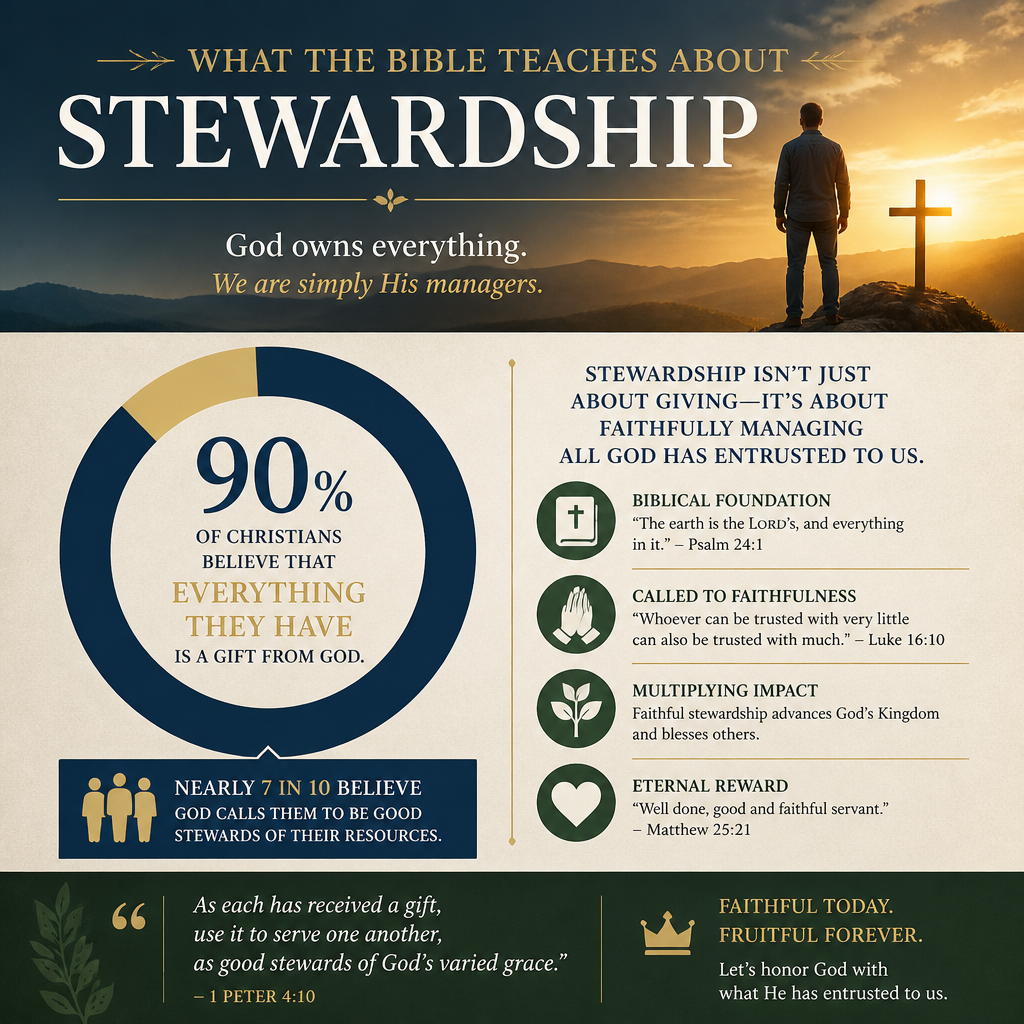
What the Bible teaches about stewardship is not an elective doctrine for generous Christians. Scripture treats stewardship as a moral and spiritual category: God owns; we receive; we manage; we answer for what we have done with what we were given. For donors, that accountability extends beyond how much we give to how carefully we discern the ends our giving serves and the means ministries use to pursue them.
The hard part is that modern giving rarely feels like “management.” It feels like triage: a crowded inbox, urgent appeals, and real human need. Donors also face a landscape where Christian language can be sincere, manipulative, or both. A biblical doctrine of stewardship is meant to form Christians who can give freely and wisely at the same time, without cynicism and without naïveté.
Stewardship begins with God’s ownership and our entrusted responsibility
Creation establishes the stewardship relationship
Scripture does not begin with human possession but with divine possession. “The earth is the Lord’s and the fullness thereof” (Psalm 24:1). That claim reframes money, property, influence, and time as entrusted goods rather than personal entitlements. Human beings are placed in the garden “to work it and keep it” (Genesis 2:15), language that combines cultivation with protection. Stewardship is therefore not only about restraint; it is about purposeful fruitfulness under God’s authority.
That creation logic matters for donors because it removes two distortions at once. First, it challenges the assumption that wealth is self-made. Second, it challenges the assumption that giving is merely discretionary. If God owns, then our resources are already morally claimed for his purposes, and the question becomes how faithfully we direct them.
The parable of the talents and the logic of accountability
Jesus’ parable of the talents (Matthew 25:14–30) is often read as an encouragement to be industrious, but its sharper edge is accountability. The master entrusts resources, returns, and evaluates not sentiment but faithfulness. The servant who buried the talent is condemned not for theft but for refusing responsibility. Christian donors should hear the parable as a call to deliberate stewardship: careful choices, active governance of what we’ve been given, and a willingness to be evaluated by God’s standards rather than our own intentions.
What this means in practice is that a donor’s moral task does not end at writing a check. It includes asking whether a ministry’s aims are faithful to Scripture and whether its methods are consistent with Christian integrity.

Stewardship is discipleship because money exposes the heart
Jesus ties treasure to worship
Jesus’ teaching on money is not primarily about budgeting; it is about worship. “Where your treasure is, there your heart will be also” (Matthew 6:21). He also refuses the possibility of neutral allegiance: “You cannot serve God and money” (Matthew 6:24). For donors, this is bracing because it suggests that financial decisions are among the clearest diagnostic tools for spiritual formation. The question is not only whether we give, but what our giving habits reveal about our fears, our status-seeking, and our trust in God’s provision.
Christians genuinely disagree about some applications—tithing as a binding norm, the ethics of debt in modern economies, or the place of wealth in vocation. But Scripture is consistent on the spiritual peril of wealth when it becomes a rival god (Luke 12:13–21; 1 Timothy 6:9–10, 17–19). Stewardship requires more than occasional generosity; it calls for ongoing resistance to the formative power of consumerism.
Generosity is not the same as impulsiveness
The New Testament repeatedly praises generosity that is voluntary and intentional. Paul’s teaching in 2 Corinthians 8–9 commends sacrificial giving while also emphasizing purpose and integrity. “Each one must give as he has decided in his heart, not reluctantly or under compulsion” (2 Corinthians 9:7). That language supports thoughtful budgeting and planned giving as genuinely spiritual practices, especially for donors whose giving is substantial and whose choices shape institutions.
Stewardship, then, involves forming a conscience capable of both compassion and discernment. A donor can feel real pity and still fund something ineffective; a donor can demand efficiency and still neglect mercy. Biblical stewardship does not allow either reduction.
Stewardship includes diligence about who handles God’s money
Scripture assumes safeguards and reputational integrity
When Paul organized the Jerusalem relief collection, he took pains to avoid suspicion. He described the purpose as doing what is “honorable not only in the Lord’s sight but also in the sight of man” (2 Corinthians 8:20–21). The point is not public relations. It is the moral duty to protect the church from scandal and to protect the poor from being used as props for fundraising. Stewardship includes structures that constrain temptation and preserve trust.
That biblical instinct is one reason serious donors ask concrete questions about governance, oversight, and financial controls. Ministries should welcome such questions. The faithful steward is not offended by accountability; the faithful steward is strengthened by it.
What donors should reasonably verify
Across our verification work at Most Trusted, we observe that donors often assume a false choice: either give with childlike trust or give with prosecutorial suspicion. Biblical stewardship points to a third way—clear-eyed generosity that tests what can be tested and then gives freely. A short set of verifications can prevent avoidable harm and can also protect faithful ministries from being lumped together with those operating without adequate integrity.
- Whether the ministry’s doctrinal commitments are explicit and operative, not merely ornamental
- Whether audited financial statements or other credible financial reviews are available and current
- Whether the board is meaningfully independent and engaged in oversight
- Whether the ministry reports outcomes with humility, including limitations and failures
- Whether fundraising practices avoid manipulation and respect donor intent
These are not merely “best practices.” They are stewardship applications of the biblical concern for honesty, wise administration, and the protection of the vulnerable. Donors who want to support ministries connected to lending, debt relief, financial counseling, and economic discipleship can find related context in Christian Financial Service Ministries, where the particular stewardship risks and promises of this ministry category become clearer.
Stewardship in giving requires both mercy and realism about impact
The Bible’s concern for the poor is direct and demanding
Scripture is unambiguous that God hears the cry of the poor and judges societies by their treatment of the vulnerable (Proverbs 14:31; Isaiah 58; Amos 5). Jesus identifies himself with those in need in Matthew 25:31–46, and James warns that faith without practical mercy is dead (James 2:14–17). Donors are therefore not simply funding “projects.” They are participating in a moral economy where justice, compassion, and truthfulness matter to God.
That moral urgency can pressure donors toward speed rather than discernment. Yet Scripture also condemns harm done in God’s name and calls for wisdom. “The simple believes everything, but the prudent gives thought to his steps” (Proverbs 14:15). A mature stewardship posture refuses to treat discernment as a lack of faith.
Effective compassion avoids predictable harm
In international relief and development, for example, the When Helping Hurts framework, articulated by Steve Corbett and Brian Fikkert, has influenced a generation of Christian practitioners by naming how aid can unintentionally undermine local agency and markets if it is not designed carefully. The point is not to make donors timid; it is to align generosity with an honest account of human systems, incentives, and dignity.
For donors, this often means asking ministries to articulate not only what they do, but why their approach is likely to help rather than harm. It also means recognizing that some outcomes are slow, difficult to quantify, and still worth pursuing. Not everything valuable is easily measured; not everything measurable is valuable. Stewardship asks for evidence where evidence is possible and for theological sobriety where it is not.
Contemporary giving patterns also underscore how much formation is still needed. Research from the Lilly Family School of Philanthropy at Indiana University has long documented that giving to religion remains the largest category of American philanthropy in many years, even as participation patterns shift (https://philanthropy.iupui.edu/). For donors, that scale brings responsibility: Christian giving does not merely express personal piety; it helps shape what the public associates with Christian witness.
Stewardship is communal and institutional, not only personal
The church’s credibility is part of what stewardship protects
Financial scandal does not remain private. It damages trust, wounds donors, and gives plausible grounds for cynicism among those already inclined to dismiss Christian faith. The New Testament’s emphasis on being “above reproach” in leadership (1 Timothy 3; Titus 1) should therefore be read as a stewardship imperative. Donors are not responsible for everything a ministry does, but donors do have agency in choosing which institutions to strengthen.
That is why verification is not a luxury for “professionalized” donors. It is one of the ways Christians love their neighbors: by helping ensure that gifts are handled truthfully, that beneficiaries are treated with dignity, and that donors are not manipulated. Most Trusted exists to serve that discernment by evaluating ministries against The Most Trusted Standard, a 15-criteria framework that examines faith foundation, financial integrity, governance and leadership, and transparency and effectiveness. Those categories track longstanding Christian moral concerns: truthfulness, accountability, and faithful doctrine embodied in public practice.
How stewardship applies to financial service ministries
Ministries operating in credit counseling, debt relief, microenterprise support, or other financial services sit at a sensitive intersection of pastoral care and financial power. The temptation is not only greed; it is paternalism, conflicts of interest, and opaque fee structures that can burden the very people a ministry claims to serve. Donors should expect clarity about pricing, client protections, and the ministry’s theology of economic discipleship.
Stewardship in this category also raises legitimate debates. Some Christians see debt as primarily a spiritual and moral issue; others emphasize structural pressures such as predatory lending, wage stagnation, and medical costs. The best ministries refuse simplistic diagnoses. They address heart-level formation while also providing competent, regulated, and transparent services that do not exploit distress.
For donors who want to think more carefully about how biblical teaching intersects with nonprofit practice, Biblical Stewardship and Christian Financial Service Ministries provides a wider set of considerations relevant to this ministry landscape.
FAQs for What the Bible teaches about stewardship
Is stewardship only about money?
No. Scripture frames stewardship as the faithful management of all that God entrusts—time, abilities, relationships, influence, and material resources. Money receives special attention in the teaching of Jesus because it so reliably competes for worship and so quickly reveals what a person loves and fears.
How can donors practice biblical stewardship without becoming cynical about ministries?
Biblical stewardship calls for discernment anchored in love. Donors can verify what is verifiable—doctrine, governance, financial integrity, and truthful reporting—while still giving with open hands and hopeful expectations. Healthy skepticism is not the goal; trustworthy generosity is. Verification work, including evaluations against The Most Trusted Standard, can help donors direct concern into concrete due diligence rather than suspicion.
Stewardship as faithful giving under God’s gaze
What the Bible teaches about stewardship is ultimately a vision of life lived before God: receiving with gratitude, managing with wisdom, giving with mercy, and answering with honesty. Donors are not asked to carry omniscience, but we are called to carry responsibility. Stewardship joins generosity to truth, compassion to prudence, and private discipleship to the public integrity of the church.



