
What Christian anti-trafficking ministry ratings mean is not primarily a question about labels. It is a question about whether a donor can verify, with moral clarity and practical evidence, that a ministry’s work against exploitation is faithful, safe, and effective. In an area where trauma is real, stories are powerful, and outcomes are difficult to measure, ratings can either serve truth or reward presentation.
Christian donors feel that tension acutely. We are commanded to “do justice” and “love mercy” (Micah 6:8), yet we are also accountable for the stewardship entrusted to us. Anti-trafficking work is a place where both imperatives matter at once: the urgency to act and the discipline to verify.
Ratings are signals, not substitutes for discernment
What a rating can and cannot tell you
A rating is a compressed judgment about a larger reality. It can highlight risk, commend transparency, or surface governance concerns. But no single score can carry the full moral weight of anti-trafficking ministry, because the work itself is complex: legal systems differ across countries, survivor safety requires confidentiality, and prevention outcomes rarely fit into neat counting.
Good ratings tend to reward what is verifiable: audited financials, independent boards, clear safeguarding policies, and documentation that funds are used as promised. Poor ratings often reflect the absence of these basics. Yet donors should resist two common errors: assuming a high rating proves spiritual faithfulness, or assuming a low rating proves bad intent.
Why anti-trafficking work is especially vulnerable to rating distortion
The anti-trafficking space is vulnerable to distortion because the public imagination is easily captured by dramatic rescue narratives, even when those narratives obscure what actually reduces exploitation. The U.S. Department of State has consistently emphasized that trafficking is a crime involving compelled labor or commercial sex through force, fraud, or coercion, and that effective responses include prevention, protection, and prosecution rather than sensationalism alone U.S. Department of State.
What this means in practice is that a rating that rewards marketing rather than documentation can mislead donors. Mature discernment asks whether an organization is doing verifiable good in the ordinary, costly work of case management, shelter, legal aid, employer accountability, and long-term care.

Christian donors should prioritize faithfulness and evidence together
Theological seriousness is not optional
Christian giving is not philanthropy with a religious accent. It is worship and stewardship. The New Testament treats money as a discipleship issue, and it treats integrity as a public matter: “we aim at what is honorable not only in the Lord’s sight but also in the sight of man” (2 Corinthians 8:21). Anti-trafficking ministries should be evaluated with that same double accountability: fidelity before God and credibility before people.
That is why our work at Most Trusted evaluates ministries against The Most Trusted Standard, a 15-criteria framework that examines whether claims match evidence across a ministry’s faith commitments, financial integrity, leadership, and public transparency. Donors rightly expect more than good intentions, particularly in a field where vulnerable people can be harmed by untrained intervention.
Evidence should be proportionate to the claim
Not every ministry can run a randomized controlled trial. But every ministry can be honest about what it knows, what it does not know, and what it is doing to learn. A modest program that claims to provide trauma-informed counseling should be able to show staff qualifications, safeguarding practices, referral pathways, and follow-up care. A large organization that claims to “rescue thousands” should be able to show definitions, documentation standards, and independent verification that those numbers reflect genuine, ethical outcomes.
Christians genuinely disagree about how quantifiable anti-trafficking outcomes should be, especially when survivor confidentiality is at stake. The harder question is whether a ministry’s reporting is disciplined: clear definitions, consistent methodology, and refusal to inflate numbers for fundraising.
What responsible ratings should examine in anti-trafficking ministries
Safeguarding and survivor-centered practice
In this field, safeguarding is not a compliance document; it is a moral boundary. Donors should expect a ministry to demonstrate survivor-centered practice, including informed consent, confidentiality protocols, and partnerships with qualified local professionals. Ministries working with minors should have heightened child protection procedures and clear limits on volunteer access.
One reason this matters is that anti-trafficking work can unintentionally mirror patterns of control if it is not careful. Survivor care requires agency, patience, and a commitment to long-term restoration rather than short-term optics.
Governance, financial controls, and transparency
Trafficking provokes righteous anger. Anger can also lower discernment. Responsible ratings should probe whether an organization has independent governance, clear oversight of executive authority, conflict-of-interest policies, and credible financial statements. For U.S. nonprofits, the IRS Form 990 is not sufficient by itself, but it is a baseline artifact for understanding compensation, related-party transactions, and program spending Internal Revenue Service.
Transparency is not the same as disclosure of sensitive details. Ministries can protect survivors while still providing public clarity on budgets, program categories, and outcomes. A reluctance to publish any meaningful information is not always disqualifying, but it should raise a question: what accountability mechanisms exist if donors and the public cannot see the substance of the work?
How to interpret ratings without being manipulated by them
Beware simplistic spending rules
Many donors have been trained to treat administrative and fundraising costs as the primary measure of integrity. The nonprofit sector has broadly rejected that approach because it can punish organizations for investing in compliance, evaluation, and safeguarding. In 2013, Charity Navigator, GuideStar, and the BBB Wise Giving Alliance publicly warned against the “overhead ratio” as a sole measure of charity performance Charity Navigator.
What this means for anti-trafficking is straightforward: a ministry that spends on licensed clinicians, legal expertise, secure facilities, and background checks may look “less efficient” on paper while being more responsible in practice. Donors should ask what those costs purchase and whether the organization can explain them with clarity.
Interrogate the story the rating is telling
Ratings tend to tell a story, whether they admit it or not. Some systems privilege scale. Others privilege financial cleanliness. Others privilege public reporting. Each emphasis has value, and each can mislead if it becomes absolute. A small, locally rooted ministry may lack polished reporting yet operate with strong church accountability and careful practice. A large organization may produce beautiful reports while obscuring weak governance or inflated outcome claims.
When donors interpret ratings well, they treat them as a starting point for disciplined questions. The aim is not suspicion; it is love that refuses to be naïve.
- Clarify definitions: What does the ministry mean by rescue, prevention, restoration, and partnership?
- Ask about safeguarding: What policies govern survivor confidentiality, consent, and volunteer access?
- Review governance: Is there independent oversight, and are conflicts of interest disclosed and managed?
- Check financial artifacts: Are audits, Form 990 filings, and annual reports accessible and coherent?
- Evaluate outcomes with humility: Are results reported with consistent methodology and appropriate caution?
Where Most Trusted fits and how donors can use our ratings
Verification is not cynicism
Most Trusted exists because Christian donors should not have to choose between compassion and verification. Across our verification work, we observe that ministries that meet The Most Trusted Standard tend to treat truth as part of discipleship: they name limits, publish meaningful documentation, welcome governance accountability, and resist using survivors as fundraising content.
Verification is also a form of protection for ministries doing the work well. In a crowded marketplace of claims, credible standards help differentiate careful organizations from those that rely on emotional momentum. That differentiation matters because trafficking is not reduced by attention alone; it is reduced by sustained, lawful, locally informed action.
Use ratings within a larger stewardship posture
Anti-trafficking giving often sits alongside other convictions: support for local churches, global missions, foster care, poverty alleviation, and crisis response. Donors are not simply buying outcomes. We are participating in the works of mercy and justice that Scripture commends, in a manner consistent with wisdom. That wisdom includes learning from the field’s hard lessons about unintended harm and the necessity of accountable structures.
For readers comparing ministries or learning how to evaluate the category as a whole, the broader landscape of Christian Anti-Trafficking Ministries provides helpful context for the range of models and claims donors encounter.
For donors who want to sharpen their standards for disclosure, reporting, and governance in this space, Accountability and Transparency in Christian Anti-Trafficking Ministries names the specific questions that often separate admirable intent from verifiable integrity.
FAQs for What Christian anti-trafficking ministry ratings mean
Do strong ratings guarantee a ministry is doing effective anti-trafficking work?
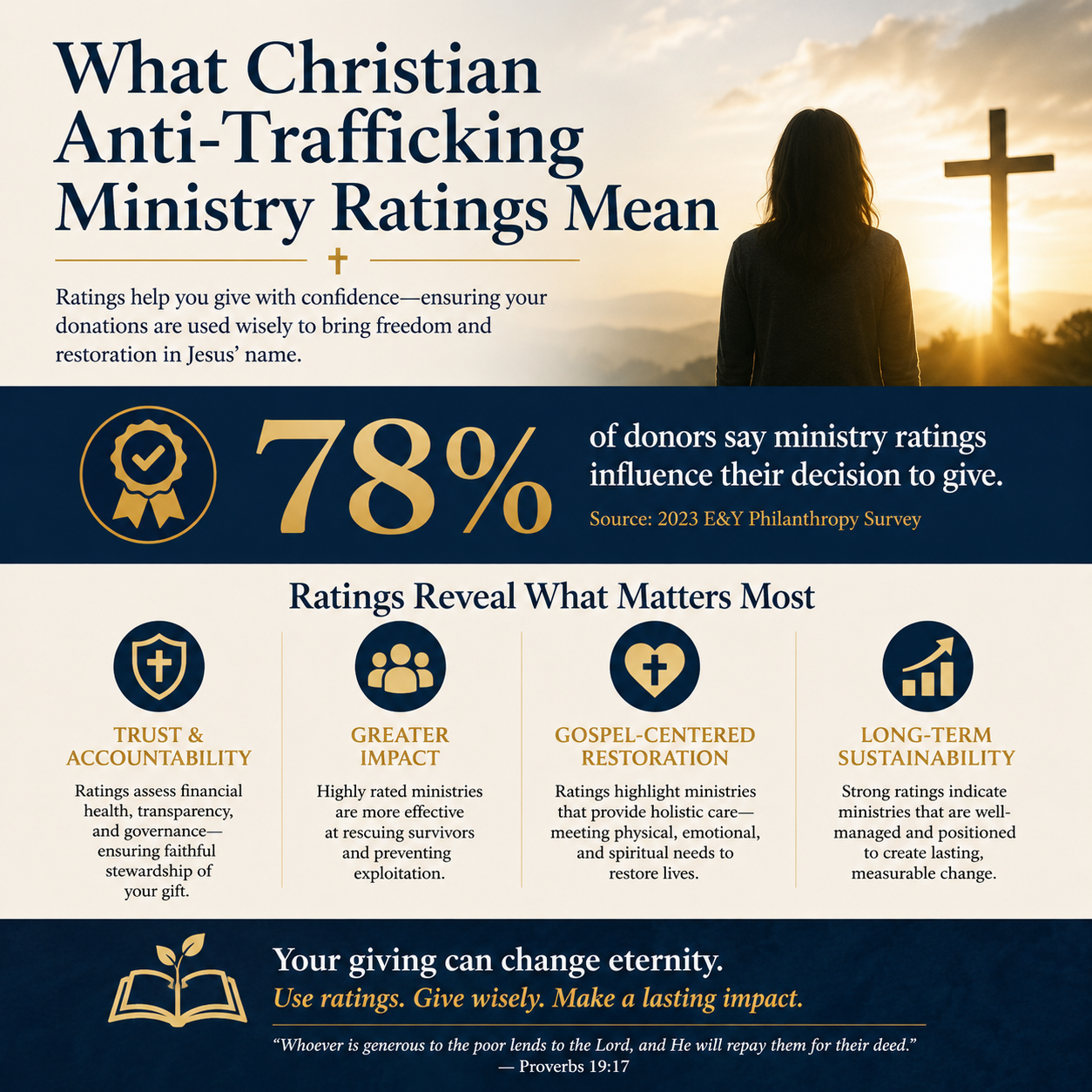
No. Strong ratings usually indicate stronger documentation, governance, and financial accountability, which are essential in this field. Effectiveness also depends on program model, local partnerships, staff competence, survivor safety practices, and the ministry’s ability to learn over time. A responsible donor treats a rating as a credible signal, then asks whether the organization’s claims are proportionate and verifiable.
Why do some reputable ministries have limited public reporting?
Some anti-trafficking ministries limit public detail to protect survivors, ongoing investigations, and partner networks. That caution can be legitimate. The question is whether confidentiality is paired with meaningful accountability through other means: independent governance, audited financials, clear policies, and outcome reporting that protects identities while still offering honest evidence.
Stewardship that matches the gravity of the cause
Anti-trafficking ministry invites Christians into a costly form of justice that cannot be sustained on outrage and stories alone. Ratings can help donors act with clarity, but only when they reward what is true: accountable leadership, lawful practice, survivor-centered care, and honest reporting. The goal is not a perfect score. It is giving that honors Christ by seeking what is honorable in the Lord’s sight and in the sight of others.



