
Why child sponsorship ministries translate sponsor letters because the relationship donors are invited into is cross-cultural, multilingual, and often mediated through local staff. For Christian donors, that mediation can feel like a spiritual question as much as an operational one: does translation protect a real relationship, or does it dilute it into a marketing product?
The reality is more complex than a simple choice between “direct” communication and “filtered” communication. Translation can be an act of love—making mutual understanding possible—while also being a point of risk, where tone, content, or even power dynamics can drift. Mature sponsorship ministries treat translation as stewardship: of the child’s dignity, the sponsor’s trust, and the ministry’s witness.
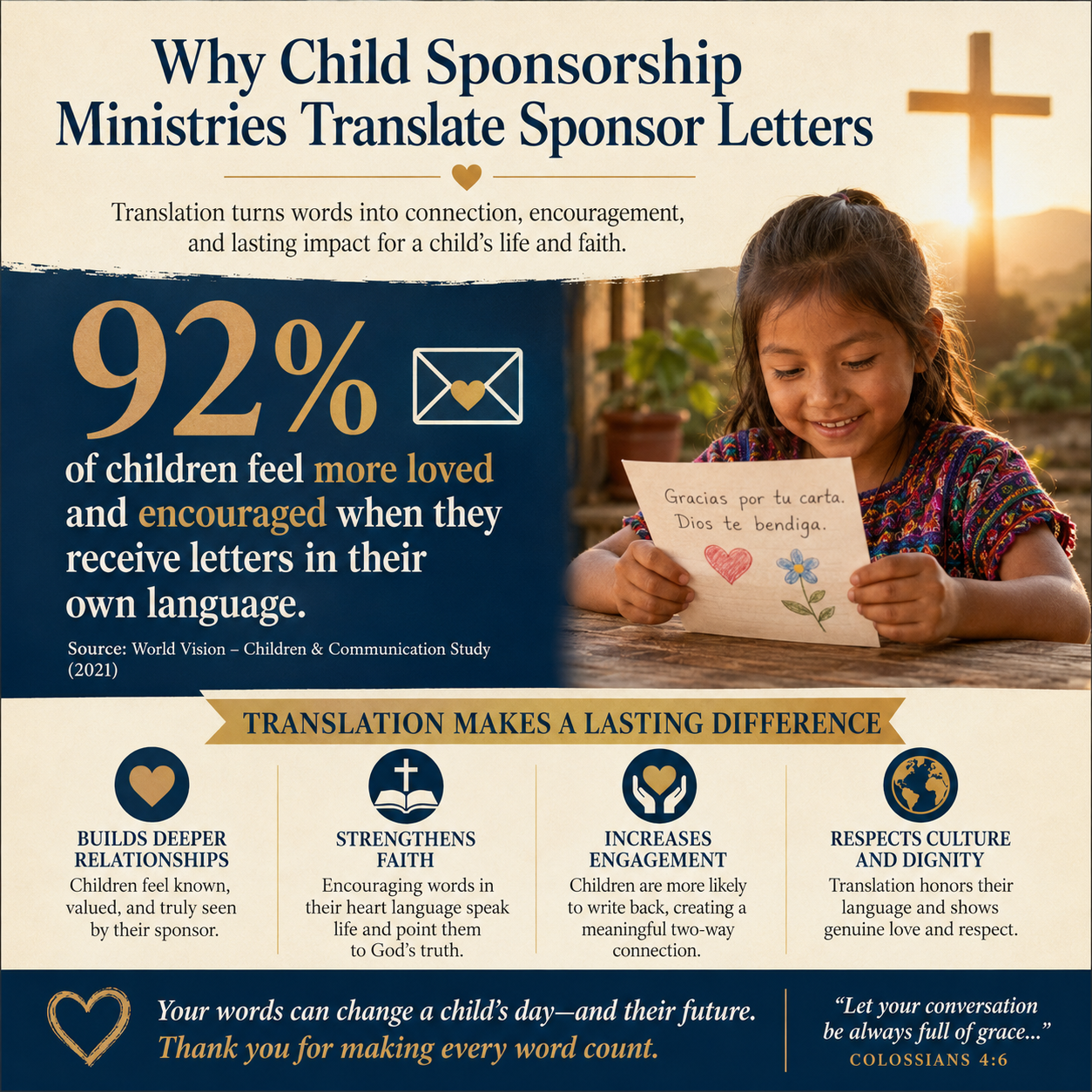
Translation exists to make real communication possible across distance and language
Most sponsorship relationships span languages, writing systems, and cultural assumptions about how adults and children speak to one another. Without translation, a sponsor letter may never be understood by the child, and a child’s letter may never be understood by the sponsor. That is not a small inconvenience; it would make the relationship largely symbolic.
Christian giving is not merely transactional. Many sponsors understand letter writing as a form of encouragement and prayerful presence, even across distance. Translation, at its best, protects that intent. It is a practical application of the Pentecost logic in Acts 2: God dignifies languages, and he makes understanding possible without erasing difference.
Translation is not only about words
Good translation also carries meaning across cultures. A child in one context may write with indirectness or formulaic politeness that is culturally appropriate but reads as emotionally distant in American English. Conversely, a sponsor may write idioms or spiritual phrases that do not map neatly into another language. Skilled translators work to preserve meaning and tone without forcing every letter into one cultural style.
Why ministries do not rely on sponsors alone
Some donors ask why ministries cannot simply ask bilingual sponsors to write in the child’s language. In practice, that would exclude many supporters, limit participation to a narrow set of donors, and introduce uneven quality and safeguarding risk. Translation is part of what makes sponsorship accessible to a broad Christian donor base while still honoring the child’s ability to understand what is being said.

Translation also functions as safeguarding for children and families
The harder question is why ministries sometimes translate and also edit or screen letters. Here, donor expectations and child protection obligations can collide. Sponsorship involves minors, and ministries have a duty to protect children from harmful content, privacy breaches, manipulation, and inappropriate contact.
Responsible ministries treat letter handling as a safeguarding channel, not a mere customer service function. That includes screening for content that could compromise a child’s safety or create inappropriate dependency.
Protecting identifying information and location details
Sponsors often mean well when they ask for a child’s direct address, social media profile, or precise location. But in many contexts, releasing identifiable information can create safety risks for the child and family, and it can expose the ministry to coercion or fraud. Many ministries therefore remove specific identifiers and translate in a way that preserves relationship without exposing the child to unwanted access.
Preventing coercive or confusing spiritual pressure
Christian donors often write from deep conviction. That is a good impulse, but it can become harmful if a sponsor letter functions as a private discipleship pipeline outside the oversight of local church partners. Ministries may screen for spiritual coercion, manipulative promises, or messages that undermine a child’s family or local church. This is not an argument against evangelism; it is an argument for ordered discipleship under accountable leadership, consistent with the New Testament pattern of shepherding and oversight (Hebrews 13:17).
Translation choices can shape trust, so transparency matters
Christians genuinely disagree about how mediated a sponsorship relationship should be. Some donors want maximal directness and minimal institutional involvement. Others prioritize the child’s protection and accept more mediation. The integrity question is not whether a ministry translates; it is whether the ministry tells the truth about how it translates, and whether its practices align with its stated promises.
Across our verification work at Most Trusted, we see that ministries earning durable donor confidence tend to be specific about their letter process: who translates, what is screened, what is edited for length or clarity, how quickly letters are delivered, and how the ministry handles sensitive content.
What strong disclosure looks like
Clear ministries do not hide behind vague assurances. They explain the flow: the letter is received, logged, translated by trained staff or vetted contractors, reviewed for child protection, and then delivered. They also explain what they do not do: invent content, script children, or alter meaning to flatter donors.
What this means in practice is that donors should be able to find policy language that answers basic questions without speculation. When donors cannot find that clarity, they are forced into guesswork—precisely the condition in which mistrust grows.
Why “unedited” is not always a virtue
Some ministries market “unedited letters” as a hallmark of authenticity. There are contexts where minimal editing is appropriate. But when children are involved, unedited can become irresponsible if it includes personal data, references to abuse, or requests that the ministry is not equipped to address privately through a sponsor relationship. A ministry can be transparent and protective at the same time, but it must say what it is doing.
Letter translation sits inside broader questions about sponsorship ethics
Translation cannot be evaluated in isolation. It reflects deeper choices about how the ministry understands the child, the sponsor, and the purpose of sponsorship. The field has had to reckon with situations where sponsorship communication was used to produce a sense of intimacy that was not grounded in reality, or where fundraising incentives pressured staff to “keep sponsors happy” at the child’s expense.
Some of the most helpful critique has come from within the Christian development conversation. The When Helping Hurts framework, articulated by Steve Corbett and Brian Fikkert, pressed churches and ministries to consider how aid can unintentionally reinforce dependency or paternalism. Translation practices can either intensify those dynamics or restrain them through truthful communication and respect for local agency.
Children are not marketing assets
When a ministry treats letters primarily as retention tools, translation becomes a mechanism for producing a particular emotional outcome in donors. That is where donors should be alert. The child’s voice should not be shaped to fit a fundraising narrative. A child may express gratitude; a child may also express ordinary concerns, hopes, faith, and even confusion. Faithful translation makes room for the child to be a person rather than a storyline.
Community development versus one-to-one expectations
Many sponsorship programs fund community-based interventions—school fees, tutoring, nutrition, church partnerships, and social work supports—rather than direct cash transfers to an individual child. That model can be effective, but it creates understandable donor questions: if support is community-oriented, what does the letter relationship represent?
Trust increases when ministries explain this plainly. Sponsors can still have a meaningful relationship with a particular child while the program strengthens the environment around the child. Confusion arises when ministries imply a direct personal pipeline while operating a broader development model.
For donors seeking to understand these broader dynamics, it can help to read within the wider context of Child Sponsorship Ministries, where the ethical questions extend beyond correspondence into program design and accountability.
What donors should look for when evaluating a ministry letter process
Because translation is partly invisible, donors need evaluation criteria that do not depend on gut instinct. A ministry can translate faithfully, and it can translate deceptively. The difference is usually visible in policies, safeguards, and governance, not in a single letter.
The ministries that meet The Most Trusted Standard tend to document their communications practices in ways that can be evaluated: written safeguarding policies, staff training expectations, complaint processes, and truthful representations of what sponsorship does and does not provide. Donors do not need perfection, but they should expect clarity and accountability.
Practical indicators of a trustworthy translation and letter system
- Written explanation of translation and review, including what is screened and why.
- Child protection safeguards that address privacy, grooming risk, and inappropriate contact.
- Realistic timelines that acknowledge language and logistics without overpromising speed.
- Consistent handling of gifts and requests so letters do not become a channel for pressure or unequal treatment.
- Mechanisms for sponsor questions and concerns that are responsive and documented.
Evidence of sector-wide accountability expectations
Donors are not alone in asking for clarity and responsible reporting. In a different but related debate, major evaluators and nonprofit accountability organizations have publicly argued that simplistic measures can distort nonprofit behavior and mislead donors. Charity Navigator, Candid (GuideStar), and the BBB Wise Giving Alliance summarized this in their joint statement often referred to as the overhead myth critique, urging donors to focus on governance, transparency, and results rather than narrow ratios (Charity Navigator). While letter translation is not an “overhead ratio” issue, the same principle holds: responsible evaluation looks at systems and integrity, not just surface impressions.
Donors who want to assess correspondence practices in detail often find clarity by focusing specifically on Communicating with Your Sponsored Child, where safeguarding, expectations, and trust intersect most directly.
FAQs for Why child sponsorship ministries translate sponsor letters
Do ministries ever change what the child said in order to keep sponsors?
It can happen, and the possibility is one reason donors should value transparency and governance. A mature ministry distinguishes between translation (carrying meaning across languages), editing (clarifying grammar or length), and fabrication (inventing or materially altering content). Ethical ministries explicitly prohibit fabrication, train staff accordingly, and maintain supervision and auditability in their correspondence process. When a ministry cannot explain its controls, sponsors are being asked to trust without evidence.
Why can sponsors not communicate directly with the child without the ministry involved?
Direct communication can expose children to privacy risks, inappropriate dependence, and unequal power dynamics. It can also bypass local pastoral and social work oversight, which is often necessary when a child discloses sensitive information. Ministries that restrict direct access are not necessarily being evasive; they may be practicing child protection and honoring family authority. The more responsible approach is not maximum access, but accountable access—communication that is meaningful while remaining safe and supervised.
Trustworthy translation is a form of stewardship
Translated letters are not a lesser version of relationship; they are often the only way a real relationship can exist across languages. But translation also concentrates responsibility in the ministry’s hands. Christian donors should not be asked to ignore that fact. They should be given clear policies, credible safeguards, and truthful explanations of what correspondence can and cannot carry.
When a sponsorship ministry handles translation with transparency and child-centered protection, donors can write with confidence that their encouragement is understood, that the child’s dignity is honored, and that the ministry’s work is consistent with the truthfulness Scripture requires of God’s people.



