

Why Bible engagement ministries collaborate with churches is not a secondary question for Christian donors. It is one of the clearest indicators of whether a ministry understands what Scripture says the Word is for: forming a people under Christ, not simply distributing content. The Bible is given to the covenant community, proclaimed in the gathered church, and carried into the world by disciples who are taught to obey all that Christ commanded.
Collaboration is not automatically virtuous, and independence is not automatically suspect. Some Bible engagement work began precisely because local churches lacked access to Scripture, translations, or literacy tools. Yet across our verification work at Most Trusted, the ministries that endure and bear mature fruit tend to treat the local church as more than a downstream “channel.” They treat the church as a spiritual authority, a formation environment, and a long-term steward of the people reached.
The church is the normal habitat of Scripture
Scripture forms a people before it forms a program
Bible engagement ministries often speak in the language of “access,” “distribution,” and “usage.” Those terms have their place. But biblically, the Word is not primarily a commodity delivered to individuals; it is a covenant word addressed to a people. In the Old Testament, the Law is read publicly to Israel. In the New Testament, apostolic letters are written to churches, read aloud, and obeyed together. Collaboration with churches is a theological recognition that Scripture is meant to be received, interpreted, and lived in community under shepherds.
This is one reason donors should pay attention to whether a Bible engagement ministry is church-connected in practice. If the ministry’s core outcomes are purely individual and private—downloads, reading streaks, “engagement minutes”—without meaningful connection to worship, sacraments, discipline, and pastoral care, the ministry may drift toward metrics that do not map cleanly onto biblical discipleship.
Authority and accountability guard the ministry and the hearers
Collaboration is also a protection. A ministry that routinely works with local pastors, elders, and denominational leaders is more likely to face questions about theological commitments, contextual wisdom, and the pastoral consequences of its materials. That kind of friction is often healthy. Christians genuinely disagree about translation philosophy, interpretive traditions, and the boundaries of contextualization. Partnerships with churches force those disagreements into the light, where they can be handled with clarity rather than marketing.
Donors who want a broader view of how this work functions across the field can begin with Bible Study and Engagement Ministries, where we track patterns that affect long-term trustworthiness and effectiveness.

Church partnerships strengthen contextual credibility
Local leaders understand local risks
Bible engagement work inevitably moves across cultural boundaries: language, class, urban and rural life, trauma histories, and political realities. Churches embedded in a place typically understand the risks outsiders miss: which “help” can destabilize fragile family systems, which messages can expose believers to persecution, and which public events may unintentionally signal foreign control.
In some settings, the greatest danger is not overt hostility but subtle distortion. A well-produced Bible resource may arrive with assumptions about prosperity, individualism, or Western therapeutic categories that are not derived from the text. Churches, at their best, are a testing ground where materials are received with pastoral discernment.
Distribution without formation creates predictable failure modes
Many donors are drawn to Bible distribution because it is tangible and concrete. Yet mature practice has learned that “access” is not the same as “understanding,” and “understanding” is not the same as “obedience.” Where literacy is limited, where oral cultures predominate, or where believers are newly converted, Scripture engagement typically requires patient accompaniment: oral Bible storying, small group discovery methods, trauma-informed discipleship, and pastoral teaching that returns again and again to the gospel.
When Bible engagement ministries collaborate with churches, they can embed resources in rhythms that endure: weekly worship, catechesis, youth formation, pastoral visitation, and long-term leadership development. Without that embedment, even excellent tools can become short-lived projects with uncertain fruit.
Collaboration reduces duplication and improves stewardship
Donors should expect clarity on who does what
Christian donors often feel the burden of fragmentation: too many small initiatives repeating the same work, too many overlapping platforms, too many mailers that sound similar. Church partnerships can reduce that duplication when roles are explicit. A Bible engagement ministry may provide translation expertise, digital tools, training curricula, or research capacity; churches provide long-term shepherding, local volunteer leadership, and contextual credibility.
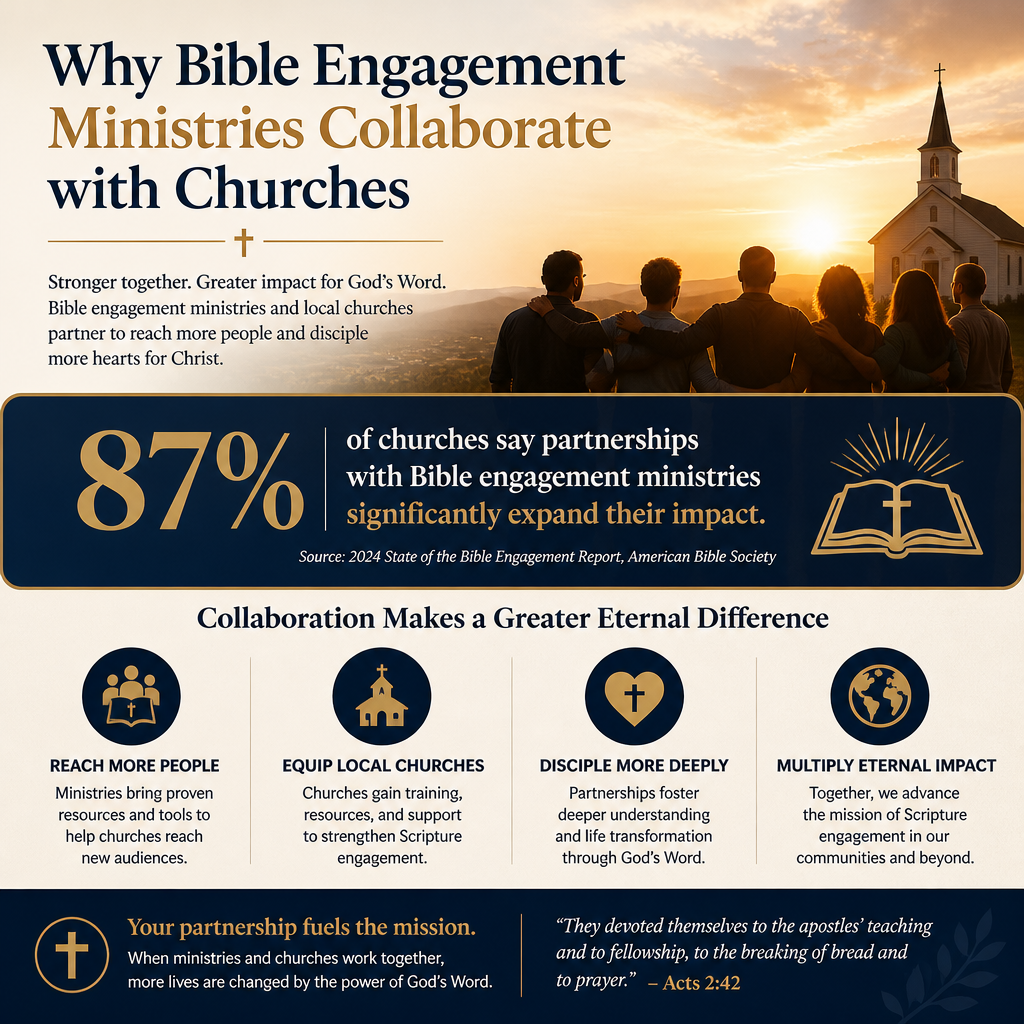
There is also a stewardship logic here that is not merely financial. The New Testament assumes interdependence in the body of Christ. A ministry that collaborates well usually articulates what it will not do. That restraint can be as spiritually mature as ambition, especially in a donor economy that rewards novelty.
Funding flows are changing, and partnerships help ministries adapt
Giving patterns in the United States have shifted in ways that affect Christian nonprofits broadly. For example, the share of Americans who report giving to charity has declined over time; one widely cited long-run analysis found a drop from 66% in 2000 to 47% in 2018, published through the Indiana University Lilly Family School of Philanthropy’s Philanthropy Panel Study research Indiana University Lilly Family School of Philanthropy. When fewer households give, ministries often face pressure to demonstrate outcomes quickly, multiply fundraising channels, and produce more content.
In that environment, collaboration with churches can function as a stabilizer. Churches are not immune to financial pressures, but they represent durable networks of relationships. A Bible engagement ministry anchored in church partnerships may be less tempted to chase platform-dependent growth and more able to invest in slower work: training, translation review, and pastoral integration.
- Shared theological accountability through pastors and elders who can evaluate teaching
- Clear division of labor between specialized tools and local discipleship
- Lower duplication when multiple ministries coordinate around existing church structures
- More durable follow-up for new believers and seekers
- Better risk management in persecution-sensitive or politically volatile contexts
Trust is built where governance and transparency are real
Partnerships can reveal integrity, but they can also mask weakness
Not all collaborations deserve donor confidence. Some are nominal: a logo on a website, a photo with a pastor, a one-time event framed as “church-based.” Others are transactional: churches are treated as distribution points while the ministry retains all decision-making and data. Donors should distinguish between collaboration that shares authority and collaboration that borrows legitimacy.
Across our work, the most reliable signal is not the number of partners but the quality of disclosure. Strong ministries can name their church partners, describe governance boundaries, and explain how theology is reviewed. They can also articulate what happens when conflict arises: doctrinal disputes, safeguarding concerns, or misuse of funds by local intermediaries. A ministry that cannot discuss failure modes usually has not faced them with seriousness.
The Most Trusted Standard highlights what collaboration should make visible
Most Trusted evaluates Christian nonprofits against The Most Trusted Standard, a 15-criteria framework spanning faith commitments, financial integrity, governance and leadership, and transparency and effectiveness. Church collaboration intersects with each area. It raises questions such as: Who has final theological authority over materials? How are partners vetted and trained? How are restricted gifts tracked when resources flow through local church networks? What evidence exists that engagement leads to discipleship outcomes rather than only distribution outputs?
Donors also benefit from remembering that nonprofit financial ratios are an incomplete proxy for health. The sector has broadly acknowledged what is often called the “overhead myth”—the idea that low administrative spending automatically indicates impact. Charity Navigator, Candid, and the BBB Wise Giving Alliance have jointly argued that donors should look beyond overhead ratios to governance, transparency, and results Charity Navigator. In Bible engagement work, collaboration with churches can increase certain costs (training, oversight, translation review) while improving long-term fruit. Discernment requires more than a pie chart.
Collaboration clarifies what outcomes are spiritually credible
Counting Bibles is easier than counting disciples
The Bible itself resists simplistic measurement. The seed of the Word falls on different soils; some growth is immediate, some delayed, some choked. Donors should not despise measurable outputs—Scripture distribution, app adoption, literacy class completion—but should ask whether the ministry’s stated outcomes are plausibly connected to the church’s mission of making disciples.
Church collaboration helps because it forces a ministry to define what faithfulness looks like beyond initial contact. Churches can confirm whether resources are used in small groups, whether new readers are integrated into community, whether leaders are trained to teach responsibly, and whether Scripture engagement is forming habits of repentance, prayer, generosity, and love of neighbor. Those are not metrics that fit neatly into marketing dashboards, but they are closer to biblical categories of fruit.
There are real tensions around dependence, control, and contextualization
Partnership also introduces hard questions. Churches can be weak, conflicted, or compromised. Some settings include prosperity teaching, ethnic favoritism, or leadership patterns that misuse authority. A Bible engagement ministry may sometimes need to operate adjacent to churches or across multiple networks to avoid empowering harmful local dynamics. Donors should not demand a simplistic “always partner” rule; they should require a clear rationale and transparent safeguards.
This is where category-level understanding matters. The church is Christ’s appointed means of ordinary discipleship, yet mission work sometimes occurs in places where the church is underground, fractured, or newly forming. For a broader view of how ministries approach these trade-offs, see How Bible Study and Engagement Ministries Reach Communities.
FAQs for Why Bible engagement ministries collaborate with churches
Is partnering with churches mainly a fundraising strategy?
It can be used that way, and donors should be alert to performative partnerships. But at its best, church collaboration is a theological and pastoral commitment: Scripture is meant to be taught, obeyed, and embodied in the community of faith. When partnerships share authority, integrate resources into discipleship, and include clear accountability, they serve the church’s long-term health rather than a ministry’s short-term growth.
What should donors ask a Bible engagement ministry about church collaboration?
Donors should ask which churches or networks the ministry works with, how theological review is handled, what training and safeguarding practices exist for local leaders, how funds and distributions are tracked, and what evidence suggests Scripture engagement is leading to durable discipleship. The goal is not to pressure a ministry into a particular model but to ensure its partnerships are real, transparent, and ordered toward the church’s mission.
Collaboration is a discipleship decision, not a branding choice
Why Bible engagement ministries collaborate with churches ultimately comes down to what kind of outcome a ministry is willing to pursue. If the aim is maximum distribution, churches may appear slow and complicated. If the aim is faithful formation under Christ, churches are not a peripheral partner; they are the ordinary context where the Word is preached, heard, and obeyed. Christian donors who want to give with confidence should look for ministries whose collaboration reflects that ecclesial seriousness, and whose transparency makes that seriousness verifiable.



