
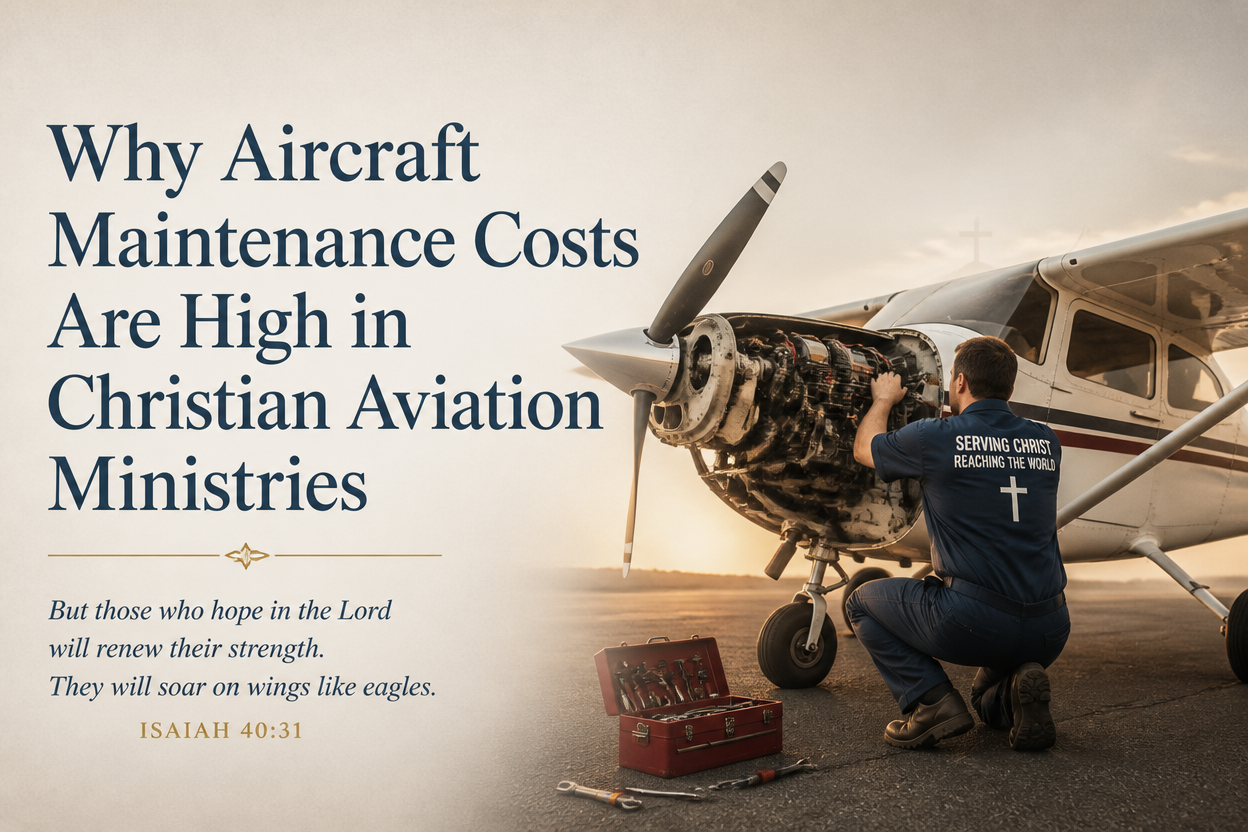
Aircraft maintenance costs are high in Christian aviation ministries because aviation is an unforgiving stewardship domain: the safety standards are exacting, the operating environments are harsh, the supply chains are specialized, and the regulatory burden is non-negotiable. Donors sometimes encounter a maintenance line item that feels disproportionate next to salaries or program grants. The harder reality is that, in aviation, maintenance is often the ministry’s most direct expression of love of neighbor.
When ministries fly pastors, medical teams, Bible translators, or humanitarian cargo into remote places, they accept a moral obligation that Scripture treats with seriousness: “whoever knows the right thing to do and fails to do it, for him it is sin” (James 4:17). In practical terms, “the right thing” includes disciplined inspection cycles, conservative component replacement, and a budget that is resilient when parts, labor, and downtime rise unexpectedly.
Maintenance is not overhead in the moral sense
Aviation does not permit the donor fiction of cheap faithfulness
Many donors have been formed by an unhealthy nonprofit narrative: that the most faithful ministry is the one that appears to spend the least on operations. In aviation, that narrative is not just misleading; it can be dangerous. Flight operations are a high-consequence system, and the consequences of underfunding maintenance are measured in human lives, not in marginal program efficiency.
There is a broader sector correction here. Charity Navigator, GuideStar, and the BBB Wise Giving Alliance jointly warned donors that “overhead ratios” are a poor measure of nonprofit performance and can pressure organizations into underinvesting in necessary infrastructure. Their “Overhead Myth” statement remains one of the clearest public signals that responsible governance includes spending what safety and effectiveness require (Charity Navigator, Candid, and BBB Wise Giving Alliance).
Stewardship includes preserving what has been entrusted
Aircraft are capital assets that can serve for decades when maintained to standard. Christian donors often understand capital stewardship instinctively in other contexts: church facilities, mission hospitals, or translation software that needs sustained support. Aviation is similar, but less forgiving. Deferred maintenance compounds, and the eventual correction is often more expensive than steady, disciplined care.
Across our verification work at Most Trusted, we observe that ministries that can explain their maintenance philosophy plainly and document it consistently tend to be the ministries that withstand both operational shocks and public scrutiny. They do not treat maintenance as a public-relations vulnerability. They treat it as part of their witness.
Regulation and airworthiness are built around documented discipline
Compliance is labor-intensive by design
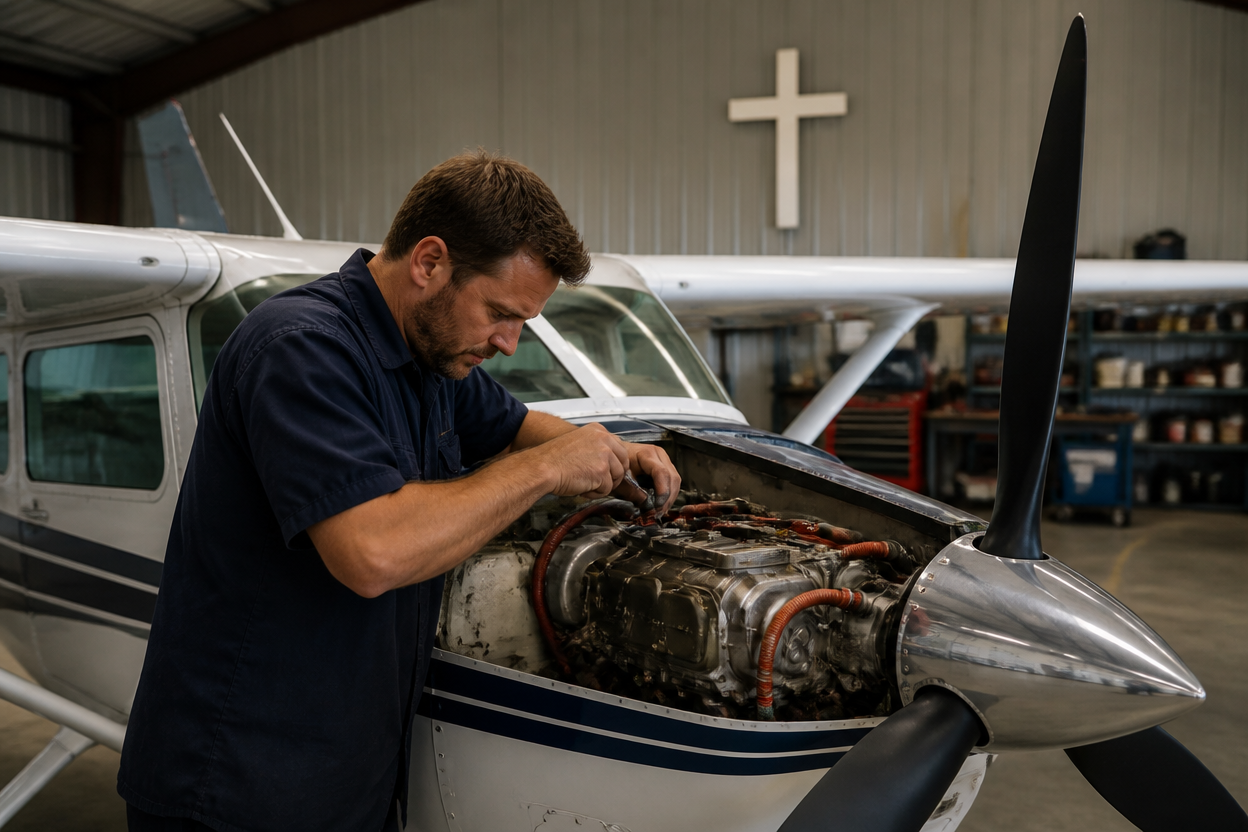
Aircraft maintenance costs are high in part because aviation regulation is designed to make “good intentions” insufficient. The U.S. Federal Aviation Administration requires extensive recordkeeping and adherence to approved maintenance procedures, service bulletins where applicable, and airworthiness directives when issued. This is not bureaucratic ornamentation. In aviation, documentation is part of safety itself, because it creates traceability and accountability across time, staff turnover, and changing operating contexts (Federal Aviation Administration).
Even ministries operating outside the United States often anchor their standards to FAA or EASA expectations because donors, insurers, and partner organizations recognize those benchmarks. The administrative cost is real: logbooks, component times, inspection sign-offs, defect tracking, and audit readiness. The labor behind those tasks is specialized, and it is not easily substituted by general volunteer help.
Inspections and maintenance schedules are not optional choices
Most aircraft operate under required inspection intervals. Beyond the baseline annual or 100-hour inspections common in general aviation contexts, mission aircraft often have additional requirements driven by their usage patterns, modifications, and operating environment. A ministry that flies short legs into unimproved strips is placing very different wear demands on landing gear, brakes, tires, and airframes than a privately-owned aircraft that spends most of its life on paved runways.
This regulatory reality matters for donor interpretation. A maintenance expense spike can indicate responsible compliance after a hard season of flying, not mission drift. The question is not whether maintenance costs rise. The question is whether leadership planned for predictable cycles and governed the surprises with integrity.
Mission environments accelerate wear and increase risk controls
Remote operations turn minor issues into expensive events
Christian aviation ministries often operate far from the support ecosystem that makes private aviation manageable. A small mechanical issue at a major U.S. airport can be solved with local parts availability and multiple certified technicians. The same issue in a remote region can require flying in a mechanic, ferrying the aircraft to a suitable facility, or waiting weeks for parts to clear customs.
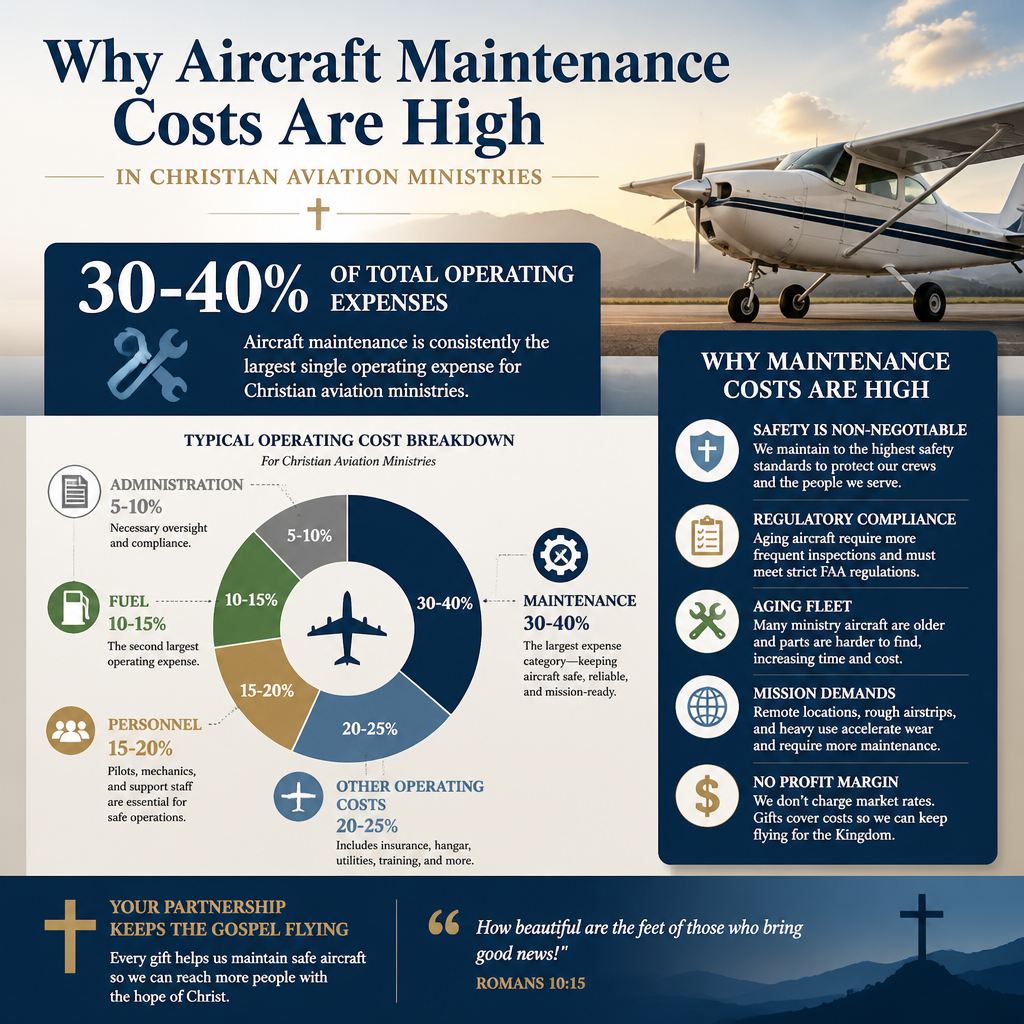
Downtime itself becomes a cost. Even when a ministry is not paying passengers, aircraft time on the ground affects mission commitments, partner relationships, and crew utilization. Ministries must either carry operational redundancy or accept that mission delivery will periodically pause. Either approach carries cost, and neither is a sign of waste. It is an honest accounting of geography.
Harsh conditions increase parts consumption
Heat, humidity, salt air, dust, and short-field operations all increase maintenance demands. Corrosion control, filtration, and more frequent replacement of consumables are part of faithful operations in these contexts. The ministry is not purchasing comfort; it is purchasing reliability under strain.
Donors sometimes ask why a ministry cannot simply “be more efficient” in maintenance. The field has had to reckon with the uncomfortable fact that “efficiency” is sometimes the name we give to risk-shifting. In aviation, the ethical question is whether the ministry is shifting risk onto passengers, crews, and communities that did not consent to that risk.
Labor, parts, and supply chains are structurally expensive
Certified expertise is scarce and cannot be improvised
Aviation maintenance is a skilled trade with stringent qualification requirements. Ministries may benefit from volunteer mechanics, but even volunteer labor must align with certification standards and quality control. When a ministry pays for an A&P mechanic, avionics technician, or inspector, it is paying for competence that has been tested and regulated, and for liability carried with sobriety.
Donors can rightly expect ministries to be cost-conscious. They should not expect ministries to chase the lowest bid when the work governs safety margins. The church has learned this lesson in other areas: financial audits, child protection practices, and safeguarding protocols are expensive precisely because they are meant to be dependable.
Aircraft parts pricing behaves differently than consumer markets
Aircraft parts supply chains are specialized, heavily regulated, and sensitive to disruptions. Many parts must be traceable, approved, and installed according to strict procedures. Substituting “equivalent” components is often not allowed. When a part becomes scarce, the price can rise sharply, and the operational impact is disproportionate.
For donors evaluating ministries, this is why simplistic cost comparisons between aviation and ground-based programs frequently mislead. Aviation does not scale linearly. A single grounded aircraft can constrain an entire region’s mission movement.
- Specialized parts with traceability requirements
- Shipping and customs delays for international operations
- Limited maintenance facilities near remote airstrips
- Higher wear from short-field and unimproved runway operations
- Downtime costs that ripple through mission commitments
What donors should examine when maintenance costs rise
Transparency that shows the ministry is governing risk
Higher maintenance costs can be a sign of either faithful stewardship or poor planning. Donors should ask for evidence of governance. In the aviation context, responsible ministries are usually able to describe, without defensiveness, how they budget for inspection cycles, how they respond to defects, and how they decide when an aircraft is nearing end-of-life for mission purposes.
Most Trusted exists to help donors give with confidence by evaluating Christian nonprofits against The Most Trusted Standard, a 15-criteria framework that examines faith foundation, financial integrity, governance, and transparency. Aviation ministries present unique verification questions because the mission impact is compelling and the safety stakes are high. Donors should not be left to interpret these dynamics alone.
Healthy funding models that resist the starvation cycle
Nonprofit research has long described the tendency of organizations to underinvest in core capacity to satisfy donor expectations, then struggle when predictable costs arrive. In aviation, that pattern can become acute because maintenance is cyclical and sometimes lumpy. The ministry that appears “lean” for a season may simply be deferring costs into a future crisis.
Donors can look for a few concrete signals: audited financials, clear accounting for restricted and unrestricted funds, and leadership that can explain reserves without embarrassment. If a ministry is consistently forced into emergency appeals for routine maintenance, it may be operating with structural fragility. If a ministry budgets maintenance steadily, communicates variance honestly, and shows disciplined oversight, higher costs may reflect mature operations rather than waste.
For readers tracking the broader landscape of Christian Aviation Ministries, it helps to compare how different organizations explain their maintenance philosophy and how they document safety governance. Donors should expect difference in context without excusing opacity.
Readers who want more specific safety context can also consult Aircraft Safety and Pilot Training in Christian Aviation, since maintenance decisions are inseparable from training, standard operating procedures, and incident reporting culture.
FAQs for Why aircraft maintenance costs are high in Christian aviation ministries
Should donors be concerned when maintenance costs seem to spike in a given year?
Not automatically. Aviation maintenance is often cyclical: major inspections, engine overhauls, avionics replacements, and corrosion remediation can cluster. The donor question is whether the ministry anticipated the cycle, governed the process with documented oversight, and communicated the variance with transparency rather than surprise.
Is it reasonable to expect Christian aviation ministries to keep maintenance costs low by using more volunteers?
Volunteer service can be a gift, but it does not remove certification requirements, quality control processes, or documentation duties. A ministry can responsibly incorporate volunteers while still budgeting for paid expertise, inspections, and parts. When safety standards are treated as negotiable, the ministry is no longer stewarding risk faithfully.
Funding maintenance is funding faithful presence
Aircraft maintenance costs are high in Christian aviation ministries because the work is costly: regulated discipline, harsh environments, specialized labor, and supply chains that do not behave like ordinary markets. Mature donors should resist the false choice between safety and mission. In aviation, safety is the condition that makes mission possible, and a ministry’s willingness to pay for it is often one of the clearest indicators of integrity.



