

When should Christian donors bunch donations for taxes? The practical answer hinges on whether a larger, less frequent pattern of giving helps you itemize charitable deductions in some years while taking the standard deduction in others. The spiritual answer is more searching: whether a tax strategy is serving faithful stewardship, or subtly teaching the heart to give only when it is efficient.
Christian giving is not a mere financial transaction. Scripture consistently treats money as a discipleship issue, not an administrative one. Yet in the United States, tax law does shape what many households can afford to give. Bunching donations can be a legitimate way to increase after-tax capacity for generosity, so long as it does not erode regular, accountable support for the local church and for ministries doing durable work.
What donation bunching is and when it actually matters
Donation bunching is the practice of concentrating multiple years of charitable gifts into one tax year so that total itemized deductions exceed the standard deduction. The donor then takes the standard deduction in the off year and repeats the cycle. The approach matters most when a household’s deductions are near the itemization threshold and charitable giving is the variable that can push them above it.
For 2025, the federal standard deduction is $15,000 for single filers and $30,000 for married couples filing jointly (with additional amounts for certain taxpayers). Internal Revenue Service. When a household’s mortgage interest, state and local taxes, and other itemizable expenses fall well below these levels, charitable giving may not change the tax outcome. When those other deductions are close, bunching can.
The standard deduction is the gatekeeper
Many donors intuitively assume charitable giving always reduces their taxable income. In reality, charitable deductions generally benefit taxpayers who itemize. Since the Tax Cuts and Jobs Act increased the standard deduction, fewer households itemize than in prior decades.
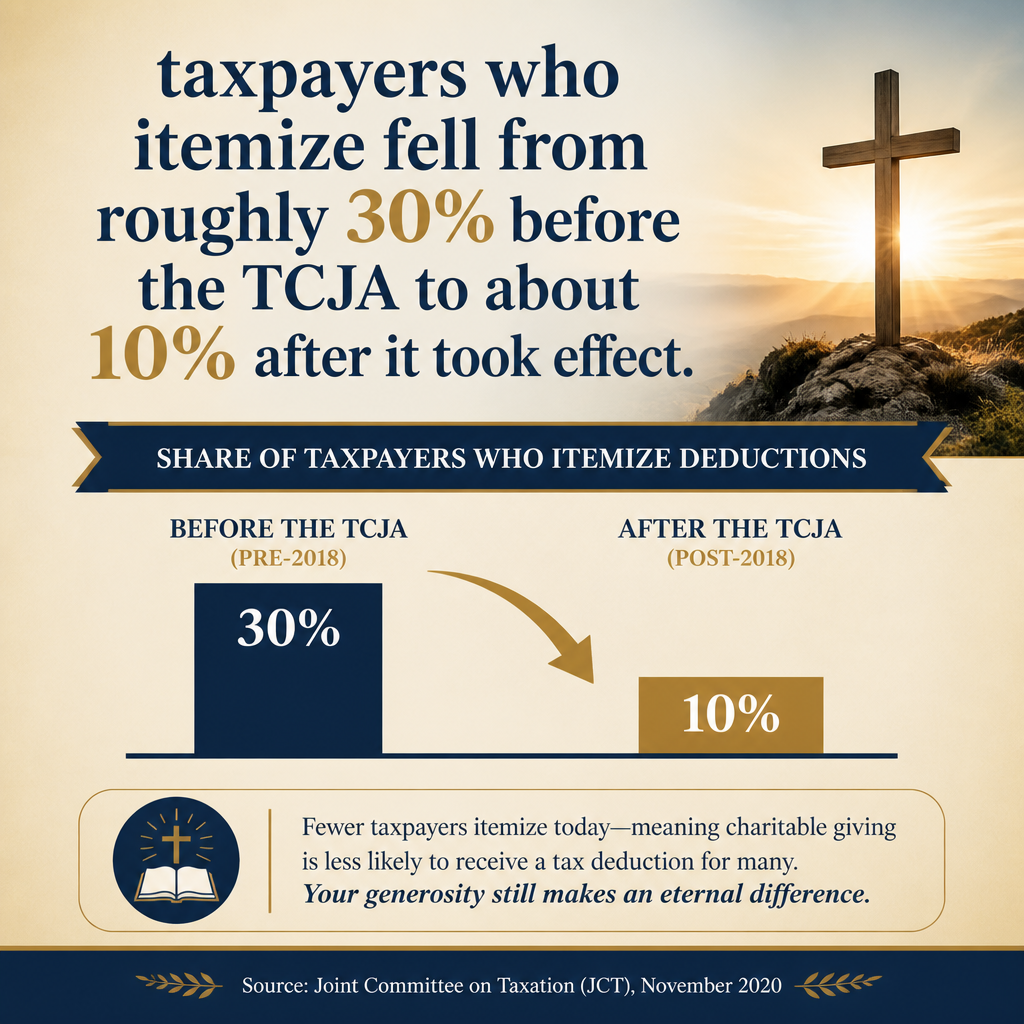
The share of U.S. taxpayers who itemize fell from roughly 30% before the TCJA to about 10% after it took effect. Tax Policy Center. That shift does not diminish the biblical call to generosity, but it does mean that bunching is relevant primarily for a subset of donors.
Itemizing is not the only goal
Tax savings can free resources for the Kingdom, but itemizing is not a moral achievement. For many Christian households, the more faithful decision is to maintain steady giving patterns and accept that the tax code will not always “reward” them. The goal is not to make every dollar deductible. The goal is to steward every dollar under God.

When bunching is wise and when it is not
Bunching tends to be most effective for donors who have consistent generosity, predictable income, and the ability to give larger amounts without jeopardizing obligations. It is usually less wise for donors whose giving is tightly tied to monthly cash flow, or for those whose primary commitments depend on regular contributions.
Signals that bunching may be prudent
Bunching is often worth considering when several conditions align:
- Your household is near the itemization threshold, and a larger charitable year would meaningfully exceed the standard deduction.
- You already have disciplined giving habits and want to increase long-term capacity, not merely reduce taxes.
- You can fund the larger gift without consumer debt or destabilizing emergency reserves.
- Your favored ministries can responsibly absorb a larger one-time contribution without distorting programming decisions.
- You have a plan to sustain consistent support in the “off” year, especially for your church and core partners.
Common reasons to avoid bunching
Christians genuinely disagree about how much weight tax strategy should carry in a discipleship framework. Still, several red flags recur. If bunching becomes an excuse to delay generosity, if it leads to irregular support that harms a ministry’s planning, or if it pressures a household into over-giving in one year and under-giving in the next, the strategy is likely misapplied. Scripture commends planning and prudence, but it does not commend financial drama as a mark of faith.
There is also a governance concern. A sudden, oversized restricted gift can unintentionally steer a ministry’s priorities. Mature donors take care that their giving strengthens a ministry’s mission rather than bending it toward donor preference.
Methods Christian donors use to bunch without harming ministries
The best bunching approaches preserve two goods at once: (1) the donor’s legitimate desire to steward taxes responsibly, and (2) the ministry’s need for predictable, accountable income. The most common tools include donor-advised funds and multi-year pledges supported by a single-year funding event.
Donor-advised funds as a pacing mechanism
A donor-advised fund (DAF) can allow a donor to take a charitable deduction in the year contributions are made to the DAF, while distributing grants to ministries over time. For donors who want to bunch giving for tax purposes without causing feast-and-famine volatility for ministries, this can be a disciplined solution.
The trade-offs should be named clearly. A DAF introduces an additional layer of administration, and it requires intentional follow-through so that funds are granted rather than left idle. For Christian donors, there is also a spiritual temptation to treat “money already deducted” as “money already given,” even when ministries have not yet received it. We recommend treating grantmaking as an extension of worship, not as an afterthought.
Multi-year commitments supported by a single-year gift
Some donors bunch by making a single larger contribution that funds a multi-year pledge, either held by the ministry as a designated reserve or released annually according to a written agreement. This is not appropriate for every ministry; strong financial controls and transparent accounting are essential. Across our verification work, we observe that ministries that meet The Most Trusted Standard tend to document restricted gifts clearly, report on use, and avoid vague internal buckets that are difficult for boards and donors to audit.
How tax strategy intersects with Christian stewardship and spiritual formation
Jesus’s teaching about treasure is not merely cautionary; it is diagnostic. “Where your treasure is, there your heart will be also” (Matthew 6:21). Tax planning can be a form of wisdom, but it can also become a subtle catechism, training donors to treat generosity as a tool for personal advantage rather than love of God and neighbor.
Bunching must not replace regular obedience
Many Christian donors rightly prioritize the local church as their primary giving commitment. Regular giving under the oversight of a real community is part of how Scripture forms Christians. A bunching strategy that unintentionally sidelines weekly or monthly church generosity should be reconsidered, even if it “works” on a spreadsheet.
What this means in practice is that some donors choose to bunch primarily for parachurch giving while keeping church giving steady. Others bunch by using a DAF to maintain monthly granting patterns. Either approach can honor the spiritual aim: consistent participation in God’s work, not sporadic bursts of philanthropy.
The moral frame is stewardship, not maximum deduction
Christian stewardship is not the art of extracting the largest possible benefit from the tax code. It is the practice of managing God’s resources faithfully, prudently, and generously. The parable of the talents commends wise deployment of entrusted resources, but it also condemns fear-driven preservation. A donor who bunches out of fear of “wasting” a deduction may need to ask whether the larger anxiety is financial control rather than faithful trust.
A more coherent frame is capacity-building for generosity. If bunching increases the resources available for faithful giving over a lifetime and does not compromise core commitments, it can be an instrument of stewardship rather than a distraction from it.
Due diligence matters more when gifts get larger
Bunching typically increases the size of individual gifts. That raises the stakes of discernment. Larger gifts can do genuine good, but they can also amplify harm when given to ministries with weak governance, unclear doctrine, or opaque reporting. Christian donors often focus on overhead ratios or compelling stories. Those signals are not sufficient for accountability.
What to verify before making a bunched gift
Across our work at Most Trusted, we encourage donors to examine a ministry with the same seriousness they bring to other consequential decisions. The question is not whether a ministry is inspiring, but whether it is faithful and responsible.
A few due diligence markers matter disproportionately when you are planning a larger year:
- Clear statement of faith and demonstrated theological commitments in actual practice
- Audited financials or reviewed statements where appropriate for size and complexity
- Board independence and meaningful governance oversight
- Transparent reporting on outcomes and limitations, not only success stories
- Policies that reduce fraud and conflicts of interest
Most Trusted evaluates Christian nonprofits against The Most Trusted Standard, a 15-criteria framework that covers faith foundation, financial integrity, governance and leadership, and transparency and effectiveness. Donors exploring the broader landscape of Christian Stewardship Services often find that verification reduces guesswork precisely when giving decisions become more complex.
Tax-smart giving should not outrun ministry accountability
The harder question is whether a donor’s financial sophistication is matched by their discernment. When gifts are bunched, the margin for error shrinks. If a ministry later collapses under moral failure or financial mismanagement, the donor cannot simply “undo” the concentration of giving. This is not an argument for cynicism; it is an argument for verification, governance awareness, and sober-minded generosity.
Donors who want a more focused view of Tax-Smart Giving Through Christian Stewardship Services often benefit from holding tax strategy and ministry credibility together rather than treating them as separate decisions.
FAQs for When should Christian donors bunch donations for taxes
Is it unspiritual to bunch donations to get a better tax outcome?
No. Scripture commends wisdom and planning, and the tax code is part of the real environment Christian households inhabit. The spiritual risk is not the existence of strategy, but the displacement of obedience. If bunching increases long-term generosity, preserves regular support for the church and core partners, and is paired with careful due diligence, it can be an expression of stewardship rather than self-interest.
Should we bunch giving to our church, or only to parachurch ministries?
Many households keep church giving steady and bunch other charitable giving, especially when church budgeting depends on consistent offerings. Others use a DAF so that a bunched contribution can be granted to the church monthly, preserving regularity while still taking the deduction in the funding year. The right approach depends on your cash flow, your church’s expectations, and whether you can sustain steady commitments without creating volatility for the ministries you serve.
A faithful approach to bunching
Bunching donations can be a prudent choice when it materially changes your ability to itemize and, over time, increases your capacity for generous giving. It is less faithful when it makes generosity episodic, undermines steady commitments, or substitutes tax efficiency for discernment. Christian donors do not honor God by ignoring the realities of the tax code, but neither do we honor him by allowing the tax code to set the terms of our generosity.



