
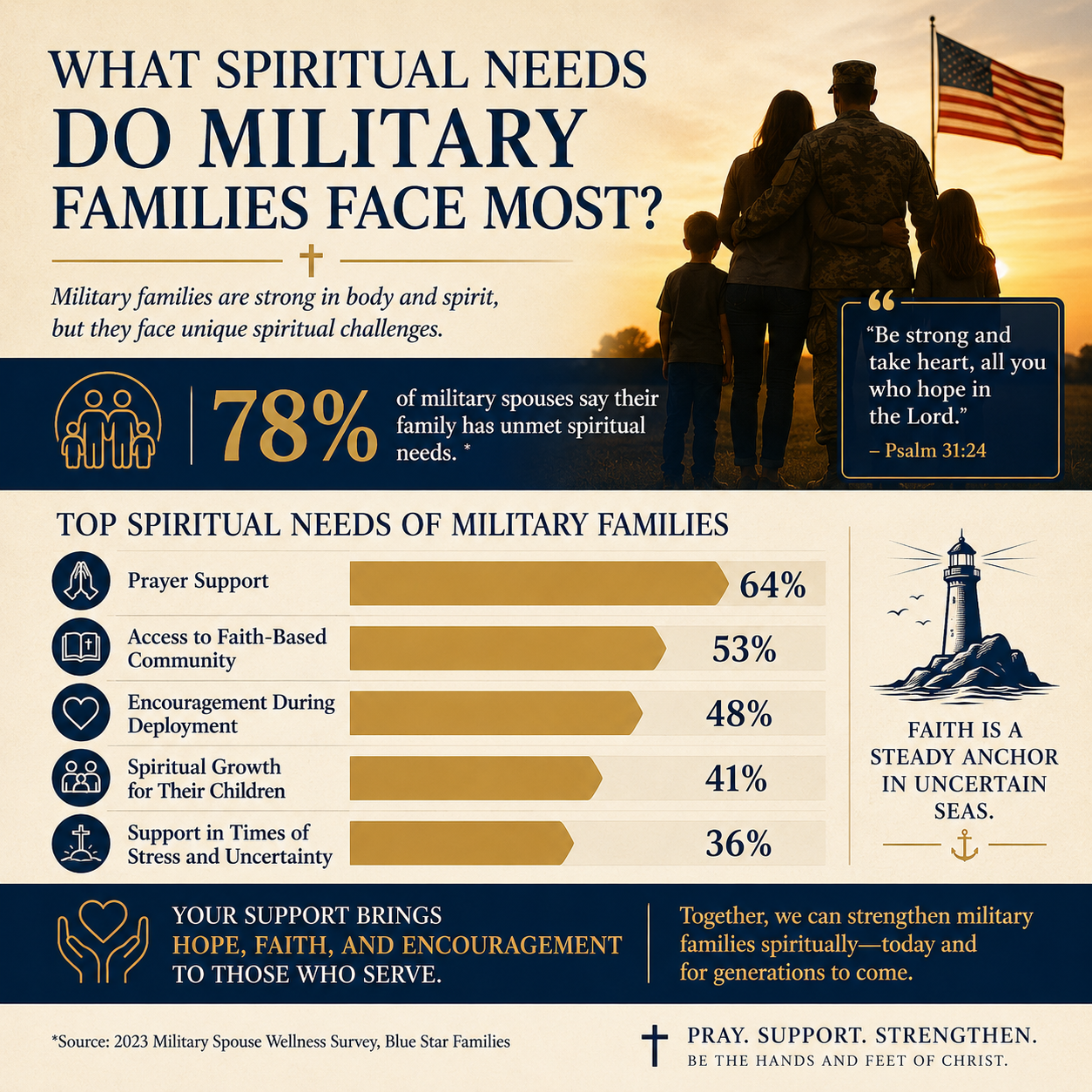
What spiritual needs do military families face most? The question matters because military life concentrates stressors that test a household’s faith, its sense of calling, and its ability to endure long seasons where normal church rhythms are interrupted.
For Christian donors, the harder issue is discernment: which ministries understand those pressures and respond with pastoral realism rather than patriotic sentimentality. Across our verification work at Most Trusted, we see that the most credible military outreach efforts name the costs honestly, build durable forms of care, and can show how their programs and finances align with their stated theology.
The need for faithful presence under chronic transition
Frequent moves fracture ordinary discipleship
Military families rarely struggle because they lack a local church directory. They struggle because frequent relocation, training cycles, and deployments repeatedly break the slow bonds by which discipleship normally forms: long-term friendships, consistent small-group care, and a pastor who knows a family’s story. A move can reset a couple’s support system to zero, with children re-entering new classrooms and spouses rebuilding community from scratch.
One of the clearest social realities is simply how mobile military households are. The Department of Defense reports that Permanent Change of Station moves remain a defining feature of service life, shaping family stability and access to resources; even when exact patterns vary by branch and career field, the institutional expectation of mobility is constant. Department of Defense
What faithful presence looks like in practice
For donors evaluating ministry work, “presence” should not be treated as a vague virtue. It has programmatic content: trained chaplains and lay leaders who can stay with a family through a deployment cycle, mechanisms for continuity when a family moves, and partnerships that help a family plug into a healthy local church without being treated as a project.
This is one reason we encourage donors to view Military Outreach Ministries through the lens of ecclesiology. A ministry can support the local church, complement it, or subtly replace it. The spiritual need is not merely access to religious services; it is belonging to the people of God in a way that survives the next set of orders.
The need to interpret fear, risk, and loss before God
Anxiety is not only psychological
Military life introduces a distinctive form of fear: the ordinary fear any family feels when someone they love drives to work, intensified by higher baseline risk and long periods of limited communication. That fear can express itself as insomnia, irritability, control, and a constant sense that catastrophe is nearby. Those are pastoral issues as much as clinical ones. Scripture does not treat fear as merely a feeling to suppress; it treats it as a spiritual reality to bring into the presence of God with honesty and trust.
At the same time, mature care refuses simplistic contrasts between “pray more” and “get therapy.” Many military households need both pastoral counsel and evidence-based mental health care, especially when deployment-related stress interacts with prior trauma or family-of-origin patterns. Ministries serve families well when they know their limits, maintain referral relationships, and teach believers how to pursue help without stigma.
Grief and moral injury require more than resilience language
Some military families carry grief that is public and ceremonial; others carry losses that are unseen: miscarriages during solo parenting, marriages eroded by distance, friendships lost at each move, or the quiet despair of a spouse whose vocational path is repeatedly interrupted. For service members, spiritual strain can also include moral injury, a term used in clinical and chaplaincy settings to describe the lasting spiritual and moral distress that can follow actions, betrayals, or witnessed horrors that violate deeply held beliefs.
The Department of Veterans Affairs has described moral injury as distinct from PTSD, with strong spiritual dimensions and a need for care that can include chaplaincy and spiritually integrated supports. U.S. Department of Veterans Affairs
Donors should expect ministries to address lament, confession, forgiveness, and reconciliation with theological care. A credible ministry will speak about the Cross not as a slogan, but as God’s decisive answer to guilt, shame, and death. What military families often need most is not a pep talk about toughness, but the assurance that Christ meets them where their courage has run out.
The need for church integration without exploitation or isolation
Military culture can be honored without being idolized
Local churches can struggle to understand military households. Some congregations over-celebrate them, turning service members into symbols rather than fellow disciples. Others ignore them, assuming a family will soon move anyway and investing relationally is not worth it. Both postures wound. Military families need to be received as ordinary Christians with particular burdens, not as mascots and not as temporary guests.
There is also a genuine debate Christians should name plainly: to what extent should churches critique aspects of the military institution, and how should they pastor those whose employment is embedded within it? Faithful ministry neither baptizes every policy decision nor treats service members as morally suspect. It begins with the dignity of the person made in God’s image, the demands of discipleship, and the church’s calling to speak truth with humility.
What donors can look for in ministry design
Programs that strengthen integration tend to have three marks: they collaborate with local pastors, they train volunteers to understand the rhythms of deployment and reintegration, and they avoid building parallel church structures that keep families perpetually separate. Some of the strongest initiatives focus on equipping churches near installations to offer practical and pastoral care, rather than drawing families into a separate “military-only” religious ecosystem.
Within How Military Outreach Ministries Support Service Members, we encourage donors to ask a basic governance question: does the ministry’s model foster long-term discipleship in the local church, and can leadership explain why that model is theologically appropriate? When answers are thin, programs tend to drift toward event-driven activity that looks fruitful in reports but does not form resilient households.
The need for marriage and parenting discipleship shaped for military realities
Reintegration tests the household’s covenant life
Deployments are not only absences; they are repeated disruptions of family systems. A spouse at home becomes both parent and administrator. A returning service member may come back exhausted, alert to threats, and uncertain how to re-enter a home where routines changed in their absence. Reintegration is often where couples discover how much spiritual formation they did or did not receive during the deployment itself.
Research on military family outcomes is complex and varies by population, but the association between deployment-related stress and family strain is well documented in military family scholarship. The DoD’s ongoing attention to family readiness reflects the institutional recognition that a service member’s effectiveness is intertwined with a household’s stability. Military OneSource
Parenting requires stable meaning as well as stable schedules
Children in military families often become fluent in change. That adaptability can be a strength, but it can also mask insecurity. Kids absorb the unspoken message that relationships are temporary and that home is a concept rather than a place. Spiritual care for military children, therefore, is not entertainment and not merely “values.” It is the patient work of giving them a stable story: God is faithful, the church is family, and their identity is received in Christ rather than earned through performance or toughness.
For donors, this is where program substance matters. A weekend retreat can be a genuine gift, but it is not a replacement for year-round pastoral care, marriage mentoring, and age-appropriate discipleship for children who have learned to keep their bags half packed.
- Marriage mentoring that accounts for deployments and reintegration patterns
- Parenting support for solo parenting seasons, including spiritual formation at home
- Children’s discipleship designed for grief, change, and anxiety rather than generic curriculum
- Peer community that reduces isolation without becoming insular
- Referral pathways to clinical care when trauma or depression exceeds volunteer competence
The need for trustworthy ministries with demonstrable integrity
Military-adjacent fundraising can attract both excellence and opportunism
Military service carries moral weight in American life, and that creates a fundraising environment where donors can be moved quickly. This is not inherently bad; gratitude can be a form of justice. Yet donor emotion also creates risk. Some organizations rely on patriotic imagery and urgent appeals while providing limited evidence of outcomes, weak governance, or unclear financial practices.
Christians who want to give responsibly should not treat due diligence as suspicion. Scripture treats stewardship as a serious moral obligation. The question is not whether a ministry’s stories are compelling, but whether its leadership, financial practices, and public claims are verifiable and aligned with its theological commitments.
How The Most Trusted Standard clarifies donor discernment
Most Trusted evaluates Christian nonprofits against The Most Trusted Standard, a 15-criteria framework spanning faith foundation, financial integrity, governance and leadership, and transparency and effectiveness. In military outreach work, this means we look for clear doctrinal commitments, competent boards, responsible handling of restricted gifts, honest reporting about program limits, and evidence that services provided are what donors believe they are funding.
We also encourage donors to name a practical tension: some of the most necessary care is not easily quantified. Pastoral counsel, spiritual formation, and reconciliation do not always yield neat metrics. Still, credible ministries can show meaningful indicators of faithfulness: consistent chaplaincy coverage, trained volunteers, partnerships with local churches, documented safeguarding practices, and financial reporting that allows donors to see whether resources are actually reaching families.
FAQs for What spiritual needs do military families face most
Are military families primarily looking for practical help or spiritual care?
Most need both, and separating them can be artificial. Practical support during deployments, childcare help, and meals can be genuine mercy ministries, but they are most stabilizing when they are connected to pastoral care, prayer, and long-term discipleship. Donors should favor ministries that treat practical support as a doorway into sustained spiritual formation rather than as an end in itself.
What should donors ask before funding a military outreach ministry?
Donors should ask how the ministry partners with local churches, what training and safeguards exist for anyone working with children and vulnerable families, and what evidence the organization can provide that services are delivered as described. Financially, we recommend reviewing audited statements when available, board independence, and clarity about restricted gifts. Ministries that can answer these questions plainly and document their claims tend to be the ones positioned for faithful, durable impact.
A sober and hopeful view for Christian donors
Military families face spiritual needs that are both ordinary and intensified: belonging, courage, confession, forgiveness, and endurance under pressure. The church’s calling is not to romanticize their sacrifice or to reduce discipleship to resilience, but to offer the steady ministry of Word, prayer, sacrament, and love.
Donors play a real role in whether that care is present and credible. Giving that is both compassionate and verified helps ensure military households are met not only with gratitude, but with the kind of long obedience that forms saints in the midst of orders, absence, and return.



