
When donors ask what red flags signal weak accountability in Christian legal services, they are rarely asking about administrative polish. They are asking whether a ministry that speaks in the name of Christ can be trusted with vulnerable clients, complex legal matters, and the moral weight that comes with both.
Christian legal services sit at an intersection of pastoral care, professional ethics, and civil authority. Scripture calls rulers and judges to defend the weak and uphold justice (Psalm 82:3–4), and Christian donors rightly desire to fund work that protects the oppressed rather than unintentionally exposing them to further harm. Accountability is where that desire is tested.
1) When legal work is treated as a brand rather than a fiduciary responsibility
Client outcomes are presented as spiritual proof rather than professional evidence
A common early warning sign is narrative-driven reporting that substitutes testimony for verifiable practice. Christian ministries should tell stories carefully and reverently, but legal services also require measurable integrity: clear scope of representation, accurate expectations, and documented results. Where everything is framed as “victory” and little is documented as “case disposition,” “referral,” or “services delivered,” donors should ask whether leadership is avoiding accountable categories.
Legal aid is not only “helping people.” It is engaging rights, deadlines, evidence, and procedural rules that can meaningfully alter a person’s housing, immigration status, family stability, or safety. Ministries that blur this line can unintentionally drift toward spiritualized marketing, where the ministry’s reputation matters more than whether clients are protected.
There is vagueness about who is actually practicing law
Weak accountability often appears as ambiguity about staffing. Are clients served by licensed attorneys, accredited representatives, supervised law students, trained advocates, or volunteers offering informal support? Different models can be faithful and effective, but the distinctions are not optional. In immigration work, for example, the difference between a licensed attorney and an unqualified “consultant” is precisely where abuse and fraud have historically flourished, prompting repeated public warnings from federal agencies about immigration scams and notario fraud. See U.S. Citizenship and Immigration Services.
Donors should expect a ministry to state plainly what services it provides, who provides them, and what supervision and safeguards govern the work.

2) When governance is informal, founder-centered, or insulated from correction
A board exists on paper but does not exercise oversight
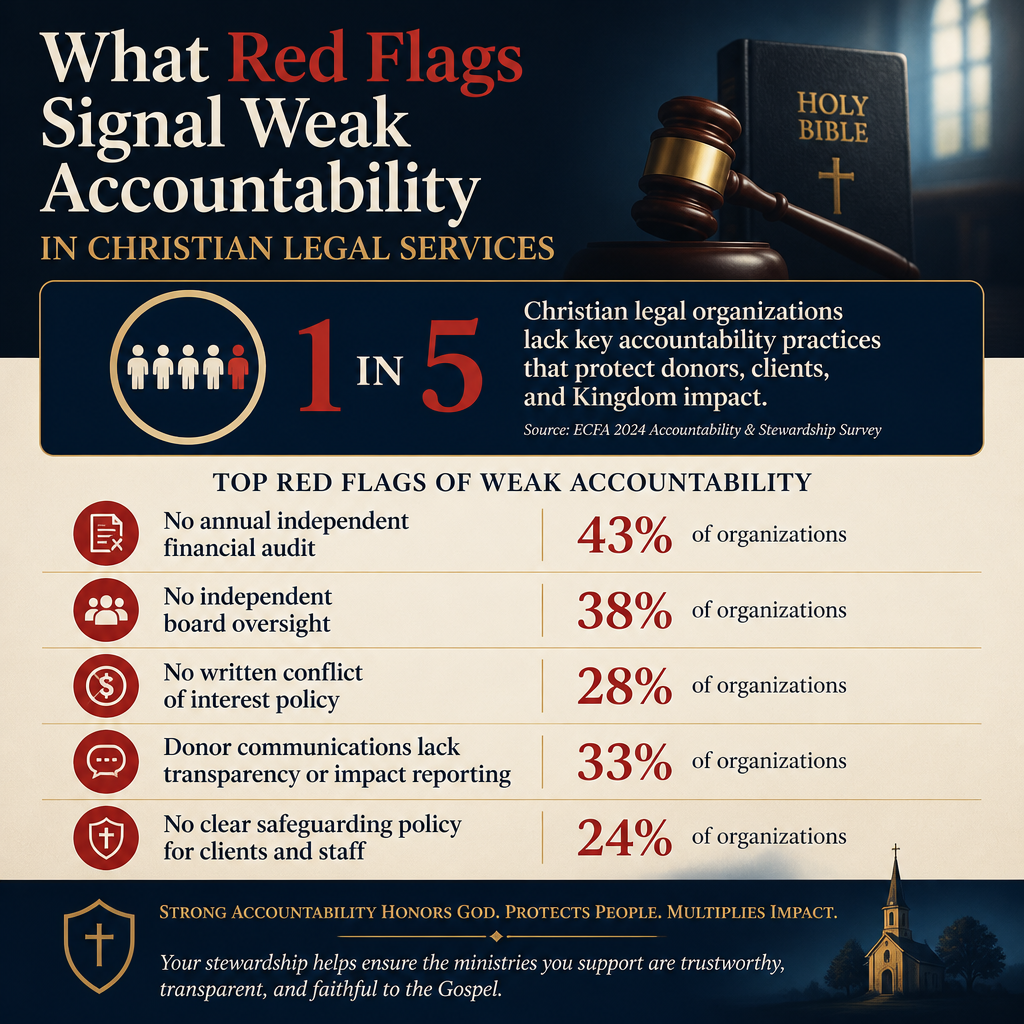
In any Christian nonprofit, governance is a spiritual issue because it is a stewardship issue. In legal services, it is also a risk-management necessity. Red flags include boards that rarely meet, boards without independent members, or boards composed primarily of family, employees, or close associates. Another warning sign is a ministry that cannot describe how the board evaluates the executive leader, handles conflicts of interest, or responds to complaints.
Across our verification work at Most Trusted, the ministries that meet The Most Trusted Standard tend to treat board accountability as an instrument of protection: protection for clients, protection for staff, and protection for donors. The opposite posture treats the board as a ceremonial endorsement of the founder’s vision.
Leadership speaks as if criticism is persecution
Christian organizations sometimes face unfair suspicion, particularly when they work in contested legal and cultural spaces. The tension is real. Yet a ministry that interprets any external question as hostility often becomes impossible to correct. Scripture distinguishes between suffering for righteousness and suffering for wrongdoing (1 Peter 2:19–20). A leader who cannot receive scrutiny without spiritualizing the conflict may be signaling an environment where problems will be concealed rather than addressed.
This does not require cynicism from donors. It requires sobriety. Accountability demands leaders who can distinguish between ideological opposition and legitimate oversight.
3) When financial clarity is thin and restricted funds feel discretionary
Financial statements are inaccessible or delayed
A basic marker of accountability is whether a ministry readily provides timely financials: recent Form 990, audited financial statements where appropriate, and clear explanations of revenue sources and program costs. Donors can verify whether a ministry files a Form 990 by searching the IRS Tax Exempt Organization Search. See Internal Revenue Service.
Some ministries are not required to file a 990 (for example, certain churches and integrated auxiliaries). That exemption can be legitimate, but it is not a blanket excuse for opacity. If a ministry is functionally operating like a public-facing legal aid nonprofit while relying on “church-like” opacity, donors should ask why ordinary transparency is being avoided.
Restricted giving is treated as leadership discretion
Christian donors often give restricted gifts: “for immigration casework,” “for domestic violence legal advocacy,” “for court fees,” or “for clinic expansion.” Weak accountability shows up when restrictions are accepted enthusiastically but not honored with precision. Donors should look for written gift acceptance policies, clear fund accounting practices, and reporting that ties restricted gifts to actual expenditures.
A related warning sign is when a ministry dismisses donor questions about overhead with scorn. The wiser approach is to affirm the widely recognized principle that overhead ratios are not a sufficient measure of effectiveness, while still providing legitimate transparency. The sector’s joint statement on this point is often referred to as the Overhead Myth letter signed by major evaluators. See Candid GuideStar.
- Refusal to share recent financials or a credible explanation for why they are unavailable
- Frequent emergency appeals without a stable operating plan
- Restricted gifts accepted without written terms or follow-up reporting
- Related-party transactions that are not clearly disclosed and reviewed
- Cash handling practices that rely on trust rather than documented controls
4) When transparency is selective and client dignity is treated as optional
Stories are detailed, but consent is unclear
Legal services ministries often work with people facing intimate crises: family violence, immigration status, criminal records, financial hardship, or housing instability. A ministry can violate accountability without mishandling money simply by mishandling people. Red flags include client stories that share identifying details, photographs, or case specifics without clear evidence of informed consent, particularly when the client is in a dependent relationship with the ministry.
Confidentiality is not merely a professional technicality; it is a form of neighbor-love. When a ministry treats vulnerable clients as content, donors should consider whether the ministry’s internal culture has learned to prize growth over dignity.
Impact claims cannot be reconciled with public information
Some legal ministries make sweeping claims: “we saved thousands from deportation,” “we stopped trafficking,” “we restored families,” “we changed public policy.” The work can be truly significant, but accountability requires a methodology. When numbers are offered without definitions, time frames, or boundaries, trust becomes impossible to calibrate.
Donors should ask: What counts as a “case”? Is a “client served” a person who received a consultation, a representation agreement, or a full litigation process? Are referrals counted as services? Are outcomes tracked beyond the immediate clinic? In sophisticated giving, terms must be stable or impact reporting becomes public relations.
For donors seeking a broader map of how these ministries are structured and what faithful practice tends to include, we maintain an overview of Christian Legal Services Ministries that situates common models and accountability expectations within a Christian stewardship framework.
5) When effectiveness is asserted but not evaluated, and safeguards lag behind risk
There is no serious case triage and referral discipline
Christian legal services cannot accept every need. Accountability often means saying “no” when competence, capacity, or jurisdiction is not present. Red flags include ministries that imply they can handle nearly any matter, or that treat triage as a nuisance rather than a moral obligation. Sound triage protects clients from false hope and protects ministries from practicing beyond competence.
In practice, this usually requires written intake protocols, conflict checks, supervision structures, and referral networks with reputable partners. In immigration, it also requires clear lines against unauthorized practice of law and disciplined use of qualified representatives, an area where federal and state authorities have repeatedly warned the public. See U.S. Department of Justice Executive Office for Immigration Review.
Complaints, incidents, and errors are handled privately without process
Any legal services organization will face mistakes, grievances, and hard judgments about strategy. Accountability is not the absence of failure; it is the presence of truthful processes when failure happens. A ministry that has no clear complaint pathway, no whistleblower policy, or no documented incident response plan is signaling that problems will be managed relationally rather than institutionally.
Across How to Give Wisely to Christian Legal Services, we return to a simple principle: donors should fund ministries that make it easier for the truth to surface, not harder. That includes policies that protect staff who raise concerns, governance structures that can discipline leaders, and reporting practices that do not require heroic trust.
FAQs for What red flags signal weak accountability in Christian legal services
Should donors avoid ministries that engage in policy advocacy or impact litigation?
Not necessarily. Christians genuinely disagree about the boundaries of policy engagement, but accountability questions are similar across models: clarity of mission, board oversight, financial transparency, and truthful reporting. Donors should ask whether advocacy goals are disclosed plainly, whether legal strategies are supervised by qualified counsel, and whether the ministry can explain how it evaluates both legal outcomes and unintended consequences.
What if a ministry is small and cannot afford an audit or large administrative systems?
Scale affects the form of accountability, but not the need for it. A small ministry can still provide clear financial statements, documented board minutes, basic internal controls, written client consent practices, and transparent explanations of who provides legal services and under what supervision. Where resources are limited, donors should expect increased clarity, not reduced clarity, because the margin for harm is often thinner.
Accountability is the way love becomes credible
Christian legal services are a profound witness when they combine professional competence with the mercy of Christ and the fear of the Lord. Red flags are not a call to suspicion; they are a call to stewardship. The most trustworthy ministries do not ask donors to suspend judgment. They provide the evidence, structures, and humility that allow generosity to be confident, and justice to be pursued without pretense.



