
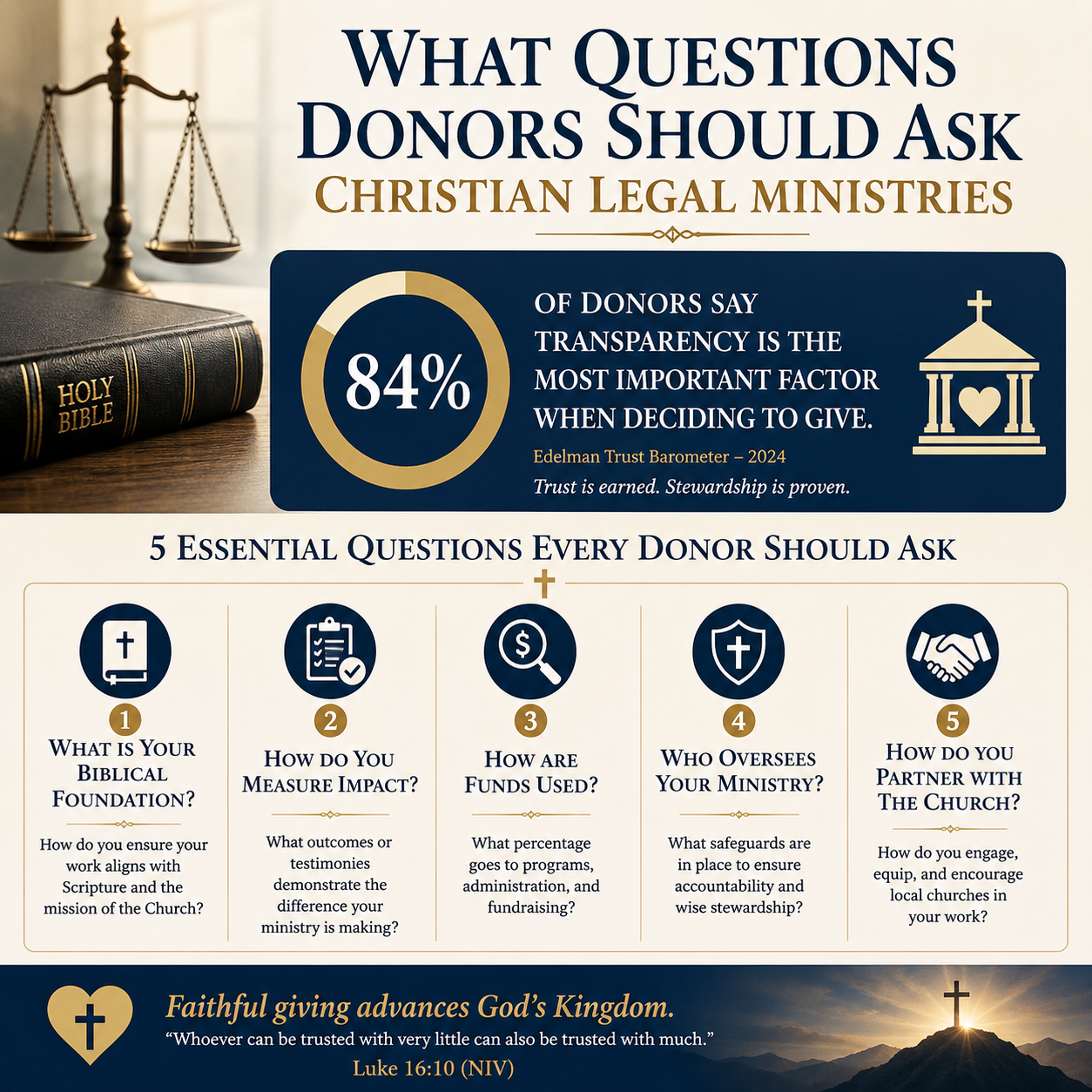
What questions donors should ask Christian legal ministries is not a matter of suspicion; it is an act of stewardship. Christian legal work regularly sits at the intersection of conscience, contested public questions, vulnerable people, and real institutional risk. Donors who love the Church and want to love their neighbors well should expect clarity about what a ministry does, why it does it, and how it measures faithfulness.
Legal ministries can defend religious liberty, strengthen families, provide immigration representation, advocate for the unborn, fight human trafficking, or serve low-income clients in civil matters. Those aims can overlap, and they can also pull in different directions. Christians genuinely disagree about strategy in some areas, and the field has had to reckon with how quickly legal advocacy can become partisan identity. The questions below are designed to help donors support ministries that combine conviction with integrity.
1. What is the ministry trying to accomplish and for whom
Define the mission in operational terms
Start with plain definitions. Is the ministry primarily a direct-service legal provider, a litigation shop, a policy advocate, a training and resourcing organization for churches, or some combination? “Justice” can mean many things; a donor needs to know whether the ministry is representing individual clients, pursuing strategic cases, writing amicus briefs, lobbying, or equipping pastors and lay leaders.
Ask who the primary beneficiaries are. Some Christian legal ministries exist chiefly to defend the institutional church and its ministries. Others exist chiefly to serve people in crisis: migrants, trafficking survivors, prisoners reentering society, mothers with unplanned pregnancies, or families navigating custody and protection orders. Neither focus is automatically superior, but the public messaging should match the operational reality.
Clarify the theory of change and the limits
Legal work is inherently constrained. Courts cannot heal trauma, repair marriages, or reconcile a community. A trustworthy ministry will describe what litigation and legal counsel can realistically do, and what it cannot do, without sliding into inflated claims. It will also name trade-offs: high-impact cases can be expensive; direct representation can be slow; policy wins can be reversible; and some work is intentionally quiet to protect clients.
Donors who want broader context can review the landscape of Christian Legal Services Ministries and note how different organizations define their “who” and “what.” The key is coherence: stated mission, staffing, caseload or docket, and spending should reinforce each other.

2. How does the ministry hold Scripture and Christian witness in legal conflict
Doctrinal commitments that shape practice
Because legal ministries often contend in adversarial settings, donors should ask how the organization anchors its work theologically. Many will reference Micah 6:8, Proverbs’ concern for the poor, or the biblical theme of impartial justice. Those citations are not enough by themselves. The question is whether the ministry’s governing documents, leadership expectations, and internal formation reflect a serious Christian ethic: truthfulness, restraint, love of neighbor, and humility under God.
Scripture warns against using the tongue as a weapon and calls God’s people to speak truth without deceit. In legal contexts, that includes candor to courts, accuracy in public statements, and refusal to manipulate facts for rhetorical advantage. Donors should ask what controls exist to prevent fundraising and communications from overstating threats, misrepresenting opponents, or dehumanizing those on the other side of a case.
Partisanship, prudence, and public credibility
Christians can agree on core moral claims and still disagree about prudential strategy. A legal ministry may litigate on issues that also appear on party platforms, but it should not need party loyalty to justify its work. Ask how the ministry protects its Christian identity from becoming a proxy for political identity, and how it decides which cases to take or decline.
It is also reasonable to ask how the ministry responds when its own side behaves unjustly. Does it have the moral vocabulary to critique allies and correct course? Legal advocacy that is untethered from repentance and self-examination may win short-term victories while corroding long-term Christian witness.
3. What legal work is actually being done and how outcomes are measured
Distinguish activity metrics from mission outcomes
Legal organizations can report meaningful activity measures: number of clients served, hours of pro bono representation, trainings delivered, cases filed, or briefs submitted. Those measures are not trivial; they show real work is happening. But donors should ask how the ministry interprets results and avoids confusing volume with impact.
For litigation, “wins” and “losses” can be an oversimplification. A case may be lost yet establish helpful precedent, or it may be won narrowly with limited practical benefit. For direct services, a favorable outcome may still leave a family fragile. A ministry that speaks honestly will describe outcomes with appropriate specificity and acknowledge mixed results.
Questions that clarify effectiveness without demanding the impossible
We recommend pressing for verifiable evidence rather than polished narratives. The goal is not to force ministries into metrics that distort their calling; it is to ask for accountability that fits the work. Useful donor questions include:
- How many clients received representation last year, and in what case categories?
- What proportion of work is direct representation versus impact litigation versus education?
- How does the ministry evaluate client experience and safeguard against harm?
- What outcomes does the ministry track, and what outcomes does it explicitly not claim?
- What does the ministry do when a strategy is not producing the hoped-for fruit?
As donors ask for evidence, it helps to understand how the broader sector has tried to correct simplistic measures of nonprofit quality. The “Overhead Myth” statement—signed by leading evaluators—warned donors against using administrative ratios as a primary indicator of effectiveness, urging attention to results, transparency, and governance instead Charity Navigator.
4. What safeguards protect clients, counsel, and the ministry’s integrity
Client protection and confidentiality
Legal ministries work with sensitive information. Donors should ask how the organization protects confidentiality, especially when fundraising teams want compelling stories. A ministry should be able to describe its policies for informed consent, de-identification, secure data handling, and boundaries around photographs and testimonies. If the ministry serves minors, trafficking survivors, or asylum seekers, the safeguards should be especially clear.
Because legal work can carry life-altering consequences, it is also appropriate to ask about quality control: attorney supervision, case review processes, malpractice coverage, continuing legal education, and compliance with state bar rules. These are not technicalities. They are instruments of neighbor-love.
Governance, accountability, and moral hazard
Some Christian legal organizations are built around high-profile leaders or a small group of litigators. That can produce agility, but it can also create moral hazard. Donors should ask about board independence, conflict-of-interest policies, executive compensation oversight, and whether the organization has credible mechanisms for internal dissent.
Across our verification work at Most Trusted, the ministries that meet The Most Trusted Standard tend to show the same pattern here: they treat governance as spiritual responsibility, not a regulatory burden. They also provide donors with documentation that can be reviewed without relying on personal trust alone.
5. How is the ministry funded, and what does financial clarity reveal
Revenue concentration and donor influence
Ask how concentrated the funding base is. A ministry supported by a small number of major donors can be stable, but it can also become vulnerable to donor capture, where priorities shift to satisfy funders rather than mission. A ministry should be willing to describe its revenue mix and the guardrails it uses to prevent major gifts from quietly steering case selection or public messaging.
In the United States, nonprofit financial filings offer donors a baseline layer of transparency. The Internal Revenue Service makes annual Form 990 filings publicly available for many organizations, including information on governance, key staff compensation, and program spending IRS. Some explicitly religious entities are not required to file, which makes voluntary disclosure even more significant for donor confidence.
Expenses, reserves, and truthful fundraising
Legal work can be expensive in ways donors do not immediately see: court fees, expert witnesses, discovery costs, insurance, and the need for experienced counsel. Donors should ask what portion of expenses are devoted to program work, and also whether the ministry maintains appropriate reserves. A ministry that is always in emergency mode may be overpromising or underplanning; a ministry that hoards resources without explanation may be avoiding the risks inherent in serving real people in real conflicts.
Donors should also evaluate the integrity of fundraising claims. Are crises described with precision, or with vague urgency? Are opponents described as image-bearers, even when wrong? Are projected outcomes framed responsibly? These questions belong in the same category as financial review because they test whether the ministry treats truth as sacred.
For donors comparing organizations in a consistent way, How to Give Wisely to Christian Legal Services provides a wider donor lens for evaluating Christian legal work with sober confidence.
FAQs for What questions donors should ask Christian legal ministries
Should donors prioritize direct legal aid or impact litigation
The better question is whether the ministry’s chosen approach matches its stated calling and is pursued with integrity. Direct legal aid can embody mercy in tangible ways for people who cannot afford counsel, while impact litigation can shape legal precedent that affects many. Each carries risks: direct services can become overwhelmed by need, and litigation can tempt organizations toward publicity or ideological escalation. Donors should ask for clear beneficiary focus, transparent case selection criteria, and honest reporting on outcomes and limitations.
What level of transparency is reasonable for a legal ministry that must protect confidentiality
Confidentiality is a moral and professional obligation, not an excuse for opacity. Donors can reasonably expect aggregated reporting, clear policies on client stories and consent, third-party financial documentation where applicable, and governance disclosures that do not compromise legal strategy. When a ministry cannot share specifics about cases, it should be able to share specifics about safeguards, decision processes, and accountability.
Stewardship that strengthens Christian witness
Christian donors do not ask hard questions because we distrust the Church; we ask because we love the Church and want our giving to honor Christ. The most trustworthy Christian legal ministries combine doctrinal clarity with professional rigor, tell the truth even when it costs them, and accept accountable governance as part of discipleship. When donors insist on that standard, we help ensure that legal advocacy serves neighbor-love rather than institutional self-protection, and that Christian witness remains credible in conflict.



