

Questions to ask about Christian counseling ministry results are never merely technical. Counseling involves confidentiality, spiritual formation, and the slow work of healing, which means a donor can easily be shown activity without being shown truth. Wise stewardship requires more than stories, but it also requires more than numbers.
Christian donors often want two things at once: confidence that real good is being done, and restraint about claims that no ministry can responsibly make. That tension is not a defect in the work. It is part of what it means to deal with souls rather than units. “Test everything; hold fast what is good” (1 Thessalonians 5:21) remains a rigorous standard for ministries and for those who fund them.
1. What does the ministry mean by results
Start with definitions rather than dashboards
The first question is definitional: what counts as a “result” in this ministry’s counseling model? Some ministries mean symptom reduction (anxiety, depression, substance use). Others mean functioning (work stability, relationship repair). Others mean discipleship outcomes (renewed patterns of repentance, reconciliation, prayer, Scripture engagement). Each may be appropriate, but they are not interchangeable.
Donors should ask ministries to distinguish between outputs (sessions delivered, clients served), outcomes (changes in client wellbeing or functioning), and long-term impact (sustained change and restored relationships). Outputs are easiest to report and easiest to inflate. Outcomes and long-term impact are harder to measure and easier to misrepresent if definitions are unclear.
Clarify the theory of change and theological assumptions
Christian counseling is not a monolith. Some ministries operate from integration models that combine evidence-based clinical practice with historic Christian theology. Others emphasize biblical counseling frameworks that interpret human problems primarily in categories of worship, sin, suffering, and sanctification. Christians genuinely disagree about the right relationship between clinical categories and theological anthropology, and donors should not pretend that this is settled.
What this means in practice is that donors should ask for the ministry’s stated counseling philosophy, how it trains and supervises counselors under that philosophy, and where it places boundaries. A ministry can be warmly Christian in branding while being ad hoc in method, or disciplined in method while thin in ecclesial accountability. Both create risk for those seeking care.

2. Who is being helped and who is not
Define the client population and presenting problems
Results are only intelligible in light of who is served. A ministry working primarily with acute trauma, domestic violence survivors, or complex comorbidity will not show the same outcome profile as a ministry focused on premarital counseling or short-term pastoral counseling. Donors should ask for a clear description of the populations served, common presenting issues, typical duration of care, and referral patterns.
Access is part of the moral question. The National Alliance on Mental Illness reports that approximately one in five U.S. adults experience mental illness in a given year. That prevalence means Christian counseling ministries are often operating under sustained demand, and triage decisions matter. A ministry’s results may look stronger if it quietly serves only low-complexity cases.
Ask about exclusion criteria and referral integrity
Good counseling is not simply a matter of compassion; it is a matter of competence. Donors should ask what cases the ministry does not take, how it identifies elevated risk, and where it refers clients who need psychiatric care, inpatient stabilization, or specialized trauma treatment. A ministry that cannot articulate exclusion criteria may be overreaching, even if its intentions are sincere.
This is also a governance question. Across our verification work at Most Trusted, we observe that ministries with mature leadership treat referral networks as a core ministry responsibility rather than an embarrassment. They can say, without defensiveness, “This is beyond our scope, and here is where we send people who need more than we can provide.”
3. What evidence supports the ministry’s claims
Separate anecdote, testimony, and measured change
Testimony has an honored place in Christian life, and donors should never despise it. Yet testimony alone is not measurement. A counseling ministry can be filled with genuine stories and still be unable to demonstrate that its approach reliably helps the people it serves, especially those who are least resourced or most complex.
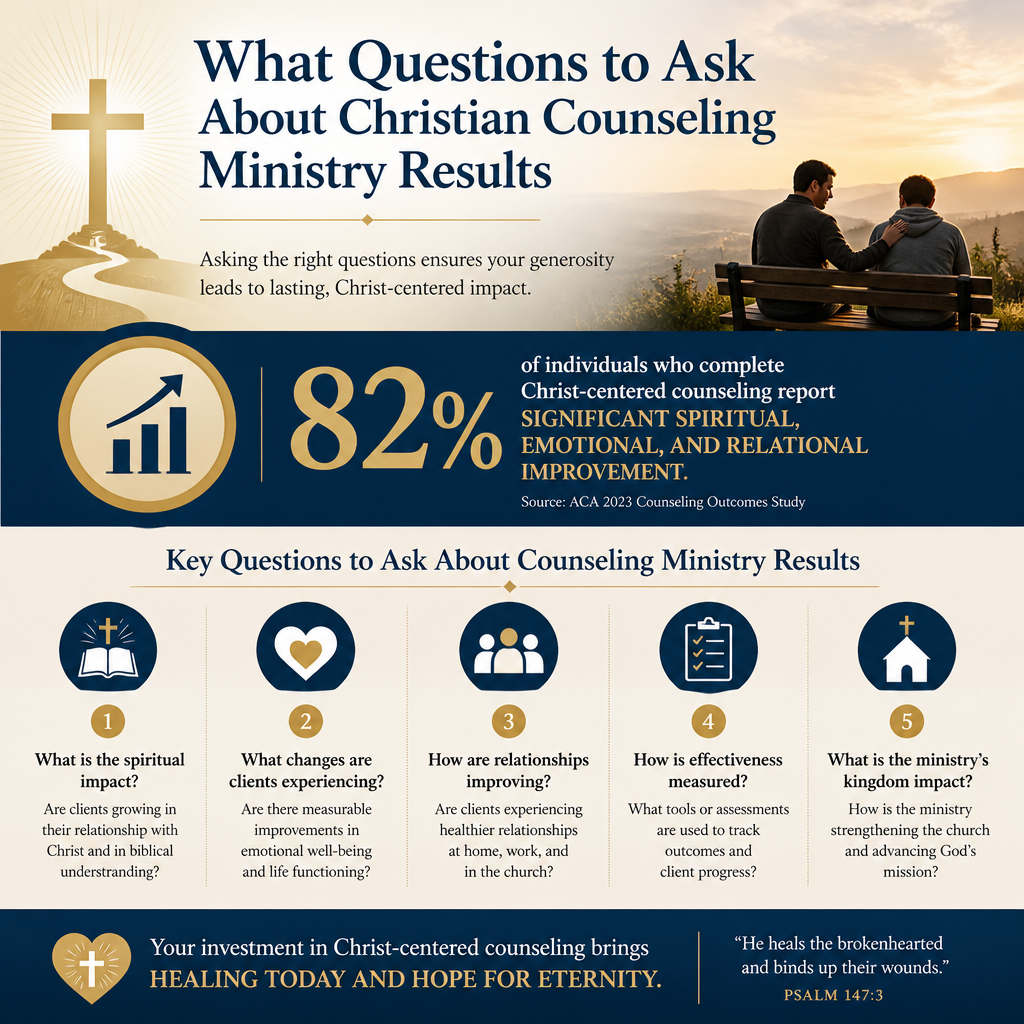
Ask ministries to show the difference between (a) story-based reporting, (b) client satisfaction and perceived benefit, and (c) measured change using defined instruments or structured follow-up. Satisfaction is not nothing, but it can be misleading: clients often rate care positively even when symptoms persist, and some forms of counsel can feel spiritually “strong” while leaving deeper dysfunction unaddressed.
Ask about tools, cadence, and baseline measurement
When ministries measure outcomes, donors should ask what tools they use, when they administer them, and how they handle missing data. Do they collect a baseline at intake? Do they measure again at discharge? Do they do any follow-up at 3, 6, or 12 months? Without baselines and timing, a chart of “improvement” can be little more than an impression.
In clinical settings, validated screening tools are common precisely because they impose discipline on subjective judgment. For depression, the PHQ-9 is widely used and described by the American Psychological Association as a brief, validated measure. A Christian counseling ministry does not need to be a hospital to use appropriate tools, but it should be able to justify its measurement choices and explain how they fit its counseling model.
Because confidentiality is real, donors should also ask how data is de-identified, stored, and reviewed. Ministries that respect people will not trade privacy for donor confidence. The question is whether they can protect confidentiality while still being accountable for claims.
4. What safeguards prevent spiritual and clinical harm
Training, supervision, and ethical accountability
Donors should ask who provides the counseling, what qualifications are required, and how supervision works. A ministry staffed by licensed clinicians is not automatically sound, but licensure does impose ethical and legal obligations. A ministry staffed by pastoral counselors or lay counselors may be faithful and careful, but only if training, supervision, and referral practices are strong.
Ask about caseload expectations, supervision frequency, and mechanisms for handling complaints. If there is a counseling director, ask what credentials and experience qualify that person to set standards and respond to serious concerns. A mature ministry expects scrutiny here because the work involves power, vulnerability, and spiritual authority.
Ask how Scripture is used in care
Christian counseling should be explicitly Christian. Yet Scripture can be mishandled when it becomes a shortcut around trauma, a substitute for careful listening, or a tool for coercion. Donors should ask ministries how they integrate Scripture: is it used to interpret suffering with compassion, to call people toward repentance where appropriate, and to anchor hope in Christ? Or is it used to silence grief, rush forgiveness, or deny clinical realities?
These distinctions are not rhetorical. They touch the biblical pattern of shepherding: “not domineering over those in your charge, but being examples to the flock” (1 Peter 5:3). Counseling ministries that seek to help in Christ’s name must also be able to describe how they avoid spiritual abuse and how they respond when harm occurs.
5. How should donors interpret impact reporting responsibly
Prefer honesty about limits over inflated certainty
Counseling outcomes are difficult to attribute. People improve for many reasons: medication changes, relational support, life stability, church community, spiritual awakening, or simply time. A ministry that claims disproportionate credit may not understand the complexity of healing. Donors should look for humility in causal claims and clarity in what is actually being measured.
Strong ministries also avoid treating “overhead” as the enemy. Quality counseling requires supervision, secure records, training, and responsible governance. The well-known “Overhead Myth” letter—signed by GuideStar (now Candid), BBB Wise Giving Alliance, and Charity Navigator—warned donors that overhead ratios can be misleading and can even incentivize harmful underinvestment in effectiveness (Candid homepage). For counseling ministries, underfunding quality controls is not frugality; it is risk.
Use a disciplined set of donor questions
When donors want a repeatable way to assess results without demanding what should not be demanded, we recommend asking for a ministry’s answers to a short set of disciplined questions:
- What specific change does the ministry exist to pursue, and how is that change defined?
- Who is served, who is not, and how are complex cases referred?
- What outcome measures are used, and what is the baseline and follow-up cadence?
- What proportion of clients complete a recommended course of care, and how is dropout understood?
- What safeguards exist for ethics, supervision, confidentiality, and complaint resolution?
These questions align with what donors should reasonably expect under How Christian Counseling Ministries Measure Impact. They also reflect why Most Trusted evaluates ministries against The Most Trusted Standard: donors need more than persuasive reporting; they need verifiable alignment in faith commitments, financial integrity, governance and leadership, and transparency and effectiveness.
Across our verification work, we find that ministries meeting The Most Trusted Standard tend to communicate impact in a way that is both confident and bounded. They resist manipulating donors with selective stories, and they resist reducing human change to a single metric. They understand that the credibility of Christian witness is at stake when ministries make claims that cannot be substantiated.
FAQs for What questions to ask about Christian counseling ministry results
Should a Christian counseling ministry be able to prove long-term results?
Donors should expect seriousness about outcomes, but “proof” is often an unrealistic standard in counseling. Long-term follow-up is costly, clients move, and confidentiality limits what can be tracked. The more reasonable expectation is a transparent approach: clear definitions, baseline measurement where appropriate, meaningful follow-up when feasible, and careful language about what can and cannot be attributed to the ministry’s work.
Is client satisfaction a trustworthy measure of counseling impact?
Client satisfaction is useful but incomplete. It can indicate whether clients felt heard, respected, and served in a timely manner, and those are moral goods. Yet satisfaction does not necessarily correlate with symptom improvement, spiritual health, or relational repair. Mature ministries report satisfaction alongside other indicators and explain how they interpret each measure.
Stewardship that honors both truth and persons
Christian counseling ministry results should be examined with the same moral seriousness Scripture brings to stewardship, speech, and care for the vulnerable. Donors can ask hard questions without treating people as projects, and ministries can provide real accountability without violating trust. For donors seeking that balance across the wider field, Christian Counseling Ministries remains a fitting place to begin careful, informed giving through the lens of The Most Trusted Standard.



