
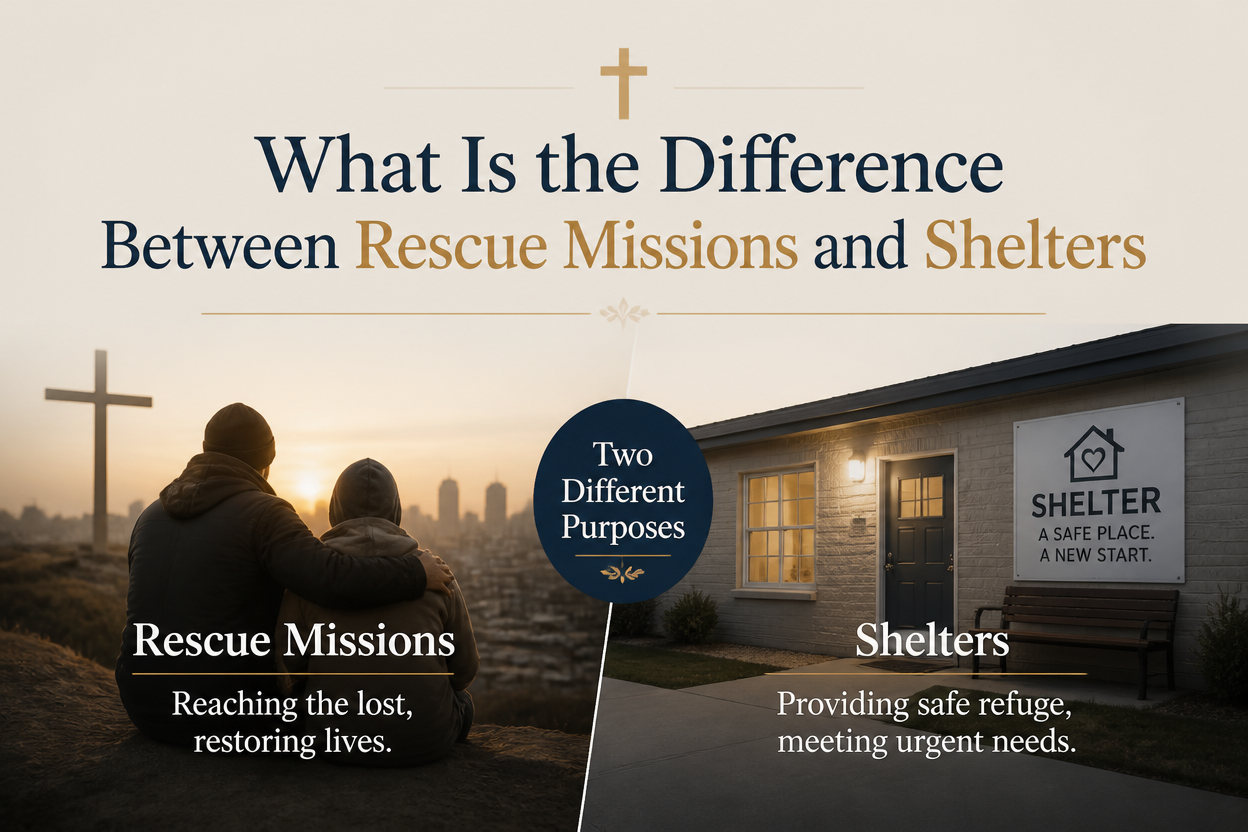
When Christian donors ask, “What is the difference between rescue missions and shelters,” they are usually trying to do more than sort out terminology. They are trying to place their giving where it will relieve suffering without reinforcing it, where compassion is joined to integrity, and where gospel witness is neither absent nor performative.
The distinction is real, but it is not absolute. Many communities have organizations that combine elements of both, and public funding rules can shape how faith-based ministries describe themselves. Still, most donors can make wiser decisions by understanding the typical aims, service models, and accountabilities that set rescue missions and shelters apart.
Rescue missions and shelters differ in purpose and theological posture
Rescue missions tend to integrate spiritual care with recovery
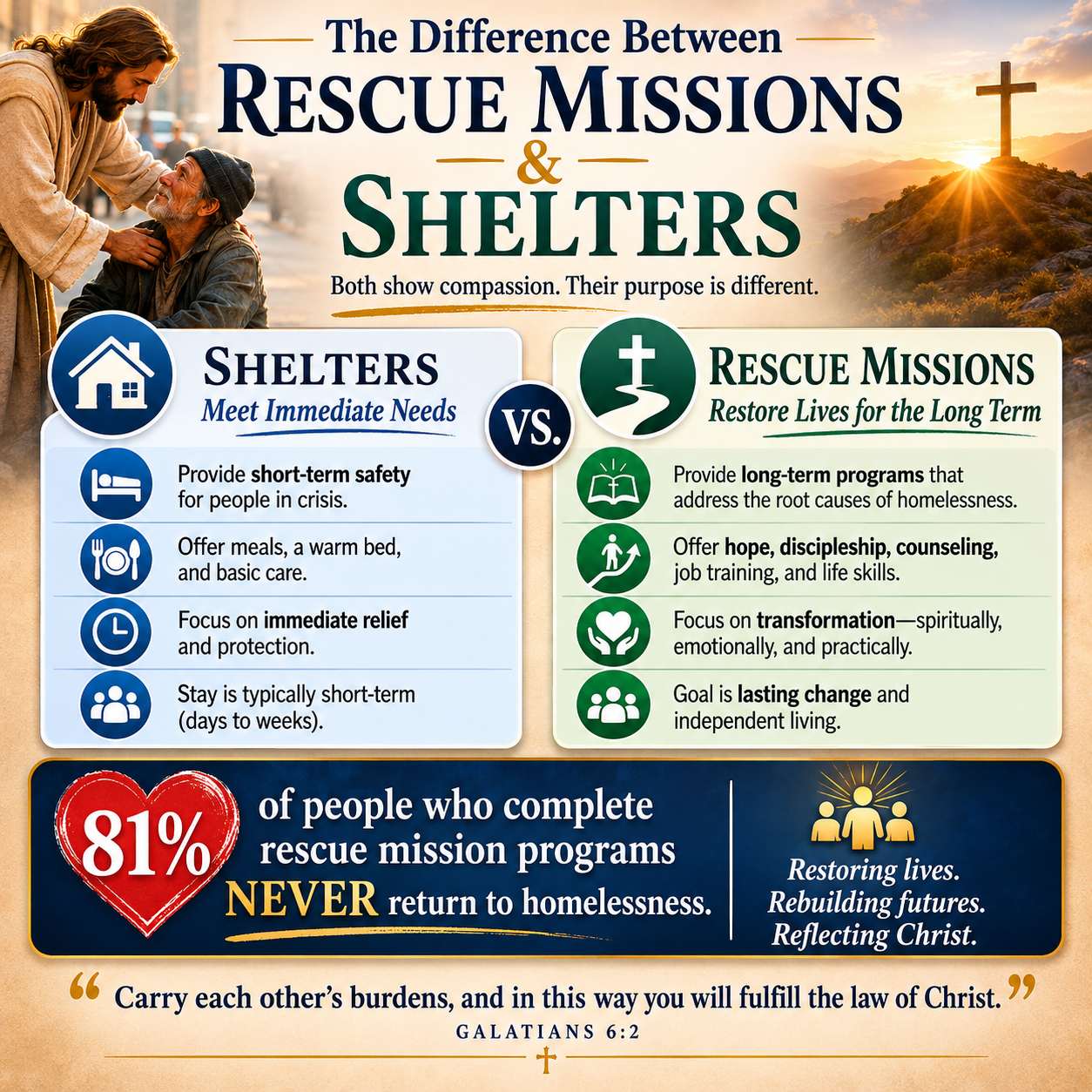
A rescue mission is typically a Christian ministry that offers emergency assistance alongside explicitly Christian discipleship and longer-term restoration. Many missions began with evangelistic intent, addressing immediate needs as a concrete expression of Christ’s mercy. In practice, that often means a continuum: a meal and a bed tonight, and then pathways toward sobriety, employment readiness, counseling, and community.
Because rescue missions commonly operate as ministries first and social services second, they often frame homelessness through a lens that includes spiritual formation, moral injury, trauma, and relational rupture. Christians can disagree about emphasis here. Some fear that a spiritual diagnosis can become simplistic, overlooking structural drivers like housing costs or disability. Others fear that a purely material response reduces a person to a “case” and leaves deeper bondage untouched. Mature missions name both realities and avoid treating the gospel as an incentive or prize.
Shelters tend to focus on safety and stabilization
A shelter is usually defined by function rather than faith identity: it provides temporary housing and basic services for people who lack safe alternatives. Shelters may be government-run, secular nonprofit, or faith-based, and the sheltering function itself is often governed by local regulations, grant requirements, and nondiscrimination rules.
Many shelters do excellent work precisely because they focus on stabilization: a safe bed, hygiene, case management access, and connection to housing resources. For donors, the key is to discern whether “shelter” describes the scope (emergency housing) or the philosophy (a low-barrier model oriented to immediate safety). Those two can overlap, but they are not identical.

The service model often differs: emergency beds versus a restoration pathway
Night-by-night sheltering versus program-based residency
Rescue missions frequently operate both an emergency shelter and a residential program. The emergency side may function similarly to other shelters. The program side, however, is often structured around participation expectations: sobriety, work therapy, classes, counseling, chapel services, or community norms. Some donors are drawn to this clarity. Others worry that requirements exclude people with severe mental illness or active addiction who cannot comply.
Shelters, particularly “low-barrier” shelters, often prioritize access over compliance. The logic is straightforward: the first moral imperative is that people do not freeze, overheat, or face violence outside. Public health evidence also supports reducing exposure and connecting people to services from a place of safety. That does not eliminate the need for accountability; it simply locates it differently.
Case management can be central in shelters and uneven in missions
Shelters vary widely in whether they offer strong case management. Some are essentially a safe sleeping space with limited daytime services. Others are coordinated entry partners, integrated with local homelessness response systems and staffed by professional social workers.
Rescue missions also vary. Some have clinically informed case management and partnerships with behavioral health providers. Others rely heavily on pastoral counseling and informal mentoring. For Christian donors, the question is not whether pastoral care is present—many of us want that—but whether the ministry has the competence and partnerships to address trauma, addiction, and mental illness with appropriate care.
Accountability pressures differ: public system standards and ministry standards
Public funding can increase reporting and constrain religious programming
Shelters that receive government funding often face significant reporting requirements and performance expectations tied to local Continuums of Care. That can strengthen accountability, but it can also narrow what explicitly religious activities can be offered within funded programs. Faith-based shelters navigate this in different ways, sometimes separating privately funded discipleship from publicly funded shelter services.
Rescue missions may be less entangled with government funding and therefore freer to integrate prayer, worship, and biblical teaching across their services. That freedom is meaningful, but it raises another stewardship question: if a ministry is less regulated by public systems, does it have internal governance and transparency strong enough to compensate?
What donors should examine beyond the label
Across our verification work at Most Trusted, we find that names can mislead. Some organizations call themselves “missions” primarily for fundraising appeal while operating essentially as an emergency shelter. Others use “shelter” language because it fits municipal categories, even though they are deeply faith-shaped. The responsible move is to examine governance, finances, and outcomes rather than assuming the label guarantees either effectiveness or theological integrity.
This is one reason donors benefit from independent verification. Most Trusted evaluates ministries against The Most Trusted Standard, a 15-criteria framework spanning Faith Foundation, Financial Integrity, Governance and Leadership, and Transparency and Effectiveness. The aim is not to reward a preferred model, but to identify ministries that combine faithful witness with responsible stewardship.
Common trade-offs donors should weigh with open eyes
Low-barrier access and the limits of program requirements
Low-barrier shelters tend to reach people at the highest risk of harm: those with active substance use, acute mental illness, or deep distrust of institutions. Program-based rescue mission models can struggle to serve this population well if requirements function as gatekeeping rather than as supports within a relational community. At the same time, residential programs can provide a structure that some people need in order to break cycles of addiction, develop work habits, and rebuild trust.
Christians who give in this space should refuse simplistic narratives. Homelessness is not only a personal-morality issue, and it is not only a housing-market issue. The U.S. Department of Housing and Urban Development’s Annual Homeless Assessment Report documents the scale and complexity of homelessness across the country, including the persistence of unsheltered homelessness in many regions HUD.
Emergency relief and the risk of creating dependency
Donors rightly fear the possibility of “enabling.” The concern is not new, and it deserves a serious hearing. The harder question is how to distinguish enabling from mercy. The When Helping Hurts framework, articulated by Steve Corbett and Brian Fikkert, has shaped many Christian approaches by warning that assistance can unintentionally harm dignity and agency when it is not paired with restoration and participation Moody Publishers.
Yet the corrective can become its own distortion. A ministry can speak of “empowerment” while withholding practical help from people in crisis. Scripture does not permit us to make suffering someone else’s spiritual lesson. The Good Samaritan does not require the wounded man to demonstrate readiness before binding his wounds. And James warns against blessing the needy with words while refusing tangible aid (James 2:15–17). The wise donor looks for ministries that offer both immediate relief and a credible path toward stability.
How Christian donors can evaluate a rescue mission or shelter responsibly
Questions that clarify mission integrity and program reality
Different models can be faithful. The question is whether a particular organization is truthful about what it does, competent in how it does it, and accountable for the resources entrusted to it. We recommend pressing beyond marketing language to evidence.
- Clarity of purpose: Does the organization plainly state whether it is emergency shelter, a residential recovery program, or both?
- Faith practice with integrity: If explicitly Christian, is spiritual care invitational and respectful, not coercive or tied to access to a bed?
- Safeguarding and trauma awareness: Are there documented policies for safety, staff training, and appropriate care for survivors of violence?
- Financial transparency: Are audited statements, Form 990s, and clear fundraising practices accessible and consistent?
- Outcome credibility: Are outcomes defined carefully, with appropriate humility about what can and cannot be measured?
Donors who want to understand the broader ecosystem can situate a specific ministry within Rescue Missions and Homeless Outreach, including how emergency services, recovery programs, and housing partnerships function together in a community.
What effectiveness looks like in this field
In homelessness work, simplistic scorekeeping can corrupt ministry priorities. The sector has had to reckon with the “overhead” obsession and the damage it can do when donors treat administrative cost as a proxy for virtue. The well-known Overhead Myth letter—signed by organizations including GuideStar (now Candid), Charity Navigator, and the BBB Wise Giving Alliance—argues that focusing on overhead ratios can mislead donors and pressure nonprofits to underinvest in capacity Candid.
For Christian donors, the more faithful question is whether the ministry is stewarding resources to achieve its stated purpose with honesty. A shelter may do holy work by preventing death tonight. A rescue mission may do holy work by walking with a person for a year toward sobriety, employment, and reconciliation. Both can be faithful. Both can also fail through weak governance, unclear program standards, or inflated claims. Our concern is verifiability.
Those who want to see how faith-based approaches vary across programs and funding environments can examine Faith-Based Programs in Homeless Outreach and note the range of models that still aim to honor Christ and the dignity of the poor.
FAQs for What is the difference between rescue missions and shelters
Do rescue missions require people to attend religious services to receive help?
Practices vary. Many rescue missions offer chapel and spiritual counseling as central parts of their restoration programs, but ethically run missions do not coerce participation as the price of basic safety. Donors should ask directly how spiritual activities relate to access to meals, beds, and services, and whether participation is required for emergency shelter versus for voluntary residential programming.
Is a shelter or a rescue mission more effective at reducing homelessness?
Effectiveness depends on the goal and the population served. Low-barrier shelters can be crucial for immediate safety and for engaging people with high barriers to services. Rescue missions with residential programs can be effective for individuals who benefit from structure, community, and recovery supports. The most responsible assessment looks at governance, financial integrity, safeguarding, partnerships, and credible outcomes rather than assuming one model is always superior.
Giving with discernment in homelessness ministry
The difference between rescue missions and shelters is often the difference between a ministry built around long-term restoration and a service designed around immediate safety. Christian donors do not have to choose between mercy and wisdom. We can insist on both: tangible love for the neighbor in front of us, and accountable stewardship that honors the God who sees the widow, the stranger, and the poor as bearers of his image.



