
What is the best way to give to Christian medical ministries depends on what kind of healing a donor intends to strengthen: immediate clinical care, long-term health systems, or gospel-rooted presence with the sick. Christian donors often feel the urgency of need—maternal mortality, treatable infections, trauma from conflict, the loneliness of chronic illness—while also wanting assurance that a ministry’s compassion is matched by competence and integrity.
Scripture treats care for the sick as a serious marker of discipleship, not a philanthropic preference. Jesus identifies himself with the vulnerable—“I was sick and you visited me” (Matthew 25:36)—and the early church treated practical mercy as integral to its witness. The modern medical ministry landscape is broad: mission hospitals, mobile clinics, community health workers, disability care, maternal programs, medical education, and disaster response. The best giving is not merely generous; it is faithful stewardship under accountability.
Begin with clarity about the medical problem and the ministry model
Different health burdens require different kinds of interventions
Medical need is not uniform. Emergency surgery, prenatal care, tuberculosis treatment, trauma counseling, and palliative care each require distinct capabilities, timelines, and cost structures. A mature giving approach names the burden the ministry is addressing and asks whether the ministry’s model fits that burden.
For example, a mobile clinic can be a strong answer for geographic access barriers, while a mission hospital is often the more appropriate platform for obstetrics, surgery, inpatient care, and training local clinicians. Community health worker programs can reduce preventable deaths through education, screening, and referrals, but only when referral pathways and supply chains are credible. Donors who match gift design to ministry model generally fund work that holds up over time.
Christian donors should also ask what kind of presence is being funded
Christians genuinely disagree about how explicitly evangelistic a medical ministry should be in every setting. Some ministries prioritize overt proclamation; others emphasize long-term presence, local church partnership, and the credibility of embodied love. We recommend donors be candid about their convictions while also recognizing constraints on clinical ethics and local law. The question is not whether a ministry uses Christian language in fundraising; it is whether it demonstrates a coherent theology of mercy, human dignity, and truth-telling in clinical practice.

Give to care that strengthens local capacity rather than dependence
Beware the well-known pitfalls of outsider-driven aid
Medical missions can unintentionally weaken local health systems when they substitute for local clinicians, distort local markets, or create expectations that cannot be sustained once a visiting team leaves. The When Helping Hurts framework, articulated by Steve Corbett and Brian Fikkert, helped the church name a hard reality: well-intended help can harm when it reinforces dependency or undermines dignity. Donors should therefore look for programs that train, employ, and empower local professionals and that coordinate with local institutions rather than bypassing them.
Evidence of capacity-building can be observed and verified
Capacity-building is not a slogan; it leaves a paper trail. Strong medical ministries can usually show clinical protocols, licensing pathways, local hiring and salary structures, continuing education programs, and partnerships with churches and community leaders that are more than ceremonial. In settings where government cooperation is possible, credible ministries often work within national health strategies or recognized referral networks.
When donors want a tangible benchmark for why systems matter, maternal health offers a sobering example. The United States continues to face an unusually high maternal mortality rate for a high-income nation, reminding us that medical outcomes reflect systems, not only compassion Centers for Disease Control and Prevention. In low-resource contexts the same principle applies with higher stakes: training, supply chains, infection control, and continuity of care can determine whether a birth is safe.
Fund what can be accounted for, not only what can be described
Outcomes are complex, but transparency is not optional
Healthcare outcomes are notoriously difficult to measure cleanly. Patient populations differ, medical records may be incomplete, and spiritual outcomes do not fit easily into metrics. Complexity, however, is not an excuse for opacity. Donors should expect clarity about what is tracked, what is not tracked, and why.
We recommend looking for ministries that can articulate a short list of meaningful indicators: follow-up rates, treatment adherence where relevant, maternal and neonatal outcomes for obstetric programs, surgical site infection protocols, or patient safety practices. When a ministry cannot name any measurable commitments, donors should assume the organization is operating primarily on narrative rather than accountable practice.
Do not over-weight simplistic overhead claims
Many Christian donors were trained to equate low overhead with faithfulness. The field has had to correct that assumption. Administrative capacity can be part of responsible clinical work—quality assurance, staff training, safeguarding, financial controls, and data protection are not luxuries in healthcare.
Major charity evaluators have publicly argued that overhead ratios are a poor proxy for impact, urging donors to focus on governance, transparency, and results Charity Navigator. A medical ministry that underinvests in compliance, supervision, or clinical standards may appear “efficient” while quietly taking unacceptable risk with patients.
- Clinical accountability: licensure, protocols, supervision, and referral pathways
- Financial clarity: audited statements when feasible, readable budgets, and restricted-fund discipline
- Governance: independent oversight with relevant expertise and conflict-of-interest controls
- Safeguarding: patient protection, child protection where applicable, and grievance reporting
- Truthful communication: accurate stories, consent, and non-exploitative imagery
Choose a giving vehicle that fits the ministry’s cash flow and the donor’s intent
General support is often the most strategic gift
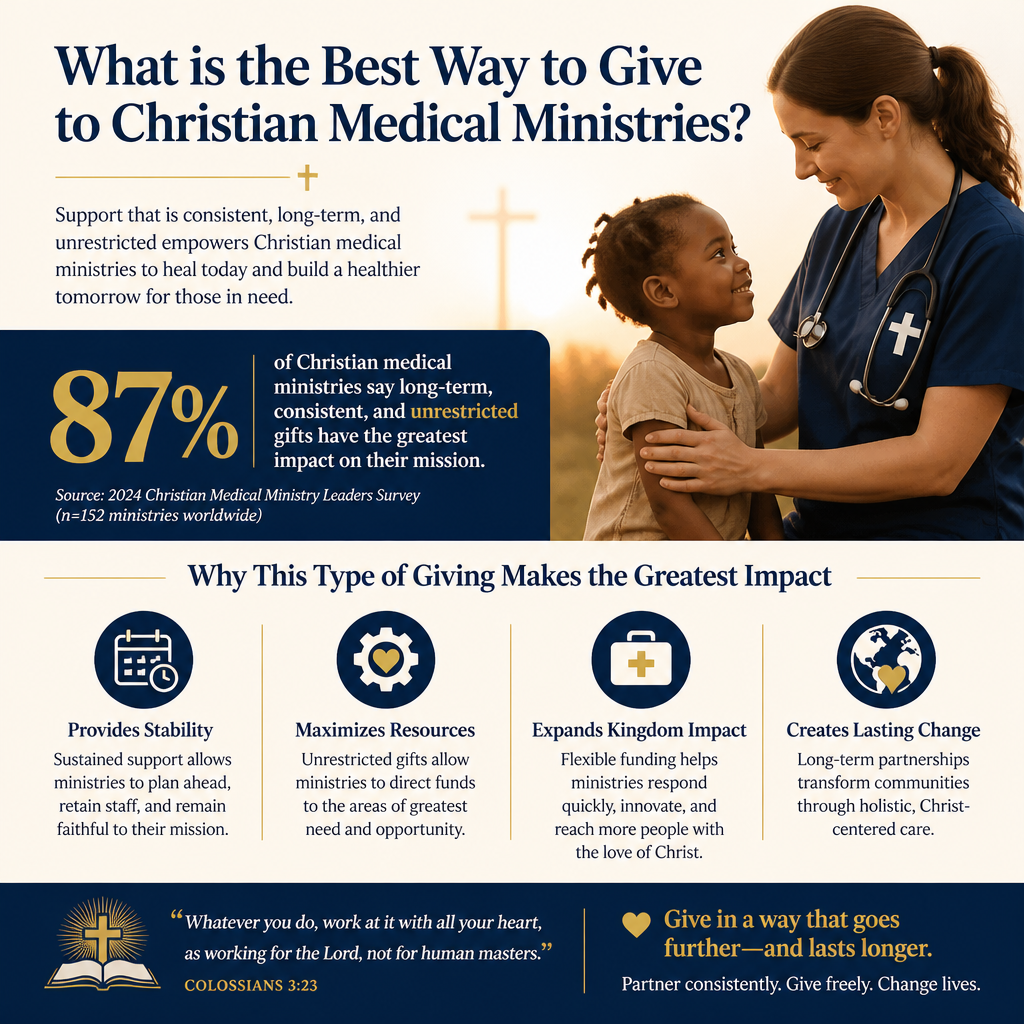
In medical work, unrestricted or broadly directed support can be the difference between a clinic that functions and one that constantly scrambles. Medications, fuel, lab reagents, equipment maintenance, local staff compensation, and emergency transport costs do not always fit neatly into a donor-defined project line item. When donors trust an organization’s governance and financial controls, general support is often the most strategic form of funding.
This is also where donors should be careful about restricted gifts. Restrictions can be appropriate—capital projects, scholarships for nursing students, ultrasound equipment—yet they can also create a mismatch between donor enthusiasm and on-the-ground necessity. A ministry that accepts any restriction without counsel may be signaling financial pressure rather than stewardship.
Match the timing of your giving to clinical realities
Medical ministries operate on schedules that do not align neatly with year-end giving cycles. Supply chains require lead time; staffing requires predictable cash flow; disasters require rapid liquidity. Donors with the capacity to give monthly or to fund a reserve for continuity of care can provide stability that is difficult to overstate in healthcare settings.
For donors evaluating options across the field, it can be helpful to review the broader landscape of Christian Medical Ministries and how different models approach care, evangelism, training, and local partnership. The best gift is often the one that sustains faithful presence through ordinary months, not only extraordinary events.
Verify trustworthiness with a disciplined framework before scaling your support
Medical ministry magnifies the cost of weak governance
Healthcare is unusually exposed to moral and operational risk: patient privacy, informed consent, pharmaceuticals, vulnerable populations, cross-cultural communication, and the temptation to overclaim results for fundraising. Because the stakes are high, donors should be slow to confuse sincere spirituality with institutional maturity.
Most Trusted exists to serve donors at precisely this pressure point. We evaluate Christian nonprofits against The Most Trusted Standard, a 15-criteria framework across Faith Foundation, Financial Integrity, Governance and Leadership, and Transparency and Effectiveness. Our aim is not to replace a donor’s prayerful discernment, but to strengthen it with verifiable evidence and consistent expectations.
What verification should include for Christian medical ministries
Across our verification work, the ministries that meet The Most Trusted Standard tend to show a stable pattern: doctrinal clarity that shapes practice, board governance that is more than honorary, disciplined financial controls, and public transparency that does not depend on marketing. In medical contexts, we also look for indicators that clinical work is conducted responsibly—qualified oversight, training, and an institutional commitment to patient dignity.
Donors who want to give substantially or long-term should also consider where to focus their due diligence time. For many, the most practical approach is to prioritize organizations that welcome scrutiny, publish meaningful information, and can explain their model without defensiveness. Those habits often correlate with the kind of internal culture that protects patients and honors Christ.
For readers comparing approaches to due diligence and gift structures in this field, How to Give to Christian Medical Ministries reflects the practical questions donors raise most often: how to assess credibility, how to avoid unintended harm, and how to support sustainable care.
FAQs for What is the best way to give to Christian medical ministries
Should we fund short-term medical mission trips or local health systems?
Short-term trips can be appropriate when they are invited by local leadership, integrated into a long-term plan, and staffed with clinicians operating within their competence and under proper supervision. Even then, the donor should ask whether the trip strengthens local capacity or substitutes for it. In many cases, funding local clinicians, training pipelines, equipment maintenance, and continuity of care produces deeper and more durable fruit than episodic visits.
Is it better to give restricted gifts for equipment and supplies or unrestricted support?
Restricted gifts can be wise when the ministry has demonstrated financial discipline and the restriction matches a real operational priority. Unrestricted support is often more strategic in healthcare because it sustains staffing, quality controls, transportation, and follow-up care—costs that determine whether equipment and supplies actually serve patients. The best practice is to discuss the ministry’s highest needs candidly and let that counsel shape the form of the gift.
A faithful way to give is a verified way to give
The best way to give to Christian medical ministries is to fund care that is both compassionate and accountable: clinically responsible, locally strengthening, financially transparent, and grounded in a theology of human dignity. Christian donors do not have to choose between heartfelt mercy and disciplined stewardship. When giving is guided by verified trustworthiness, it is more likely to protect patients, honor local churches and clinicians, and endure long enough to reflect the steadfast love we proclaim.



