

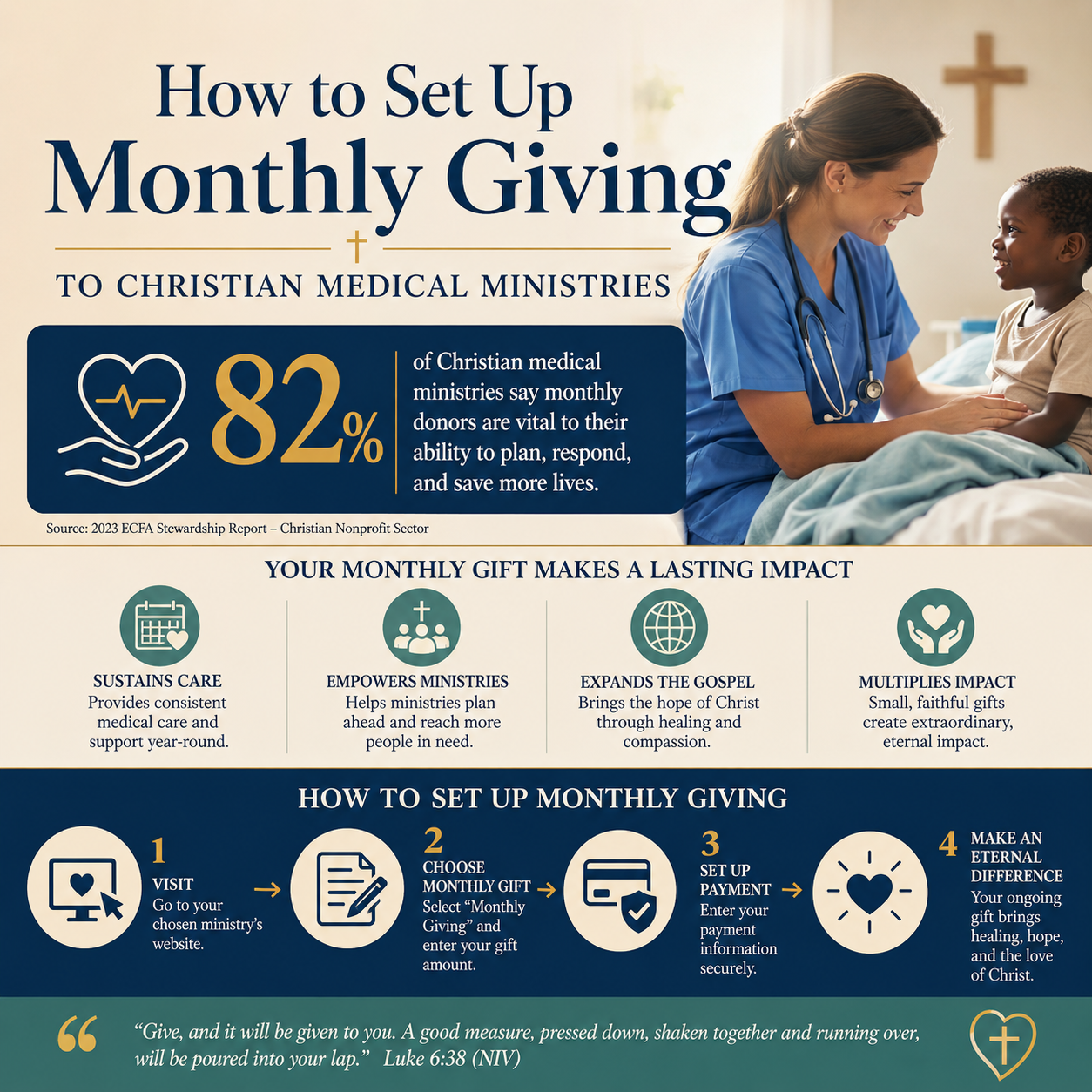
How to set up monthly giving to Christian medical ministries begins with a spiritual and practical question: what does faithful, sustained care for the sick require of Christian stewards over time? Scripture does not treat mercy as episodic sentiment. In the parable of the Good Samaritan, compassion includes continuity: he binds wounds, transports the injured man, and provides for ongoing care.
Monthly giving is one of the simplest ways to fund that continuity. It also introduces real risks for donors: unexamined autopilot giving, unclear restrictions, and weakened accountability once a relationship is “running in the background.” Serious generosity holds together constancy and discernment.
Begin with a theology of steady mercy
Monthly giving as ordinary faithfulness
Christian medical work often sits at the intersection of acute need and long timelines. A hospital chaplaincy, a maternity waiting home, a church-based clinic, or a medical missions supply chain can rarely be sustained through intermittent gifts. When the church gives steadily, ministries can staff responsibly, purchase medicine ethically, and plan care beyond the next crisis.
The New Testament pattern of proportional, planned giving supports this posture. Paul instructs the Corinthians to set aside a gift regularly, “on the first day of every week,” so that care for others is not a last-minute emotional response but a disciplined act of worship (1 Corinthians 16:2). Monthly giving is not a biblical command, but it coheres with a biblical logic: planned generosity that does not depend on urgency to be activated.
Discernment is not distrust
Christians genuinely disagree about how much scrutiny is appropriate for ministry giving. Some worry that due diligence can become a functional refusal to trust. Others have seen enough misconduct—financial, moral, and doctrinal—to insist that verification is a form of love for both donors and beneficiaries.
What this means in practice is that donors can pursue accountability without cynicism. The goal is not to control a ministry; it is to give in a way that honors truth, protects the vulnerable, and sustains Gospel witness.

Choose the right ministry and the right kind of monthly support
Clarify what kind of Christian medical ministry you mean
“Christian medical ministries” describes several distinct models, each with different funding needs and risk profiles. A domestic clinic serving uninsured neighbors faces different constraints than a global surgical program, a Bible-based nursing school, or a disaster response team that deploys medical personnel.
Before selecting a monthly commitment, define the ministry’s primary mode of work: direct clinical care, capacity building, medical missions, supply distribution, or pastoral and spiritual care in medical settings. The more precisely the ministry understands its calling, the easier it is to evaluate whether its budgets, staffing, and reporting align with that calling.
Decide whether your monthly gift should be restricted
Many donors default to restricted gifts because restriction feels safer. Restrictions can be appropriate when a ministry offers a clearly defined program with credible reporting, or when donors have a particular conviction (for example, maternal health, disability care, or Scripture engagement in medical contexts). Yet restrictions also carry trade-offs: they can create administrative burden, distort priorities, and underfund the “unseen” infrastructure that makes care safe and effective.

The field has had to reckon with the harm of simplistic overhead thinking. Leading charity evaluators and accountability organizations have argued that administrative and fundraising costs cannot be reduced to a moral score, and that underinvestment in systems can produce fragility and even abuse. See the joint statement commonly known as the Overhead Myth letter from Charity Navigator, Candid, and BBB Wise Giving Alliance: Candid.
Verify integrity before you automate generosity
What we evaluate at Most Trusted
Automated giving should never mean automated trust. Across our verification work at Most Trusted, we observe that recurring donors often read fewer updates and ask fewer questions over time, even though their cumulative giving can be substantial. That makes front-end diligence especially important.
Most Trusted evaluates ministries against The Most Trusted Standard, a 15-criteria framework across Faith Foundation, Financial Integrity, Governance and Leadership, and Transparency and Effectiveness. In a medical context, several questions become non-negotiable: does the ministry clearly articulate its doctrinal commitments; does it handle restricted gifts with documented care; does it provide audited or reviewed financial statements when appropriate; does it maintain independent governance; and does it communicate outcomes with candor rather than marketing gloss.
Donors who want a wider view of the landscape can begin with Christian Medical Ministries, where we frame common models and the accountability questions each model raises.
Pay attention to safeguarding and clinical responsibility
Medical ministry adds layers of ethical duty beyond standard nonprofit operations. Competent care requires credentialing, appropriate supervision, referral pathways, and patient privacy practices that respect both local law and moral obligation. In cross-border settings, donors should be alert to “medical voluntourism” patterns where short-term teams provide care without adequate continuity, cultural competence, or follow-up.
The When Helping Hurts framework, articulated by Steve Corbett and Brian Fikkert, has reshaped how many Christians think about the potential for well-intended aid to undermine dignity and local capacity. Medical care can fall into similar traps when outside actors treat local institutions as optional. Donors should favor ministries that partner with local churches and health systems, invest in training, and communicate limitations honestly.
Set up your monthly gift with clarity, protection, and appropriate flexibility
Use a short checklist before you enroll
Monthly giving works best when it is both simple and explicit. Before you click “submit,” confirm a few concrete details in writing on the ministry’s giving page or in a follow-up email.
- Designation: Is your gift going to general operations or a specific program, and is that designation documented?
- Frequency and start date: Monthly, quarterly, or annually; immediate or scheduled.
- Processing: Credit card, ACH, donor-advised fund distributions, or checks; fees and whether the ministry absorbs them.
- Receipts and statements: What documentation you receive for tax records and how often.
- Change and cancellation: A clear, dignified way to adjust the amount or stop without friction.
Match the amount to a real budget line
Some donors choose an amount that “feels meaningful” but is disconnected from the ministry’s actual cost structure. Others choose an amount so high that it is unsustainable, leading to quiet cancellation later. A mature approach is to connect the gift to something concrete the ministry actually funds—without demanding artificial precision.
For example, a monthly gift might underwrite a portion of a nurse’s salary at a faith-based clinic, support consistent purchase of essential medicines, sustain chaplaincy presence in a hospital, or fund transportation assistance for patients who otherwise miss appointments. Many ministries can describe realistic monthly funding needs if asked directly.
Where donors want additional context on discernment in giving, we address recurring support and related practices within How to Give to Christian Medical Ministries, including the questions that tend to separate inspiring stories from reliable stewardship.
Maintain accountability and spiritual attentiveness over time
Review at least annually
Recurring giving should be reviewed with the same seriousness as any other long-term commitment. At least once a year, donors should revisit a ministry’s financial reporting, leadership stability, and communications. In medical work, it is also reasonable to look for signs of clinical responsibility: referral relationships, program continuity, and appropriate humility about what the ministry can and cannot do.
If a ministry stops publishing basic information, grows evasive about governance, or relies increasingly on unverifiable claims, that is not a reason for panic, but it is a reason for questions. Silence is not transparency, and urgency is not evidence.
Practice relational giving without creating dependence
Some donors hesitate to engage because they fear becoming emotionally entangled. Others engage in ways that unintentionally pressure staff to provide constant personal updates. A wise middle path is to pursue relational connection that strengthens accountability and prayer without creating unhealthy expectations.
Pray with specificity for patients, clinicians, and chaplains. Ask for the ministry’s strategic priorities rather than only success stories. Encourage honesty about setbacks. Christian medical work often involves grief and limits; credibility grows when ministries can speak truthfully about both fruit and fracture.
FAQs for How to set up monthly giving to Christian medical ministries
Should monthly gifts go to general funds or a specific medical program?
General support is often the most responsible form of monthly giving because it funds the staffing, compliance, and infrastructure that make medical care safe and sustainable. Program-restricted monthly gifts can be appropriate when the program is clearly defined, consistently reported, and not simply a marketing label. The best choice depends on how well the ministry communicates its true cost of care and how faithfully it manages restrictions.
What warning signs matter most before starting a recurring gift?
Before automating a monthly gift, look for clear doctrinal commitments, documented governance with meaningful oversight, accessible financial reporting, and straightforward explanations of how gifts are used. In medical contexts, add questions about credentialing, patient safeguarding, and continuity of care. If a ministry relies on urgency, avoids specifics, or cannot explain how it evaluates its work, donors should slow down and request clarification.
A faithful monthly gift is a commitment to truth as well as compassion
Monthly giving to Christian medical ministries can be one of the most constructive forms of Christian generosity because it funds steady mercy rather than episodic reaction. Yet steady mercy requires steady truth. When donors combine recurring support with verification, clear designations, and periodic review, they participate in care that honors Christ, protects patients, and strengthens the church’s witness in a suffering world.



