

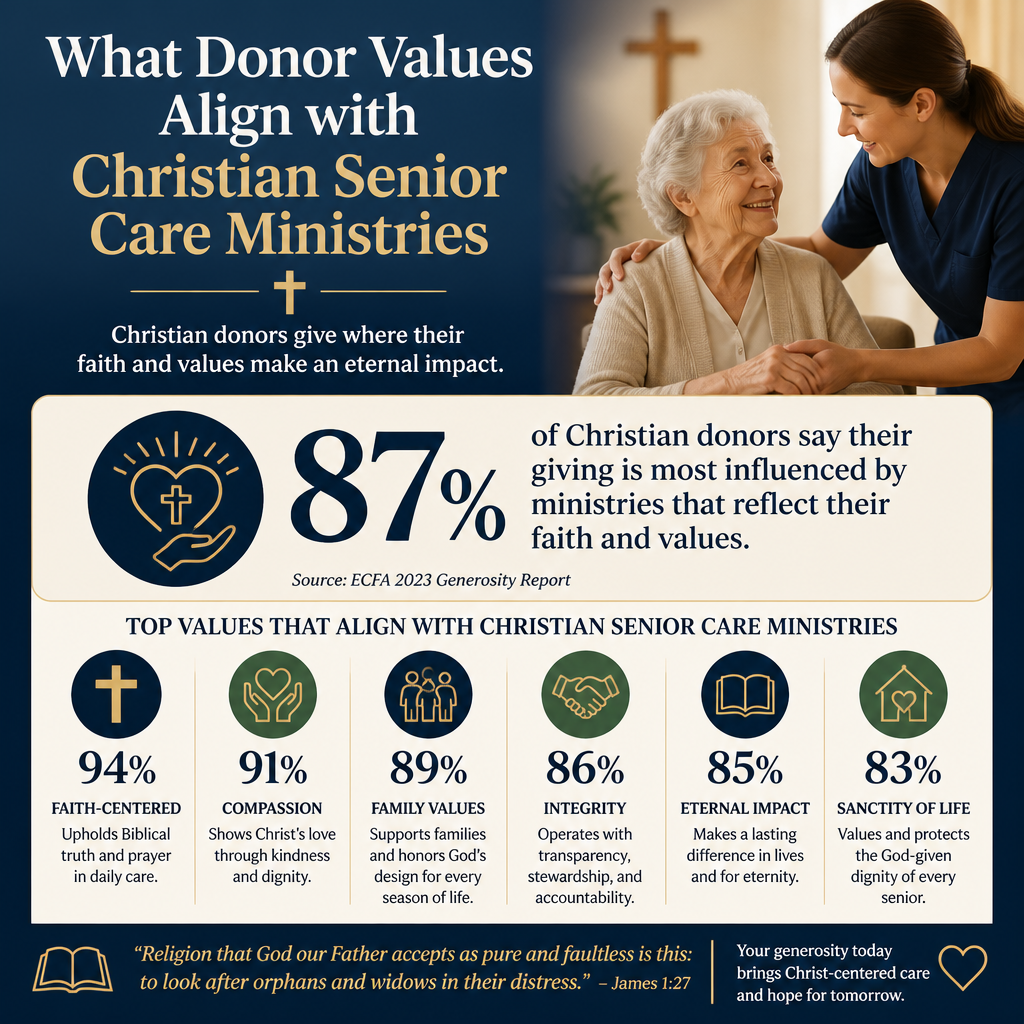
When donors ask what donor values align with Christian senior care ministries, they are usually trying to reconcile two callings that Scripture refuses to separate: honoring older adults as bearers of God’s image and practicing sober stewardship with resources entrusted by God. Senior care brings these together in unusually concrete form. The work touches bodies, homes, family systems, and finances, often in seasons of grief, frailty, and spiritual vulnerability.
Christian donors also recognize a second reality: the senior-care landscape is complex. It spans modest home-delivered meals, pastoral visitation, affordable housing, memory care, and long-term skilled nursing. It includes ministries funded primarily by philanthropy and organizations sustained by resident fees, insurance reimbursements, or government programs. Values-alignment therefore cannot be reduced to sentimental narratives about “our elders.” It must be tested in governance, theology, outcomes, and candor.
Honor for elders as image-bearers and neighbors
The most foundational value is theological rather than programmatic: older adults are not a demographic problem to manage but neighbors to honor. Scripture consistently frames aging within covenant community, not as an afterthought. Paul’s instruction to Timothy is notable for its dignity and concreteness: “Do not rebuke an older man harshly, but exhort him as if he were your father… older women as mothers” (1 Timothy 5:1–2). Christian senior care that aligns with mature donor values treats elders as persons with agency, relationships, and spiritual needs, not as “beds” or “units.”
Personhood over throughput
In practice, donors can look for ministries that can describe the daily life they are protecting: meaningful routines, community, spiritual care, and attention to family relationships. Many organizations can produce activity calendars. Fewer can describe how they handle the spiritual and relational costs of cognitive decline, bereavement, or the loss of independence without reducing residents to tasks.
Mercy without paternalism
Christian donors also bring a holy caution to mercy ministries: compassion can drift into paternalism if the recipients’ voice is absent. Elders should be listened to, not merely served. Even in advanced frailty, honoring the person includes clear communication, consent where possible, and careful attention to the role of family and legal guardians. The work is slower than donors often prefer, but it is closer to the tempo of love.

Faithful presence and spiritual care that is not performative
Christian senior care ministries often claim spiritual distinctives. Donors should ask whether those distinctives are embodied in daily practice or merely placed in brochures. We find that high-integrity Christian care avoids two equal errors: hiding the gospel under generic “values language,” or using spiritual language as a cover for inadequate clinical, safeguarding, or accountability standards.
Word and deed held together
For many seniors, isolation and fear intensify near the end of life. Christian care that aligns with donor values offers a faithful presence that is not transactional: pastoral availability, prayer offered with sensitivity, Scripture read without coercion, and consistent companionship. This is especially significant in light of the measurable toll of social disconnection. Older adults are at heightened risk for loneliness, which is associated with adverse health outcomes; the U.S. Surgeon General’s advisory on loneliness and social isolation summarizes the evidence and the public health implications (U.S. Department of Health and Human Services).
Freedom of conscience and clarity about identity
Christians genuinely disagree about how explicitly Christian an elder-care setting should be, particularly when it receives public funds or serves residents from many backgrounds. Serious donors should not demand uniformity, but they should expect clarity. A ministry should be able to explain how it preserves freedom of conscience while still operating from an explicit Christian identity, and how it handles staff formation, chapel participation, and end-of-life spiritual care in a way that is hospitable rather than coercive.

Stewardship, financial integrity, and the refusal of financial fog
Senior care is expensive. Labor is significant, physical plants are costly to maintain, and clinical compliance is demanding. Donors who fund Christian senior care are not merely “covering overhead.” They are underwriting dignified care and the infrastructure that makes it safe. At the same time, because the work is complex, it is also easier for an organization to obscure true performance behind complexity. Mature donor values therefore insist on financial clarity and governance discipline.
Transparent economics of care
Donors should expect ministries to explain how money flows: resident fees, Medicare or Medicaid reimbursements where applicable, philanthropy, and restricted gifts. When an organization relies on public reimbursement, it should be candid about the constraints and incentives that follow. When it relies on philanthropy for subsidized housing or benevolence care, it should be clear about eligibility, sustainability, and the gap philanthropy is truly covering.
We also encourage donors to resist simplistic proxies like “low overhead.” The nonprofit sector has repeatedly clarified that overhead ratios are a poor measure of impact or integrity; the Overhead Myth letter, signed by GuideStar, BBB Wise Giving Alliance, and Charity Navigator, remains a helpful corrective (Candid GuideStar).
What The Most Trusted Standard asks donors to verify
Across our verification work at Most Trusted, we observe that trustworthy senior care ministries do not merely publish documents; they make them intelligible. The Most Trusted Standard emphasizes evidence across faith foundation, financial integrity, governance and leadership, and transparency and effectiveness. In senior care settings, a few donor-facing questions tend to surface quickly:
- Are audited financial statements available, recent, and consistent with the organization’s narrative?
- Does the board demonstrate independence, relevant expertise, and documented oversight?
- Are related-party transactions disclosed and managed with clear conflict-of-interest practices?
- Does the ministry describe outcomes in human terms and measurable terms, without pretending care is fully quantifiable?
- Is fundraising truthful about what gifts can and cannot accomplish in a high-cost care environment?
Governance that protects the vulnerable and steadies the mission
Christian donors often focus on program stories, but senior care requires a second lens: governance as protection. Older adults may be physically frail, cognitively impaired, grieving, or dependent on others for basic needs. That vulnerability is not theoretical. It must shape policy, staffing, reporting channels, and board oversight. Donor values align with ministries that treat safeguarding as part of discipleship, not merely compliance.
Safeguarding as a moral obligation
Ministries should be able to describe screening and training practices, incident reporting, mandatory reporting obligations, and how concerns reach independent oversight. Where an organization operates licensed facilities, donors should also consider whether it discloses inspection histories and how it responds to deficiencies. Not every deficiency signals bad faith; patterns of denial, blame-shifting, or opacity often do.
Leadership that is accountable and spiritually mature
Senior care is a setting where power imbalances are routine. This raises the stakes for leadership character and accountability structures. Donors can appropriately ask: Is executive compensation set through a documented process? Is the senior pastor or founder subject to board oversight, or effectively above it? Are there clear boundaries around spiritual authority so that “Christian culture” does not become a tool for silencing staff, residents, or families?
Readers who are comparing ministry models across this field often benefit from seeing the broader landscape of Christian Senior Care Ministries, particularly because governance and funding models differ substantially across organizations that share similar language.
Truthfulness about outcomes, limits, and the ethics of hope
Christian donors are rightly drawn to hopeful stories. Senior care, however, demands an ethics of hope: hope that does not deny decline, and compassion that does not promise what God has not promised in this life. Values alignment often becomes clearest in how a ministry communicates hard realities—memory loss, falls, family conflict, and end-of-life decisions—without manipulating donors or families.
Outcomes that respect the nature of the work
Some outcomes in senior care are measurable: staff retention, resident satisfaction, response times, fall rates, rehospitalization, or housing stability. Other outcomes are moral and relational: reduced isolation, peace at end of life, restored family connections, faithful pastoral presence. Donors should be wary of two extremes: ministries that report nothing concrete, and ministries that claim overly tidy impact that does not fit the fragility of aging.
Care for families as part of care for elders
Many donors give to senior care because they have lived inside the pressures: adult children trying to honor a parent with diminishing capacity, spouses carrying invisible burdens, siblings disagreeing about finances, and the slow grief of anticipatory loss. Ministries aligned with donor values recognize families as part of the care ecosystem. They communicate clearly, document decisions, and offer pastoral support without taking sides in family conflict. This is also where transparent policies—visitation, grievances, discharge, and financial expectations—become forms of mercy.
Donors who want a deeper view into the moral and stewardship questions that surface in this space often find helpful context in Faith and Stewardship in Christian Senior Care, where we address the tensions donors regularly carry: dignity and cost, mercy and accountability, spiritual care and professional standards.
FAQs for What donor values align with Christian senior care ministries
Should Christian donors prioritize evangelism in senior care, or quality of care?
Scripture does not give us permission to separate love of neighbor from truthful witness. Donors can reasonably prioritize ministries that hold word and deed together, but the test is integrity: spiritual care should be offered with clarity and freedom of conscience, and clinical care should meet rigorous standards. A ministry that speaks often about the gospel but cannot demonstrate safe, dignified care is not aligned with Christian stewardship.
How can donors evaluate senior care ministries when outcomes are hard to measure?
Donors can look for a balanced posture: clear reporting on what is measurable, candid description of what is not, and governance that makes truth-telling costly to evade. In our work at Most Trusted, we recommend asking for audited financials, board policies, safeguarding practices, and plain-language explanations of how resident fees, reimbursements, and philanthropy interact. When an organization welcomes those questions and answers them without defensiveness, donors are usually seeing alignment between stated faith and operational reality.
A faithful gift is one that protects dignity and insists on truth
Donor values align with Christian senior care ministries when compassion is paired with accountability, and when spiritual language is matched by transparent practices. Honoring elders is not only a sentiment; it is a set of verifiable commitments that shape budgets, staffing, governance, and how a ministry speaks about the limits of human life under the curse while bearing witness to the resurrection. The most trustworthy ministries invite scrutiny because they understand that Christian stewardship is not suspicion; it is love expressed through truth.



