
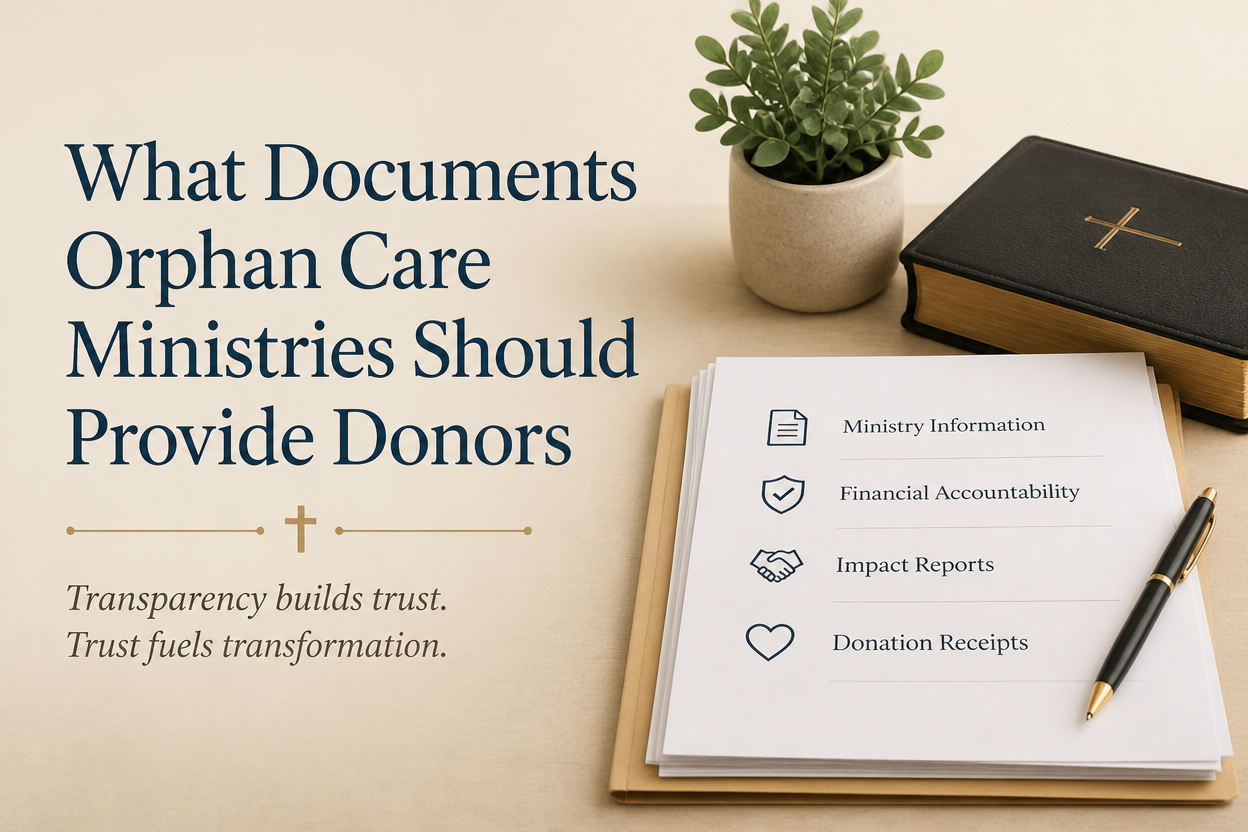
When Christian donors ask what documents orphan care ministries should provide donors, they are asking a question of stewardship before they are asking a question of administration. Scripture repeatedly ties care for the vulnerable to truthful dealing, honest weights, and public accountability. In orphan care, where images and stories carry unusual emotional force, verifiable documentation is one of the few protections donors have against good intentions funding practices that do not serve children’s long-term good.
Orphan care is also a field with genuine complexity. Christians agree that God is “a father to the fatherless” (Psalm 68:5), and James calls care for orphans “pure and undefiled religion” (James 1:27). Yet the movement has had to reckon with harms associated with institutionalization, perverse incentives created by sponsorship models, and the difficulty of measuring outcomes across borders. Donors should expect ministries to meet that complexity with evidence, not defensiveness.
Why documents matter in orphan care
Donor diligence is not suspicion
Some ministries read document requests as a lack of trust. Mature Christian philanthropy treats them as the normal counterpart to prayerful generosity. When Paul organized relief for Jerusalem, he arranged transparent handling of funds “to avoid any criticism of the way we administer this liberal gift” (2 Corinthians 8:20–21). That is not the language of suspicion; it is the language of integrity.
Across our verification work at Most Trusted, we see that ministries willing to show their work tend to be the ministries most attentive to child protection, local partnership, and long-term family outcomes. The pattern is not perfect, but it is consistent enough to guide donor practice.
Orphan care has documented risk factors
Documentation matters because the sector has known failure modes. Large-scale research has shown that children raised in institutional settings face elevated developmental and mental health risks compared with family-based care. One of the most-cited syntheses is the Bucharest Early Intervention Project, which found significant developmental impacts of early institutional deprivation and measurable gains when children moved into family-based foster care Bucharest Early Intervention Project.
That does not mean every residential program is the same, or that emergency shelter is never necessary. It does mean donors should press for documents that clarify whether a ministry’s model reinforces family separation or strengthens families so separation is less likely.

The baseline documents every orphan care ministry should provide
Financial and governance documents that can be verified
Christian donors should begin with a small set of documents that are ordinary for any credible nonprofit. If a ministry cannot produce these promptly, it is typically a sign of weak internal controls rather than a theological difference in philosophy.
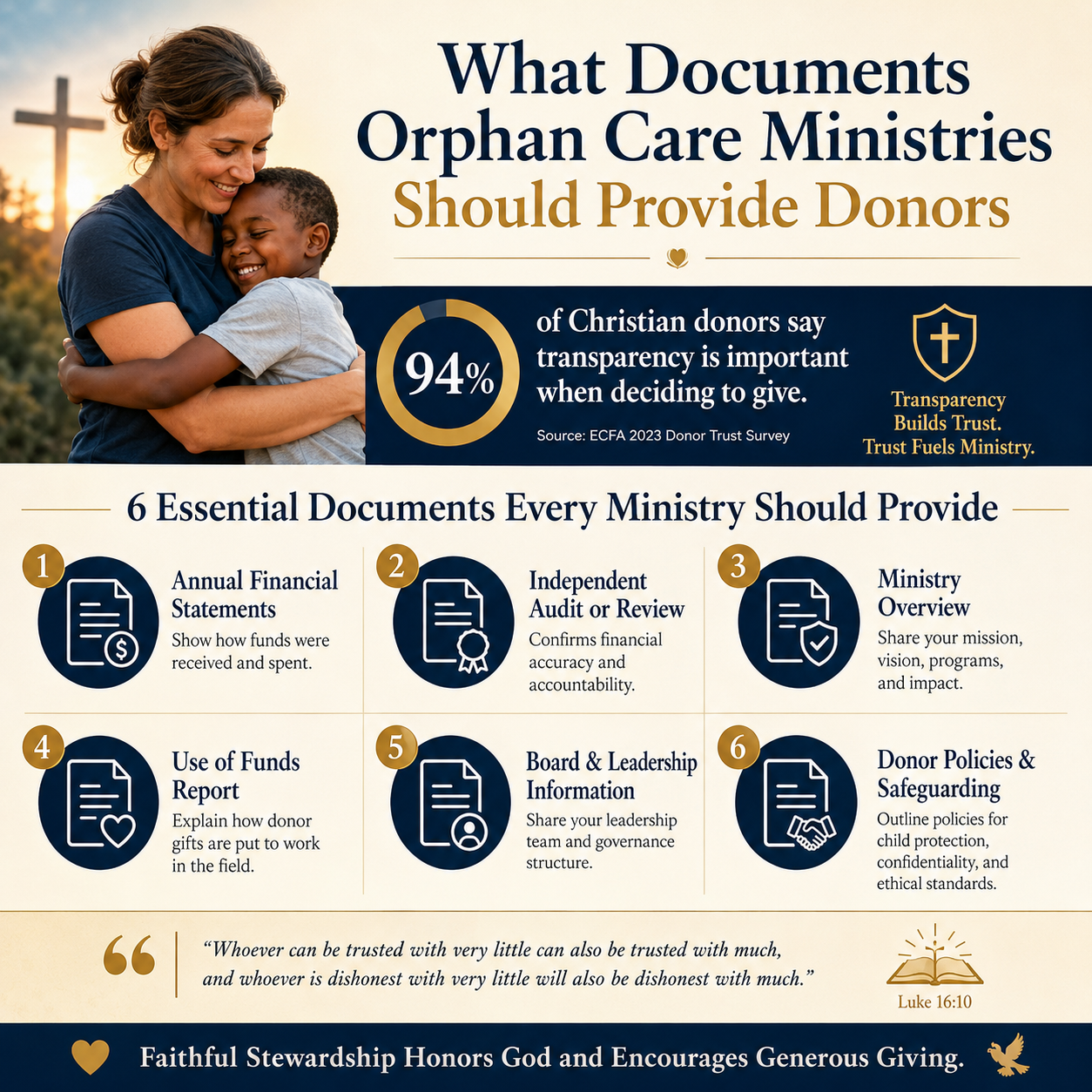
- Recent audited financial statements (or reviewed statements for smaller organizations), including the auditor’s opinion letter.
- IRS Form 990 (for U.S. nonprofits), with schedules, for the most recent year available.
- Annual report that ties finances to program activity rather than only stories and photos.
- Board roster and governance policies (conflict of interest, whistleblower, document retention).
- Fundraising and marketing policies (including how children’s images and stories are obtained and used).
For many U.S. charities, the Form 990 is foundational because it provides a standardized view of governance, compensation practices, and finances. The IRS provides the form and related guidance directly IRS Charities and Non-Profits.
Program documents that show what the ministry actually does
Orphan care ministries often describe their work with inspiring terms: rescue, refuge, family, restoration. Donors should ask for documents that define those terms operationally. A ministry can be sincerely motivated and still run a model that unintentionally pressures families toward separation or encourages dependency.
At a minimum, donors should expect a current program brief or theory of change describing: the population served; the pathway into services; the pathway out; the role of government social services; the role of local churches; and how the ministry prioritizes reunification, kinship care, foster care, domestic adoption, or supported independent living where appropriate.
Many donors find it helpful to keep the broader landscape in view. Orphan Care Ministries is a useful starting point for understanding the range of models and why documentation needs differ between, for example, a family preservation program and a residential care program.
Child protection and dignity documents donors should insist on
Safeguarding policies are not optional
In orphan care, the highest stakes are not financial. They are the safety and dignity of children. Donors should ask for written child safeguarding policies and confirm they are implemented, not merely posted. Ministries should be able to supply policies covering staff screening, volunteer screening, supervision ratios, prohibited conduct, reporting pathways, and how allegations are handled.
Donors should also look for a credible external framework. Many Christian ministries align their child safeguarding practices with recognized standards such as those promoted by Keeping Children Safe, an international network focused on safeguarding policies and procedures Keeping Children Safe.
Photography, storytelling, and consent documentation
Christian donors often want to “know the child” they are helping. The desire is understandable, but it can collide with a child’s right to privacy and long-term safety. Ministries should be able to provide written policies governing:
Consent (who can consent, under what conditions, and how it is documented), identifying information (what is withheld and why), and story verification (how the ministry prevents exaggeration, simplification, or composite storytelling presented as fact).
The question is not whether stories are told; Christian giving is often mobilized through testimony. The question is whether the ministry tells the truth with the restraint and reverence the imago Dei requires.
Documents that show family-first practice and legal compliance
Case management and placement documentation
Christians genuinely disagree about how quickly family reunification is possible in high-risk contexts, and about when residential care is a necessary bridge rather than a default. Those disagreements can be discussed responsibly only when a ministry can show its decision process.
For ministries involved in child placement or residential care, donors should ask whether the ministry can provide, in de-identified form, templates and policies for:
Intake assessments, family tracing and reunification plans, kinship assessments, care plans, transition plans, and follow-up protocols. Ministries should also clarify what role government authorities play and how legal custody is established and documented.
Cross-border work requires clarity about authority and accountability
Many orphan care ministries operate internationally through partners. That can be a strength when it reflects local ownership; it can be a weakness when it becomes a way to avoid accountability. Donors should ask for:
Partner agreements describing roles and responsibilities, local registration documents where applicable, and financial controls for funds sent abroad. For U.S.-based donors, the question is not whether international work is inherently risky. The question is whether the ministry can show how it mitigates known risks: weak documentation systems, inconsistent government enforcement, and the temptation to prioritize donor-facing outputs over child outcomes.
Outcome and transparency documents that mature donors should expect
Metrics that fit the mission and resist manipulation
Orphan care has suffered from simplistic metrics: beds filled, children “rescued,” sponsorships sold, buildings constructed. Those numbers are easy to report and easy to misuse. Better ministries track outcomes that are harder to achieve and harder to market: family stability, school attendance and progression, placement stability, reunification durability, and reductions in preventable family separation.
Donors should ask for an outcomes report that explains what is measured, how it is measured, and what the ministry does when the results are disappointing. A ministry does not need perfect results to be credible. It does need honest results.
Financial transparency that avoids false shortcuts
Donors often ask for a single efficiency number. The field has had to correct that impulse. The “Overhead Myth” letter, signed by major evaluators, explains why overhead ratios are a poor proxy for effectiveness and can create unhealthy incentives Charity Navigator.
In orphan care, underinvestment in trained social workers, safeguarding staff, trauma-informed care, and monitoring can be catastrophic. Donors should seek documentation that shows not only where money went, but whether spending patterns match a family-first, child-protective model.
This is where independent verification can serve donors well. Most Trusted evaluates ministries against The Most Trusted Standard, examining faith commitments alongside financial integrity, governance, transparency, and effectiveness. Documentation does not replace discernment, but it gives discernment a factual basis.
For donors comparing organizations, How to Give Wisely to Orphan Care Ministries is a helpful context for setting document expectations that fit different models of care.
FAQs for What documents orphan care ministries should provide donors
Is it unloving to ask for audits and policies when children are in need?
It is not unloving to ask. Christian love includes justice and truth, not only compassion. In practice, documentation protects children from programs built on weak controls, protects local families from perverse incentives, and protects donors from being steered by emotion rather than reality. A ministry serving vulnerable children should already have these documents because it already bears the responsibility.
What if a small orphan care ministry says it cannot afford an audit?
Not every organization can afford a full audit every year. A smaller ministry can still provide reviewed financial statements, bank reconciliation practices, clear segregation of duties, a conflict of interest policy, and a board that actively oversees finances. Donors can also support capacity-building as part of a grant, but only after the ministry demonstrates willingness to be accountable and to adopt safeguards appropriate to the risk of its work.
A credible orphan care ministry welcomes the light
Christian donors are not funding an idea; they are funding a set of practices that shape real children’s lives. The documents orphan care ministries should provide donors are, at root, evidence that the ministry is willing to be known truthfully: financially, operationally, and morally. Where children are vulnerable and incentives are complex, light is not a burden. It is a form of care.



