

What Christian apologetics ministries say about science and faith shapes far more than intellectual debate. It influences whether donors fund a public witness that honors both God’s revelation in Scripture and the integrity of God’s world, or whether giving unintentionally reinforces brittle arguments that collapse under scrutiny.
For mature Christian donors, the question is not whether science matters. The question is whether an apologetics ministry’s posture toward science and faith produces clarity, charity, and credibility—especially for students, skeptics, and working scientists inside the church. “The heavens declare the glory of God” (Psalm 19:1) is not a retreat from evidence; it is a claim that creation is a meaningful arena of divine communication, rightly read under the Lordship of Christ.
The spectrum of approaches apologetics ministries take
Christian apologetics is not a monolith. Ministries speak about science and faith from differing theological traditions, differing readings of Genesis, and differing judgments about what is at stake culturally. Christians genuinely disagree about origins, about methodological naturalism, and about how to interpret certain scientific claims without surrendering core doctrines.
Across our verification work at Most Trusted, we observe that donor confusion often comes from treating “science and faith” as a single issue. In practice, ministries are answering several questions at once: What is Scripture? What is science? What counts as knowledge? What is a human person? These distinctions determine whether an apologetics ministry equips the church or inflames it.
Conflict, integration, and public credibility
Some apologetics ministries present science and faith primarily in conflict terms: “science versus the Bible,” “evolution versus Christianity,” or “secular science versus biblical truth.” Others aim for a more integrated account: the Bible as God’s word, creation as God’s work, and scientific inquiry as a limited but genuine form of human knowing under common grace.
The ministries most persuasive to thoughtful audiences typically avoid caricaturing either side. They will name real tensions—such as interpretive disputes over early Genesis—without implying that faithful Christians who disagree are surrendering the gospel.
The difference between defending doctrine and defending a model
A recurring risk is the collapse of core doctrine into a particular scientific model. Christianity is accountable to historic claims—creation, fall, redemption, resurrection—but not to every modern inference Christians may attach to those claims. Donors can ask whether a ministry carefully distinguishes between what the creeds require and what a particular apologetic strategy prefers.
When ministries blur that line, they may win short-term rhetorical victories but create long-term pastoral liabilities for young believers who later encounter serious scholarship.

What thoughtful apologetics ministries affirm about science
At their best, apologetics ministries treat science as a legitimate form of inquiry into the created order, bounded by its methods and dependent on philosophical assumptions it cannot itself prove. This is not a concession to secularism; it is a recognition that God is Lord of all truth, and that human knowing is creaturely.
Christians have long recognized ordered creation as compatible with investigation. Historically, many early modern scientists in the West explicitly framed scientific study as exploring God’s handiwork, even as the modern institution of science later developed its own norms and sometimes its own secularizing story.
Methodological naturalism and its limits
Apologetics ministries often address “methodological naturalism”—the practical rule that science explains phenomena in terms of natural causes, without invoking divine agency as a scientific variable. Responsible ministries clarify that this is a method, not a metaphysical verdict that God does not act. The former can be compatible with Christian theism; the latter is not.
Donors should listen for whether a ministry can explain this distinction without belittling scientists or overstating what science claims. A ministry that consistently treats scientists as moral or intellectual enemies will rarely serve Christian witness in the long term.
Science, wonder, and intellectual humility
Christian theology makes room for wonder and for limits. Job is confronted not with a laboratory manual but with a divine interrogation of creation’s breadth (Job 38–41). Many ministries draw on this passage to encourage humility: we do not possess exhaustive knowledge, and we should be wary of weaponizing scientific uncertainty or theological certainty for rhetorical dominance.

Humility does not require vagueness. It requires precision: what do we know, how do we know it, and what would change our minds about secondary claims?
Where science and faith flashpoints typically appear
Apologetics ministries commonly focus on particular flashpoints where scientific claims intersect with theological claims about human origins, human uniqueness, and moral order. Donors can anticipate the pressure points because they recur across campuses, media, and pastoral counseling.
Origins and the interpretation of Genesis
Origins debates—young-earth creationism, old-earth creationism, evolutionary creation, and intelligent design—receive disproportionate attention because they function as symbols of authority: “Will we submit to Scripture, or to modernity?” The difficulty is that faithful Christians can affirm Scripture’s authority while disagreeing about genre, chronology, and how to relate biblical and scientific claims.
When evaluating a ministry, donors should ask whether it presents competing Christian views fairly. A ministry may hold a strong position, but it should not misrepresent other orthodox positions as a capitulation to unbelief.
Human uniqueness and the image of God
Even when Christians disagree about evolutionary mechanisms, many agree that the image of God and the moral accountability of human persons are non-negotiable. Apologetics ministries may engage neuroscience, evolutionary psychology, or genetics to argue that human rationality and moral responsibility resist reduction to material processes.
The best work here avoids simple “science proves” claims. It argues at the level of philosophy of mind, moral realism, and theological anthropology—areas where serious scientists themselves often acknowledge that empirical data alone cannot settle the question of meaning.
Miracles, resurrection, and the scope of historical reasoning
Another common flashpoint is miracles. Ministries such as Reasonable Faith have argued that the resurrection is open to historical evaluation and that miracles are not ruled out a priori if God exists. This line of argument typically distinguishes between science as the study of regularities in nature and history as the evaluation of singular events.
Donors should watch for whether a ministry can discuss miracles without turning science into a straw man, and without treating historical evidence as a mere pretext for fideism.
How donor priorities should shape evaluation
Christian donors are rarely funding abstract debate. They are funding formation: what students believe, how pastors preach, how scientists in the church remain, and how skeptics hear the gospel. This makes governance, financial integrity, and transparency more than administrative concerns; they are credibility concerns.
Across our work as an independent verification service, we find that apologetics ministries that meet The Most Trusted Standard tend to pair intellectual ambition with institutional seriousness. They handle money soberly, disclose their leadership clearly, and avoid exaggerated claims about impact.
What a donor should look for in a science and faith posture
- Doctrinal clarity without doctrinal inflation: affirming historic Christian teaching without treating a debated scientific position as a test of orthodoxy.
- Fair representation of opposing views: quoting sources accurately and acknowledging where Christians disagree in good faith.
- Competence and accountability: using qualified speakers, referencing primary sources, and correcting errors publicly when needed.
- Pastoral awareness: recognizing that young believers and scientists often need permission to ask questions without shame.
- Evangelistic integrity: engaging skeptics with truthfulness rather than rhetorical shortcuts.
Why transparency matters in apologetics
Apologetics ministries sometimes operate in media ecosystems that reward controversy. That incentive can distort fundraising, messaging, and reporting. A donor should not assume that a strong public presence equals institutional health.
What this means in practice is that donors should prioritize verifiable disclosures: audited financials when feasible, conflict-of-interest policies, board governance, and clear reporting on how programs are evaluated. Most Trusted was built for this exact donor need: giving with confidence to ministries that can substantiate their claims and demonstrate integrity over time.
How to read claims and evidence with discernment
Science and faith conversations are vulnerable to two errors: treating science as an ultimate authority, or treating it as an enemy to be defeated. Christian apologetics ministries serve donors well when they reject both extremes and instead train believers to reason carefully.
When ministries cite research, donors should look for whether the citation is accurate, whether counterevidence is acknowledged, and whether the conclusion being drawn is proportionate to the evidence. The same standard applies to theological claims: careful exegesis, awareness of the tradition, and restraint when the text does not answer a modern question directly.
What public trust requires in a polarized environment
Public trust is fragile, and apologetics is often judged by its least careful representatives. Many Americans perceive an inherent conflict between science and religion: a 2015 Pew Research Center report found that 59% of U.S. adults say science and religion are “often in conflict.” Pew Research Center
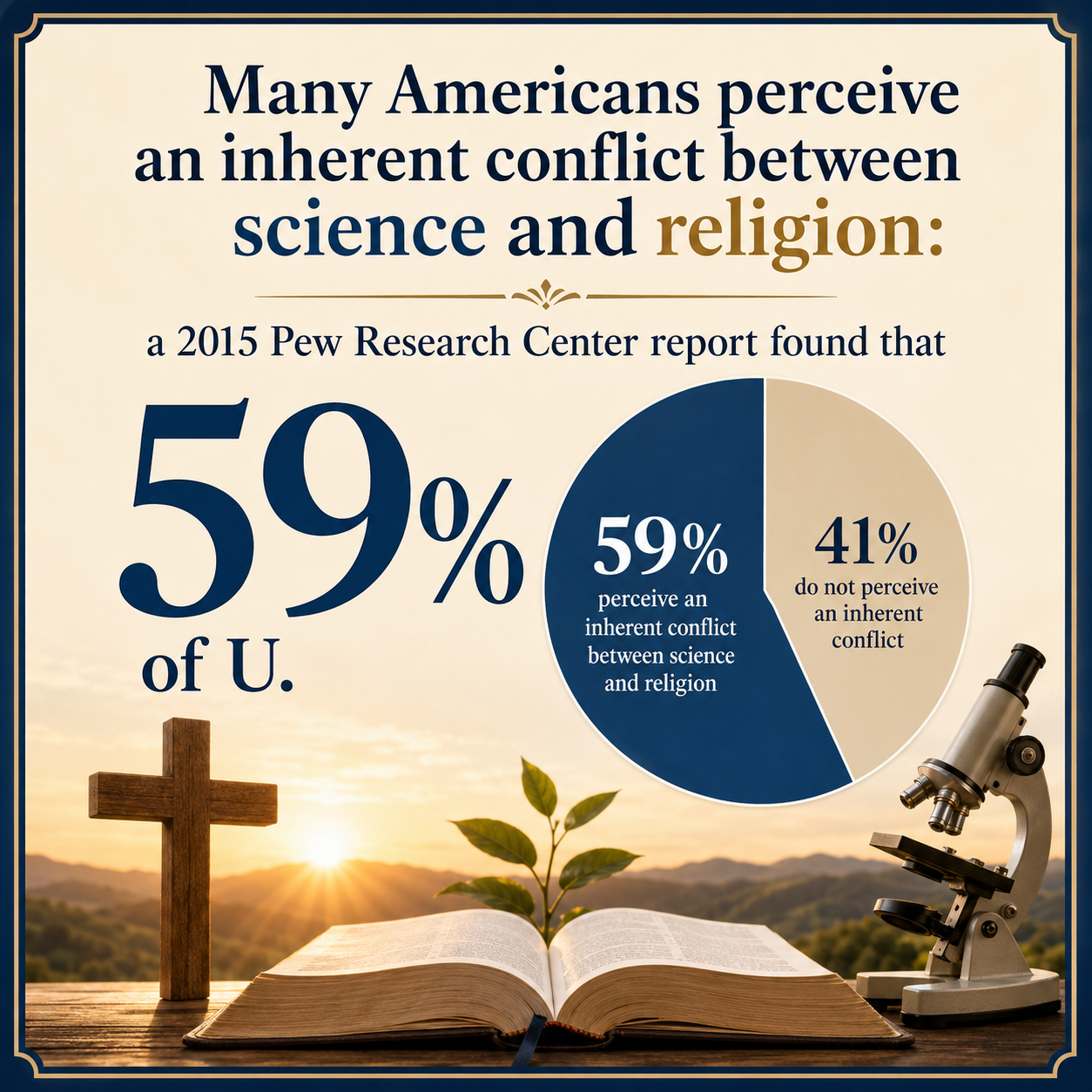
That perception does not settle the truth, but it does shape the mission field. If donors want apologetics ministries to reach scientists, medical professionals, and students in STEM fields, ministries will need more than slogans. They will need careful argument, a credible posture, and institutional maturity.
Confidence without overclaiming
Some apologetics ministries overpromise: “this argument proves God,” or “science now confirms the Bible.” Sophisticated readers generally recognize that most arguments in this space are cumulative and probabilistic. A ministry that routinely overclaims may excite supporters but can also set up believers for disillusionment.
Better ministries model a classic Christian epistemology: we can offer reasons for faith, we can expose incoherences in unbelief, and we can commend Christ as Lord, while acknowledging that conversion is finally the work of the Holy Spirit (John 16:8).
Donors seeking a broader view of how ministries frame public witness can explore Cultural Engagement in Christian Apologetics in order to compare approaches and assumptions across organizations.
FAQs for What Christian apologetics ministries say about science and faith
Do Christian apologetics ministries have to choose between defending the Bible and respecting science?
No. The more faithful and persuasive ministries distinguish between Scripture’s authority and any single scientific model Christians may adopt. They respect science as the study of the created order while also naming science’s philosophical limits. This approach can defend the Bible without caricaturing scientific work or treating honest questions as rebellion.
How can donors tell whether an apologetics ministry is trustworthy on science and faith?
Donors can look for doctrinal clarity, intellectual fairness, and institutional transparency. Strong ministries cite sources carefully, represent opposing views accurately, and show governance and financial practices consistent with long-term credibility. Most Trusted’s verification work evaluates ministries against The Most Trusted Standard so donors can give with confidence where integrity and effectiveness are demonstrable.
A responsible apologetics witness serves both truth and neighbor
What Christian apologetics ministries say about science and faith will either widen the church’s credibility or narrow it. Donors can help fund ministries that honor Scripture, respect the created order, and speak to skeptics with intellectual honesty and moral seriousness. The goal is not a truce between competing authorities, but a coherent Christian witness in which all truth is received under Christ.
For donors comparing organizations across the field, Christian Apologetics Ministries provides a broader context for evaluating mission, methods, and trustworthiness in public-facing Christian witness.



