

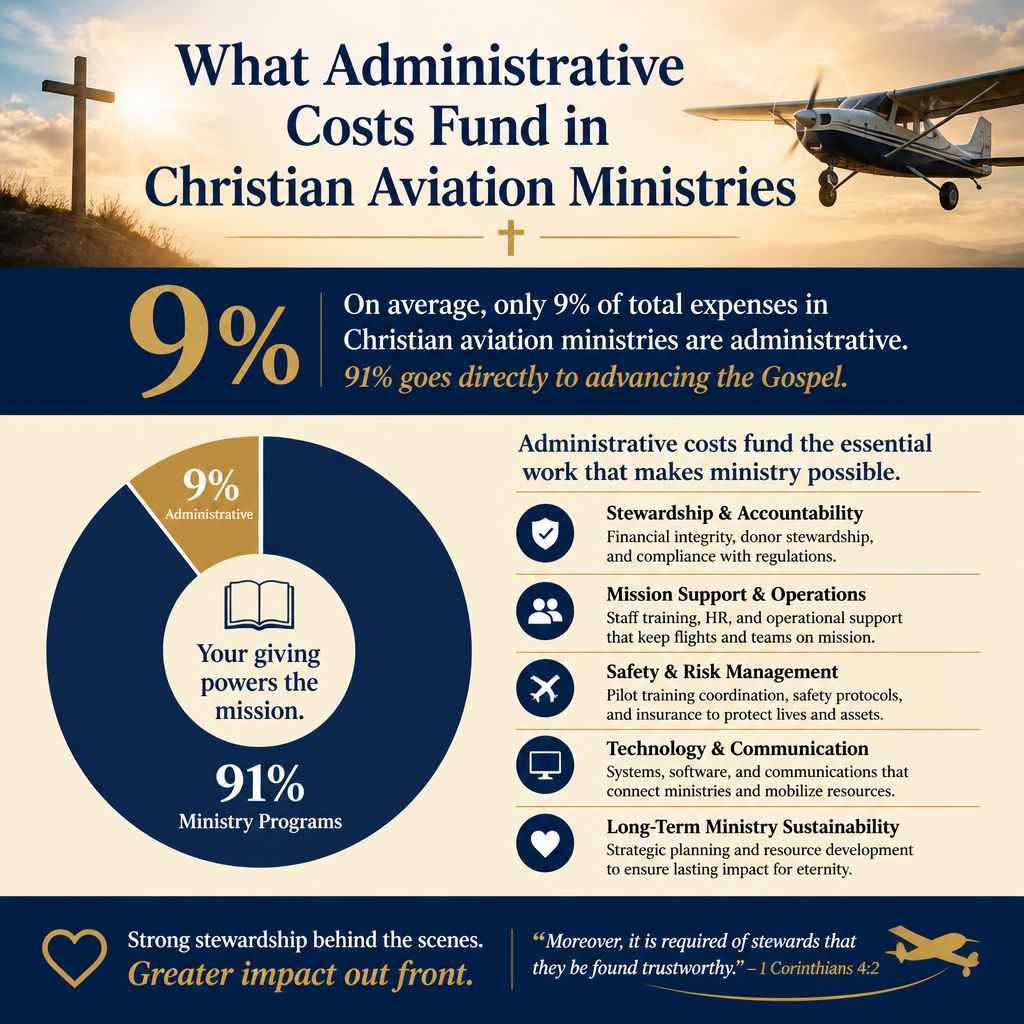
Administrative costs fund in Christian aviation ministries are not a distraction from mission; they are the infrastructure that keeps aircraft safe, finances accountable, and gospel service sustainable over decades. Donors who care about stewardship often feel a tension here: every dollar routed to “administration” can look like a dollar not routed to a flight. Yet aviation is not a simple commodity, and Christian ministry is not exempt from the moral responsibility to govern money, people, and risk with seriousness.
Scripture’s concern is not that overhead be minimal, but that stewardship be faithful. Jesus commends the servant who manages entrusted resources with prudence (Matthew 25:14–30). Paul insists on visible financial integrity so that “no one should blame us” in the administration of a gift (2 Corinthians 8:20–21). Those principles do not eliminate hard trade-offs, but they do frame the question: what administrative costs actually fund, and what should donors expect to see if a ministry is operating with integrity?
Administrative costs in aviation are often safety costs in disguise
Compliance and documentation are part of airworthiness
In aviation, paperwork is not cosmetic. Maintenance records, pilot currency documentation, and operations manuals sit behind nearly every safe takeoff. Administrative staff time is often what ensures inspections are scheduled, recurring requirements are tracked, and corrective actions are documented. When donors hear “administration,” they may picture generic office work. In an aviation ministry, a portion of that category can be a safety system: the quiet, disciplined work that prevents preventable failures.
Even for smaller operators, the regulatory and technical environment is demanding. The National Transportation Safety Board has repeatedly emphasized the role of organizational factors—such as procedures, training, and oversight—in accident prevention and investigation findings National Transportation Safety Board. Donors do not need an accident report to validate strong administration; the point is that safety is rarely a single heroic decision in the cockpit. It is usually an organizational posture sustained over time.
Risk management protects people and the witness
Christian aviation ministries operate in remote regions, challenging weather, limited infrastructure, and complex cross-cultural settings. Administrative costs frequently include insurance coordination, incident reporting systems, security protocols, and the governance processes that decide when not to fly. Declining a flight can be as much a ministry decision as accepting one, especially when pressure arrives through compassion, urgency, or donor expectations.
The harder question is whether a ministry has built a culture that empowers staff to prioritize safety over performance metrics. If donors are accustomed to treating overhead as a problem to be solved, they may unintentionally reward ministries that underinvest in the very systems that keep pilots, passengers, and communities safe.

People costs are administrative because people are the mission
Training, supervision, and pastoral care are not optional
In many Christian aviation organizations, staff serve as pilots, mechanics, and cross-cultural workers at the same time. Administrative costs commonly include recruiting, background checks, training pathways, continuing education, supervision, and member care. Donors sometimes ask why a ministry needs human resources capacity. In aviation, a staffing mistake can become a safety issue. In missions, a staffing mistake can become a moral injury to a local church or community.
Serious donor stewardship includes concern for the people doing the work. The New Testament’s emphasis on qualified leadership and careful oversight is not abstract (1 Timothy 3). Ministries that treat formation, supervision, and accountability as “extra” often pay for it later—through burnout, failure, or public scandal. The cost does not disappear; it is deferred.
Support-raising administration can be a legitimate service
Some donors bristle at the administrative load created by support-raised staffing models: receipting, donor communications, restricted gift tracking, and compliance with charitable giving rules. There is room for principled disagreement about particular fundraising approaches, and Christians genuinely disagree about what feels fitting in different contexts. Still, if a ministry relies on support-raised workers, the administrative work that makes that possible is not merely internal comfort. It is part of honoring donors’ intent and protecting integrity in how funds are handled.
Across our verification work at Most Trusted, ministries that meet The Most Trusted Standard tend to treat donor care as a moral obligation, not a marketing opportunity. Administrative costs can be a sign of that seriousness when they produce accurate receipting, clear gift restrictions, timely acknowledgments, and readily available financial answers.
Financial administration funds integrity, not bureaucracy
Controls, audits, and segregation of duties
Financial administration is where good intentions meet reality. In a field where aircraft parts are expensive, fuel costs swing, and international operations can create complex cash handling scenarios, internal controls matter. Administrative costs often include bookkeeping, finance leadership, accounting software, payroll administration, and the professional oversight that keeps accounts reconciled and restricted gifts honored.
Independent audits can be expensive, especially for ministries with multiple entities or international programs. But the discipline of external review is one of the clearest ways to reduce risk for donors and boards. Donors should look for evidence that finance is not handled by a single heroic person with too much access and too little oversight. The point is not suspicion; it is wisdom about how temptation and error work in real organizations.
The overhead ratio is not the whole story
Many donors were formed by a simple rule: low overhead equals trustworthy ministry. The sector has had to reckon with how incomplete that measure is. A widely cited joint letter warned donors against over-relying on overhead ratios, because underinvestment in administration can reduce effectiveness and weaken accountability BBB Wise Giving Alliance. That warning does not sanctify waste. It clarifies that some overhead is necessary for a ministry to function ethically and effectively.
What this means in practice is that donors should ask better questions than “Is overhead low?” A ministry can report a low administrative percentage while carrying hidden costs in deferred maintenance, undertrained staff, weak governance, or inadequate financial controls. In aviation, those liabilities rarely stay hidden forever.
Administrative capacity funds governance and donor clarity
Board governance takes time and competent support
Board members are often volunteers with limited bandwidth. Administrative staff frequently supply the operational support that makes governance real: preparing board packets, documenting minutes, maintaining conflict-of-interest disclosures, tracking policy updates, and ensuring key decisions are recorded and implemented. This is not clerical trivia. It is part of how an organization demonstrates that it is not built around a single personality or insulated leadership circle.
Donors who give significant gifts should expect evidence of governing maturity: clear bylaws, coherent decision-making processes, and documented oversight. These are not luxuries reserved for large institutions. They are the means by which a Christian organization makes itself accountable to the body of Christ and to the public that grants it charitable privileges.
Transparency is an administrative outcome
Transparency is not merely a virtue; it is work. Producing clear financial statements, publishing annual reports, maintaining accurate program descriptions, and responding to donor questions requires administrative attention. A ministry may have sincere leadership and strong mission outcomes and still be opaque simply because no one is assigned to organize and communicate verifiable information.
Donors who want a broader view of how this plays out in the sector can review Accountability and Transparency in Christian Aviation Ministries. The central issue is not whether a ministry uses the word “transparent,” but whether a donor can see enough to make a responsible decision.
What wise donors should ask before judging administrative spending
Questions that respect both stewardship and reality
Administrative costs are not automatically a sign of faithfulness, and they are not automatically a sign of waste. The discerning path is to ask what those costs accomplish and whether they are proportionate to the ministry’s scale and risk profile. Aviation amplifies both the consequences of failure and the need for disciplined systems.
- What specific functions are included in “administration,” and are safety and compliance embedded there?
- Does the ministry have an independent audit or external financial review appropriate to its size?
- Are restricted gifts tracked and reported in a way that honors donor intent?
- What policies exist for conflicts of interest, related-party transactions, and whistleblower reporting?
- How does the ministry measure outcomes beyond flight hours, such as medical access, church partnership, or community benefit?
Verification helps donors move from suspicion to evidence
Many donors are tired of either naive optimism or cynical withholding. The church deserves better categories. Most Trusted exists to help donors give with confidence by evaluating ministries against The Most Trusted Standard, a 15-criteria framework spanning faith commitments, financial integrity, governance, and transparency and effectiveness. When a ministry welcomes verification, it signals that it expects its stewardship claims to be tested rather than merely asserted.
For donors seeking a broader understanding of the field, Christian Aviation Ministries provides context on how these organizations operate and the common points of donor concern. Administrative spending becomes easier to interpret when it is set inside a clear picture of operational complexity and accountability expectations.
FAQs for What administrative costs fund in Christian aviation ministries
Is it unfaithful for an aviation ministry to have higher administrative costs than other ministries?
No. Aviation carries distinctive safety, compliance, and training demands, and those demands often appear in administrative lines. Faithfulness is not measured by a single ratio; it is measured by whether a ministry manages risk wisely, tells the truth about its finances and results, and governs itself in a way that honors Christ and protects people.
What is a reasonable way to evaluate overhead without being misled?
Start by asking what the administrative category contains and whether it funds necessary systems: financial controls, independent review, safety management, training, and transparent reporting. Compare trends over time rather than one year in isolation, and look for evidence of mature governance. Overhead is a signal, not a verdict.
Stewardship that funds the work behind the work
Administrative costs fund in Christian aviation ministries the work behind the work: safety discipline, financial integrity, governance, and the human systems that keep service sustainable. Donors are right to resist waste and institutional self-protection. Donors are also right to resist the illusion that mission can be separated from the structures that make mission trustworthy. In aviation, particularly, responsible administration is not a rival to gospel service; it is one of the ways love of neighbor becomes operational.



