
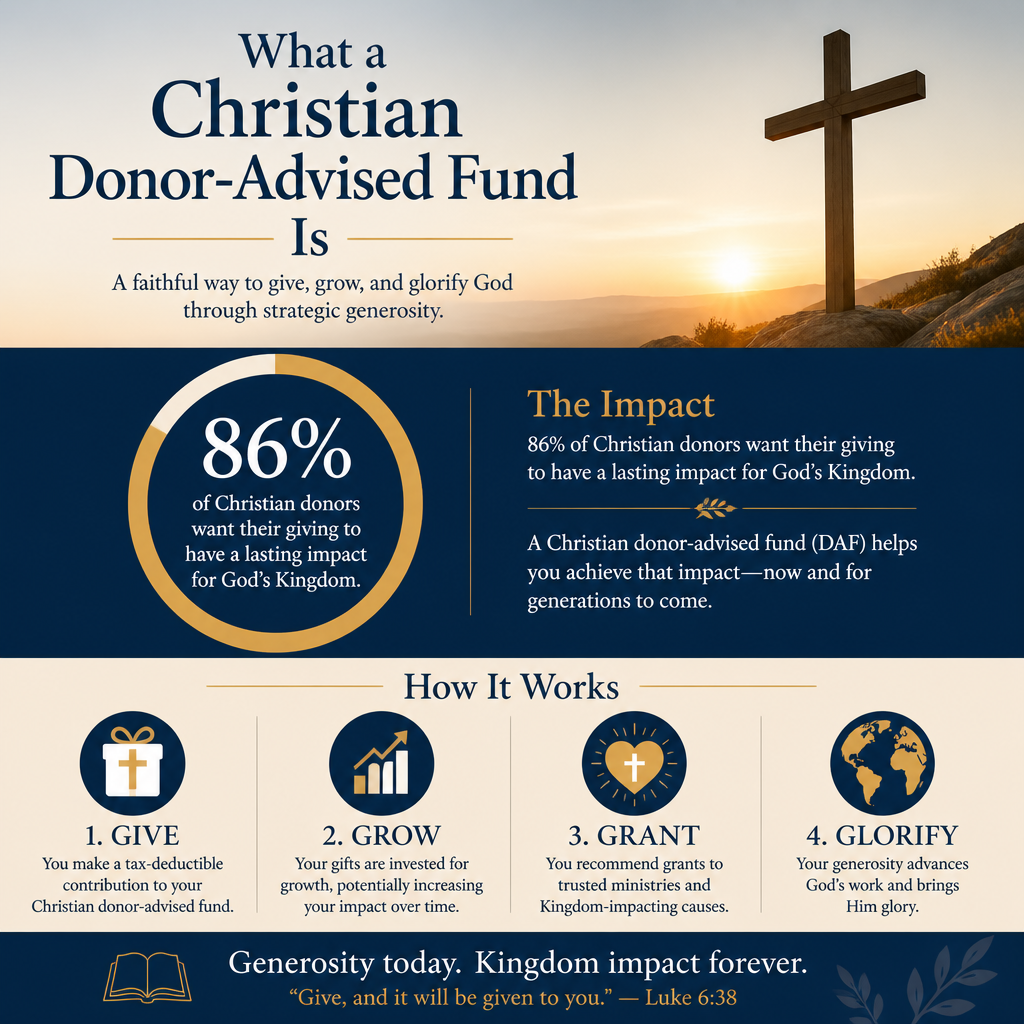
A Christian donor-advised fund is a philanthropic account administered by a sponsoring organization that allows a donor to make an irrevocable charitable contribution, receive a tax deduction when the gift is made, and then recommend grants to qualified ministries over time. For many Christian donors, the appeal is not merely administrative convenience. It is the ability to practice deliberate stewardship: to separate the moment of giving from the moment of granting, so generosity can be planned, prayed over, and executed with disciplined oversight.
That separation, however, introduces a real tension. Donors are stewarding money that no longer belongs to them, yet they still feel pastoral responsibility for its faithful use. A Christian donor-advised fund can help reconcile that tension when the account is governed well, the sponsoring organization is transparent, and grantmaking is tethered to Christian conviction rather than sentiment.
What makes a donor-advised fund Christian
Christian purpose, Christian guardrails
At a basic level, a donor-advised fund is a mainstream charitable vehicle. What makes a Christian donor-advised fund distinct is the purpose it serves and the guardrails it applies. Many Christian DAF sponsors are structured to prioritize grants that advance biblical ministry, and they may restrict grants that conflict with historic Christian teaching. That does not make the DAF a church, but it does mean the sponsor is not pretending that values are neutral.
Christians genuinely disagree about how explicitly a sponsor should define “Christian.” Some donors want a narrow definition tied to creedal orthodoxy and ecclesial accountability. Others prioritize a broader, ecumenical approach focused on gospel-centered fruit. A serious sponsor will name its standards plainly, because hidden filters undermine trust and create future conflict.
Stewardship as discipleship, not only technique
Jesus spoke frequently about money because money is not merely an instrument; it is a competitor for allegiance. “Where your treasure is, there your heart will be also” (Matthew 6:21). A Christian donor-advised fund can serve discipleship by creating space for discernment: donors can plan giving, involve family members in decisions, and respond to needs without improvising when urgency or emotion is high.
What this means in practice is that the “Christian” adjective should not be treated as branding. It should mean the DAF sponsor has a credible theology of stewardship and a governance posture that treats donor intent, ministry integrity, and public trust as weighty moral obligations.

How a Christian donor-advised fund works in practice
Contribution, deduction, and recommendations
Mechanically, the process is straightforward. A donor contributes cash, appreciated securities, or other eligible assets to the DAF sponsor. The donor generally receives a charitable deduction for that tax year, because the gift is to a qualified charitable organization. The funds are then held in an account associated with the donor, who can recommend grants to eligible nonprofits over time.
That word “recommend” matters. Legally, the sponsor retains control and must ensure grants go to qualified public charities and comply with applicable rules. For most donors, this is not an adversarial arrangement; it is a compliance safeguard. But the arrangement does mean a sponsor’s integrity is central. A DAF only serves the donor well if the sponsor is committed to transparent policies, timely grant processing, and a consistent standard for eligibility.
Investment and distribution are moral questions too
Many DAFs allow funds to be invested while they await distribution. This can meaningfully increase the total available for ministry, but it also introduces a spiritual and ethical layer. Christians may consider whether investment options align with convictions about human dignity, sexual integrity, and the common good. Some sponsors offer faith-aligned investment pools; others offer broad market options with limited screening.
Further, the question of timing is not trivial. Philanthropy researchers and policymakers have raised concerns about charitable dollars sitting undistributed for long periods. The National Philanthropic Trust’s annual report tracks DAF growth and payout patterns and has helped bring needed clarity to the public debate about DAF distribution rates; see National Philanthropic Trust. For Christian donors, the concern is not primarily political. It is pastoral: money dedicated to the Lord should be treated as a trust to deploy for the neighbor’s good, not a reservoir to preserve indefinitely.
Why Christian donors choose a donor-advised fund
Complex giving, simplified administration
Many Christian households and foundations are supporting a portfolio of churches, missionaries, international partners, crisis-response efforts, and domestic mercy ministries. Without a DAF, that can become a scattered system of receipts, year-end letters, and ad hoc recordkeeping. A DAF can consolidate giving, simplify tax documentation, and provide a single dashboard for grants and receipts.
It can also make non-cash giving more feasible. Appreciated securities are a common example, but some sponsors also accept more complex assets. When properly executed, giving appreciated assets can increase what is available for ministry compared to selling and giving after tax. The specific tax treatment depends on the donor’s circumstances and should be evaluated with qualified counsel.
Strategic generosity across seasons
A DAF can help donors give faithfully across uneven seasons of income. A business owner with a liquidity event, a family selling property, or a donor experiencing an unusually high-income year can contribute to a DAF in that year, then grant steadily to ministries over subsequent years. That rhythm can protect ministries from feast-and-famine support, and it can protect donors from reactive giving driven by the calendar.
Many donors also use a DAF to involve children and grandchildren in deliberation about grants. When handled carefully, this can become formation in stewardship rather than merely philanthropy: a family practice of asking what faithfulness requires, what evidence should be expected, and how Christian love expresses itself through accountable action.
Choosing a Christian DAF sponsor with integrity
Fees, policies, and the meaning of transparency
A DAF sponsor is not only a service provider; it is a fiduciary-like steward of charitable assets and a gatekeeper for compliance. Christian donors should insist on clarity in at least three areas: fees, grant policies, and reporting. Fee schedules should be easy to find and understandable. Grant policies should be explicit about what kinds of organizations are eligible and how exceptions are handled. Reporting should allow a donor to see grants, balances, and processing timelines without ambiguity.
One practical way to evaluate whether an institution treats transparency as a principle rather than a public-relations posture is to compare what it publishes proactively against what it discloses only upon request. Donors should not have to pressure a sponsor to learn basic facts about costs, restrictions, or governance.
Verification, not vibes, for grantee selection
The harder question is not whether a DAF sponsor can process grants. It is whether donors can identify ministries that are both spiritually faithful and operationally trustworthy. Many ministry failures are not theological apostasies; they are breakdowns in governance, financial controls, or honesty with supporters. Christian donors are not unspiritual for requiring verifiable evidence. Scripture repeatedly treats stewardship as accountable management, not wishful thinking (Luke 16:10–12).
Across our verification work at Most Trusted, we observe that healthy ministries tend to share a pattern: clear faith commitments, board governance that is more than ceremonial, financial statements that can be understood, and public communication that tells the truth about outcomes and limitations. The Most Trusted Standard evaluates ministries across 15 criteria covering faith foundation, financial integrity, governance and leadership, and transparency and effectiveness, because donor confidence is rarely preserved by a single metric.
For donors who want to compare ministries consistently, Christian Stewardship Services provides a broader frame for how stewardship tools and verification practices intersect when generosity is meant to be both heartfelt and accountable.
Common pitfalls and how to avoid them
The temptation to substitute a vehicle for discernment
A DAF is an instrument; it is not discernment. The presence of an account does not guarantee that grants are wise, that partners are credible, or that impact claims are honest. The philanthropic field has had to reckon with how easily donors can confuse administrative polish with ministry health. A Christian donor-advised fund can support faithful giving, but it cannot replace due diligence, ecclesial wisdom, and sober evaluation of fruit over time.
We recommend that donors establish a simple, repeatable decision process for grants. The goal is not bureaucratic burden. The goal is to resist the cultural habit of treating giving as consumption driven by story and novelty.
A short set of practices that strengthens grantmaking
- Confirm the organization is a qualified public charity and in good standing with regulators, using the IRS Tax Exempt Organization Search.
- Ask whether the ministry’s board appears independent and engaged, not merely honorary.
- Review financial statements and look for clarity on major revenue sources and related-party transactions.
- Look for truthful reporting on outcomes, including what is difficult to measure or has not worked.
- Decide in advance how the DAF will balance emergency response with long-term commitments.
These practices do not guarantee perfection. They do, however, meaningfully reduce preventable risks and honor the moral seriousness of directing funds given to God’s work.
Donors exploring how Christian stewardship organizations administer, safeguard, and process DAF activity often begin with How Christian Stewardship Services Manage Donor-Advised Funds, because mechanics and mission cannot be separated without cost.
FAQs for What a Christian donor-advised fund is
Is a Christian donor-advised fund the same as a private foundation?
No. A private foundation is a separate legal entity typically controlled by a family or corporation and subject to distinct rules, filings, and excise-tax considerations. A Christian donor-advised fund is an account within a public charity that sponsors DAFs; donors receive an immediate deduction for contributions to the sponsor and then recommend grants. Foundations can offer greater control but also carry greater administrative responsibility and regulatory complexity.
Can a Christian donor-advised fund support churches and missionaries?
In many cases, yes, provided the recipient is an eligible qualified charity and the grant complies with the sponsor’s policies. Churches are often eligible as 501(c)(3) organizations, even when they are not required to file the same annual forms as other nonprofits. Support for missionaries is commonly routed through recognized sending agencies rather than directly to individuals, because DAF sponsors must ensure grants are made to qualified organizations and not treated as personal gifts.
A DAF can serve faithful giving when accountability remains central
A Christian donor-advised fund is best understood as a stewardship tool that can strengthen generosity through order, patience, and careful grantmaking. Its moral value depends less on the account itself than on the integrity of the sponsor and the seriousness with which donors verify the ministries they support. When a DAF is paired with clear Christian convictions and disciplined evaluation, it can help donors give with both compassion and confidence.



