
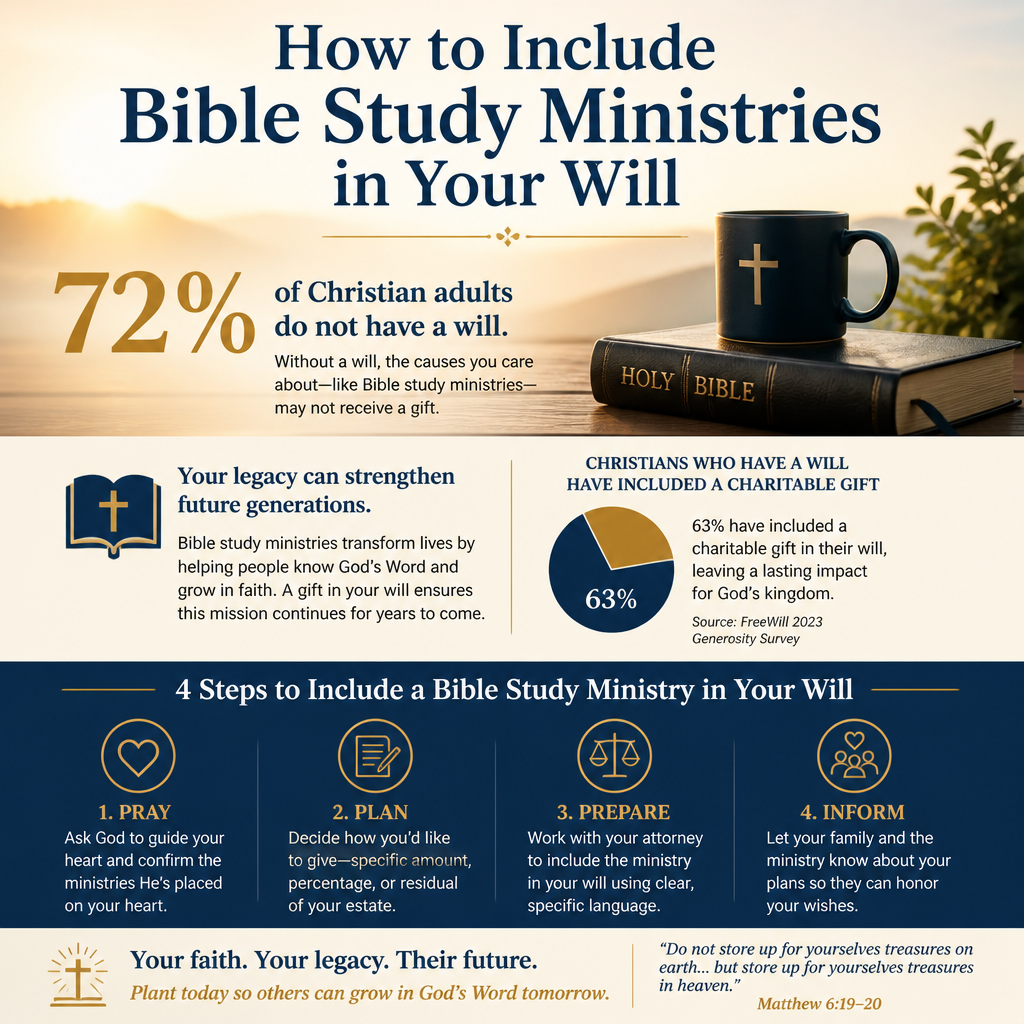
How to include Bible study ministries in your will is, at its core, a stewardship question: what portion of our accumulated resources will be directed toward the Word of God continuing to be taught, understood, and obeyed after our lives are finished. Scripture treats legacy not as an exercise in personal brand-building, but as a sober handoff of responsibility under God’s ownership (Psalm 24:1).
For many Christian donors, the harder question is not whether Bible study matters, but which ministries should be entrusted with a lasting gift, and how to do it with clarity that protects both heirs and the work itself. A will can become a point of conflict, confusion, or litigation when language is imprecise. A well-prepared estate plan can do the opposite: provide for family, honor obligations, and strengthen the church’s long obedience in the same direction.
Begin with a biblical theology of legacy and the Word
Legacy giving is stewardship under God’s ownership
In the Old Testament, the passing down of inheritance is morally weighty because it shapes faithfulness in the next generation, not merely financial security. Deuteronomy repeatedly connects memory, teaching, and covenant fidelity to the future of God’s people. In the New Testament, Paul frames generosity as a gospel fruit that outlasts the giver (2 Corinthians 9:8–11). The point is not that planned giving earns spiritual merit, but that Christian stewardship considers the long-term formation of disciples.
Bible study and engagement ministries serve that formation in a direct way. Christians genuinely disagree about which strategies are most effective—small-group curriculum, pastoral training, translation work, digital platforms, prison-based study, or children’s Scripture memorization programs. But the shared center is clear: “the word of God is living and active” (Hebrews 4:12), and the church’s health is tied to its faithful handling of that Word.
Clarify what you mean by Bible study ministry
“Bible study ministry” can describe a wide range of work. Some organizations publish curriculum; others train lay leaders; others focus on underserved contexts such as prisons, refugee communities, or low-literacy settings; still others provide Scripture access through translation and distribution. The practical implication is that a bequest should align with a specific ministry purpose that you recognize as faithful and durable, not merely with a familiar brand name.
Many donors begin by revisiting the broader landscape of Bible Study and Engagement Ministries, then narrowing to organizations whose theology, governance, and outcomes are transparent enough to withstand long-term scrutiny.

Choose the ministry carefully before you draft the bequest
Longevity requires more than good intentions
A bequest is different from an annual gift because it may be executed years from now, under conditions you cannot anticipate. Ministries can change leadership, drift in doctrine, merge, rebrand, or close. Some organizations are faithful but structurally fragile; others are financially resilient but theologically thin. The estate plan should assume change and build in safeguards.
Across our verification work at Most Trusted, we observe that ministries that meet The Most Trusted Standard tend to show consistency where donors most need it in planned giving: clear faith commitments, board accountability, audited financials or equivalent independent review, and forthright reporting about results and limitations. This is not a guarantee against every future risk, but it meaningfully reduces avoidable uncertainty.
Do due diligence in the same categories your executor will face
When a bequest is paid, the people administering the estate will need unambiguous information. Before you finalize language, confirm details that are often overlooked:
- Legal name of the ministry and its current address
- Tax status and identifying information the attorney requests
- Whether the ministry has a foundation, a supporting organization, or multiple entities
- How the ministry prefers bequests to be designated or left unrestricted
- What happens if the ministry no longer exists at the time of distribution
Donors sometimes feel reluctant to ask these questions, as though they signal distrust. In reality, clarity is a form of care. A ministry that receives estate gifts regularly will welcome precision because it protects both the donor’s intent and the organization’s integrity.
Use clear will language and avoid common drafting errors
Decide between unrestricted and restricted gifts
One of the most consequential decisions is whether to restrict a bequest to a specific program or to allow the ministry’s leaders discretion. Restrictions can reflect a particular calling—say, funding a Scripture engagement initiative in prisons or underwriting training for Bible study leaders. But restrictions can also create future problems if the program changes or the need shifts. Unrestricted gifts are not “less spiritual”; they often provide the flexible capacity ministries need to keep their core work stable.
What this means in practice is that the best restriction is usually purpose-based rather than program-micro-specific. For example, “for Bible study leader training” allows adaptation over time; “for printing 10,000 copies of the 2026 curriculum edition” can become impossible to execute faithfully.
Work with an attorney and include a contingency
State law governs wills, and the cost of professional drafting is small compared to the cost of ambiguity. We recommend working with an estate attorney who is comfortable with charitable bequests and who will include contingency language. A simple contingency addresses a real-world scenario: if the ministry is no longer operating or has materially changed its mission, the executor can redirect the gift to a similar ministry or a specified alternate.
For donors who want their gift to remain tethered to the same category of work, it can be prudent to name a charitable alternative with comparable doctrinal commitments and a similar focus. The attorney can draft language that honors intent without forcing an executor into guesswork.
Coordinate your will with other planned giving tools
Beneficiary designations often control more than the will
Many assets transfer by contract, not by will. Retirement accounts, life insurance policies, and payable-on-death accounts pass according to beneficiary designations even if your will says something different. The result is that a donor can sincerely intend to include a Bible study ministry in the will while unintentionally leaving most assets outside the will’s reach.
A disciplined approach is to review beneficiary designations as part of the same planning process. A modest percentage designation to a ministry can be easier to maintain over time than a fixed dollar amount, especially if asset values fluctuate.
Consider whether your estate plan should express values, not only transfers
Some donors include a separate letter of instruction or a legacy letter that explains why they gave. It is not legally binding, but it can reduce family confusion and help heirs interpret decisions charitably. For Christian families, this can be a final act of discipleship: a testimony that the Word of God and the health of the church were not peripheral concerns, but central priorities.
Those planning conversations often lead donors to explore the broader field of Legacy and Planned Giving for Bible Study and Engagement Ministries, especially when balancing generosity toward ministry with fairness toward children, care for aging parents, and commitments to a local church.
Guard your intent with verification and documented clarity
Verification protects both donor and ministry
Planned giving is vulnerable to two opposite errors. One is naïveté: assuming any ministry with Bible language will remain faithful and effective indefinitely. The other is cynicism: assuming no organization can be trusted. A more Christian posture is sober-minded stewardship—testing what can be tested, and then giving with confidence rather than anxiety.
Independent evaluation helps because estate gifts often arrive when the donor is no longer present to ask questions. Most Trusted exists to help donors give with confidence by evaluating Christian nonprofits against The Most Trusted Standard, a 15-criteria framework that examines faith commitments, financial integrity, governance and leadership, and transparency and effectiveness. For legacy gifts in particular, donors benefit from evidence that a ministry has durable practices, not only compelling messaging.
Document the details your executor will need
Even a well-drafted will can be slowed by missing information. We recommend keeping a current record—shared with your executor and attorney—of the ministry’s legal name, current contact information, and any designation language you intend. If you have communicated with the ministry about your bequest, keep that correspondence where it can be found.
Finally, treat the estate plan as something to revisit after major life changes: marriage, divorce, births, deaths, significant asset changes, or a shift in ministry priorities. Faithful stewardship is not static. It is responsiveness to God’s providence across the seasons of a life.
FAQs for How to include Bible study ministries in your will
Should we restrict a bequest to a specific Bible study program or leave it unrestricted?
Both can be faithful. Restrictions can express a clear calling, but they can also become difficult to honor if the ministry’s programs change. Many donors choose a purpose-based designation that is specific enough to reflect intent and flexible enough to remain workable over time. An estate attorney can draft language that protects your intent while giving the ministry practical room to operate.
How do we reduce the risk that a ministry changes direction before our bequest is distributed?
No legal instrument can eliminate every risk, but several steps help: verify the ministry’s doctrinal commitments and governance practices, use clear legal names, include contingency language in case the ministry no longer exists or has materially changed its mission, and consider naming an alternate organization. Independent verification, including evaluation against The Most Trusted Standard, can also surface whether a ministry has the transparency and accountability practices that tend to endure through leadership transitions.
A will can serve the church long after our names are forgotten
Including Bible study ministries in a will is not primarily about permanence of reputation. It is about the continuity of Scripture-shaped discipleship in a world that is always catechizing people in other gospels. When a bequest is drafted with theological clarity, practical precision, and verified trust, it becomes a quiet but consequential act of Christian witness—one that strengthens the ministry of the Word beyond our lifetime.



