

How to include Christian camps in your will is not primarily a technical question. It is a stewardship question about formation: what will remain after we no longer have the capacity to attend banquets, write annual checks, or follow every update from a ministry we love. A camp’s influence is often quiet but enduring, shaping a child’s imagination of God, Scripture, repentance, friendship, and calling in ways that surface decades later.
Planned giving can also be an arena of confusion for thoughtful donors. Christians genuinely disagree about whether legacy gifts should prioritize the local church, family, or a wider set of ministries. Real risks exist: ministries change direction, boards weaken, donor intent becomes difficult to interpret, and an institution’s dependence on large gifts can tempt it toward short-term decisions. The aim is not anxiety, but clarity—so that generosity remains faithful, wise, and accountable.
Why legacy giving to Christian camps deserves theological seriousness
Camps form disciples when the local church cannot replicate the setting
Local churches are the ordinary center of Christian formation, and we should speak of camps in that order. Yet camps offer a distinctive spiritual ecology: sustained attention, removal from routines, concentrated Scripture teaching, and a community where older believers embody the Christian life in front of younger ones. Many camp leaders describe their work as “helping churches disciple,” not replacing them. That posture matters when donors decide what to fund beyond their own congregation.
Scripture repeatedly links stewardship with accountability and foresight. Jesus’ parable of the talents commends faithful management under the Master’s authority (Matthew 25:14–30). Planned giving is one way donors practice that kind of long view—especially when the gift strengthens ministries that serve children, teenagers, and families at formative moments.
Planned gifts protect ministries from the instability of annual cycles
Most camps operate with narrow seasonal windows. Weather, staffing, changing school calendars, and volatile travel costs can compress revenue while fixed costs continue. A bequest can help a camp endure lean years without panic fundraising or program drift. At the same time, unrestricted legacy gifts can be misused if governance is weak, which is why donors should think about both mission and controls when they consider a will provision.

What it actually means to include a camp in your will
Understand the basic forms of planned gifts
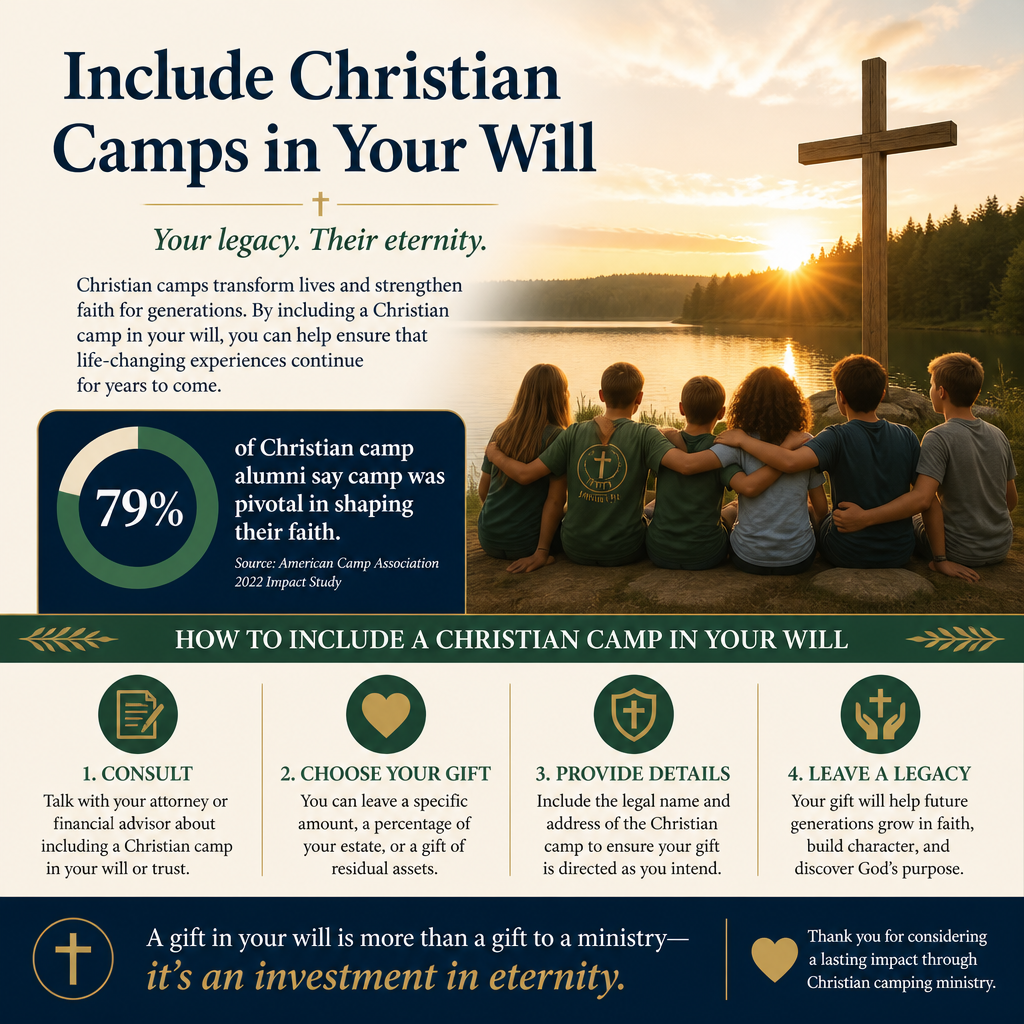
For many donors, the simplest approach is a bequest in a will or living trust: a provision that directs a set amount, a percentage of the estate, or the remainder after other distributions. Other instruments—beneficiary designations on retirement accounts, life insurance, donor-advised funds, and charitable trusts—can also direct resources to ministry, but they involve different tax treatment and levels of complexity. The technical details should be handled with qualified legal and tax counsel. The donor’s role is to set clear intent, choose a trustworthy recipient, and reduce ambiguity for future administrators.
Choose a bequest structure that matches your priorities
Each bequest approach has trade-offs. A specific dollar amount gives precision but can become disproportionate as the estate grows or shrinks. A percentage scales with the estate but requires comfort with uncertainty. A residuary bequest—what remains after other distributions—often reflects a donor’s desire to provide for family first while still making a meaningful ministry investment.
What this means in practice is that donors should decide whether their aim is to underwrite an ongoing mission (such as scholarships or staff development) or to address a defined need (such as a capital project or debt retirement). Both can be legitimate. The discipline is to match the instrument to the purpose.
Due diligence that honors both faith and prudence
Verify doctrine, governance, and financial integrity
Planned gifts are unusually dependent on trust because the gift may not be received for years. Across our verification work, we observe that the strongest ministries treat transparency as a spiritual discipline, not a marketing tactic. Donors should ask basic questions: Is the camp’s statement of faith clear and operational, not merely symbolic? Does the board exercise real oversight? Are conflicts of interest disclosed and managed? Are audited financials available when scale warrants it? Is fundraising truthful and non-coercive?
At Most Trusted, we evaluate Christian nonprofits against The Most Trusted Standard, a 15-criteria framework covering faith foundation, financial integrity, governance and leadership, and transparency and effectiveness. The point is not to replace relational discernment; it is to bring verifiable evidence into the decision, especially when the gift is meant to outlast the donor’s own involvement.
Assess program fruit without reducing ministry to metrics
Christian camps should not be judged as if they were secular service providers. Not everything that matters can be counted, and not everything that can be counted matters. Yet a camp can still provide credible indicators of faithfulness: counselor training processes, child protection policies, curriculum theology review, follow-up pathways with local churches, and evidence that spiritual decisions are handled carefully rather than emotionally exploited.
Donors should also notice whether the camp speaks honestly about the limits of camp ministry. Claims like “we changed an entire generation” may be rhetorically stirring, but they rarely reflect sober evaluation. Mature leaders tend to describe their work as one part of a larger discipleship ecosystem.
How to draft a will provision that remains clear over time
Use the correct legal name and avoid ambiguity
Many bequests fail quietly because the organization name is incomplete, the address is outdated, or the camp operates under a parent entity with a different legal identity. Donors should ask the camp for its exact legal name and tax status, and then have counsel incorporate that language into the will or trust. This is administrative diligence in service of spiritual intent.
Decide whether to restrict the gift and how tightly
Restrictions can honor donor intent, but they can also handcuff future leadership. A camp may stop running a certain program, lose access to a property, or face changing regulatory requirements. A gift restricted to an initiative that no longer exists can become unusable or contested. When donors care deeply about a purpose, a “preference” clause can sometimes preserve intent while giving leaders flexibility to apply the gift to the closest aligned need.
Many donors also choose to include a contingency: if the camp closes or substantially changes its mission, the gift passes to a specified alternative ministry. That alternative should be chosen with the same seriousness as the original recipient. Donors considering multiple ministry types can learn more about the broader landscape of Christian Camps and Conferences in a way that supports comparative discernment.
- Confirm the camp’s exact legal name and mailing address for gifts
- Choose a bequest type: specific amount, percentage, or residuary gift
- Specify whether the gift is unrestricted, designated, or expressed as a preference
- Add a contingency beneficiary if the camp no longer exists or changes mission materially
- Document the bequest with the camp so future administrators can find it
Protecting the camp and the donor from foreseeable risks
Plan for organizational change without cynicism
Christian ministries are not immune to mission drift, leadership failure, or financial overreach. Donors should not pretend otherwise, and camps should not resent the question. A bequest is a long-term relationship built on trust, but trust is strengthened by verification and clarity. For donors, this includes asking whether the camp has a succession plan for key leadership, whether board terms encourage renewal without instability, and whether the ministry’s theology is institutionally embedded rather than personality-driven.
Some donors fear that asking hard questions signals distrust or lack of faith. Scripture presents a different model: faith and prudence are not enemies. Proverbs commends foresight and honest weights, and the New Testament repeatedly calls leaders to be “above reproach” in financial handling. Prudence is a form of love when it protects children, staff, and the ministry’s witness.
Consider family obligations, church commitments, and moral coherence
Legacy giving decisions should be coherent with a donor’s broader discipleship commitments. Many Christian donors prioritize their local church as the primary beneficiary of their philanthropy because the church preaches the Word, administers the sacraments, and shepherds souls. Others emphasize ministries that reach particular groups—youth, pastors, the incarcerated, the poor—where their callings have been shaped. Some donors carry complicated family situations: adult children who are financially stable, children with special needs, estranged relationships, or blended families. These realities shape wise estate planning.
Planned giving in the camp context often intersects with major gift discernment: scholarships for low-income families, capital improvements for safety, training pipelines for counselors, and year-round retreat ministry. Donors wanting a deeper view into the practice and ethics of this kind of giving can consult Planned Giving and Major Gifts for Christian Camps as they weigh options with counsel and prayer.
Where a tax point is helpful, it should be stated carefully. For example, the IRS notes that charitable bequests may be deductible for federal estate tax purposes when the estate is large enough to owe estate tax, and when the recipient qualifies as a charitable organization under federal law (IRS Charitable Contributions). For most households, the motivation is not estate tax reduction but disciplined stewardship and mission continuity.
FAQs for How to include Christian camps in your will
Should a bequest to a Christian camp be restricted to scholarships or left unrestricted?
Both approaches can be faithful. Restrictions such as scholarships align with a donor’s desire to widen access, but they can also limit adaptability if the camp’s program model changes. Unrestricted gifts give leadership flexibility, which is beneficial when governance is strong and transparency is practiced. Many mature donors choose a middle path: state a clear preference for scholarships or discipleship programs while granting the board authority to use the gift for the closest comparable purpose if circumstances change.
How can we ensure the camp remains trustworthy years after we write the will?
No donor can eliminate uncertainty, but donors can reduce foreseeable risk. Choose camps with strong doctrine, accountable governance, and transparent financial reporting; add a contingency beneficiary; and keep the bequest language clear and current. Where possible, use independent verification as an input alongside relational knowledge. Planned giving is most stable when it is rooted in mission clarity and reinforced by verifiable practices consistent with The Most Trusted Standard.
A legacy that strengthens the church’s ministry to the next generation
A will provision is not only about distributing assets; it is a final act of stewardship that can bless children and families long after the donor’s voice is silent. Christian camps at their best serve the local church by giving young people a concentrated encounter with Scripture, worship, and Christian community. The wise donor includes a camp in a will with both spiritual confidence and practical diligence—clear intent, careful selection, and structures that keep the gift usable and accountable over time.



