

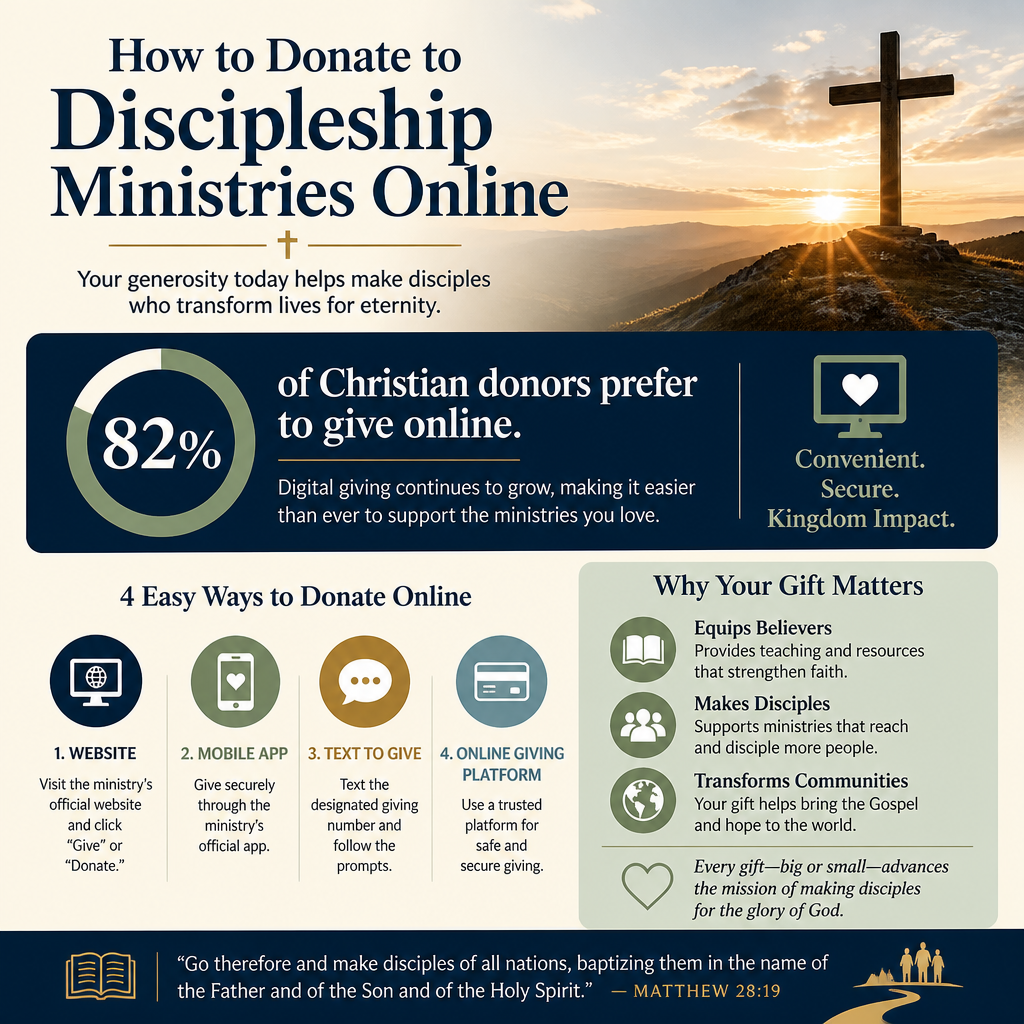
Knowing how to donate to discipleship ministries online has become part of ordinary stewardship for many Christian donors. The convenience is real, but so are the risks: recurring charges that outlast conviction, giving pages that obscure where funds go, and ministries that use spiritual language while operating without meaningful accountability.
Christian giving is not merely transactional. Scripture frames it as worship and responsibility: “Moreover, it is required of stewards that they be found faithful” (1 Corinthians 4:2). Online giving can strengthen that faithfulness when it is paired with clear priorities, verifiable evidence, and appropriate governance.
Begin with the discipleship outcome you are actually trying to fund
Discipleship is a word that can mean almost anything unless a ministry defines it. Some ministries primarily fund evangelism events; others fund leadership training; others build long-term pastoral infrastructure. Donors often discover too late that they were funding an activity they admire, but not the fruit they intended to support.
Distinguish activity from formation
Jesus’ command to “make disciples” (Matthew 28:19–20) includes teaching obedience, not merely collecting decisions. What this means in practice is that online giving should be connected to a stated theory of formation: what a ministry believes discipleship is, how it happens over time, and what practices it uses to cultivate maturity.
Ask for evidence that is faithful to the work
Discipleship is not easily reduced to metrics, and Christians genuinely disagree about what should count as “measurement” in spiritual formation. Still, mature ministries can demonstrate credible signals: retention in small groups, leaders trained and placed, churches strengthened, or curricula adopted with pastoral oversight. Evidence should be specific enough to be tested, but humble enough to acknowledge that only God gives growth (1 Corinthians 3:6–7).

Evaluate the online giving pathway for integrity and clarity
Most online gifts are made in minutes, which means the giving interface becomes a moral and governance surface. The language on a donation page can reveal whether a ministry treats donors as partners in mission or as revenue to be maximized.
What a responsible giving page makes plain
Before giving, donors should be able to answer basic questions without hunting: Is the gift tax-deductible? Is the charge processed securely? Will the ministry contact the donor, and how often? Are gifts restricted or unrestricted, and what happens if a restriction cannot be fulfilled?
- Clear designation options and an honest explanation of how restricted gifts are handled
- A visible statement of whether the gift is recurring and how to cancel
- Secure processing with standard protections and a privacy policy that is easy to find
- A mailing address and real organizational contact information
- Consistent naming across the website and payment processor so donors can identify the charge
Acknowledge the limits of online signals
A polished checkout page does not prove faithful governance. At the same time, basic sloppiness can indicate deeper weaknesses: unclear restrictions, aggressive upsells, or donor manipulation through spiritualized urgency. Serious discipleship work typically communicates with sobriety rather than pressure.

Use financial and governance signals that can be verified
Wise online giving depends on more than sentiment. Christian donors are responsible to avoid cynicism, but not naivete. The New Testament’s emphasis on appointing tested leaders and handling resources honorably (1 Timothy 3:1–13; 2 Corinthians 8:20–21) implies that donors may rightly ask for governance and financial clarity.
Start with basic public disclosures
For US-based nonprofits, IRS Form 990 remains one of the most consistent public windows into finances and governance. It is not perfect, and it can be misread, but it can reveal board composition, key compensation, related-party transactions, and fundraising practices. Donors can access many filings through the IRS Tax Exempt Organization Search at IRS.
Hold overhead questions with maturity
Discipleship ministries often require less physical infrastructure than other forms of Christian service, but that does not mean healthy organizations run at minimal “overhead.” Technology, leader development, and staff accountability cost money. The broader nonprofit sector has acknowledged the danger of treating overhead as a proxy for trustworthiness, as articulated in the “Overhead Myth” letter signed by BBB Wise Giving Alliance, GuideStar, and Charity Navigator at Charity Navigator. Donors should still ask what administrative spending is buying: internal controls, supervision, safeguarding, and financial competence.
Give online in ways that strengthen the ministry and protect the donor
Online tools give donors more control than traditional giving, but control can become instability for ministries that need predictable support. The aim is not maximal flexibility, but faithful partnership.
Recurring giving should be intentional, not default
Monthly giving can stabilize a ministry’s planning and reduce fundraising churn. It can also become thoughtless: donors forget they signed up, ministries assume retention, and the relationship decays into automation. A disciplined practice is to set a calendar review—quarterly or semiannually—so recurring gifts remain an act of considered stewardship rather than inertia.
Prefer transparency over novelty
Some giving platforms encourage novelty: micro-campaigns, gamified goals, or emotional prompts. There is a place for urgent appeals, but discipleship ministries tend to bear fruit over years, not days. Donors should prefer ministries that communicate long-term priorities, publish annual reporting, and explain how funds translate into training, pastoral care, and durable local leadership.
Donors exploring a range of ministry models may also find it helpful to situate specific opportunities within the broader work of Discipleship Ministries, where the language of “discipleship” is used differently across traditions and contexts.
Verify before you scale your giving
The more a donor gives, the more verification matters. Trust is not suspicion; it is love informed by truth. In our work at Most Trusted, we have found that strong ministries tend to welcome scrutiny because they already live under accountability—spiritual, organizational, and financial.
What verification should cover
At Most Trusted, we evaluate ministries against The Most Trusted Standard, a 15-criteria framework that assesses faith commitments, financial integrity, governance and leadership practices, and transparency and effectiveness. Donors should look for evidence in these areas even when using third-party donation processors, because payment convenience can mask weak controls behind the scenes.
Practical steps when you cannot verify everything
Some discipleship ministries operate in sensitive contexts where complete disclosure would endanger local believers. Others are small, early-stage works without mature reporting systems. These realities do not excuse opacity, but they do require judgment. A prudent approach is to start with a modest gift, watch for consistent reporting over time, and scale giving as confidence grows.
For donors who want a wider view of giving practices specific to this space, How to Give to Discipleship Ministries can help clarify patterns that distinguish sound ministries from persuasive marketing.
FAQs for How to donate to discipleship ministries online
Should we give to a discipleship ministry through a third party platform or directly?
Either can be appropriate. Third-party platforms may add convenience and sometimes better receipts, but giving directly can reduce fees and clarify the relationship between donor and ministry. The deciding factor is clarity: the donor should understand who is processing the gift, how fees are handled, and whether the ministry’s policies on privacy, restrictions, and refunds are visible and consistent.
What should we do if a discipleship ministry will not share financials?
Some ministries in hostile regions will limit public disclosure, but refusal to provide any meaningful financial accountability is a caution sign. A responsible ministry can usually provide alternatives: a recent audited financial statement under confidentiality, a board-approved annual report, or a clear explanation of governance and controls. When transparency is persistently evasive, the wisest course is often to redirect the gift to a ministry that can demonstrate honorable handling of funds.
Giving online with steadiness and discernment
Discipleship is slow work, and faithful giving should reflect that patience. Online donations are most fruitful when they are anchored in a clear discipleship vision, examined through verifiable governance and financial signals, and sustained as a deliberate partnership rather than an impulsive click.



