
How planned giving works for Christian senior care ministries is ultimately a question about stewardship over time: how a donor can translate a lifetime of provision into faithful, verifiable care for older adults when they are most vulnerable. Planned gifts are often less about sentiment than about structure—aligning a donor’s convictions, estate plan, and tax realities with a ministry’s long-term capacity to provide dignified, Christ-centered care.
Christian donors also know that longevity can magnify both faithfulness and dysfunction. A planned gift may fund care decades after it is signed. That time horizon raises serious questions: Will the ministry remain doctrinally steady? Will it govern itself with discipline? Will it tell the truth about outcomes and finances? These are not secondary concerns. Scripture’s warnings about wealth, power, and accountability are not abstractions.
Planned giving is not a fundraising tactic but a stewardship mechanism
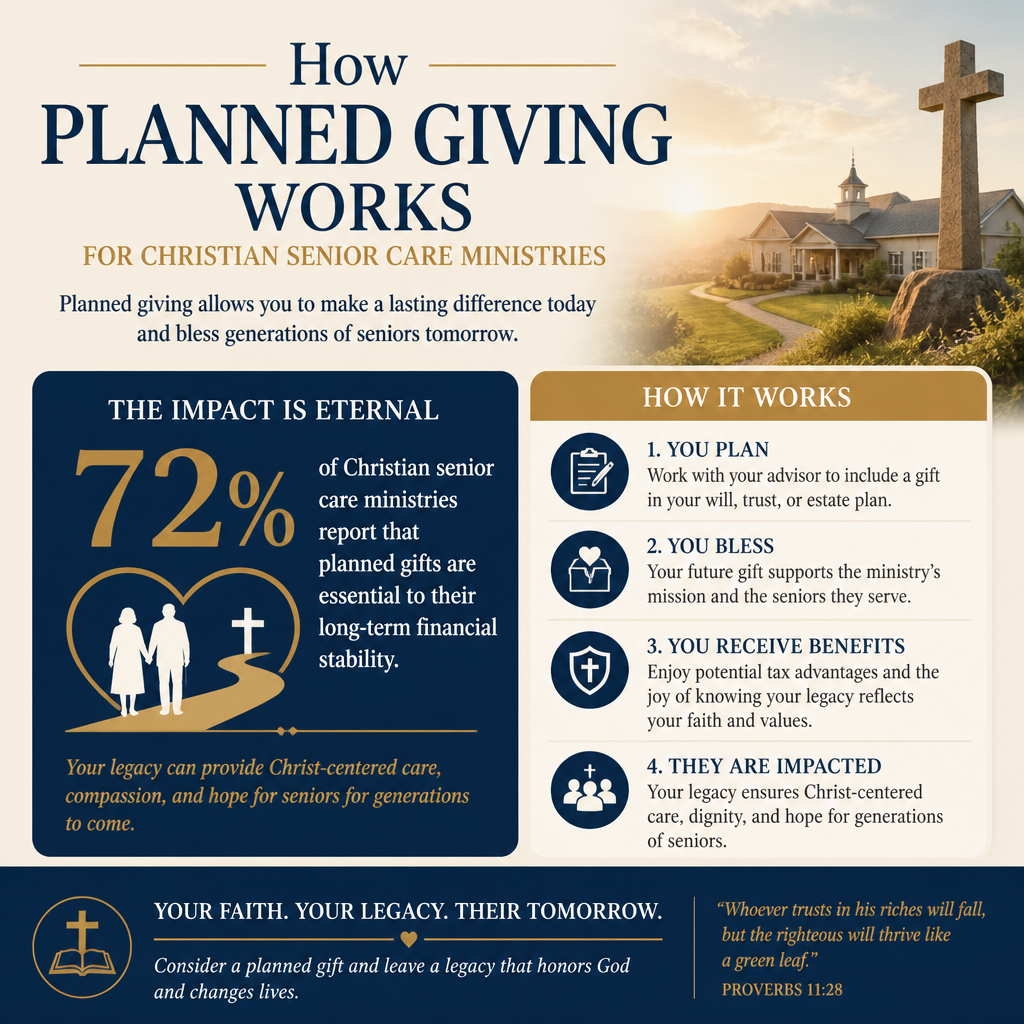
Planned giving describes gifts arranged now but realized later, usually through an estate plan or a contract that provides for both the donor and the charity. For senior care ministries, the relevance is straightforward: the work is capital-intensive, labor-intensive, and long-term. Housing, nursing, memory care, chaplaincy, and benevolence funds do not fit well into short cycles of emotional giving. Planned gifts create durable funding streams that can underwrite durable commitments.
Many donors assume planned giving is “for the wealthy.” In practice, the most common instrument is often a simple bequest in a will or trust. The spiritual posture is not complexity for its own sake; it is prudence—making provision in a way that honors heirs, supports the Church’s work, and protects the vulnerable.
What Christian senior care ministries typically do with planned gifts
Across our verification work, we see planned gifts most often directed toward mission-critical needs rather than novelty projects. In senior care, that usually includes benevolence for residents who outlive resources, scholarships for staff training, chaplaincy and spiritual formation programs, facility improvements tied to safety and accessibility, and endowments that stabilize operating budgets through economic cycles.
The harder question is whether the ministry can receive long-term capital without drifting from its mission. Endowments can protect a ministry from crisis. They can also insulate leadership from accountability if governance is weak. That is why planned giving should be paired with attention to governance, transparency, and theological clarity.
Why the time horizon changes the moral calculus
Planned giving effectively asks a donor to exercise stewardship beyond their own lifespan. That can be profoundly Christian: believers confess that their money is not ultimate, and that their labor is offered to God even when they do not see the full harvest. Yet this is also where discernment must be sharper. A donor is not only “supporting a good cause.” A donor is authorizing future leaders to deploy capital in the donor’s name.
For donors who want a broader view of the field before choosing a recipient, we maintain ongoing research on Christian Senior Care Ministries, with an emphasis on verifiable practices rather than promotional claims.

Common planned giving vehicles and how each functions
Planned giving is not one instrument. It is a family of legal arrangements, each with distinct implications for flexibility, timing, taxes, and control. For Christian donors, the best option is often the one that is simplest, clear to heirs, and well matched to the ministry’s administrative capacity.
Bequests through a will or living trust
A bequest directs assets to a ministry at death through a will or trust. It can be a specific dollar amount, a percentage of the estate, or a “residuary” gift of what remains after other obligations. Bequests are often appealing because they do not affect a donor’s cash flow today. They also allow a donor to adjust as circumstances change.
Many ministries encourage “contingent” bequests as a way of honoring family needs first: the ministry receives the gift only if other beneficiaries are no longer living. This can reduce family tension while still expressing a donor’s long-term intention.
Beneficiary designations for retirement accounts and insurance
Retirement assets and life insurance can pass outside probate through beneficiary designations. From a tax perspective, retirement accounts are sometimes efficient assets to leave to charity, depending on the donor’s overall situation. This is not an area for generic advice; it should be reviewed with an estate attorney and tax professional.
What this means in practice is that a donor may be able to support senior care ministry without changing a will at all—simply by naming the ministry as a beneficiary on a financial account.
Charitable gift annuities and charitable remainder trusts
More complex arrangements include charitable gift annuities and charitable remainder trusts. These provide income to the donor (or another beneficiary) for life or a term of years, with the remainder going to the ministry. They can be appropriate for donors with appreciated assets who want to combine generosity with predictable income.
Complexity carries risk. Not every senior care ministry is equipped to administer these arrangements directly, and some use third-party partners. Donors should ask who holds the assets, what oversight exists, and how fees are handled. When an instrument is difficult to explain plainly, it deserves extra scrutiny.
What planned giving can accomplish in Christian senior care
Christian senior care is not merely a technical service delivery sector. It is a work of mercy, a community of worship, and often a countercultural witness about aging and human dignity. Planned giving strengthens that witness when it supports concrete forms of faithfulness.
Benevolence and “no one left behind” commitments
Many Christian senior living communities hold a moral aspiration that residents should not be forced out solely because they become poor. That aspiration is costly. Planned gifts can supply benevolence funds that help residents remain in community when savings run out, family support is limited, or medical needs increase.
Donors should still ask hard questions about policy. Does the ministry define what benevolence covers? Are decisions made consistently? Is there documentation of need and outcomes? Mercy without guardrails can become favoritism. Guardrails without mercy can become bureaucracy. Faithful ministries name this tension and govern it carefully.
Workforce formation and spiritual care
Staffing is a primary constraint in senior care. Training, retention, and spiritual formation of caregivers affect everything from safety to dignity. Planned giving can underwrite scholarships for nursing and CNA training, chaplaincy, grief support, and pastoral programming for residents and families.
Research on elder care consistently highlights the pressures of an aging population and the need for a stable care workforce. For donors who want broader context on demographic realities, the National Institute on Aging provides accessible summaries and research resources at nia.nih.gov.
Facilities, safety, and accessibility that honor the imago Dei
Buildings are not the mission, but they can either protect or degrade human dignity. Memory care design, infection control capacity, accessibility, and private spaces for family presence all matter. Planned gifts can fund capital improvements without forcing ministries into short-term debt burdens that destabilize operations.
Donors should resist the simplistic instinct to equate “building projects” with vanity. A ministry can spend irresponsibly on facilities. It can also spend responsibly to prevent falls, reduce isolation, and provide safe environments for those with cognitive decline. The moral question is not whether a gift funds physical space, but whether that space serves the ministry’s stated calling with discipline.
- Resident benevolence funds tied to clear eligibility and reporting
- Chaplaincy and worship life that is integrated, not ornamental
- Training and retention for caregivers and clinical staff
- Memory care capacity with safety and dignity protections
- Endowment support governed with transparent spending policies
Due diligence that matches the weight of a legacy gift
Planned gifts can be spiritually beautiful and operationally decisive. They can also become a donor’s largest gift, made with the least day-to-day visibility. That gap between magnitude and visibility is why serious due diligence belongs at the center of planned giving, not at the margins.
Most Trusted exists precisely because donors need more than fundraising narratives. Our team evaluates ministries against The Most Trusted Standard, a 15-criteria framework across four domains: Faith Foundation, Financial Integrity, Governance and Leadership, and Transparency and Effectiveness. Planned giving is where those domains stop being theoretical.
Questions a sophisticated donor should ask before naming a ministry
Planned giving conversations often focus on the instrument and the tax effect. Those matter, but they do not answer whether the ministry is worthy of a long-term trust. Before finalizing documentation, donors should seek clear answers to questions such as:
Faith foundation: Is the ministry’s statement of faith public, substantive, and operationalized in care practices? How are chaplains selected and supervised? Are residents served regardless of faith commitment while the ministry remains clearly Christian?
Governance: Is the board independent, active, and appropriately skilled? Are conflicts of interest disclosed and managed? Is executive compensation governed responsibly?
Financial integrity: Are audited financial statements available? Does the ministry carry unsustainable debt? Are fundraising practices truthful about restricted giving?
Transparency and effectiveness: Does the ministry report meaningful indicators of care quality, resident well-being, and spiritual care? Do they disclose adverse events and improvement efforts with sobriety rather than spin?
Why “overhead” is the wrong lens for senior care
Some donors still look for a low “overhead ratio” as a primary signal of virtue. In senior care, that instinct can mislead. Compliance, clinical supervision, training, cybersecurity for medical data, and qualified finance staff are not waste; they are part of protecting residents and stewarding resources.
Major evaluators across the nonprofit sector have publicly rejected simplistic overhead metrics. The Overhead Myth letter, signed by organizations including GuideStar (now Candid), BBB Wise Giving Alliance, and Charity Navigator, explains why overhead ratios can distort donor decision-making; see candid.org. Donors should instead look for evidence of disciplined governance, transparent reporting, and outcomes that match the ministry’s claims.
For donors comparing how different giving approaches function within the senior care field, we publish additional analysis under How to Give to Christian Senior Care Ministries.
How to structure a planned gift so it remains faithful over decades
Even well-run ministries change. Leaders retire, markets shift, regulations evolve, and theological clarity can erode if it is not guarded. A planned gift should be drafted with enough specificity to protect the donor’s intent, and enough flexibility to remain useful when circumstances change.
Restricted versus unrestricted gifts
Restrictions can protect intent, but they can also create stranded funds. Senior care is especially vulnerable to this problem because care models and regulatory requirements change. A restriction that seems prudent today may be impossible tomorrow.
A balanced approach is often a purpose-aligned restriction rather than a program-specific restriction. For example, “resident benevolence and spiritual care” is more durable than “a specific wing on a specific campus.” Donors can also include variance language that allows the board to redirect funds if the original purpose becomes impracticable, while still honoring the donor’s intent.
Endowments, spending policies, and the temptation to permanence
Endowments can stabilize a ministry through recessions and crises, which matters deeply in senior care. Yet endowments also tempt institutions to treat financial continuity as the highest good. Christian donors should insist that endowment governance serves mission rather than replacing it.
Donors can ask for the ministry’s endowment spending policy, investment oversight structure, and reporting practices. Where these are unclear, the responsible step is not to assume ill intent, but to recognize that opacity is itself a governance risk. A legacy gift deserves more than reassurance.
FAQs for How planned giving works for Christian senior care ministries
Should a planned gift go to a senior care campus or to a supporting foundation?
Either can be appropriate, but donors should clarify who will receive the assets, who governs the funds, and what reporting will be provided. Some senior care ministries operate a separate foundation to manage philanthropy and endowments; others receive gifts directly as an operating entity. The key is whether governance is strong, conflicts of interest are managed, audited statements are available, and donor intent is honored with transparent accounting.
Can we make a planned gift and still keep flexibility if our family circumstances change?
Yes. Many planned gifts are revocable by design, especially bequests in a will or living trust and beneficiary designations. Donors can also start with a contingent bequest or a percentage bequest rather than a fixed amount. Because planned giving intersects with tax law and family considerations, donors should consult a qualified estate attorney and tax professional before finalizing documents.
A legacy gift should be matched with verifiable trust
Planned giving for Christian senior care ministries is one of the clearest opportunities to join mercy with prudence: to provide dignified care for older adults and to strengthen institutions that embody Christian witness in a culture that often fears aging. The same long horizon that makes planned gifts powerful also makes them morally weighty. Donors should give with open hands and clear eyes, insisting on the kind of governance, transparency, and faithfulness that can bear a legacy over time.



